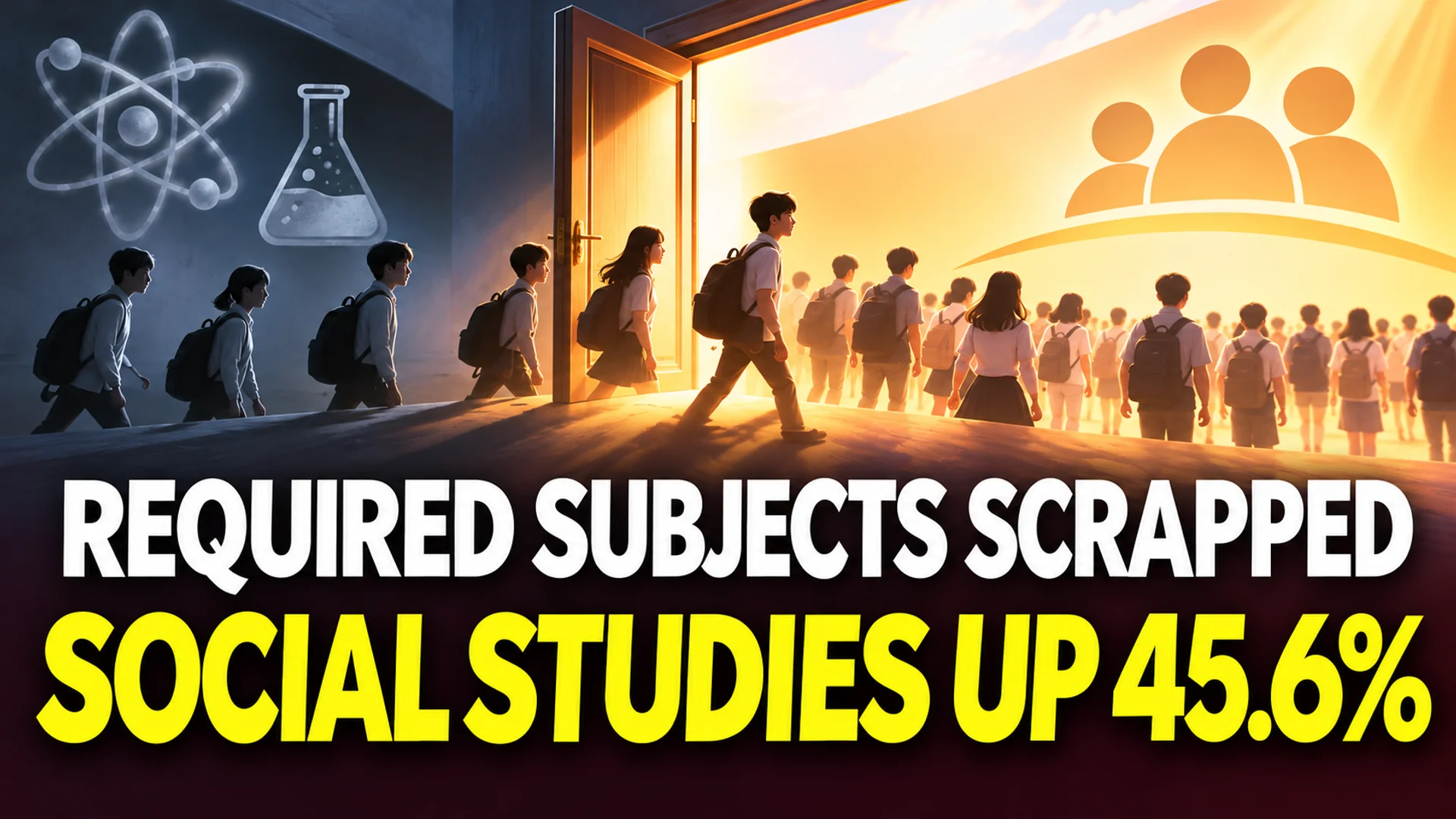
An unusual phenomenon occurred in the Inquiry area of the 2026 College Scholastic Ability Test (CSAT), with a large number of examinees flocking to a single specific subject. According to reports based on grading results from the Korea Institute for Curriculum and Evaluation, of the 473,911 examinees in the Inquiry area, 50.5% (239,403 students), or more than half, selected “Society and Culture.” This represents a sharp increase of 45.6% (74,947 students) compared to the previous year’s 164,456 students 1. It is difficult to explain the movement of tens of thousands of students to a single subject in just one year solely as a change in student preferences. Structural changes in the admissions system, which opened the door for science-track examinees to choose Social Studies Inquiry instead of Science Inquiry, lie behind this trend.
Lowering the threshold for science-track applicants through the ‘abolition of designated subjects’
For example, Seoul National University previously required specific subjects in Mathematics and Inquiry for applicants to science-track departments in its early and regular admissions cycles, and maintains these designated subjects for the 2027 academic year alongside some universities such as Gyeongsang National University and Jeonbuk National University 2.
Universities such as Konkuk University, Korea University, Sogang University, Ewha Womans University, and Hankuk University of Foreign Studies have eliminated designated subjects in Mathematics and Inquiry for their early admissions. Sogang University also abolished the designated test area requirements altogether 2.
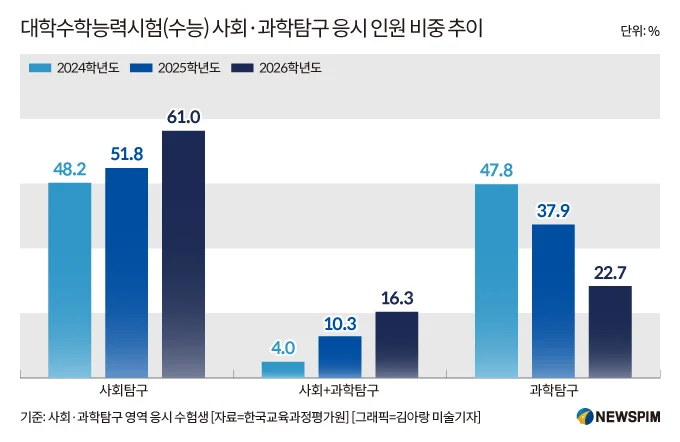
Actual statistics confirm that these institutional changes have had an immediate impact on student choices. The rate of mixed testing, where students combine Social and Science Inquiry subjects, was only 3.7% (15,927 students) in the 2024 academic year but rose to 17.2% (81,023 students) in the 2026 academic year after the regulations were relaxed 1. The proportion of students choosing Social Studies Inquiry also surged from 53.3% in the 2023 academic year to 77.3% in the 2026 academic year 3.
Reasons for the shift confirmed by rising scores
The decisive reason science-track examinees shifted to unfamiliar Social Inquiry subjects is supported by actual performance data. According to data released by Jinhaksa tracking repeat students who took the CSAT in both the 2025 and 2026 academic years, the group that switched from two Science Inquiry subjects to two Social Inquiry subjects saw an average increase of 21.68 percentage points in their Inquiry area percentile. The average percentiles for Korean, Mathematics, and Inquiry areas also rose by 11.18 points, showing marked academic improvement 3. This indicates that the “Sa-Tam-Run” (rush to Social Studies) is not merely speculation or a trend, but a strategic choice confirmed to be advantageous for score management.
This shift is also observed among the highest-scoring science-track applicants, led by medical schools. According to Jinhaksa’s analysis, 9.3% of medical school applicants without subject restrictions took Social Inquiry exams, while 40.5% of veterinary medicine applicants and 23.8% of pharmacy school applicants chose Social Inquiry 3. Even among the top-tier group where Science Inquiry traditionally dominated, there is a noticeable shift toward Social Inquiry in pursuit of score stability.
Why the concentration on ‘Society and Culture’?
The reason examinees concentrated specifically on “Society and Culture” among the nine Social Inquiry subjects appears to be related to its entry barriers and the characteristics of the grading results. For science-track students entering Social Inquiry, “Society and Culture” is generally perceived as having a lower perceived difficulty than Science Inquiry, which requires memorizing complex principles and formulas, as its curriculum focuses on everyday human relationships and social phenomena. However, the source data does not separately specify the exact reasons why “Society and Culture” was disproportionately selected among the nine Social Inquiry subjects.
Actual grading results also reveal indicators confirming this subject’s relatively low entry barrier. In the Korea Institute for Curriculum and Evaluation’s 2026 grading data, the standard score cutoff for the 1st grade (top tier) in “Society and Culture” was 65 points, forming one of the lowest levels among the nine Social Inquiry subjects alongside East Asian History and Politics and Law 4. However, since standard scores are calculated based on the distribution of the test-taking population, one cannot definitively conclude that a lower cutoff ensures a higher probability of achieving a 1st grade score for the same raw score. Nevertheless, this indicator likely influenced science-track examinees entering for score improvement to view “Society and Culture” as an attractive option 4, 1.
An ‘open door’ and ‘advantage’ are separate issues
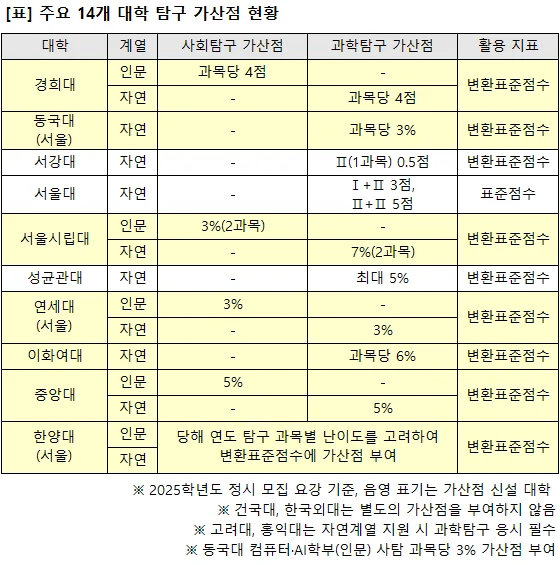
While the abolition of designated subjects has indeed made it possible for science-track examinees to choose Social Inquiry, it does not guarantee unconditional advantage in regular admissions competition. First, one must consider the impact of the surge in test-takers on standard scores. Standard scores are calculated based on the average and standard deviation of the test-taking population; as more students enter, the average rises, which may lower the maximum standard score or make it difficult to gain a favorable score relative to the same raw score 1. Regarding this, Kim Byung-jin, director of the Edu Evaluation Research Institute at Edu Plus, warned, “A paradox may occur where the ‘subject crowded with easy tests’ actually leads to fiercer competition in standard scores” 1.
Furthermore, even with designated subjects abolished, the variable of bonus points awarded to Science Inquiry test-takers still exists. In Seoul National University’s regular admissions for science tracks, up to 5 bonus points are awarded depending on whether a student took a Science Inquiry Level II subject. Universities such as Kyung Hee University, Korea University, and Sookmyung Women’s University also apply bonus points for Science Inquiry test-takers 3, 2. Thus, while students have gained the right to choose Social Inquiry institutionally, a structure remains in the actual aggregate scores that offsets the disadvantages for Science Inquiry test-takers.
In conclusion, the 45.6% surge in “Society and Culture” test-takers is the result of a combination of the “institutional path” created by changes in university regulations in the 2025 academic year and the “strategic choice” of science-track examinees seeking score stability. However, considering the possibility of standard score declines due to the large influx of test-takers and the surviving university-specific bonus point systems, choosing Social Inquiry is not an unconditional correct answer. Examinees are required to maintain a balanced perspective, carefully examining the reflection methods of their target universities rather than focusing solely on the initial effect of rising scores.
References
- 쉽다고 사탐런·확통런했다가 '낭패'…"표준점수 경쟁 심화" · widedaily.com↩
- '사탐런' 대세라지만…"대학별 '가산점'도 염두에 둬야" · v.daum.net↩
- 의대까지 번진 '사탐런'…2027학년도 수능 사회탐구 선택률 80% 넘본다 · newspim.com↩
- 2026학년도 수능 채점 결과 분석 · localnaeil.com↩