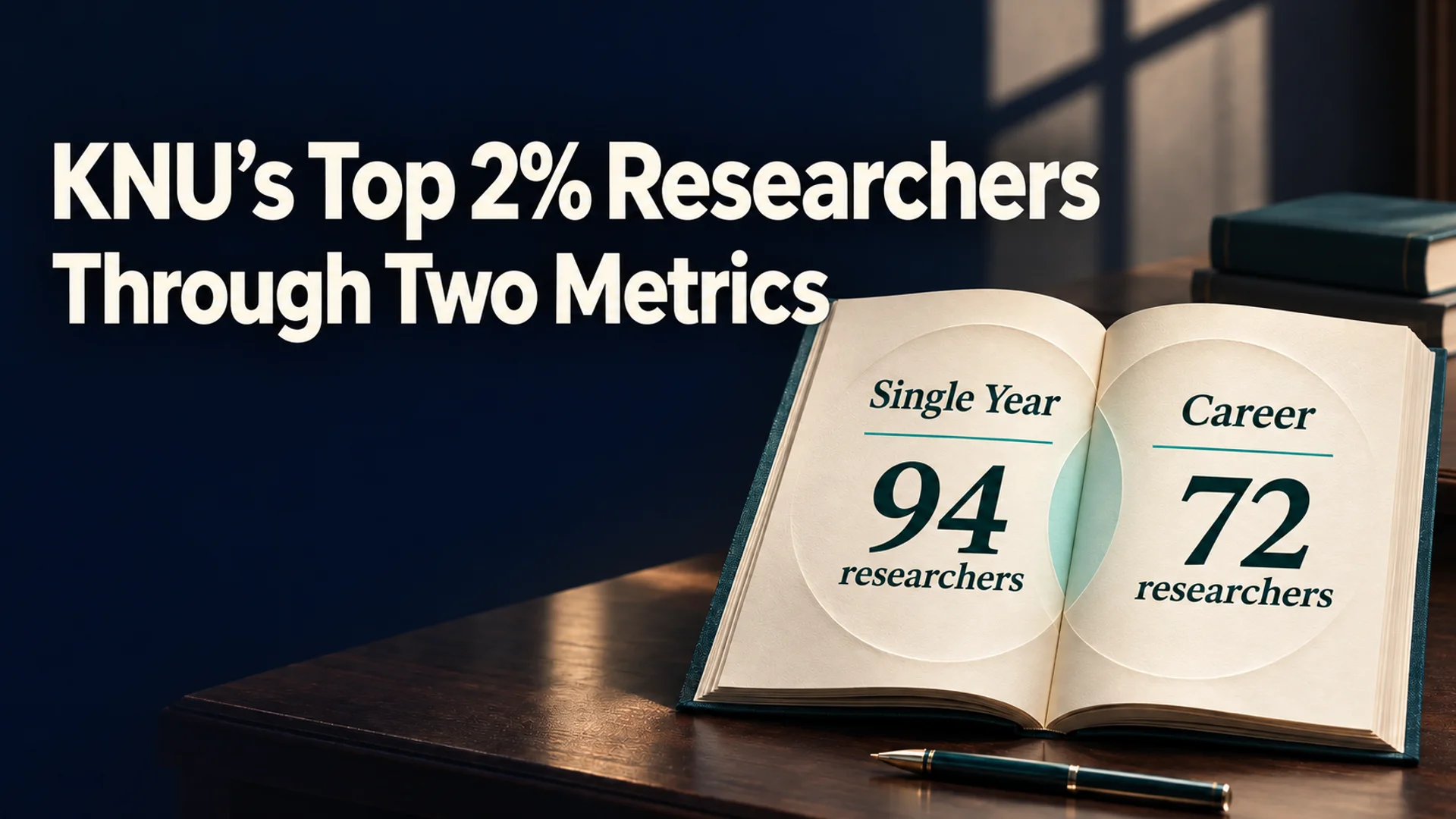
Kyungpook National University recently announced that many of its affiliated researchers were included in the “World’s Top 2% Scientists” list. While the expression “world’s top 2%” may sound like it refers to an absolute university ranking, it is actually the result of evaluating researchers’ influence based on two separate criteria. In the Stanford-Elsevier list, the figures of 94 researchers for the single-year criterion and 72 for the career-long criterion reflect independent evaluation windows. Treating these as two distinct, independent groups and adding them together to arrive at a single figure of 166 (as some reports have done) ignores the overlapping nature of the list. The figure of “123 researchers” does not appear in any of the provided sources 1.
A List That Separately Aggregates Research Influence Through Two Distinct Perspectives
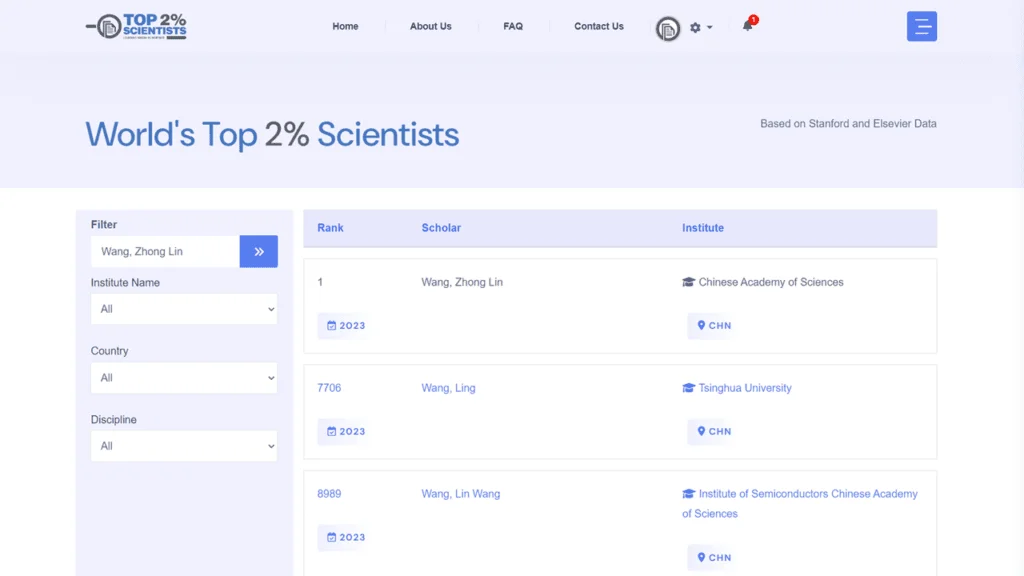
Example researcher-list search screen using 2023 data, separate from the KNU counts discussed here.
The “World’s Top 2% Scientists” list jointly published by Stanford University and Elsevier selects researchers annually based on international indicators such as publication counts, citation numbers, and research impact 2. The core structure of this list lies in its clear separation of evaluation periods.
The “career-long” measure assesses citations and research outcomes accumulated by a researcher throughout their academic career. In contrast, the “single-year” measure evaluates a researcher’s most recent research impact based on citation counts from the year immediately preceding publication 2.
According to Kyungpook National University’s official web magazine, 94 researchers were named in the single-year category and 72 in the career-long category 1. The distinction between the two figures—94 and 72—illustrates how individual researchers exert stronger influence in either accumulated scholarly legacy or recent research output. A researcher with strong career-long citations but limited recent activity may appear only on the career-long list, while an early-career researcher experiencing a surge in citations may be listed solely in the single-year category. In other words, the two lists are not mutually exclusive groups but rather indicators of which aspects of a researcher’s trajectory are more prominent at present.
Understanding Double Listing and Current Influence Through a Case Study
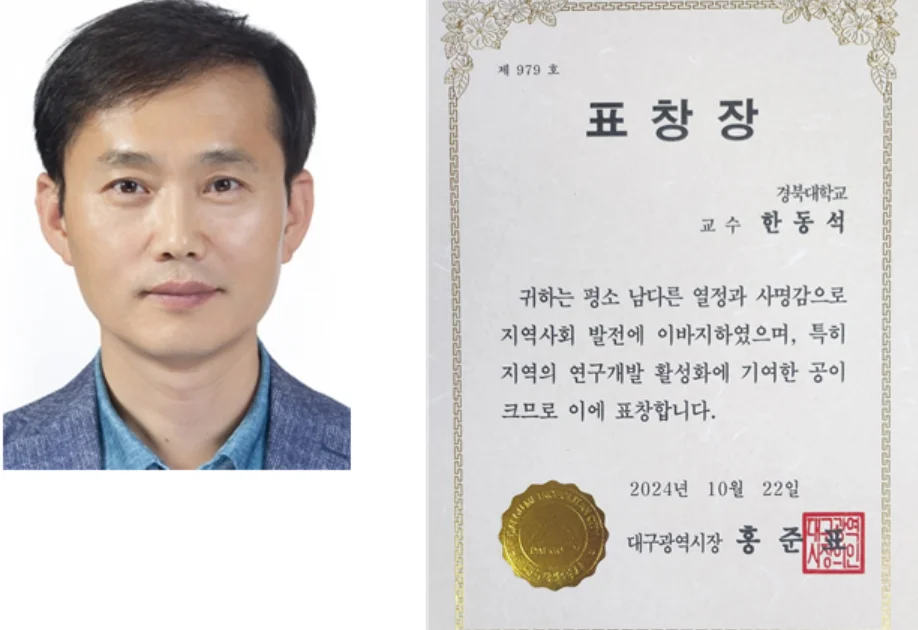
Professor Dong Seog Han and his 2024 Daegu mayoral commendation, published by KNU ISPL.
To understand this dual-aggregation structure, it is helpful to examine detailed data from a specific department. The Department of Electronic Engineering within Kyungpook National University’s College of IT reported that nine of its faculty members were included in the list, with some appearing in both categories. The electronic engineering case provides a concrete view of how the same professors are evaluated under the two criteria and the differences between them 2.
Seven professors were selected under the career-long criterion and seven under the single-year criterion. Comparing the two lists shows that some professors are recognized for both cumulative and recent citations, while others differ based on the criterion applied.
| Evaluation criterion | Selected professors (Kyungpook National University College of IT, Department of Electronic Engineering) | Number selected |
|---|---|---|
| Career-long | Kang Jae-mo, Malla-Peddi Rammohan, Vellooru, Yang Jung-min, Lee Sang-mun, Choi Byung-jo, Han Dong-seok | 7 |
| Single-year | Kang Jae-mo, Malla-Peddi Rammohan, Park Young-ho, Vellooru, Woo Ji-yong, Lee Sang-mun, Han Dong-seok | 7 |
| Overlap | Kang Jae-mo, Malla-Peddi Rammohan, Vellooru, Lee Sang-mun, Han Dong-seok | 5 |
Five professors—Kang Jae-mo, Malla-Peddi Rammohan, Vellooru, Lee Sang-mun, and Han Dong-seok—were recognized for both career-long cumulative influence and recent one-year research activity. The department interpreted this as evidence of “sustained research activity” alongside “current influence” 2. For example, Professor Lee Sang-mun has been recognized as a Clarivate Highly Cited Researcher three times due to high citation counts in artificial intelligence and physical intelligence, while Professor Kang Jae-mo has published numerous papers at top-tier conferences such as NeurIPS and CVPR in deep learning theory and applications, leading current research trends 2.
Professors Yang Jung-min and Choi Byung-jo, on the other hand, were included only in the career-long list. This suggests that although their research outcomes and citations accumulated over many years are high, there may not have been a surge in citations or explosive impact from new publications in the most recent year 2. Conversely, Professors Park Young-ho and Woo Ji-yong appeared only on the single-year list. Professor Woo Ji-yong has published more than 70 SCIE-level papers in the fields of next-generation resistive switching memory (RRAM) and neuromorphic devices, which likely contributed to recent attention on semiconductor and AI hardware platform research 2. This distribution is a typical characteristic, where the way researchers are included in the list varies depending on their field and research stage.
The Link Between Research Infrastructure and Citation Indicators at a Regional Flagship University
Citation indicators at a national flagship university extend beyond individual laboratory outcomes to reflect the university’s research infrastructure. The Department of Electronic Engineering acknowledges that the Daegu-Gyeongbuk region has faced challenges in expanding research capacity relative to the metropolitan area, and views this list inclusion as a sign that the university’s standing as a region-based research institution is being strengthened 2. It is expected to have a positive ripple effect on attracting top talent, industry-academia cooperation, and winning national research projects.
Against this backdrop, connections to large-scale national funding programs are evident. Professor Han Dong-seok, included in both lists, is also serving as a leader of a regional R&D hub. The ICT-Automotive Convergence Research Center he directs was selected for the Ministry of Education’s 2021 University Key Research Institute support program and is receiving up to approximately KRW 7.7 billion in research funding for a maximum of nine years 3. The center conducts research on human-centered autonomous driving technologies under the theme “Development of Key Human-Centric Autonomous Driving Technologies Based on Multiple Intelligence” 3.
Academic indicators such as “inclusion in the top 2% researcher list” and the development of “AI solutions for the automotive parts industry” that contribute to the regional economy proceed in parallel within the same research ecosystem. Professor Han’s research group received a commendation from the Mayor of Daegu in 2024 for contributing to regional corporate innovation through autonomous driving technology development 3. This illustrates a trend in which long-term financial support and the national research environment manifest as academic citation indicators and contributions to regional industries. However, it cannot be concluded that obtaining research funding is the sole cause of increased list inclusion. Instead, it should be understood as one facet of a complex ecosystem that links the success or failure of specific projects to the citation metrics of the entire research community.
The Scope of Flagship National University Rankings Based Only on Citation Indicators
Kyungpook National University’s official web magazine announced that, based on 94 researchers in the single-year category and 72 in the career-long category, the university ranked first among regional flagship national universities 1. To understand the exact meaning of this ranking, its scope must be considered. It is not a comprehensive ranking of overall university reputation, employment rates, or facility infrastructure.
Rather, it is a ranking based solely on academic citation indicators—such as citation counts for international journal articles and h-index—according to the methodology used by Stanford University and Elsevier, and it represents comparisons within the specific group of “regional flagship national universities” 2. While it is confirmed that Kyungpook National University emphasized “first among regional flagship national universities” in its own announcement, the degree of gap in citation indicators between Kyungpook and other flagship national universities cannot be determined from the present sources alone. Furthermore, the detailed methodology is unspecified as to whether this ranking is an official classification of the Stanford–Elsevier list or a result of Kyungpook University’s own extraction and rearrangement of data from the set of regional flagship national universities.
In conclusion, the figures of 94 and 72 reflect a dual measurement structure of career-long cumulative citations and single-year citations. The inclusion of five faculty members in both categories within the Department of Electronic Engineering, alongside the presence of a research center receiving up to approximately KRW 7.7 billion in national support for nine years, shows that academic citation outcomes and research infrastructure investment can coexist within the same ecosystem at regional flagship national universities 123. Therefore, the statement “first among regional flagship national universities” should be interpreted within the narrow scope of “a comparison among the flagship national university group within the citation indicator framework.” It is not a measure that determines a university’s overall standing but rather a result emerging from a specific method of measuring academic influence.
References
- 경북대학교 · knu.ac.kr↩
- 경북대학교 대학원 전자전기공학부 · gsee.knu.ac.kr↩
- ISPL - Notice & News · ispl.knu.ac.kr↩