
It is common for a dog to look around in confusion after its owner throws a bright red ball onto a lawn. To human eyes, the red stands out sharply, but to a dog, this ball appears as a dull brown mass. Conversely, dogs often retrieve a yellow tennis ball first, even though it may appear monotonous to human eyes. Reporter Jo Hong-sub of The Hankyoreh reported that while dogs retrieve a yellow tennis ball thrown on green grass with excitement, they may become confused when thrown a red ball that blends in with the grass by color[ 1 ]. The report explains that while the dog can locate the ball by the scent of the owner’s sweat on it, visually, it becomes merged with the grass as a single mass[ 1 ].
So, do blue toys appear more distinct to dogs than yellow ones? The evidence points to an unexpectedly simple answer. Both dogs and cats possess visual cells that detect both blue and yellow ranges, meaning these two colors are on the same side. No evidence has been presented to suggest one color is definitively superior. When choosing toy colors, what should truly be avoided is not blue, but red and green; and deciding between the two remaining colors should be based primarily on how they contrast with the background of the play area[ 1 ].
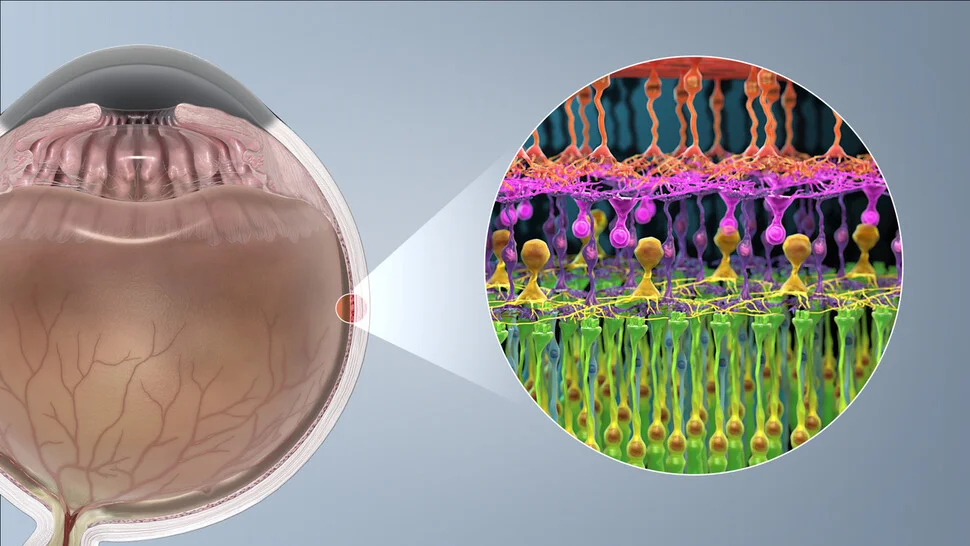
The reason humans, dogs, and cats see the world differently lies in the types and number of cone cells
The notion that dogs see the world in black and white was a misconception that persisted until the 1960s[ 1 ]. Jay Neitz, a psychologist at the University of California, Santa Barbara, overturned this through a treat-based experiment showing three panels. Two panels were illuminated with light of the same color, while the remaining one was illuminated with light of a different color. When the dog touched the panel with the different-colored light with its nose, a treat was automatically dispensed[ 1 ]. After numerous experiments, Neitz’s research team published a paper in the academic journal Visual Neuroscience in 1989, stating that dogs distinguish colors in two wavelength bands, one fewer than humans[ 1 ].
Human retinas contain three types of cone cells responsible for long-wavelength red, medium-wavelength green, and short-wavelength blue[ 1 ]. Cone cells are visual cells that enable the discrimination of color and form under bright light. In contrast, dogs possess only two types: those sensitive to yellow and blue ranges[ 1 ]. Due to this structure, items appearing green, yellow, or orange to human eyes are perceived as yellowish by dogs, and items appearing purple and blue are perceived as blue. Turquoise appears as gray[ 1 ]. This pattern is similar to human red-green color blindness, where red and green are indistinguishable[ 1 ].
Cats are in a similar situation. Like dogs, cats have one fewer type of cone cell than humans, allowing them to distinguish blue and yellow ranges, while red and green are perceived as blurry or in grayscale[ 2 ]. Veterinary Vision, a specialist agency in veterinary vision, summarizes that both dogs and cats possess dichromatic color vision systems and cannot distinguish red from green[ 3 ].
However, having a similar structure for seeing color does not mean vision acuity is the same. A dog’s ability to see sharp images is only 20–40% of that of a human; objects a human can distinguish at 9 meters away, a dog must approach to within 2 meters to identify[ 1 ]. The number of cone cells in humans is approximately 6 million, whereas in dogs it is approximately 1.2 million, a fivefold difference[ 1 ]. The acuity figures of 20/75 for dogs and 20/150 for cats presented by Veterinary Vision align with this context[ 3 ]. In other words, while they distinguish the names of colors, the boundaries between them are not as sharp as in human vision.
The common belief that blue beats yellow is not true
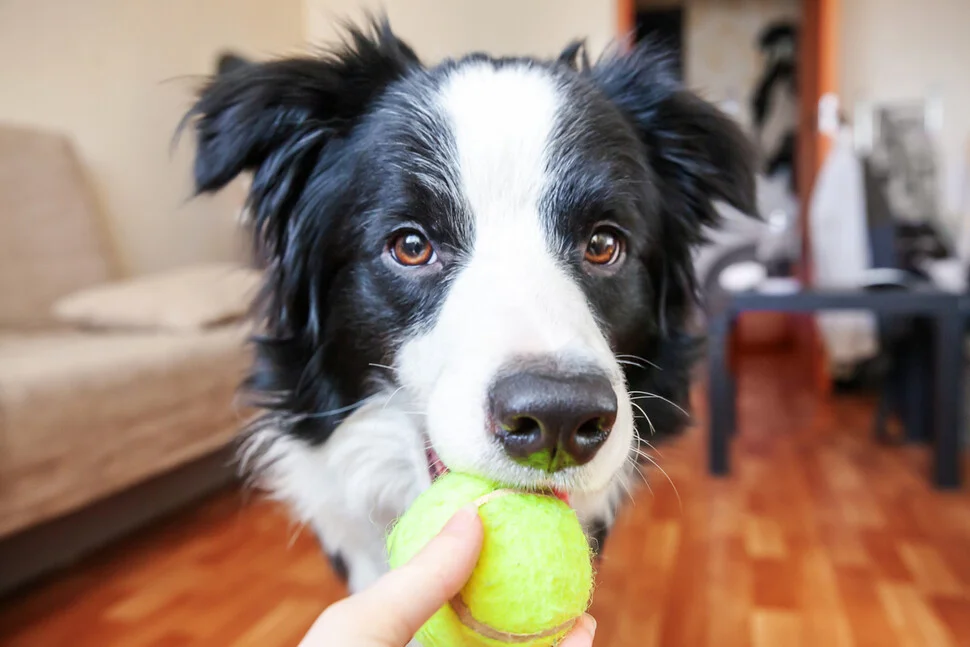
Experiments determining a winner between blue and yellow have not been confirmed in any of the presented studies. Rather, evidence of the two colors being used together is more prominent. Reporter Jo Hong-sub, describing a dog excitedly retrieving a yellow tennis ball, cited the color vision structure allowing visibility of both blue and yellow ranges[ 1 ]. If blue toys were particularly more visible, it would be difficult to explain the success of yellow balls through this structure. Because both yellow and blue fall within the detection range of the two types of cone cells, both colors are processed clearly.
According to the Dog Nerdly column led by Joseph Schifano, who has been active in the pet industry for over 20 years, blue and yellow are preferred for training and play equipment because these colors are most visible to dogs4.
Claims that blue is superior in cats are not entirely absent. The Michupet blog explains that cats most easily detect blue, especially blue and purple ranges, and also see yellow-green wavelengths well[ 2 ]. This might lead one to feel blue has a slight edge. However, since the same sentence describes seeing yellow ranges "easily" in parallel, it is difficult to interpret this content as evidence of blue’s sole superiority. The EnChroma blog adds that cats, like dogs, primarily see yellow and blue, and may have very weak sensitivity to red[ 5 ]. While acknowledging a minor exception to the common belief that red is almost invisible, it means that red is still not seen well.
To summarize, blue and yellow are not in a competitive relationship determining a winner, but are both at the ends of the visible range. In practice, preferences may vary depending on the shape of the ball or the play style. However, regarding color visibility itself, there is insufficient evidence to definitively declare either side as the correct answer[ 1 ].
The key to toy color is not blue versus yellow, but contrast with the background
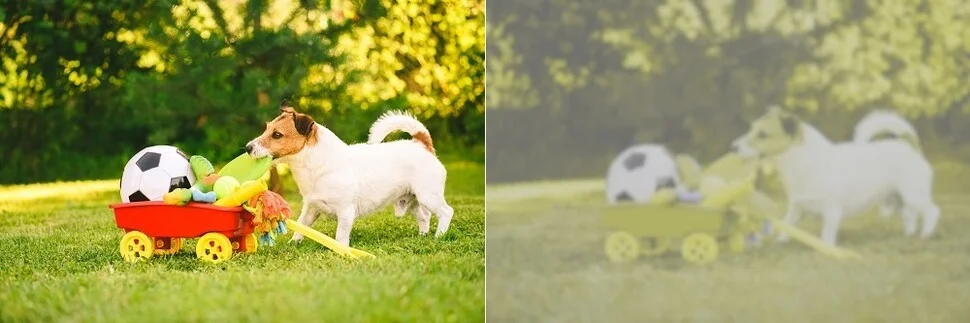
Situations where color fails to work actually occur not between blue and yellow, but when red and green merge with the background on the retina. Green grass appears in yellowish tones to dogs[ 1 ]. Since cats also primarily recognize blue and yellow ranges, grass does not appear as vivid green to them[ 2 ][ 3 ]. If red additionally appears as a dull brown, the two colors become overlapping tones, making it difficult to find the ball visually[ 1 ]. Dog Nerdly highlights the same point, explaining that on grass, a red ball blends into a grayish tone making it hard to distinguish, whereas blue or yellow balls contrast with the background and are more easily recognized[ 4 ]. The issue is not the name of the color, but contrast with the background, and this criterion applies regardless of whether the environment is an outdoor lawn or indoors[ 4 ].
Therefore, the useful order when choosing toys is slightly different. First, consider blue and yellow as candidates, and think about how the floor and walls of the play space will appear. While there is no clearly proven ranking for choosing yellow or blue on outdoor grass, the situation changes entirely on indoor floors[ 4 ]. Floors are not green grass but brown tones. Since there is a higher risk of red being mashed into brown and blending with the floor, it is better to choose blue or yellow[ 1 ].
If you want equipment that contrasts with both indoor and outdoor backgrounds, mixing blue and yellow in a toy is one method. Dog sports equipment being composed of both ranges is because these colors make it easy to distinguish both the background and the object simultaneously[ 4 ]. For cat toys, you can observe whether the cat’s gaze is drawn to the blue or yellow parts during wand feather play involving multiple colors. The Michupet blog also recommends observing in this manner to identify colors most visible to the cat[ 2 ].
The Hankyoreh report also notes the aspect of smell complementing vision by citing examples of dogs finding balls using the owner’s sweat scent on them1.
Ultimately, there is no confirmed evidence supporting the common belief that blue beats yellow. To the eyes of puppies and cats, blue and yellow are on the same side, and both fall within the detection range of the two types of cone cells[ 1 ]. As with the yellow tennis ball reported by Hankyoreh, yellow is actually effective on grass, and blue is equally visible by the same principle[ 1 ]. Situations where a ball cannot be found due to color occur when red and green turn into brown or gray and merge with the background; therefore, when choosing toys, the primary consideration should be whether the color contrasts with the background of the play space, rather than whether it is blue or yellow[ 4 ][ 1 ].
References
- 개가 보는 세상은 과연 흑백일까 · hani.co.kr↩
- What Colors Can Cats See? - Cat Vision Explained · michupet.com↩
- How animals see the World · veterinaryvision.co.uk↩
- What Colors Can Dogs See? · dognerdly.com↩
- Sind Hunde farbenblind? · enchroma.com↩