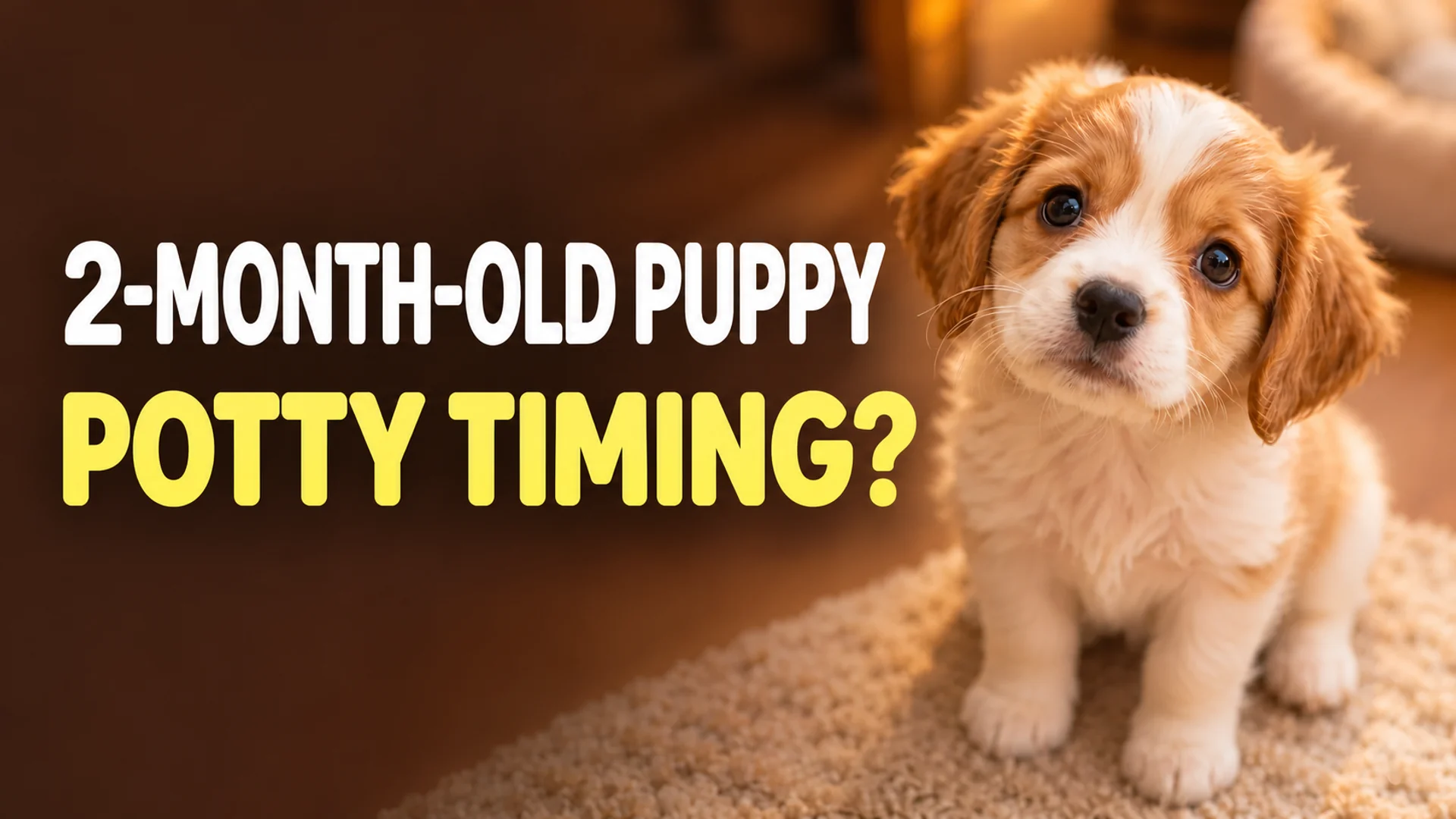
When an 8-week-old puppy that went to bed at 10 p.m. fails to hold it until morning and has an accident on the sofa, we often think, 'It seems like it hasn't been potty trained yet.' However, this scene may not be a sign of insufficient learning, but rather the result of a simple physiological limit. This is because there is a rule that puppies can only hold their bladders for a number of hours equal to their age in months. In other words, for a 2-month-old (8-week-old) puppy, approximately 2 hours is the limit 1.
In potty training puppies, more important than simply waiting is the 'timing design' of taking the puppy to the designated spot before an accident happens, and immediate reinforcement within 3 seconds after elimination. By sticking to this principle alone, you can shift the cause of failure from 'the puppy's lack of ability' to 'the owner's missed timing.'
2 Months Means 2 Hours Is the Limit
A puppy's bladder control ability is proportional to its age in months. It is generally known that an 8-week-old (2-month-old) puppy can hold it for about 2 hours, and a 3-month-old puppy for about 3 hours 1. If the puppy is left for a duration exceeding this time, the accident should be regarded not as the puppy's fault, but as the owner missing the timing to take it out 1.
Understanding this physiological limit reveals that making the daily rhythm predictable accounts for half of the potty training effort 1. The potty schedule for 8-week-old puppies published by the pet specialty site The Happy Puppy Site illustrates how this principle is applied.
| 15:00 ~ 17:00 | Inducing afternoon elimination | Includes the period after the third meal when the puppy becomes excited in the early evening 2 |
The schedule above is a guideline rather than a strict rule. The operator of 'The Happy Puppy Site' also advises, "Do not become a slave to the schedule, and always leave room for caution" 2. However, creating a consistent rhythm is a core strategy that constitutes half of potty training, playing a crucial role in reducing mistakes 3, 1.
'Golden Time' and Reading Signals Lead to Success
The 'golden time' when the urge to eliminate is concentrated is predictable. These times are immediately after waking up, approximately 15 to 30 minutes after meals (5 to 30 minutes for young puppies), after vigorous play, and before bedtime 3, 1. Simply taking the puppy to the designated spot during these periods significantly increases the success rate.
Another key factor owners must observe is the puppy's physical signals. You should take the puppy to the elimination spot immediately if it sniffs the ground while circling, paces around, suddenly whines, or moves toward a specific location 1, 2. Missing these signals results in the puppy having an 'accident' with a full bladder.
The Miracle of 3 Seconds: The Science of Positive Reinforcement
You cannot simply wait for the puppy to succeed. The 'reinforcement window' within 1 to 3 seconds immediately after the elimination behavior ends is the core of learning 3, 1.
Rewards can be treats or enthusiastic praise. What is important is 'immediacy.' The reward must be given within 1 to 3 seconds for the puppy to clearly recognize the causal relationship between its behavior (eliminating in the designated spot) and the positive outcome (treat) 3. If the reward is delayed by several minutes, the puppy will learn 'eating treats' and 'eliminating' as separate events, reducing the training's effectiveness.
Using cues like "pee" or "hurry up" is also effective. If you repeat the cue in a quiet and calm tone at the moment the puppy actually eliminates, it will associate the word with the elimination behavior 1, 2. After about a week of association linking the word to elimination, you can try using the cue in advance based on the puppy's signals to encourage elimination. However, for the effect to be maintained, you should only use the cue when the puppy is highly likely to eliminate, so it is advisable to practice slowly and with patience for the first few weeks 2.
The Backfire of Punishment: 'Hidden Elimination'
Putting the puppy's nose in the mess or scolding it for mistakes actually acts as poison. If scolded, the puppy learns that 'eliminating in front of the owner results in being scolded' 1, 3. As a result, worse habits develop, such as hiding and eliminating in corners where the owner cannot see or in empty rooms.
This phenomenon is supported by scientific research. In a comparative study conducted by a research team from the University of Lincoln in England on 93 dogs, both the reward-based training group and the electronic collar (punishment-centric tool) group reported that more than 90% of owners saw improvements in recall training. However, the electronic collar group exhibited more stress signals, such as yawning and vocalizations, and the reward-based training group demonstrated faster learning response rates 4. The American Veterinary Society of Animal Behavior (AVSAB) explicitly states that 'there is no evidence that training involving aversive stimuli is necessary,' and the co-authors of this study reported that reward-based training led to faster response times 4. Punishment only damages the trust relationship with the puppy and hinders the learning process itself.
Change the Perception of Mistake Spots from 'Toilet' to 'Living Room'

If you wipe up an accident area carelessly, residual odors remain and stimulate the puppy's senses. Because puppies remember locations as 'toilets' through scent, accidents recur in the same spot 1.
You must use an enzymatic cleaner to break down organic matter and completely remove the source of the odor 3, 1. It is also an effective method to place the puppy's favorite toys or blankets in the cleaned area to instill the perception that 'this is a resting place, not a toilet' 3.
In Conclusion
When potty training is not working, rather than patiently waiting, the first things to check are the puppy's bladder capacity relative to its age and the elimination windows after waking up, after meals, and after play. Taking the puppy to the designated spot before an accident happens and reinforcing it within 3 seconds after completion is the actual pathway that creates learning. If scolded, the puppy learns that elimination itself is dangerous and starts to hide to eliminate; therefore, the direction consistently recommended by research and veterinary behavior science is 'ignore mistakes + immediate reinforcement of success + proactive timing placement.'
References
- 강아지 배변훈련 완전 가이드 (실수 없이 성공하는 법) · 먹댕 반려견 대백과 · mukdaeng.com↩
- Puppy Potty Training Schedule With Examples For Pups Of Different Ages · thehappypuppysite.com↩
- 강아지 배변 훈련 팁: 성공률 높이는 과학적 접근과 실전 전략 · oncast.dev↩
- ↩