"It's the same matrix multiplication, so why is some data fast and some data slow?"
This is a question that any engineer training deep learning models or performing large-scale numerical analysis has likely encountered at least once. Until now, we have believed that algorithmic complexity or memory bandwidth was everything when it comes to performance.
However, as of 2026, understanding the physical limits of hardware is becoming the new pinnacle of software optimization. This is because recent fascinating discoveries have revealed that the data patterns we handle are a key variable that determines the physical power consumption and clock speeds of a GPU.
Today, we will conduct a comparative analysis of the factors that dictate GPU-based matrix multiplication performance and take a deep dive into why we must pay attention to the "texture" of data.
A Paradigm Shift in Performance Optimization: Mathematical vs. Physical Optimization
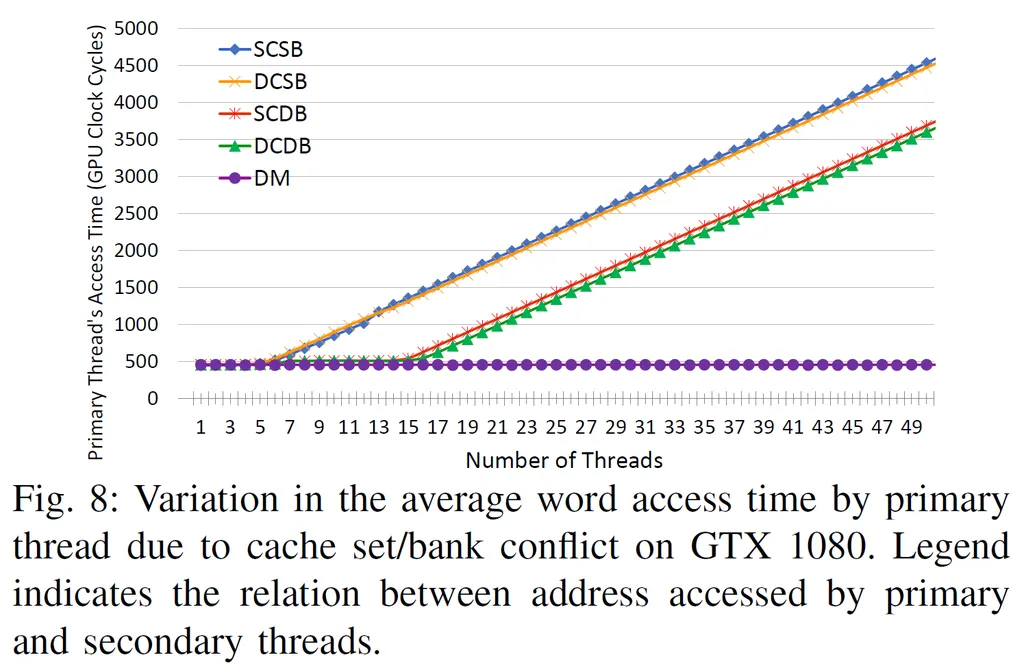
In the past, performance optimization primarily resided in the mathematical realm. For matrix operations, the main concerns were how to reduce complexity or how to align memory access to increase the Cache Hit Rate.
However, recent research points to a problem on a completely different dimension: the physical limitations of hardware.
A GPU is a massive parallel engine where thousands of cores move simultaneously. When this engine is running at full capacity, the biggest obstacle is not the mathematical formula, but the heat and power that the hardware must endure.
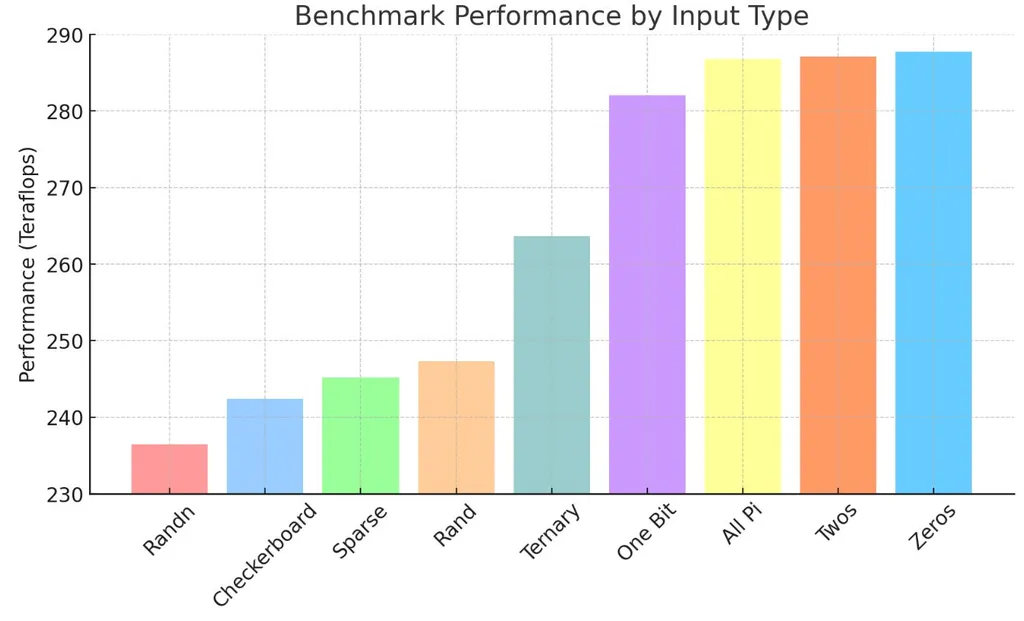
Looking at a case recently discovered by Horace He, it was observed that when performing an 8192x8192 matrix multiplication, performance varied by more than 10% depending on the values of the data. Even though the number of mathematical operations performed was identical, a phenomenon occurred where the GPU maintained a higher clock speed and ran faster when the input data was simple (like '0'), whereas performance plummeted when random data was provided.
This suggests that we are moving from an era where we only cared about the "mathematical superiority" of an algorithm to an era where we must consider the "power management mechanisms" of the hardware.
Comparative Analysis of the Three Key Factors Determining Performance
Then, what are the actual factors that determine GPU performance? We can analyze the causes of performance degradation from three major perspectives. Let's compare the characteristics of each factor.
1. Algorithm and Memory Access Patterns (The Software Layer)
This is the most classic and important factor. Performance varies depending on how regularly data is read from memory.
- Pros: If an algorithm is well-designed, you can push memory bandwidth to its limit. The more predictable the data access, the more the GPU's parallel threads can focus on computation without waiting.
- Cons: However, modern GPUs already have highly advanced memory hierarchies, meaning we have reached a "physical limit" where it is difficult to achieve further dramatic performance gains through software optimization alone.
2. Data Uncertainty and Bit Flips (The Hardware Layer)
This is the most notable variable in recent times. The key is how frequently the data values change.
- Principle: If data values are random, the state of the transistors fluctuates frequently between 0 and 1. This is called a Bit Flip. Every time a transistor's state changes, Dynamic Power is consumed.
- Pros (Predictable Data): If data contains many zeros or follows a consistent pattern, transistor state transitions are minimized. Consequently, dynamic power consumption decreases, allowing the GPU to maintain higher clock frequencies for longer without hitting the Power Limit.
- Cons (Random Data): Random data causes transistors to move constantly. When power consumption surges, the GPU's Voltage Regulator Module (VRM) executes "throttling"—forcibly lowering the clock speed to prevent overheating and power overload. This is the reality behind the sudden drop in performance.
3. System Power Management and Thermal Control (The Environment Layer)
This is the interaction between hardware architecture and the operating environment.
- Characteristics: Server-grade GPUs and consumer (gaming) GPUs have different design philosophies. Rather than optimizing idle power consumption to maintain peak performance, server-grade GPUs focus on maintaining predictable performance and latency.
- Trade-off: Running at 100% power at the maximum clock may result in fast instantaneous speeds, but it eventually leads to a performance drop due to rapid temperature increases. On the other hand, limiting power slightly to operate efficiently can be more advantageous for shortening the total task time.
| Comparison Item | Algorithm Optimization | Data Pattern (Bit Flip) | Power/Thermal Management |
|---|---|---|---|
| Primary Target | Memory Bandwidth/Cache | Transistor State Transition | Clock Frequency/Temperature |
| Optimization Method | Data Alignment & Parallelization | Data Distribution Manipulation | Power Limiting |
| Controllability | High (Code modification) | Medium (Requires preprocessing) | Low (Hardware constraints) |
Expert Advice: How Should We Prepare?

So, what strategy should we take moving forward? Simply saying "let's write more efficient code" is now only half an answer.
I am convinced that the core of future High-Performance Computing (HPC) and AI optimization lies in "Hardware-Software Co-design." To this end, I recommend the following three approaches:
First, establish preprocessing strategies that consider data distribution. If the task is extremely performance-critical, you must understand the nature of the data. Methods like the recently discussed TurboQuant technique, which applies intentional transformations to data to increase computational efficiency while maintaining data security, could be considered. If the data is too "random," you should consider whether there are ways to map it into a more "predictable" form.
Second, seek "optimal efficiency" rather than unconditional "maximum performance." Running all GPU tasks in maximum power mode is inefficient. Through experimentation, finding the point where limiting power to the 70-80% level yields more stable and faster results (throughput) without throttling will bring actual performance improvements.
Third, broaden your understanding of architecture. Engineers must now understand not only algorithms but also transistor switching power, GPU power limiting mechanisms, and the design characteristics of server-grade hardware. Simply realizing that data values determine the "movement" of physical hardware will completely change your perspective on optimization.
Closing: Data is Not Just Numbers, But a Physical Flow
Ultimately, the lesson this discovery gives us is clear. Data is not merely an object of mathematical calculation, but a flow of energy that moves the physical entity known as hardware.
The reason matrix multiplication speed varies depending on the data values is that the data determines the movement of transistors, and that movement, in turn, determines the GPU's power and clock speed. Those who understand this invisible link will win the future competition in AI optimization.
When you have been optimizing performance, have you ever considered the physical characteristics of hardware as much as the logic of the code?
Please share your optimization experiences in the comments!
References
- Matrix Multiplications on GPUs Run Faster When Given "Predictable ... · news.ycombinator.com
- Understanding the Efficiency of GPU Algorithms for Matrix-Matrix ... · graphics.stanford.edu



