Hacker News user (EA-3167) attempted to adjust the position of the false vocal folds (accessory phonation structures located above the true vocal folds) in a web browser. When an anatomically appropriate shape was configured, the overtones characteristic of Khöömei, the traditional throat singing of Mongolia and Tuva, actually resonated 1. Although the low-range Kargyraa was not implemented, the high-range Sygyt could be reproduced with considerable plausibility 1.
This tool, which produces sound by altering the shape of the vocal folds and airway with fingertip inputs, is the 'Chimera Vocal Synth.' The name may lead to misunderstandings that it is a device that displays actual vocal folds via ultrasound or MRI. However, Chimera is not a mirror that directly illuminates the user's throat. Instead, it is a physical simulation that computes the process of air passing through a virtual throat and displays it in real-time 3D visualization. Thus, rather than diagnosing 'the current state of my throat,' it serves more like a practice partner for immediately experimenting with 'this shape produces this sound.'
Calculation, Not Filming: Sounds Produced by a Virtual Airway
Jamesondh, the developer who created Chimera, clearly outlines the core concept of this project in the GitHub repository. All sounds generated here are not pre-recorded samples but are produced from air passing through a virtual airway consisting of lungs, vocal folds, separated vocal tract, lips, and nose 2. The engine is written in the Rust language and converted using WebAssembly technology, operating via the AudioWorklet method for real-time sound processing in the browser 2.
The core aspect is that sound is not played back but 'created.' When the user slightly changes the tongue position, the shape of the virtual airway changes, and as the passage through which air moves alters, the pitch and resonance of the sound change immediately. This engine operates based on FDTD (Finite-Difference Time-Domain, a numerical method that divides airflow into time and space grids for computation) 2. The computer calculates step-by-step what pressure arises when air passes through narrow gaps, how fast the vocal folds vibrate, and how those waves resonate in the mouth and nose 2.
Therefore, Chimera differs from typical AI voice synthesizers that output voice when text is entered. When English words (based on the CMUdict dictionary) or IPA (International Phonetic Alphabet) are input, the system displays 'articulatory gestures' on screen, showing how the tongue and lips must move to produce that pronunciation 2. It visualizes pronunciation as a process rather than a result.
Elements Visible on Screen and Adjustable by Hand
Voice control items for adjusting pitch, breath pressure, vocal fold tension (Pressed), and vibrato are provided on the screen 3.
A particularly notable feature is the display of vocal fold movement slowed down by 100 times 3. While actual vocal folds vibrate tens to hundreds of times per second, making their shape indistinguishable to the naked eye, displaying this slowed by 100 times allows observation of subtle movements where the vocal folds touch and separate. The tube area from the glottis (the gap between vocal folds) to the lips, the resonance spectrum, and the F1/F2 regions representing the primary resonant frequencies of vowels are also displayed 3.
In the default settings screen, values such as pitch 110 Hz (A2 note), breath pressure 8.0 cmH₂O (a unit expressing air pressure as the height of a water column), Pressed 50%, and vibrato 0 cents are confirmed 3. Adjusting these values causes the resonance curve and airflow graphs on the screen to change in real-time 3. Physical characteristics of male, female, and child bodies can also be blended continuously and applied 2.
| Elements Adjusted by User | Elements Changing on Screen |
|---|---|
| Tongue, Lip, Jaw Position | Airway shape in 3D cross-section, airflow, and sound pressure flow |
| Pitch, Breath Pressure | Vocal fold vibration speed, changes in resonance spectrum |
| Pressed (Vocal Fold Tension) | Vocal fold contact patterns, waveform changes |
| Vowel Selection | Movement of F1/F2 resonant frequency display regions |
Learning Vocalization by Visually Confirming Mouth Shapes
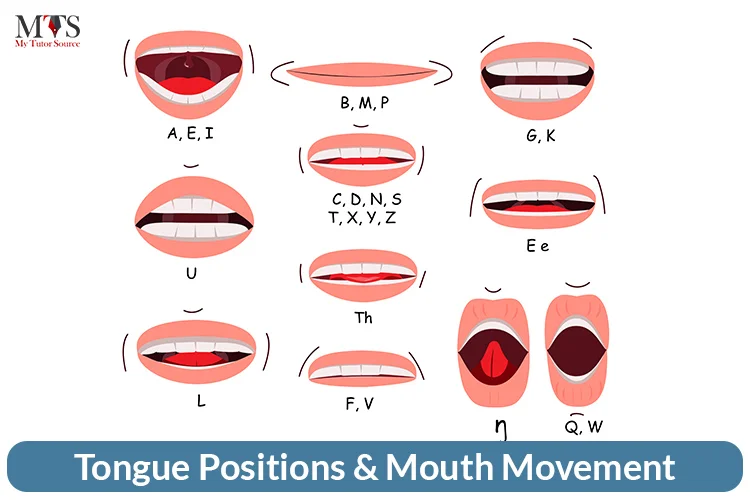
The practical value of this tool lies in visual feedback. Hacker News transgender user goodmythical evaluated it, stating, "Visual demonstration can guide much more specifically than verbal instructions like 'Try making the 'a' sound in 'aunt' closer'" 1. It was explained that it would be useful for voice training to match gender identity, singing, and language learning 1.
Traditional vocal instruction often relied on abstract language such as 'Open your mouth more' or 'Project your voice from your throat.' Chimera translates these instructions into anatomical shapes and displays them. Even for the same vowel, as the tongue position or jaw opening degree changes, the F1/F2 resonance curves move in real-time, allowing users to verify and adjust the correspondence of 'this shape produces this sound' visually.
Overall user cases also support this direction. hankbond wrote that having learned throat singing to put a baby to sleep, it was fun to figure out what shapes the various parts of the mouth and throat needed to be in order to reproduce the same sound in the synthesizer 1. nxobject shared plans to move their tongue around to learn the Australian 'o' vowel, and muglug reported having manually tuned the synthesized output for hours to match actual sounds after having an AI (Claude) read PDF sheet music 1.
Limitations of Simulation and Verification Efforts
It is also confirmed through user observations that simulations do not perfectly reproduce all conditions. odo1242 reported that when the tongue is adjusted to the farthest bottom-left, the lips are closed and pulled back as far as possible, the larynx is set to the topmost position, and the epiglottis is set to the bottommost position, a non-human screaming sound that is physically inaccurate occurs 1. It is presumed that fine setting errors undetectable under normal operations manifest as distortions under extreme conditions 1.
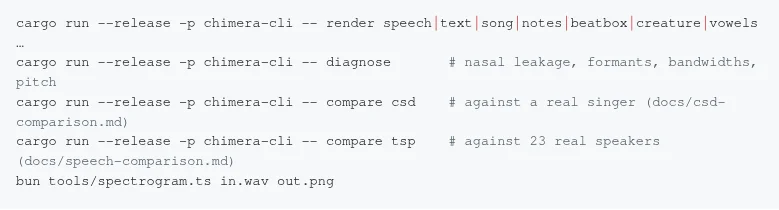
Developer jamesondh is documenting procedures to verify these discrepancies. Using the chimera CLI (command-line interface tool), offline rendering and measurements are performed, comparison scoring is conducted against actual singers' voices from the Children's Song Dataset, and contrasts are made speaker-by-speaker and phoneme-by-phoneme against 23 actual speakers from the TSP voice database 2. Diagnostic features analyzing nasal leakage, formants (resonant frequency components), bandwidth, and pitch are also provided 2.
Does sound change when the false vocal fold position changes? In the physical model of the virtual airway, it actually changes. EA-3167 generating Sygyt overtones and odo1242 experiencing unnatural sounds at extreme positions demonstrate these two sides. Chimera is not a medical device that diagnoses my voice but a laboratory where one can visually explore 'which mouth shape makes which sound.'
References
- Chimera Vocal Synth | Hacker News · news.ycombinator.com↩
- GitHub - jamesondh/chimera-vocal-synth: the ultimate vocal synthesizer - sing, speak, beatbox, and more · github.com↩
- Chimera Vocal Synth - 기도 시뮬레이션으로 소리를 만드는 음성 합성기 | GeekNews · news.hada.io↩