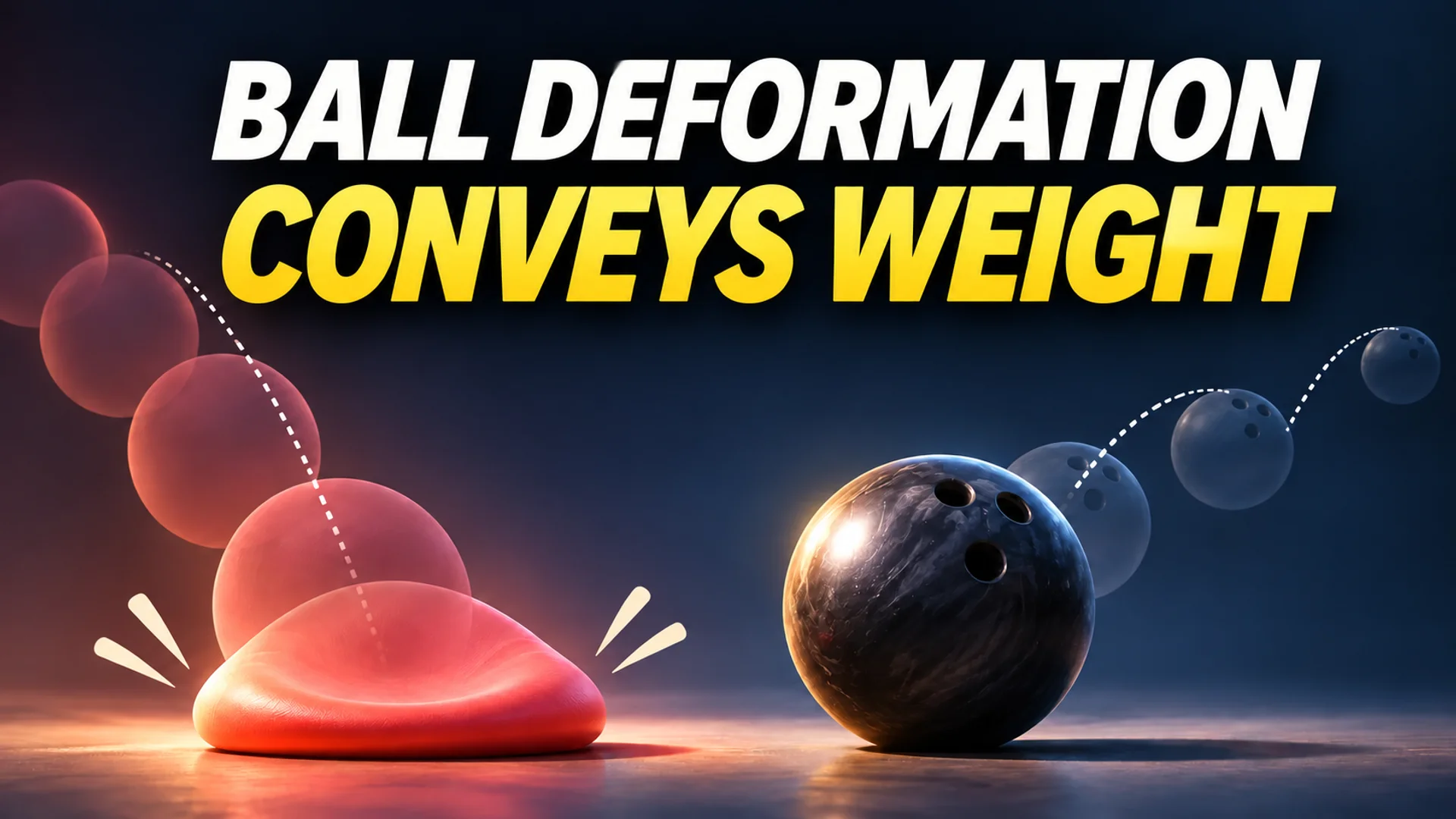
The trajectories drawn by the two balls on screen are mathematically identical. However, in the fleeting moment they hit the floor, one spreads out wide and flat like a plate, while the other maintains its circular shape almost intact. Viewers instantly perceive the flattened side as a "rubber ball" and the side retaining its shape as a "bowling ball."
Frank Thomas and Ollie Johnston, legendary Disney animators, compiled the principles of such movement into twelve guidelines in their 1981 book, The Illusion of Life: Disney Animation. The Interaction Design Foundation (IxDF) emphasizes that these principles are not merely for cartoons but are essential tools for conveying intuitive sensations to users in interfaces. One key principle highlighted by IxDF is "Squash and Stretch," which refers to the technique of stretching objects during vertical movement and compressing them upon impact. IxDF specifies that the extent of this deformation varies dramatically depending on the material. A rubber ball exhibits a "very pronounced" effect, while a bowling ball is described with "very subtle" effects. Adding this single scale of deformation intensity to the same trajectory completely reverses the perception of weight.
These twelve principles combine the fundamental laws of physics with cognitive psychology to create "believable" motion. While physical quantities like mass are not visually depicted on the screen, the brain infers weight and elasticity through motion patterns that adhere to physical laws.
A Scale for Distinguishing Materials by Deformation Intensity
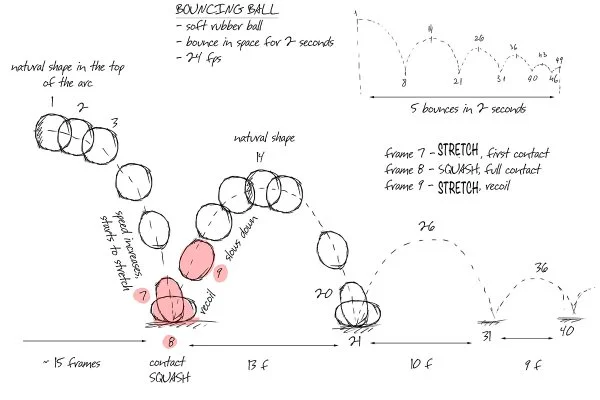
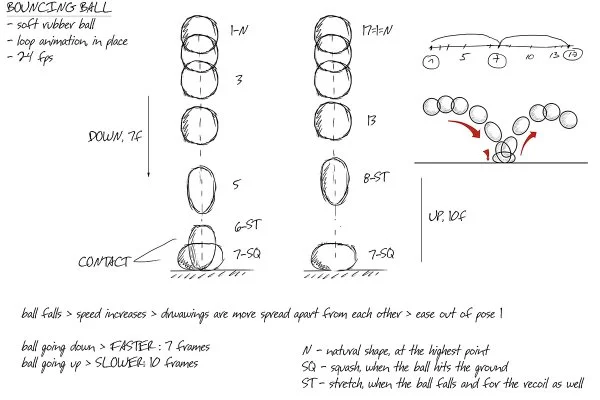
The difference between a rubber ball and a bowling ball is clear in the frames where they hit the ground. The rubber ball widens significantly due to the impact, becoming thinner and longer as it rises. In contrast, the bowling ball, even when falling from the same height with the same trajectory, shows almost no change in its contact surface with the floor. IxDF fixes this contrast in description using the terms "very pronounced" and "very subtle." Crucially, the object's "volume" must remain constant during deformation. The stretched side becomes thinner, and the flattened side becomes wider. Ignoring this rule of volume conservation and simply making objects wider results in an unnatural, balloon-like inflation. In actual animation work, adjustments are made so that the product of the flattened area and height remains similar to the original volume, even when the ball hits the ground.
There is also an educational approach that clearly distinguishes these material differences. The operator of the YouTube channel "Sang Lee" categorized three materials as combinations of two attributes (weight and flexibility) in a 2014 video description. He defined a rubber ball as "light" and "soft," a bowling ball as "heavy" and "hard," and a balloon as "light" and "very soft." To implement this, he also listed animation principles such as Timing, Slow In & Slow Out, Squash & Stretch, Arc, Gravity, and Air resistance. The classification framework presented by the Sang Lee operator is not a numerical visual simulation but a practical framework helping animators set material characteristics in their minds and select appropriate techniques. It demonstrates the process of translating the abstract concept of "heaviness" into concrete deformation patterns like "softness" or "hardness."
Where Timing Conveys Inertia
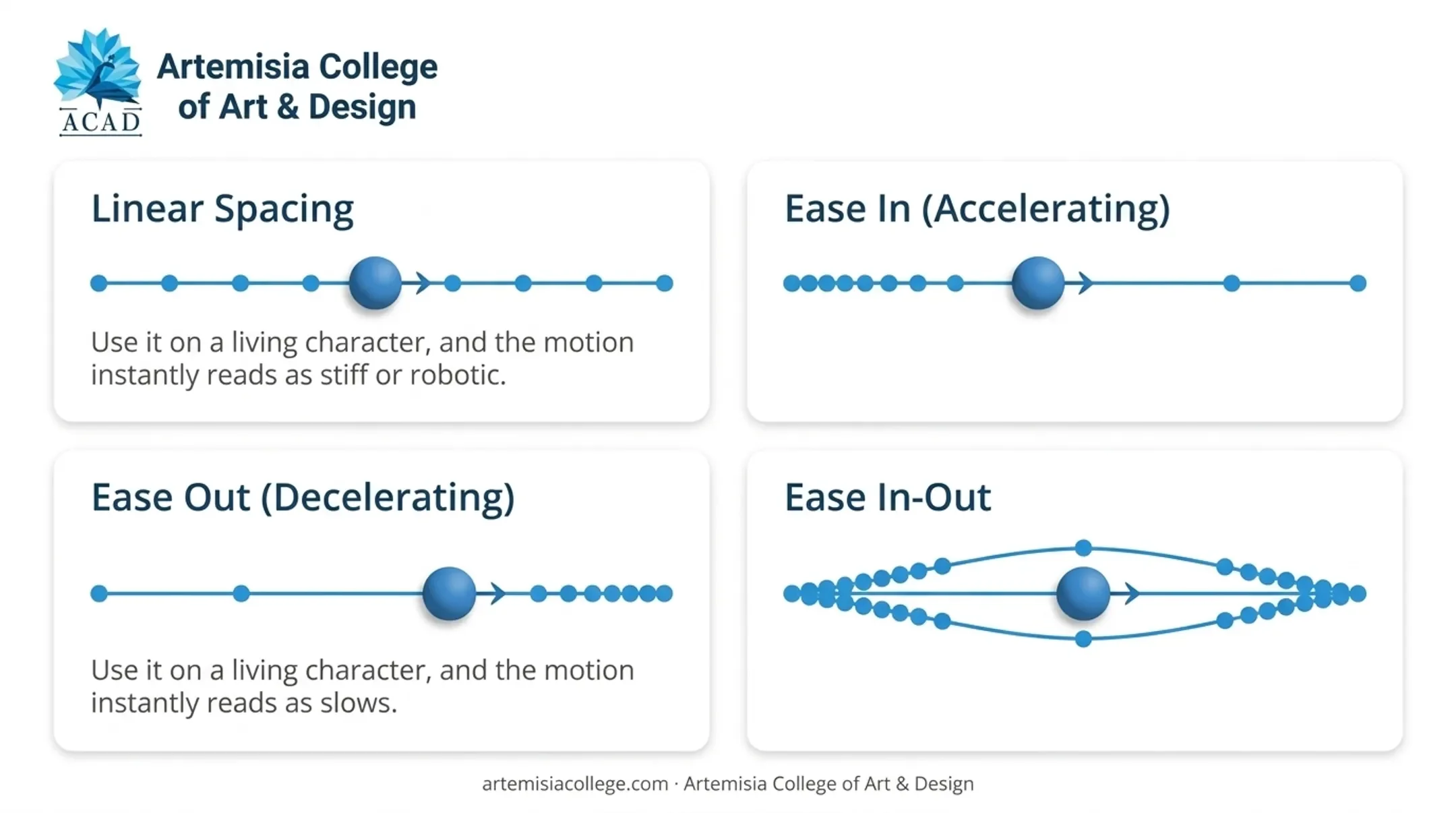
While deformation (Squash and Stretch) communicates "material," Timing communicates "inertia." IxDF explains that "how fast or slow something moves gives a lot of information." This is combined with the "Slow In and Slow Out" principle. Objects in the natural world do not start or stop moving abruptly; smooth changes are required during acceleration and deceleration. In animation, frames are packed more densely at the beginning and end of a movement to create natural acceleration and deceleration.
Even if the trajectory equations for two balls in a bouncing ball exercise are identical, the arrangement of frames must change to convey a sense of weight. When combining IxDF’s timing and Slow In & Slow Out principles with the material and air resistance factors suggested by Sang Lee, a bowling ball exhibits a smaller rebound after floor collision, making the ascent feel shorter, with relatively uniform frame intervals. Conversely, a rubber ball shows a large rebound immediately after collision and appears to have longer air time, causing frames to become denser near the peak. The sensation of "short and heavy" or "long and light" is not an exact measurement in seconds but a cognitive effect that arises when these frame adjustment principles are visually combined. In animation practice, it is much more direct to sensually learn the "sense of weight" by manually arranging these interval changes rather than substituting and calculating physical formulas. Even if the trajectory curve is copied and pasted, the materials will blend unnaturally unless the deformation intensity and frame intervals are reset.
This principle applies similarly in interface design. IxDF advises using "Squash & Stretch" to provide sensory cues that a button can be physically "pressed," thereby guiding users to click the purchase button. Although the button on the screen does not actually compress, applying a slight flattening effect that quickly returns to its original shape upon clicking creates visual feedback closer to the user's tactile sensation. However, if the deformation is excessive, it can cause discomfort or confusion for the user; therefore, a restrained intensity appropriate to the product's purpose and overall tone is required.
Ultimately, the reason for the differing feelings despite the same trajectory is not the difference in the trajectory itself. The key lies in how widely it spreads on the floor (deformation intensity) and how abrupt the rebound and deceleration are in the frames (timing). As IxDF explains, a rubber ball features "very pronounced" Squash & Stretch, while a bowling ball features "very subtle" effects. By adjusting the speed of acceleration and deceleration through timing, it is possible to clearly distinguish firmness from lightness for viewers without using a single character for the weight unit "kg."