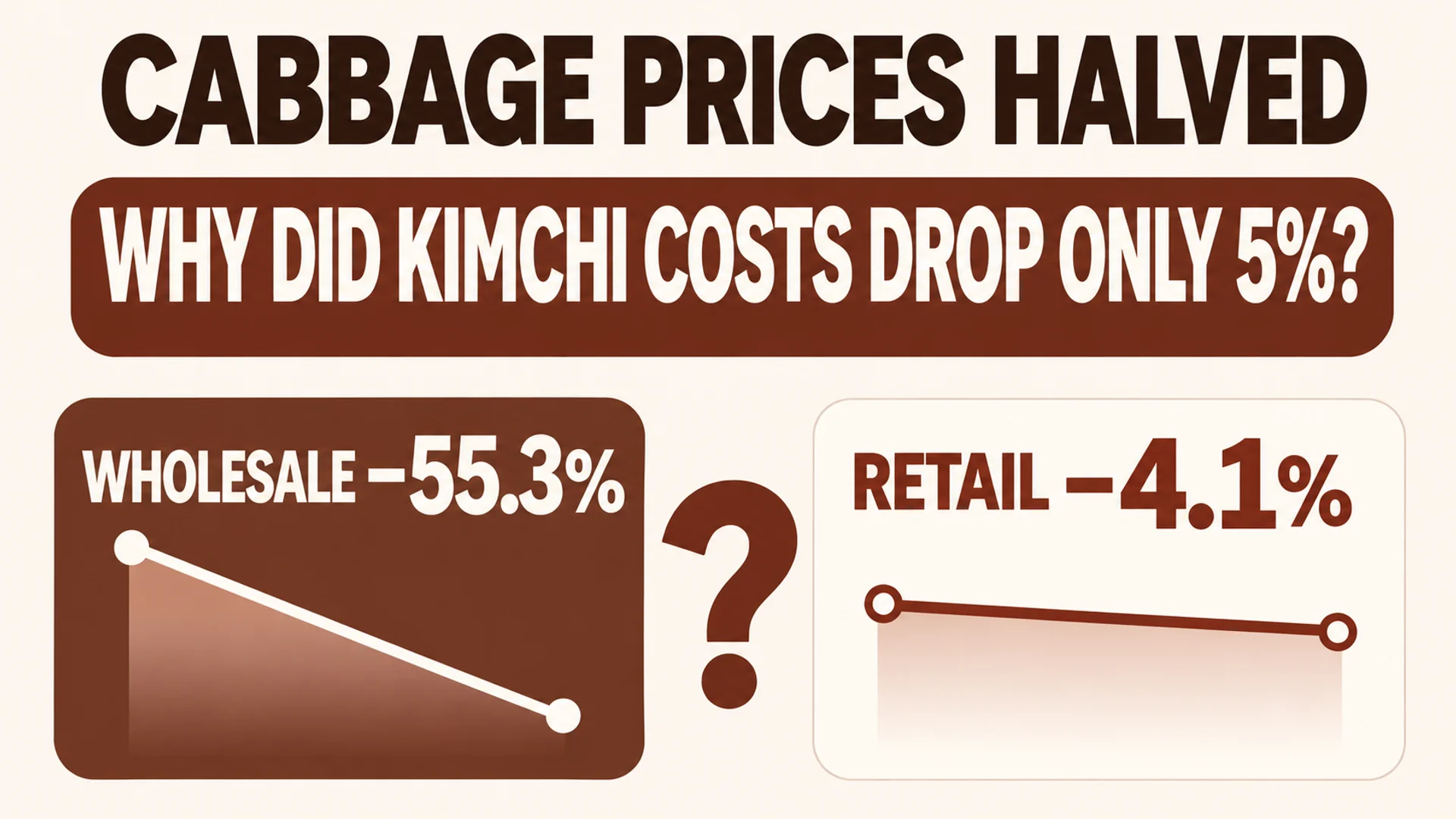
In October 2026, headlines reported that the wholesale price of napa cabbage had "plummeted 55% in just one month." Yet when you go to the supermarket, you may find that the price you actually feel has dropped by only about 10%. This is because an increase in supply and the state of your wallet do not move at the same pace. By comparing the wholesale and retail prices for the same item on the same day, it becomes clear who the term "half-price cabbage" actually applies to.
What Happened at the Wholesale Market
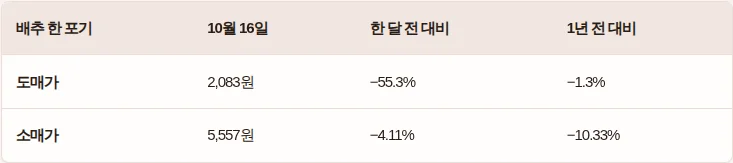
According to the Agri-Fisheries and Food Distribution Information System (KAMIS) operated by the Korea Agro-Fisheries & Food Trade Corporation (aT), the wholesale price of one head of napa cabbage was 2,083 won as of October 16, 2026. This represents a 55.3% drop from one month prior, making the description "halved" entirely accurate 1. This downward trend continued into early November. On November 5, the price at which wholesalers sold 10 kg of napa cabbage (equivalent to three heads in a net) at the Seoul wholesale market was 9,400 won, a 55.7% decrease from the previous survey date 2.
The production of autumn radishes is also expected to rise by 3.2% year-on-year to 345,000 tons, meaning that supply is plentiful for both cabbage and radishes 3.
Why Retail Prices Showed Different Numbers on the Same Day
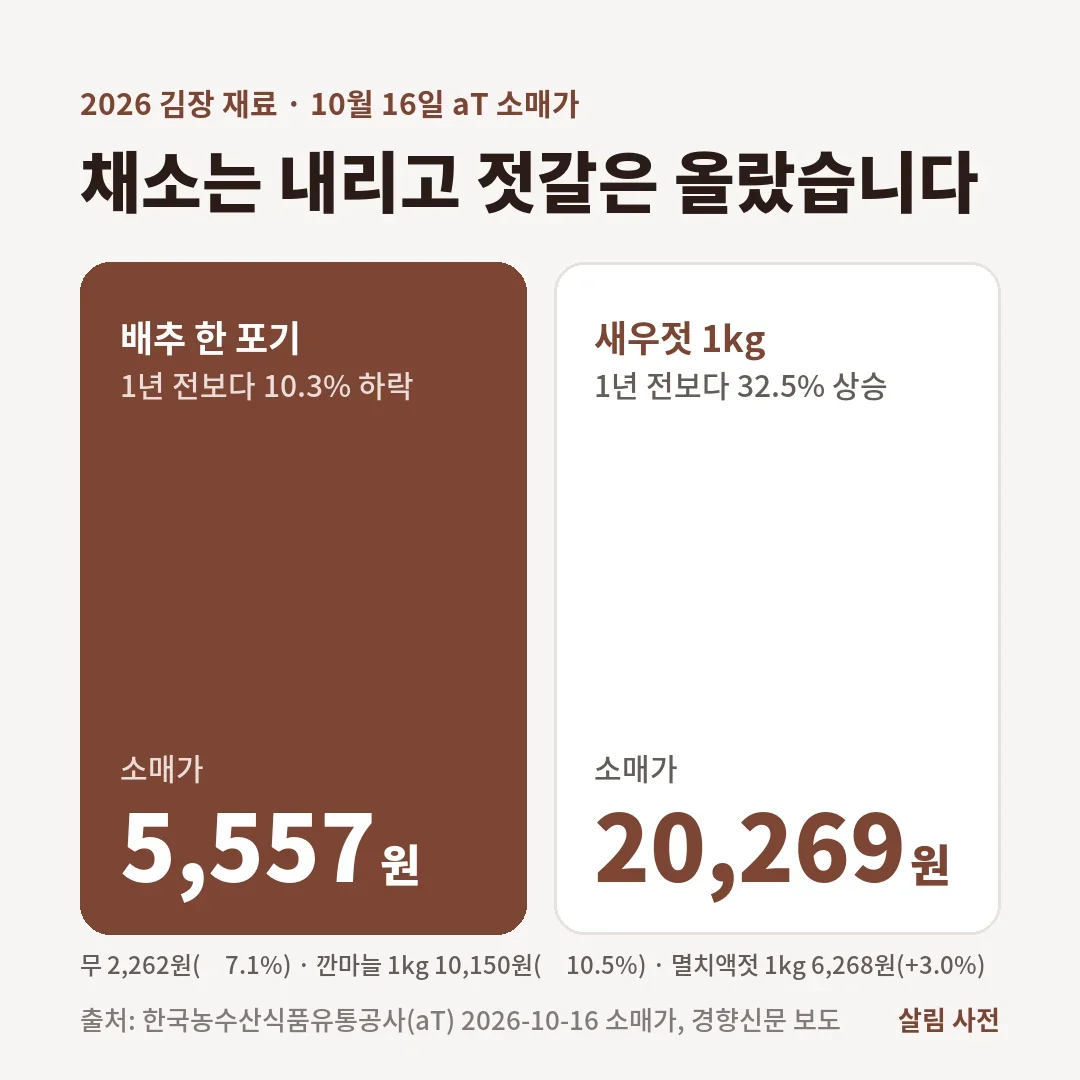
On October 16, the same day that wholesale prices were halved, the retail price for one head of napa cabbage was 5,557 won. This marked a 10.3% decline from the previous year but only a 4.11% drop from the previous month 1. While wholesale prices fell by 55.3%, retail prices dropped by just 4.11%. The price gap for the exact same product on the same day exceeds 50 percentage points. This discrepancy is driven by distribution costs incurred as goods move from origin to consumers, as well as by inventory and margin structures at each step of the supply chain. In other words, fluctuations in wholesale prices are not passed on to retail prices immediately or at the same proportional rate 1.
This gap is even more pronounced with radishes. As of October 16, the retail price of one radish was 2,262 won, down 7.1% from the previous year. In contrast, the wholesale price of radishes on the same day was 1,532 won, up 31.7% year-on-year 1. The wholesale and retail prices are moving in completely opposite directions. Because an increase in wholesale prices can eventually lead to an increase in retail prices, the possibility of retail radish prices fluctuating from mid-November onwards should be kept in mind 1.
While wholesale cabbage prices remained substantially lower on November 5, it is also essential to consider that, when compared to the 30-day average, cabbage prices are 13.6% higher than last year, and radish prices are 44.4% higher 2. A short-term plunge and the year-on-year level are separate indicators, so it is difficult to definitively conclude that prices are lower than usual based solely on wholesale prices.
The Actual Savings Across Six Items for a Family of Four
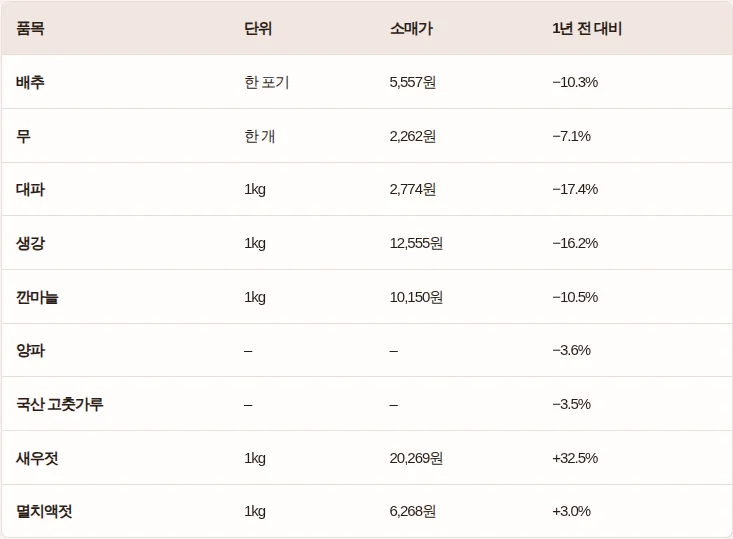
Simply applying the decline rate of individual items suggests that the total cost for making kimchi would have dropped substantially. However, actual calculations reveal a different story. According to an analysis of KAMIS retail prices published by Chungcheong Ilbo on October 26, the cost of the six main ingredients required for 20 heads of cabbage (cabbage, radishes, red pepper powder, peeled garlic, salted shrimp, and green onions) for a family of four came to 198,204 won. This was 9,548 won (4.6%) lower than the 207,752 won spent during the same period last year 3.
| Item | 2026 retail price (10/23) | Year-on-year change | Notes |
|---|---|---|---|
| 1 head of cabbage | 4,537 won | −12.5% | Costs for 20 heads reduced by 12,980 won |
| 1 radish | 2,214 won | −1.4% | |
| 1 kg of peeled garlic | 10,840 won | −3.5% | |
| 1 kg of green onions | 2,784 won | −13.8% | |
| 1 kg of red pepper powder | 31,414 won | Similar level | |
| 1 kg of salted shrimp | 20,863 won | +37.9% | 4,590 won more needed for 800g |
3 As the table indicates, the drop in cabbage prices is substantial. The cost to purchase 20 heads of cabbage was 90,740 won, which is 12,980 won less than the previous year 3. Prices for radishes, peeled garlic, and green onions have also fallen, albeit slightly 3. However, the retail price of salted shrimp surged to 20,863 won per kilogram, marking a 37.9% increase from the previous year 3. Purchasing 800 grams of salted shrimp costs 4,590 won more, and this single item alone offset approximately 35% of the savings gained from cheaper cabbage 3. Because this calculation excludes minor ingredients such as anchovy sauce, the actual perceived cost may differ 3.
The reason for the higher salted shrimp prices is a shortage of shrimp, which serves as the primary ingredient. From January to August 2026, shrimp production was approximately 9,500 tons, representing a 3.5% decrease from the previous year 1. Since salted shrimp is typically sold after a fermentation period of 3 to 6 months, analysts suggest that the drop in production after July is now being reflected in prices during the peak kimchi season 3.
Is Now the Right Time to Make Kimchi?
Once the pricing information is clear, the next question is timing. The optimal time for making kimchi depends on temperature rather than calendar dates. According to the standards set by the Korea Meteorological Administration (KMA) and the Rural Development Administration, the best time is when the average daily temperature remains at or below 4°C and the minimum temperature at or below 0°C 4. An analysis by KWeather of 30-year normal averages from 1991 to 2020 reveals significant regional variations: the typical optimal date is November 30 in Seoul, November 19 in Chuncheon, and January 9 in Busan 4.
There is a 50% chance that temperatures in November and December 2026 will be higher than usual, so you may want to plan on making kimchi a few days later than the standard calendar dates 4. According to the mid-term forecast issued by the KMA on November 6 for the period of November 10 to 16, morning temperatures in Seoul are forecast to reach 0°C (−2°C in Paju) on November 10, which will be lower than usual. However, morning temperatures from November 11 to 16 are expected to range from 1 to 12°C, similar to or slightly higher than average 5. As a result, based on Seoul's typical late-November standard, this year's kimchi-making date might be a few days later, though the exact optimal date for the central region has not been confirmed at the forecast stage 4. The KMA's three-month outlook is merely a statistical probability rather than a definitive forecast 4. The safest approach is to confirm your final plans by checking the one-month outlook released approximately two weeks before making your kimchi 4.
It is advisable to split your purchases by category, as the promotional periods for vegetables and salted seafood differ. On November 3, the government announced the largest-ever "2026 Kimchi Ingredient Supply Stabilization Measure," totaling 64 billion won 1. Under this plan, kimchi vegetables such as cabbage, radishes, chili peppers, garlic, and ginger are discounted by up to 40% at over 300 retailers from October 29 to December 2. Additionally, marine products like salted shrimp, anchovy sauce, and salt are discounted by up to 50% from October 28 to November 29 1. Because salted seafood is preserved in salt and can be kept for long periods, you can buy it in advance. It is wise to coordinate your purchases so that salted shrimp is bought before the marine product discount ends on November 29, while vegetables are bought before the deadline of December 2 1. The National Agricultural Products Quality Management Service is also conducting a targeted inspection of pesticide residues at production areas and traditional markets until November 30, allowing you to verify safety as well 1.
Conclusion
While it is true that cabbage wholesale prices fell by 55% in a month, the corresponding retail price decline was just 4.11%, meaning roughly 93% of the drop remained at the wholesale stage. The year-on-year retail decline was 10.3% [1:E2]. Approximately one-third of the money saved on cabbage is offset by a single item: salted shrimp [3:E2]. The actual savings supported by current evidence amount to 9,548 won, or 4.6%, across six items for a family of four [3:E1]. For timing, use the usual late-November baseline for Seoul but consider making kimchi a few days later, given the 50% chance of warmer-than-usual weather [4:E5]. Splitting your purchases of vegetables and salted seafood before their respective discount deadlines (December 2 and November 29) is a practical way to secure both better prices and freshness [1:E3].
References
- 2026 김장 비용, 배추는 싸지고 새우젓은 비싸졌다 · salimsajeon.com↩
- 오늘 농산물 가격·시세표 — 지역별 도매가격 (2026.11.05 기준) · imun.farm↩
- 배춧값 내리고 새우젓 38% 급등…올해 김장 재료비 4.6% 하락 · ccdailynews.com↩
- 김장 시기 지역별 날짜표, 서울 11월 30일 부산 1월 9일 · foodcombi.kr↩
- 기상청 날씨누리 · weather.go.kr↩