Why One Savings Bank Advertises Two Parked Account Rates
The Structure Separating High Rates for Small Amounts and Moderate Rates for Large Amounts
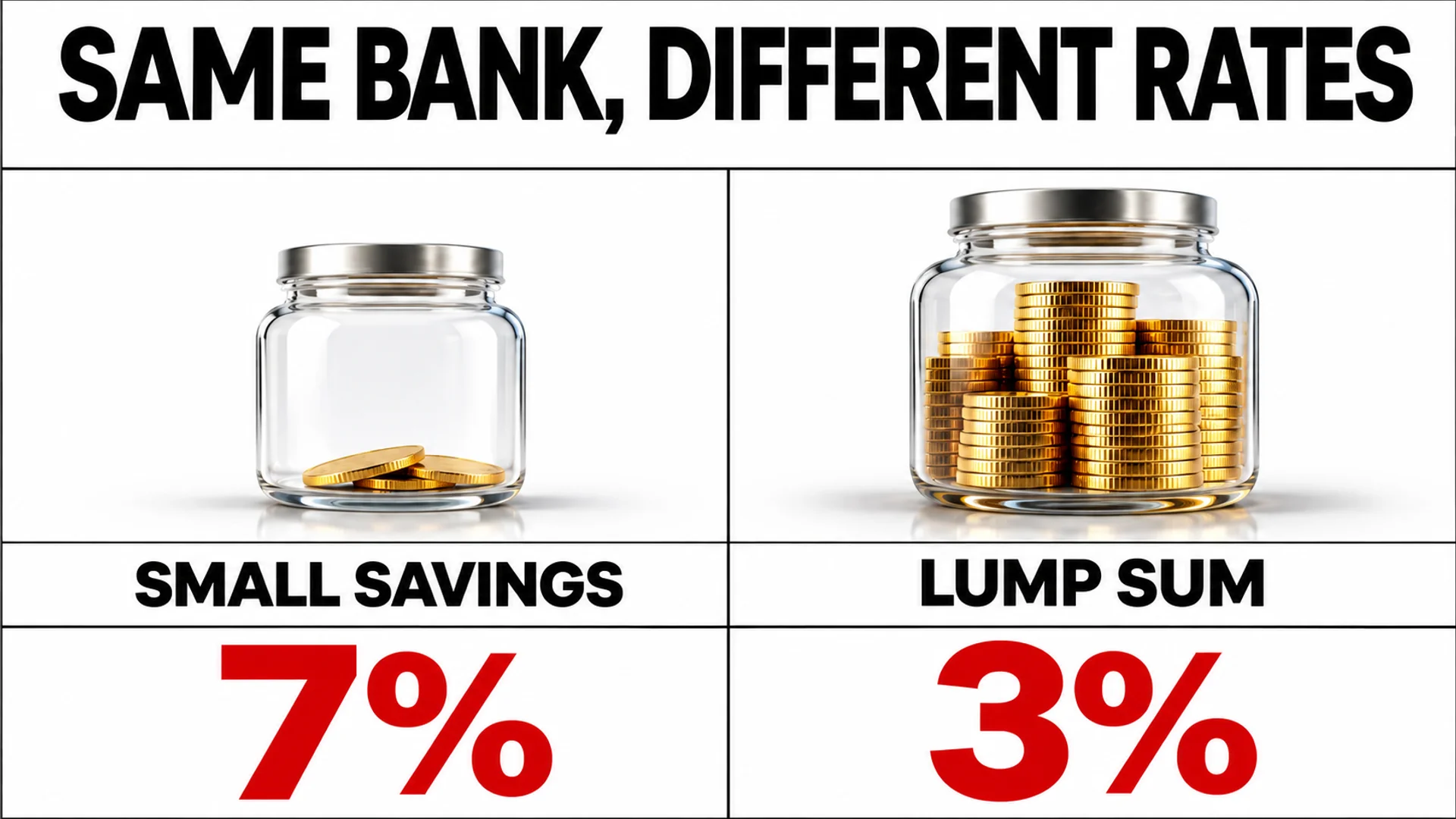
In the parked account market, banks manage funding costs efficiently through a portfolio design where the highest rates are reserved exclusively for small-balance tiers, while large deposits are kept at lower base rates.
Within the same financial institution, deposit insurance and on-demand withdrawal conditions remain identical, yet the headline maximum interest rates can differ by more than twofold.
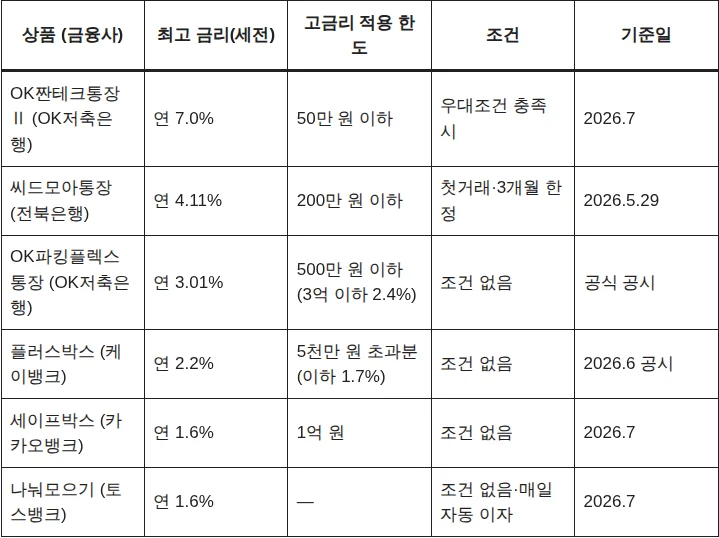
This heterogeneous tier structure is understood to operate under the dual imperatives of customer acquisition and funding cost management. The ultra-high rate of 7.0% annually on the 500,000 KRW tier applies only when promotional conditions—such as marketing consent or easy-pay registration—are met 1, and this tier constitutes a negligible share of total deposits. Conversely, applying high rates to the entire tens-of-millions-of-KRW balance that customers leave on deposit for extended periods would sharply increase the bank’s deposit acquisition cost. Thus, the structure is designed to secure customer inflow via high rates on small balances while defending overall funding costs through lower rates on larger amounts 12.
Savings banks maintain high rates on small-balance tiers relative to internet or commercial banks due to structural needs for deposit inflows. As reported by Sisajournal e in December 2022, a savings bank industry official stated, “While savings bank deposit rates are influenced by the base rate, they are more heavily impacted by interest rate competition with other nearby financial institutions and among savings banks themselves” 2. The official added that savings banks have continuously raised deposit rates as a defensive strategy to prevent outflows when commercial banks increased their deposit rates 2.
These differences in funding environments create distinct base-rate structures across financial institutions. As of July 2026, internet bank parked account rates remained at 1.6–2.2% annually 1. By contrast, ongoing rate competition among savings banks to defend deposit balances and attract customers drives aggressive high rates of up to 5–7% annually on small-balance tiers 12.
Effective Interest Rate and Net-of-Tax Interest Calculation

Depositing a lump sum based solely on the advertised maximum rate may result in net-of-tax interest significantly below expectations.
The case study published by financial blog MyWalletSense in July 2026 illustrates step-by-step how tiered rates affect individual returns 3. Consider a hypothetical account applying 3.0% annually on the first 10 million KRW and 1.0% annually on amounts above it, with a deposit of 30 million KRW held for 30 days. Pretax interest from the first tier amounts to roughly 24,658 KRW, while pretax interest from the excess 20 million KRW totals about 16,438 KRW 3. Combined, pretax interest for the 30-day period reaches approximately 41,096 KRW 3. After deducting the 15.4% interest income tax, estimated net-of-tax interest stands at about 34,767 KRW 3.
Though the advertised maximum rate is 3.0% annually, the average applied rate—the effective rate—derived by converting the 30-day pretax interest for the full 30 million KRW into an annualized basis falls to approximately 1.67% 3. Had the same 30 million KRW been deposited in an account with a simple uniform rate of 2.0% annually, 30-day net-of-tax interest would have totaled about 41,721 KRW 3. In other words, despite the higher advertised maximum rate, net-of-tax earnings were actually about 6,953 KRW lower 3.
At a deposit size of 50 million KRW, the reversal in returns due to tier structure becomes evident in concrete figures. Calculations by financial blog CreateBlog1, based on rate disclosures as of August 15, 2026, show a clear difference in interest between a uniform-rate product and a tiered-rate product 4.
| Type | Applicable Rate | Annual Net-of-Tax Interest on 50 Million KRW |
|---|---|---|
| Uniform-rate product | 2.70% annually up to 100 million KRW (SBI Saida Withdrawal/Deposit Account) | ~1,142,100 KRW |
| Tiered-rate product | 3.01% annually up to 5 million KRW, 2.40% annually on excess (OK Parking Flex Account) | ~1,041,003 KRW |
Table source: Calculation based on rate conditions disclosed as of August 15, 2026, assuming a 15.4% tax rate 4
Comparing maximum rates alone, the OK Parking Flex Account at 3.01% annually appears to yield higher returns than the SBI Saida Withdrawal/Deposit Account at 2.70% annually. Yet calculating total returns on the full 50 million KRW reveals net-of-tax interest that is about 100,000 KRW higher for the uniform-rate product 4. In the tiered-rate product, only 5 million KRW (10%) earns 3.01% annually, while the remaining 90%—45 million KRW—receives the lower 2.40% annual rate; consequently, the tier applied to the bulk of the deposit dictates overall returns 4.
Interest Rate Fluctuations and Tier-Specific Checks
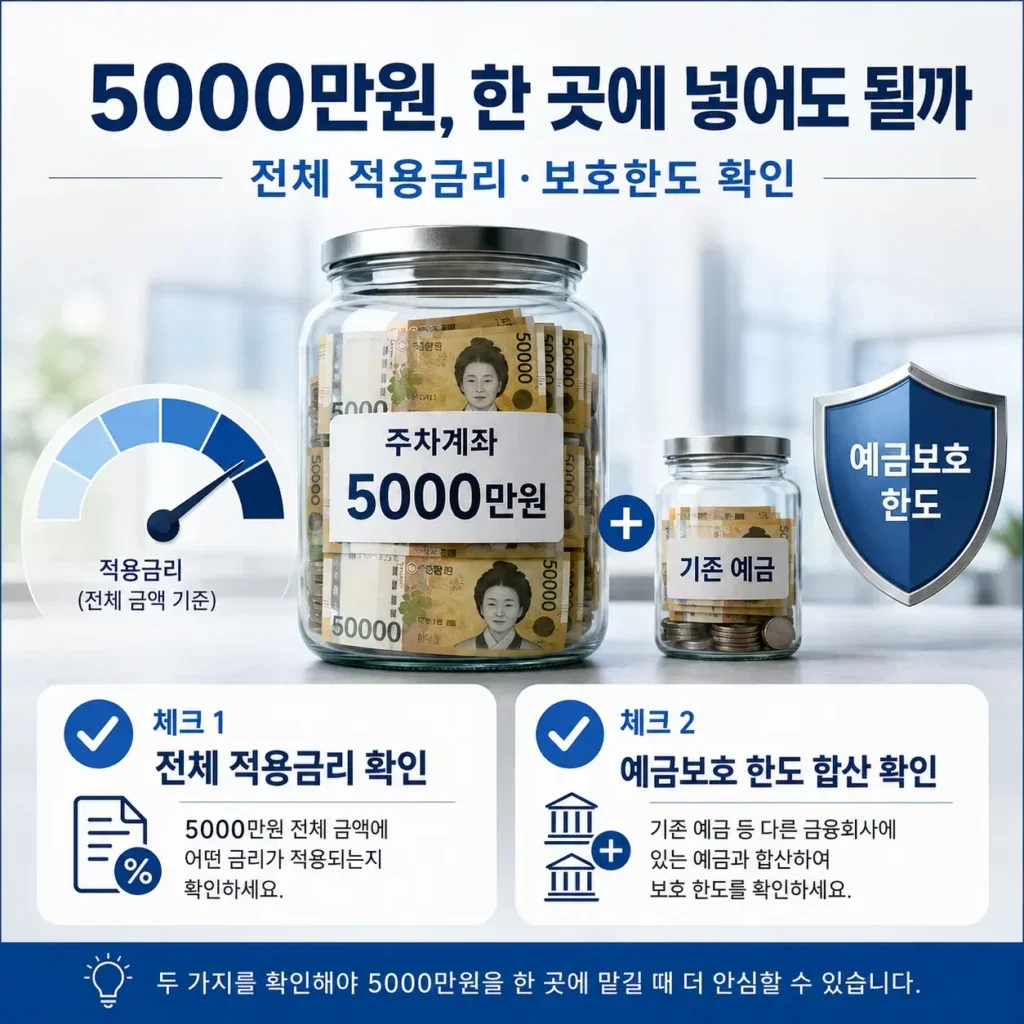
Once you determine whether a parked account structure suits your funds, you must also confirm the deposit insurance threshold and its nature as a variable-rate product to safeguard actual returns.
Unlike time deposits, parked accounts do not lock in the rate applicable at account opening for the full term. According to the operator of Alzzalab (as of August 10, 2026), parked accounts carry variable rates, allowing banks to adjust rates at any time after prior notice; several internet banks have indeed lowered parked account rates multiple times in line with their own deposit conditions 5. Thus, a 7% rate today offers no guarantee of remaining at 7% a year from now 5. Given the nature of variable rates that banks adjust freely, it is essential to examine how long higher-rate tiers persist and under what conditions, rather than focusing solely on the maximum rate at account opening.
For storage limits and safety standards, allocate funds according to the deposit insurance threshold. Effective September 1, 2025, the deposit insurance limit was raised from 50 million KRW to 100 million KRW in principal and interest 564. However, this limit is not per account but applies to the aggregate of all insured deposits held with the same financial institution 564. For example, depositing 100 million KRW in one savings bank’s parked account means any amount exceeding 100 million KRW when combined with other time deposit products at the same institution falls outside insurance coverage. To ensure full eligibility under the deposit insurance system, lump sums exceeding 100 million KRW must be distributed across multiple financial institutions 564.
Ultimately, the existence of two distinct parked accounts at the same savings bank is the outcome of a funding portfolio designed to attract ultra-small-balance customers through high-rate tiers while defending the substantial balances that remain in accounts at lower base rates. Therefore, the criterion for selecting a parked account is not listing “what maximum annual percentage is offered,” but calculating “how much net-of-tax interest remains on the tier where most of my funds will be allocated.” By computing the true effective rate under tiered structures and applying the 100 million KRW per institution deposit insurance limit, you can allocate accounts appropriately to your fund size and secure the full benefit of actual interest income.
References
- 파킹통장 추천 금리 비교 총정리 — 2026년 금액대별 최적 조합 - 머니프리덤(m-freedom) · m-freedom.com↩
- 저축은행, 수신금리 인상폭 한풀 꺾였지만···조달비용 부담은 ‘여전’ - 시사저널e · sisajournal-e.com↩
- 파킹통장 최고금리 조건|잔액 전체 적용 여부 · mywalletsense.com↩
- 5000만원 파킹통장 이자 비교, 한 곳에 넣을까 나눠 넣을까? - 금융 전문블로그 · finance.createblog1.com↩
- 파킹통장 추천, 2026년 어디가 유리한가 — 금리 구간 3가지 · alzzalab.com↩
- 나에게 맞는 파킹통장 선택 가이드 - 금액별·목적별 · glasswallet.com↩