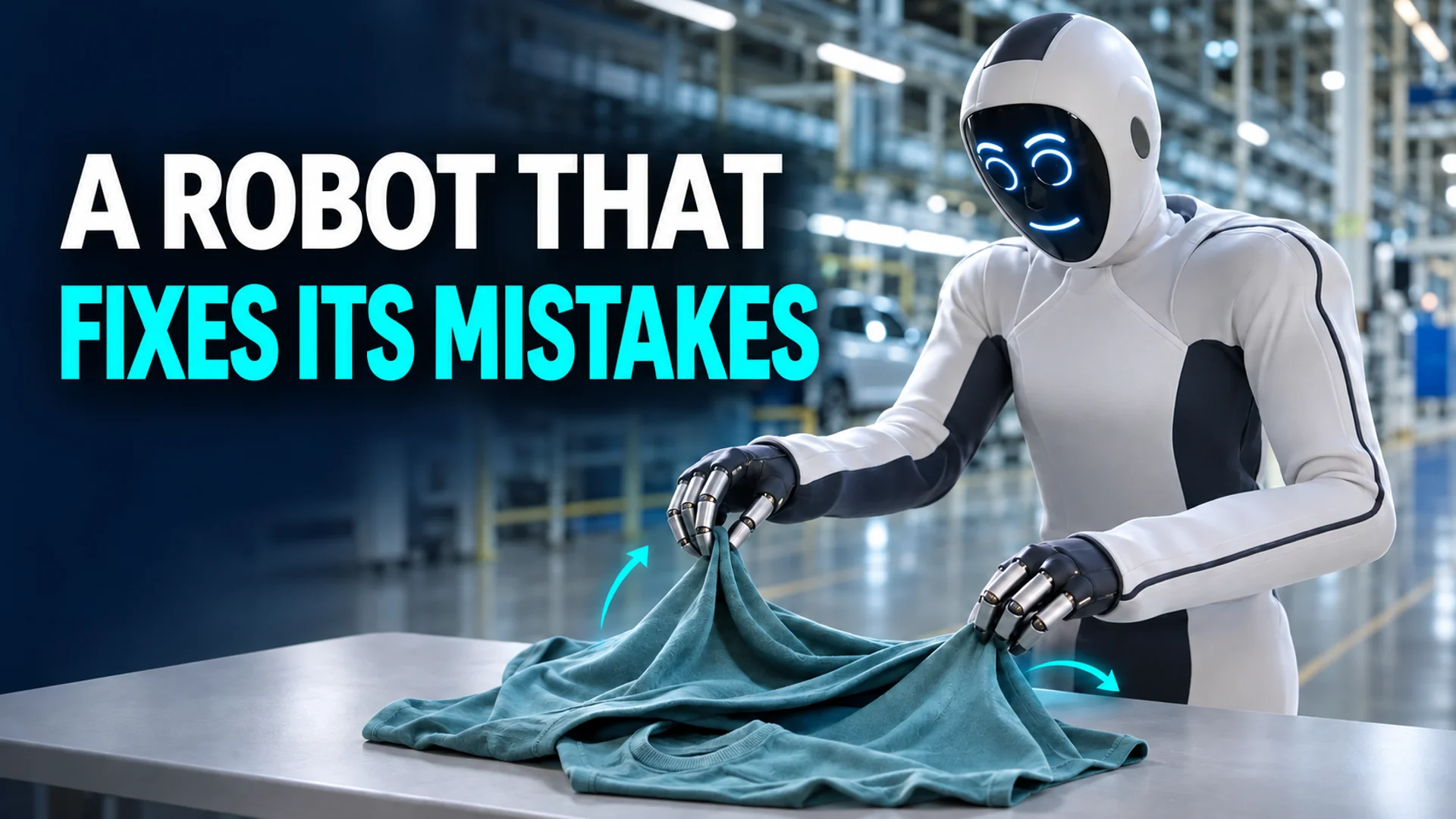
Picture a situation where two shirts in a laundry basket become tangled. A person feels the slight resistance of overlapping fabric through their fingertips and gently separates one shirt. A robot that moves only according to predetermined coordinates, however, tends to grasp the shirts with the same force, repeating the same failure. Unlike earlier precision machines, which stopped with an error when they deviated from a preprogrammed path, recent humanoid robots calculate the difference between sensor data and target states in real time to adjust their movements. This is known as self-correction and is a core capability of Physical AI. Through recent examples such as the Physical Intelligence π∗0.6 model, we will examine how robots are trained to correct mistakes, why this capability is important in factories, and what challenges remain.
The Moment an Error Is Recognized, the Closed Loop Begins
For a robot to correct its own mistakes, it requires a closed loop consisting of perception, planning, execution, and correction. The robot uses visual and tactile sensors to identify its current state, calculates how far this state is from the target, and adjusts the next movement accordingly. According to a technical analysis by Vention, recent Physical AI implementations fall into two broad categories, each handling this loop differently 1.
The first is the AI pipeline approach. This modular structure separates the task into perception, planning, and execution stages and treats robot control as a geometric problem. For example, in laundry handling or component picking, a person defines in advance the grasp point at which the robot must pick up a particular object, based on its shape and location. While this approach is advantageous for performing millimeter-precision tasks at high speed, errors occur if the basket moves slightly or if an object of an untrained size is presented. The system can be rigid: logical errors may stop the entire system, and a person may be required to reprogram it 1.
In contrast, an end-to-end learning model allows a single artificial intelligence to directly convert camera image data into motor torque. In this sense, the robot is solving a learning problem. Because it adapts to the environment through probabilistic reasoning, it is not necessary to code every variable in advance. In tasks requiring flexible movements, such as folding laundry, self-correction occurs at this stage 1.
Training in Three Stages: Learning from Failure Beyond Imitation
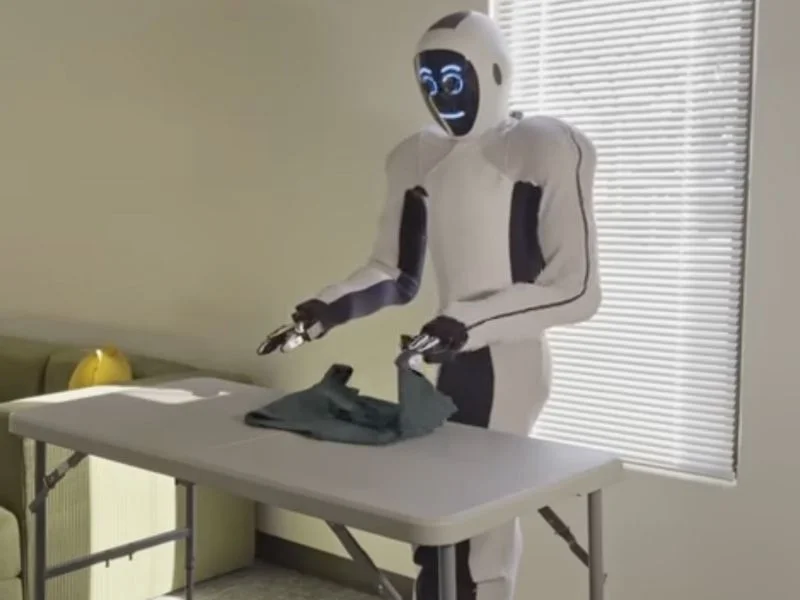
The key to self-correction is transforming failure experience into training data. Physical Intelligence’s π∗0.6 model is trained in three stages, much as a person teaches a child to act. Vention’s analysis explains how this process operates beyond simple imitation 1.
- Observation of expert demonstrations: A person shows videos of folding laundry or assembling boxes, providing the correct movements. However, materials with irregular properties, such as fabric, cannot be handled through simple imitation alone, because problems such as tangling remain unsolved.
- Real-time coaching (reinforcement learning): This is the decisive stage. If the robot makes an error while following the demonstrated movement, such as laundry sticking to itself, a person provides a correction signal in real time to guide the correction direction. Through reinforcement learning, the robot connects its own mistakes with the resulting corrections and increases the weight of successful trajectories.
- Autonomous practice: The robot performs repetitive tasks without human intervention and resolves failure experiences on its own. At this stage, it develops the ability to adjust force and path on its own, depending on the slipperiness of materials or small differences in box size.
Through this method, the robot gains a flexible strategy such as “adjust force when physical resistance is detected,” rather than a fixed instruction such as “grip a box of size A this way” 1.
Early Proof Cases That Change the Factory’s Physical Environment
When self-correction capabilities are applied, robots can work in existing factories without special installations. This is because they can use the same doors, stairs, and congested work spaces as people 2.
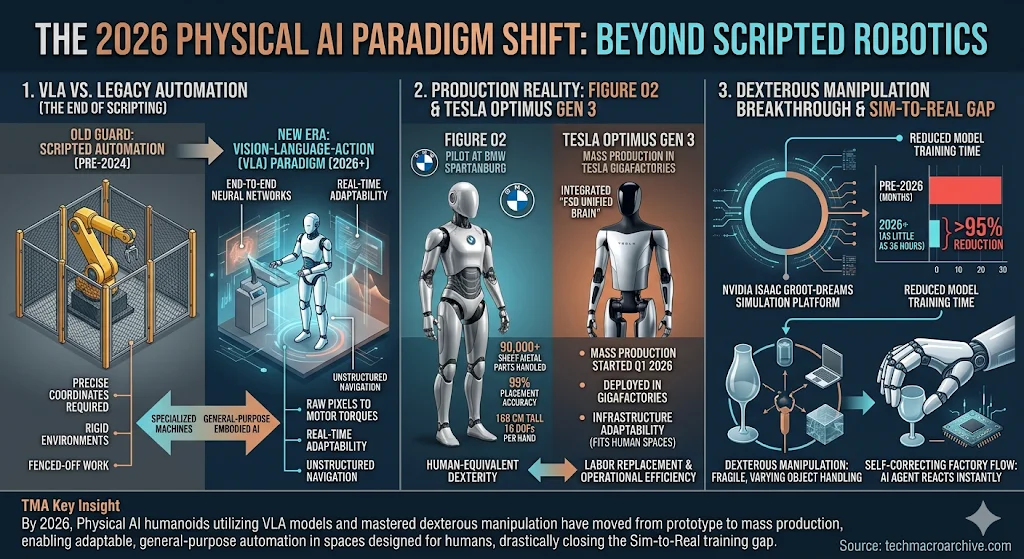
According to an April 2026 report by Tech Macro Archive, the Figure 02 humanoid robot completed a pilot test at BMW’s Spartanburg plant, moving and placing more than 90,000 sheet metal parts. The robot, which is 168 cm tall and has 32 degrees of freedom across both hands (16 per hand), was reported by the publication to have achieved 99% placement accuracy for parts. However, according to a Figure 03 review, this figure was not included in official press materials from BMW or Figure, but circulated in third-party analyst documents.
In addition, Tesla’s Optimus Gen 3 is being deployed at a Gigafactory for parts transport and machine operation by combining the principles of Tesla’s autonomous-driving AI. Through simulation platforms such as NVIDIA’s Isaac GR00T-Dreams, robots are learning with physics engines that resemble real-world conditions, including breakage of glass or microelectronic components, thereby exploring the feasibility of a self-correcting factory 2.
Speed, Battery Life, and Generalization Validation
Self-correction technology is not the answer to every industrial problem. According to Vention’s analysis, learning-based models can produce unexpected movements caused by hallucinations, so movement speed is strictly limited for safety. As a result, current self-correcting robots are not yet suitable for traditional assembly lines that require high precision and fast cycle times 1.
It also remains unknown whether a robot that has learned one task can generalize to another. Whether a robot specialized in folding laundry can immediately perform palletizing has not yet been validated 1.
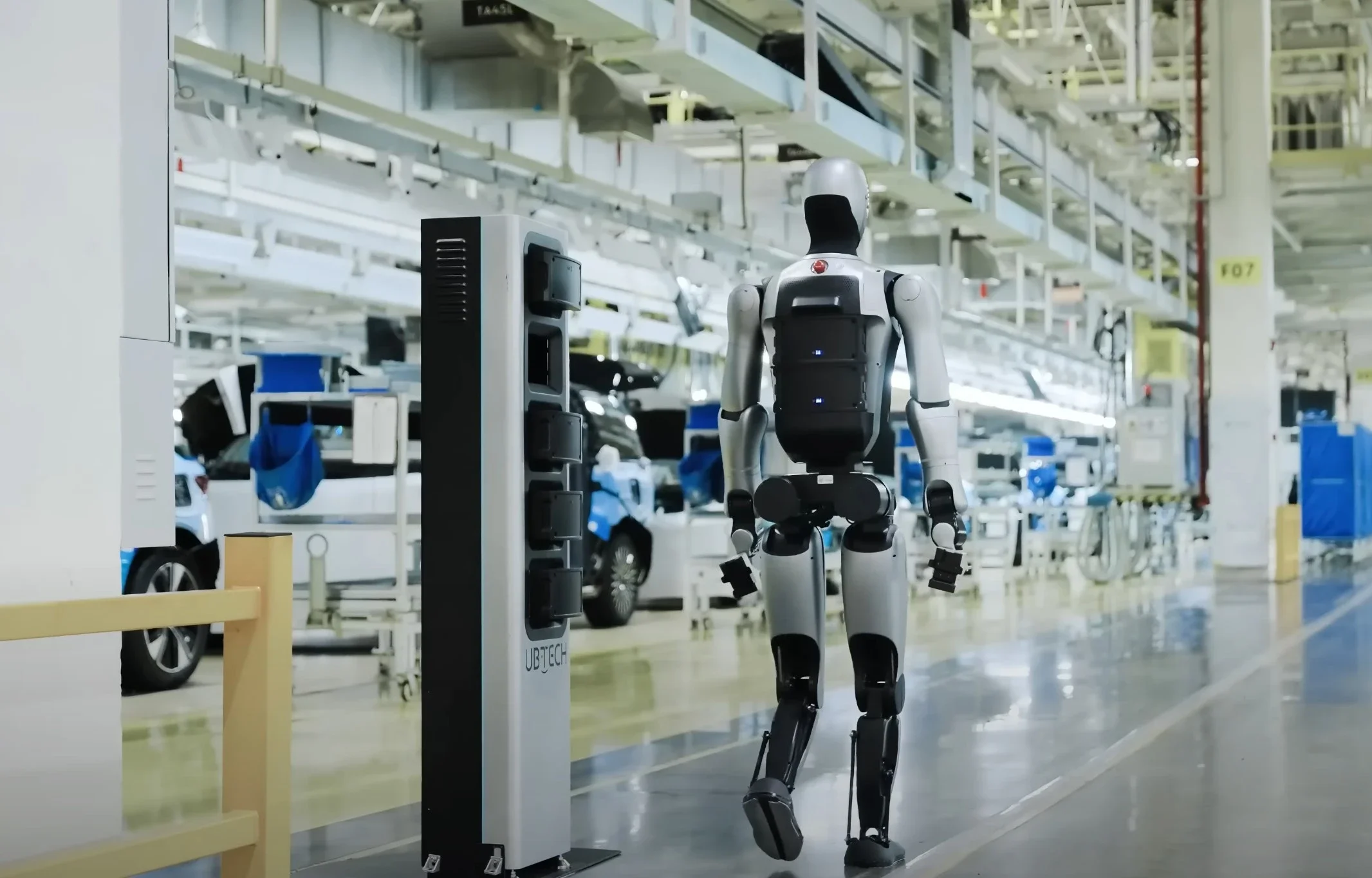
Physical constraints are also clear. Due to limits in battery energy density, most current humanoid robots have an operating time of only about five hours. Without automatic battery-swap infrastructure, overnight operation—such as night shift work—is not possible 2.
Ultimately, self-correction is not magic; it is engineered training. It reduces the repetitive work of reprogramming a robot for every product variant. At the same time, it comes at the cost of speed, and its demonstrated scope remains limited—factors that should be assessed soberly.