The following Pokémon roleplay scene was shared by YariPoké, a user on the Acarai character AI forum. Trainer "Jane Doe" arrives at Route 1 in Melemele Island of the Alola region and immediately says, "I swear we were having some epic battles up until yesterday. The moment I stepped off the ship, my head felt as white as if a pencil eraser had just rubbed it clean!" Pikachu looks up at Jane Doe’s profile with half-closed eyes. When Jane Doe makes a self-referential joke about "cooling down" by erasing her name, Pikachu drops one ear, places a paw to its forehead, and the topic moves on to "Pikachu-dad" talk 1.
At the bottom of the post, a one-line comment reads, "I think I’ve seen the brain reset more than once or twice." 1 This is the moment when the AI character naturally handled its own memory gap as dialogue within the narrative, effectively adopting the premise of "amnesia." It is not a bug report, but a scene that accurately identifies the phenomenon. The character did not intentionally feign forgetfulness; rather, it filled the void with the remaining settings after earlier conversation content had been removed from the AI’s "workbench."
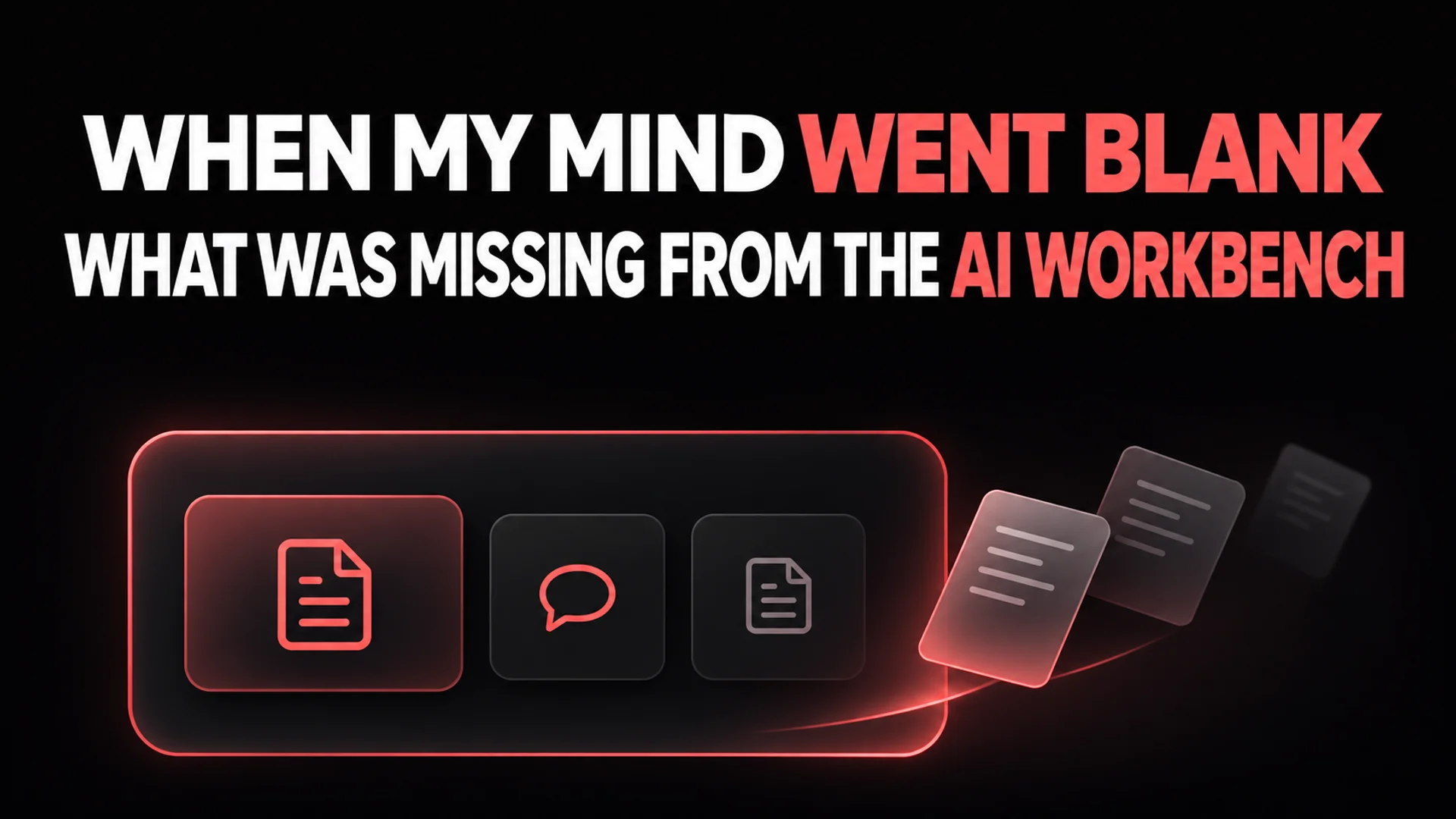
The workbench analogy: AI doesn’t remember; it rereads every time
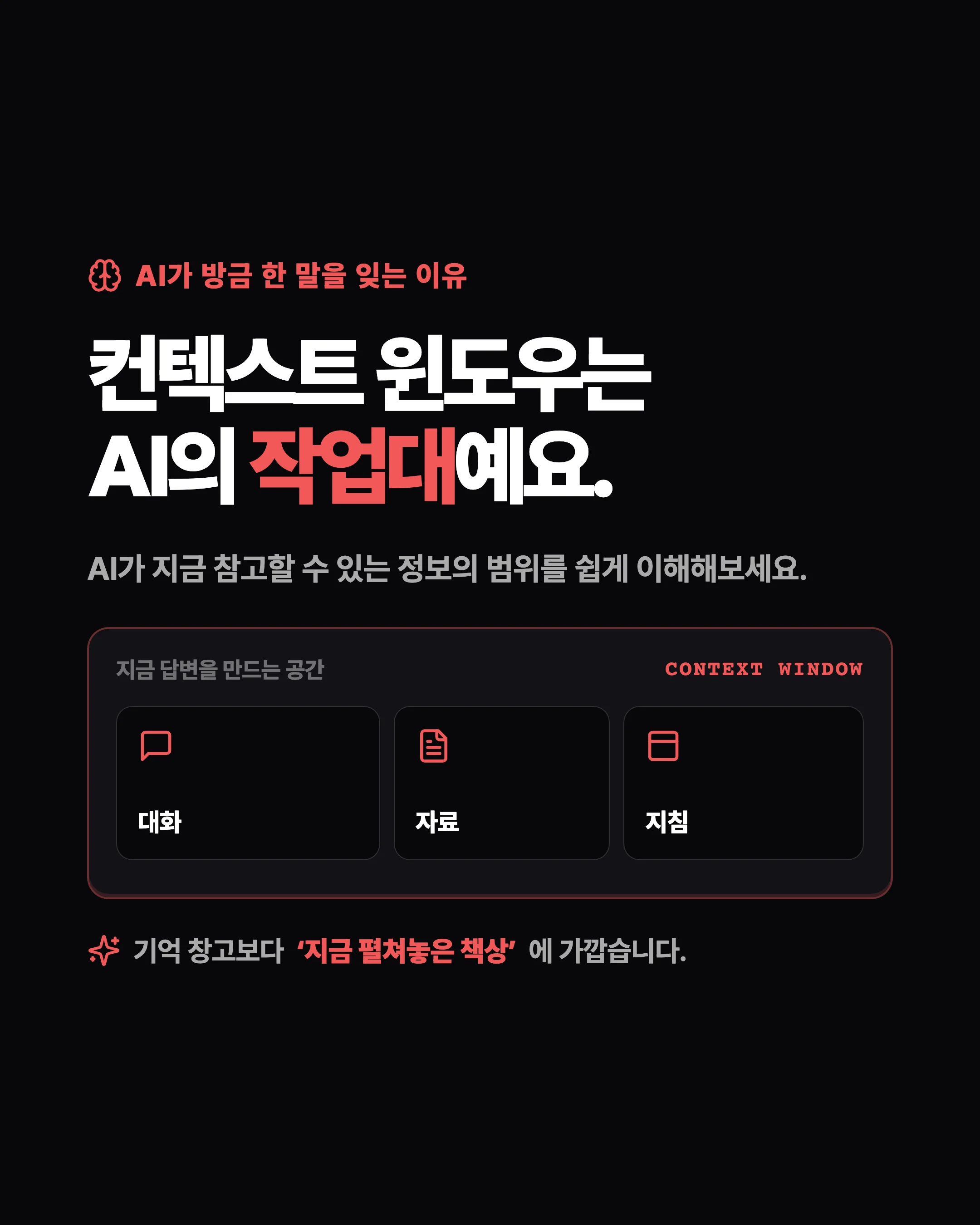
When an AI character suddenly contradicts itself, we often feel that "the AI forgot." The technical blog junhyunp.github.io describes this feeling not as model laziness, but as a structural issue. The API for large language models (LLMs) is fundamentally a stateless architecture that does not store state. While the conversation appears to flow naturally, the entire previous dialogue is actually resent, along with the new question, with every request 2. Rather than the model remembering and continuing, the user is effectively retelling the memory each time.
The problem is that the size of each request continues to grow as conversation turns accumulate. This limit is called the "context window." Lim Jae-hu, author of the "Ttuk-Ttuk Build" blog, likens the context window to a "workbench" on a desk. The workbench holds everything needed for the current response: the current question, previous conversations, attached files, preset guidelines, tool execution results, and the answer the AI is currently writing 3. Just as desk space is limited, so too is the workbench, and this capacity is measured in units called tokens. Tokens are the smallest fragments AI processes for text and do not correspond one-to-one with character counts 3.
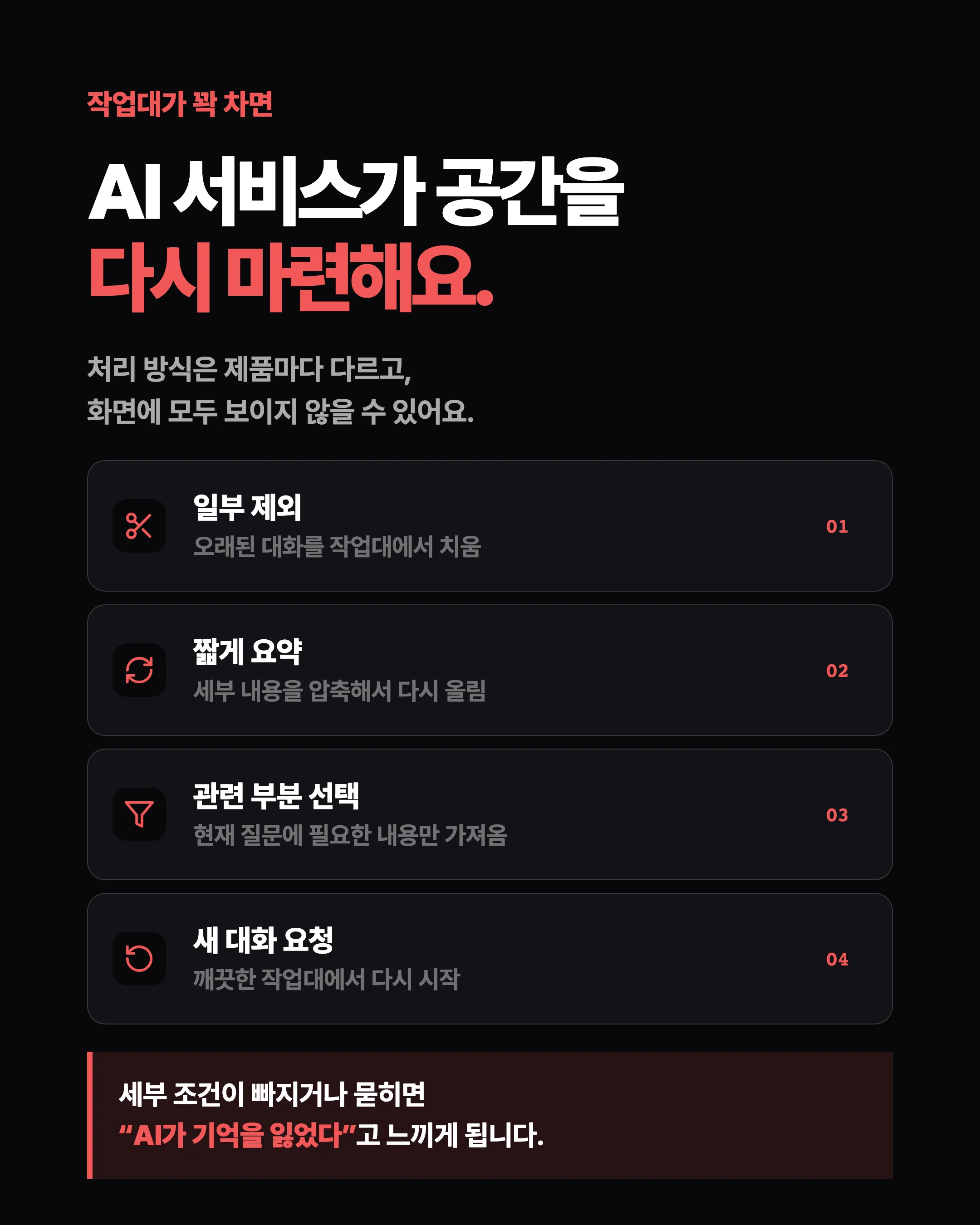
When the limit is exceeded, services adopt different methods to create space. According to author Lim, these vary by product: excluding older parts of the conversation from the workbench, summarizing previous content briefly to re-upload it, retrieving only relevant sections, or requesting a new conversation 3. According to junhyunp.github.io, direct API calls specify the limit exceeded as an error, whereas chatbot services silently summarize and delete earlier content and continue the conversation without any indication to the user 2. Because there is no way to know which facts were cut, the user arrives at the question, "Why did it forget what I just said?"
The system prompt remains, while anecdotes are erased
Why, then, does the character’s personality remain while specific incidents and adventure experiences disappear? This is due to the varying degrees of controllability of the elements filling the workbench. According to the table in the junhyunp.github.io blog, the system prompt (role/rule setting) is a highly controllable item fixed into every request. In contrast, conversation logs (all previous questions and answers) are subject to adjustment by starting a new conversation or via summarization 2. In other words, the base persona directive "You are Trainer Jane Doe, and your partner is Pikachu" is reloaded every time, while detailed narratives like "Yesterday we battled at a certain road and met a girl named Mako" are subject to truncation and compression.
In character chat services, this truncation often follows management guidelines rather than being arbitrary. A document shared on notes.io titled "Character Chat Long-Term Memory Compression/Merging Guidelines Ver. 2" illustrates this. These guidelines limit the body text of long-term memory slots to a maximum of 300 characters, including dates, durations, spaces, and punctuation. If the first-stage compression organizes originals scattered across multiple dates and scenes by event unit, the second-stage compression is defined as an optimization phase that rereads multiple already-refined event memories and merges them into larger units—such as event arcs, relationship changes, secrets, and state changes—to reduce the number of memories 4.
The core criterion of this document is a clear question: "If I delete this information, will the facts, relationships, behaviors, or information state in subsequent roleplay actually change?" 4 If nothing changes, it can be deleted or absorbed into other memories. For example, "one-off responses from background characters," "simple movements/meals/clothing," "details of already concluded events," and "specific sequences of combat or actions" are explicitly listed as candidates for reduction 4. Conversely, "retention anchors"—defined as pivotal turning points in relationship changes, currently valid promises/conditions, unresolved foreshadowing, permanent changes, and user-confirmed settings—are not deleted unless clearly transferred to another memory.
In other words, the abstract current state of "having gone around battling" is close to a retention anchor and remains, while the specifics of who was fought, where, and how can be subject to merging or deletion. The guidelines also state that "searchability and continuity take precedence over reducing the number of memories," establishing the criterion of whether the AI can accurately retrieve necessary information in subsequent roleplay rather than simply reducing information regardless 4. When the compressed result based on these regulations is loaded onto the workbench, the AI must generate a response while maintaining the character’s name and base personality, but with an empty narrative regarding the details of the adventure.
Pikachu’s lines are not AI "inventing reasons"

Returning to Jane Doe’s lines, what happened in this scene becomes clearer. With only the abstract impression "I feel like we were having great battles yesterday" remaining, the trainer produced the statement "my head went blank." This is not the AI suddenly realizing its own memory mechanism and creating a humorous line. The workbench contains only the base persona directive, a blank narrative space after compression/truncation, and the user’s input. The model merely generated the most natural next sentence within that input. The situation of a "memory gap" already existed in the input conditions, and fitting responses for the character setting were output as Jane Doe’s line about "going blank," along with Pikachu’s sigh and ear-drooping action 1.
The testimony in the comment, "I think I’ve seen the brain reset more than once or twice," is not an exaggeration when viewed from this perspective 1. In a stateless architecture, it is basic service behavior, not a model failure, for the beginning of a conversation to be silently truncated when the length exceeds the limit 2. Roleplay tends to have much larger conversation logs than standard Q&A, and since character settings and world rules are fixed as system prompts, the conditions are ripe for the experience of "the persona remains but the narrative is reset" to recur.
You cannot eliminate resets, but you can reduce their frequency
Understanding the technical structure clarifies the response. First, an important premise: the methods below do not eliminate the structure of "memory resets" itself. Since the physical condition of the workbench limit remains, the focus is on reducing the "frequency of loss for important information" and making recovery easier after truncation, rather than completely preventing cuts.
Practical strategies can be organized through recommendations from junhyunp.github.io and the Ttuk-Ttuk Build blog 23. First, if the topic has completely changed or old directives continue to clash with new goals, it is better to start a new conversation to reduce irrelevant records and costs 23. If the conversation has grown long, request a summary of the current state, such as, "Please organize this into content confirmed so far, content not yet decided, and conditions to be maintained in the next response" 23. Author Lim advises that by directly reviewing this summary, users can catch AI misunderstandings early, and that it is more efficient to start a new conversation with a clean workbench based on that summary 3.
For tasks like character roleplay with many settings to maintain, restating key conditions in the most recent message is effective. Rather than vaguely instructing "Do it as I said at the beginning," it is more accurate to briefly re-present the conditions that must be adhered to. This is because if a condition remains in the recent message, it returns to the workbench even if it was truncated earlier 23. Author Lim recommends separating these into distinct blocks, such as "Conditions that must be followed," so they are not buried within the body text 3.
Service-level solutions also exist. AI assistants like OpenClaw distinguish between short-term context memory that vanishes at session end and long-term permanent memory (MEMORY.md) maintained between sessions. When token limits are reached due to long conversations, the /compact command summarizes the dialogue to preserve core context 5. Using external storage or implementing memory features falls under the same category. However, since the AI cannot perceive information stored in memory unless it is currently loaded onto the workbench, storage and actual utilization must be understood as separate concepts 3.
Returning to Jane Doe’s scene, if the user wanted to continue the "actual battle content from yesterday" with Pikachu, the easiest path before typing dialogue might have been to explicitly restate conditions on the new workbench, such as the first meeting with Mako and the blonde girl, the 3,000 yen emergency funds currently held, and the five empty Poké Balls. Thanks to the AI incorporating its memory gap into the narrative through the line "my head went blank as if rubbed by an eraser," the user could laugh and call it a "brain reset," and we could observe what happens when the workbench fills up in the most intuitive scene possible 1. The character did not act out forgetfulness but filled the missing information from the workbench using remaining settings, and users can manage this void going forward by leaving important conditions in recent messages and using intermediate summaries to restart on a fresh workbench.
References
- AI대화 피카츄 반응이 개웃기네 · arca.live↩
- [LLM] 컨텍스트 윈도우 — 대화가 길어지면 앞을 잊는 이유 · junhyunp.github.io↩
- 컨텍스트 윈도우란? AI의 작업대 이해하기 · ddukddak.build↩
- Notes - Online Notes Service · notes.io↩
- OpenClaw 메모리 리셋 해결 2026: memory 명령어로 AI 기억 복구 · vpn07.com↩