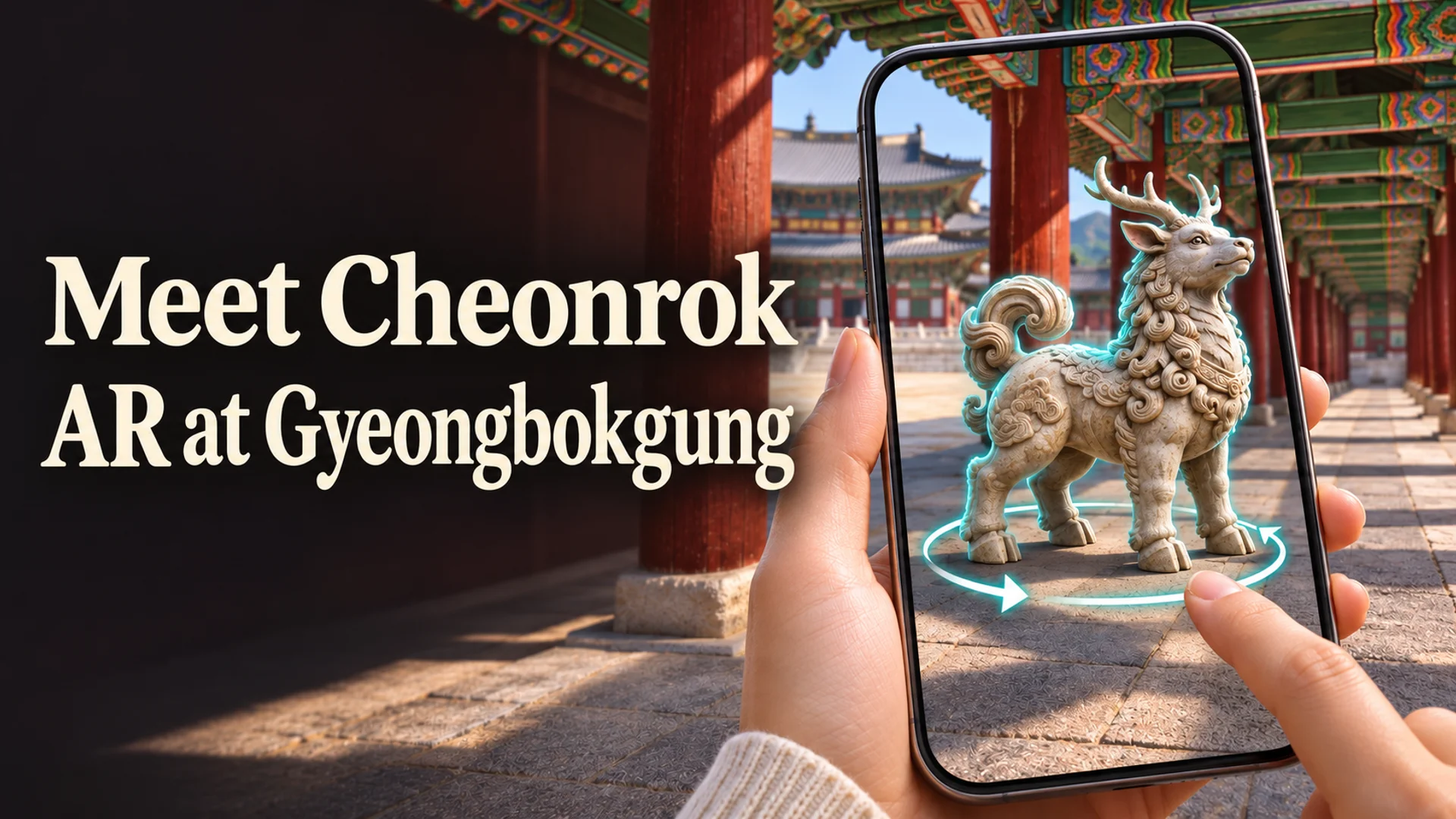
Visitors can use a finger to enlarge or rotate the Haetae. There are indeed existing cases where, at historic sites or landmarks, activating AR (augmented reality) on a smartphone delivers information in the form of "three-dimensional objects superimposed onto one’s own space" instead of relying on signage text or audio commentary 1.
The Guardian Beast You Can Touch with Your Finger: How AR Works
The essence of AR lies in the fact that the physical space currently in front of the user’s eyes becomes the "floor" of the screen. In the recording of Gyeongbokgung Palace’s production process, the team explained that this technology "adds three-dimensional images to real-world images or backgrounds to present them as a single image," further noting that "because the current space one occupies serves as the base for the superimposition of virtual images, the result is perceived as more realistic" 1. In other words, the corridor pillars, floor, and even the natural lighting captured by the camera serve directly as the stage, upon which a digitally created Haetae is placed as if it were a physical object with actual size and position.
The procedure experienced by users on site was straightforward. Scanning the banner’s QR code displayed the actual space of Gyeongbokgung Palace as the background on the mobile phone screen, overlaid by a three-dimensional model of the Haetae—the mythical guardian beast of the palace 1. By using a finger to enlarge or rotate the Haetae, visitors felt a fresh sense of novelty, experiencing the mythical creature—which previously existed only in imagination—as if it were present in the very space they occupied 1. Rather than reading signage, summoning the guardian beast into the empty space before one’s eyes and interacting with it constituted the manner in which this AR experience conveyed information.
Time Travel through VR: Changing the Entire Field of View within the Same Corridor
A noteworthy point is that this program did not utilize AR as a standalone technology 1. Within the same corridor, a dedicated VR device called the "Hanyang Fortress Time Machine" was also positioned. When a visitor stood on this device and moved it up, down, left, and right, the reconstructed landscapes of the Joseon-era Yukjogeori (Six Ministries Street), Gyeonghoeru Pavilion, and Hyangwonjeong Pavilion filled the entire field of view, accompanied by audio commentary of approximately 5 to 10 minutes per theme 1. Narratives such as the context of banquets and rain prayers at Gyeonghoeru and the seasonal changes at Hyangwonjeong were presented through a 360-degree perspective 1.
At this juncture, the nature of the information conveyed by the two technologies diverges. AR preserves the existing corridor before the visitor’s eyes, overlaying only the mythical creature to impart the sensation that "the Haetae exists in this space," whereas VR completely replaces the field of view from the current location with a street scene from centuries ago, delivering the reconstructed panorama and narrative 1. At historic sites, these two approaches do not compete but rather divide roles: one instills a sense of presence in the current space, while the other relocates the user to a vanished world.
Differences Arising When the Site Itself Becomes the Stage
Regarding the question of whether this approach is superior to signage or audio guides, the scope of what this case can answer is clear. In the verified data, the AR experience at Gyeongbokgung Palace demonstrated the interaction with the three-dimensional Haetae itself and is not recorded as displaying additional descriptive text, such as artifact chronologies or architectural blueprints, on the screen 1. Conversely, "narratives" involving historical facts and panorama reconstruction were handled by the VR device in tandem with audio commentary 1.
The understanding readers can derive from this case is one form of answer to the question, "How does an AR guide display information?" The answer is that "the actual location before the eyes serves directly as the stage, upon which a three-dimensional object that can be touched and rotated is superimposed," and in the Gyeongbokgung Palace corridor, that object was the mythical guardian beast, the Haetae 1. This program was a limited-time experience held at the corridor near Heungnyemun Gate from May 4 to October 31, 2022 (from 10:00 AM to 5:00 PM, excluding Tuesdays when the palace was closed) 1. However, one thing this case clearly demonstrated is that visitors who experienced the Haetae AR in the Gyeongbokgung Palace corridor received information by "encountering" the sensation that the mythical guardian beast was present in their space, rather than "reading" information like signage 1. Whether AR at other historic sites conveys information in the same manner depends on service design.
References
- 한국문화100 | 문화TV | 함께해요 문화생활 | 문화포털 · culture.go.kr↩