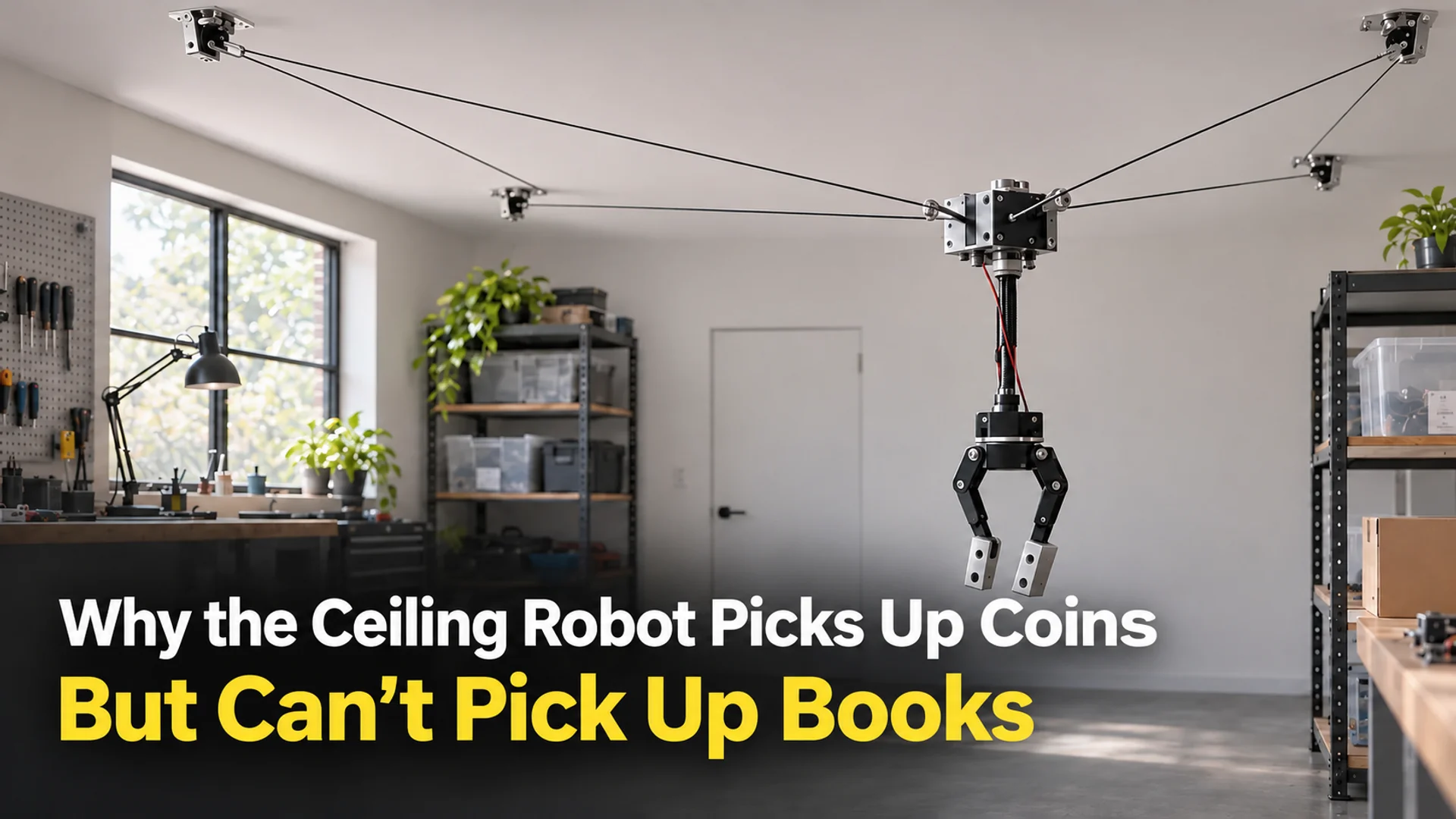
A robot that can efficiently pick up coins fallen on the floor, but cannot grasp a square-shaped book. This is the story of ‘Stringman,’ a ceiling-mounted robot sold by the US company Neufangled Robotics. The price for the assembled product is $795 (approximately 1 million KRW). In a video from the YouTube channel ‘Over Engineer,’ run by the maker Nathaniel, the robot is shown easily picking up coins and plastic toys from the floor. However, the maker himself stated, “The only thing it cannot pick up is a book.”
Coins and books may seem similar in that both lie on the floor. Yet Stringman handles the two objects in completely different ways. This limitation stems not from a malfunction, but from design intent. Stringman minimizes mechanical complexity based on the principle that “the number of motors directly dictates the price.” As a result, the physical shape of the gripper has been simplified, and the types of objects it can grasp have been limited accordingly. We will examine why this robot can pick up coins but misses books, by looking at its operating principles and structure.
Why It Chose the Ceiling Instead of the Floor: Weight Management by Eliminating Motors
Stringman does not crawl across the floor. It moves through the three-dimensional space of a room by pulling or releasing cables fixed to the four corners of the ceiling. This approach eliminates the need to load the gripper with heavy movement motors and batteries required for wheels or legs. Large motors are fixed to the wall near the ceiling, only winding or unwinding the cables, while the gripper receives power through support cables to operate the finger servos and computer.
The maker explains that the number of motors is a key factor determining the price of robotics. This is also why complex gearboxes, batteries, and heavy movement motors could all be omitted. Instead, the motors are fixed to the wall near the ceiling, and only the cables move. There is no need to charge a separate battery, and the mechanical structure is simplified. Power is supplied by embedding an FEP-sheathed wire within one of the three cables. The space left by the absence of wheels, legs, and heavy motors is filled with lightweight 3D-printed parts and fishing line. The fishing line used is a 40-pound (approximately 18kg) braided line.
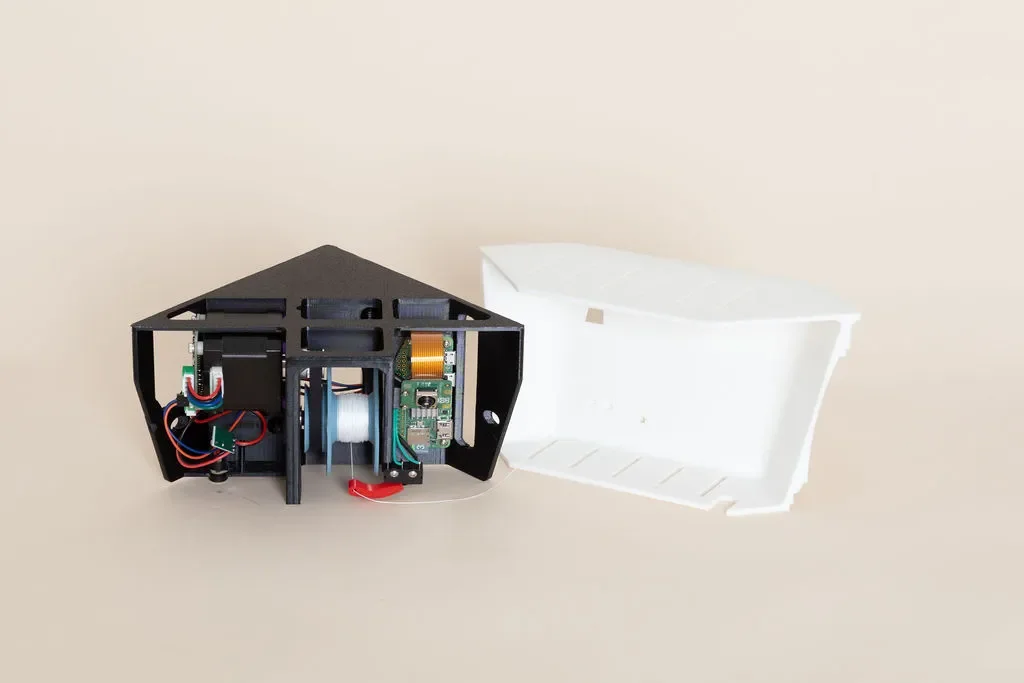
Thanks to this reduction in parts, the price of 655. However, the assembly difficulty is indicated as ‘fairly difficult,’ and assembly takes 4 to 8 hours.
The Physics of Fingertips That Pick Up Coins But Fail With Books
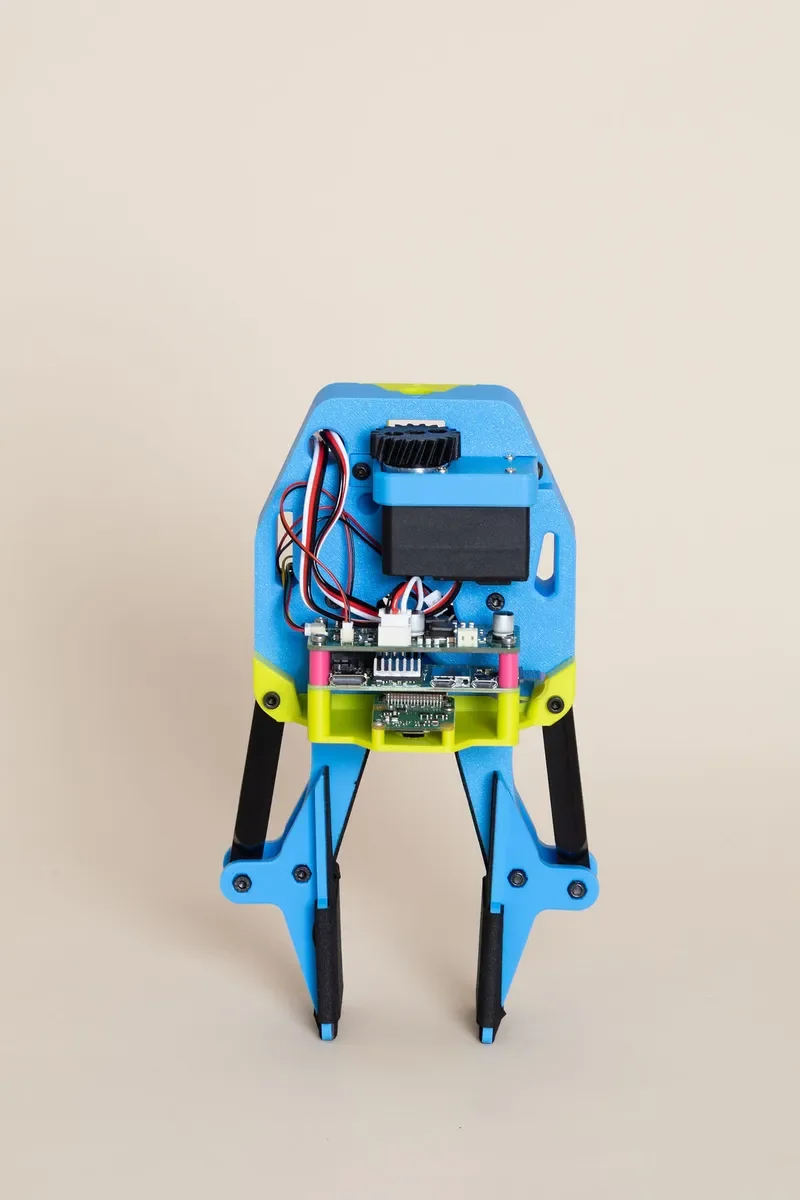
The decisive point where Stringman distinguishes between coins and books lies in the design of the gripper’s fingers. The fingertips are cut flat facing the floor, and this surface is coated with two layers of ‘grip tape’ typically used for skateboards. When picking up objects lying flat on the floor, such as coins or plastic toys, these flat fingertips and rough tape generate friction, firmly adhering to and lifting the object.
One finger is equipped with a built-in pressure sensor. This sensor precisely detects changes in pressure when the fingertip presses against an object. The friction from the tape smoothly transmits the pressure signal when an object is grasped, serving as a reference for the robot to determine how firmly it should grip. Even when slightly pinching the edge of an object with one fingertip, a smooth signal is transmitted to the pressure sensor.
However, the situation is different for books. Coins and toys have rims, allowing the flat fingertips to slip between the floor and the object to lift it. Conversely, as the maker noted, lifting a flat, thin plate using only flat fingertips and grip tape is extremely difficult. Ultimately, this can be viewed as a physical limitation resulting from a simple fingertip design that omits mechanical jaws.
A $795 Price Tag: Shifting Complexity to Software
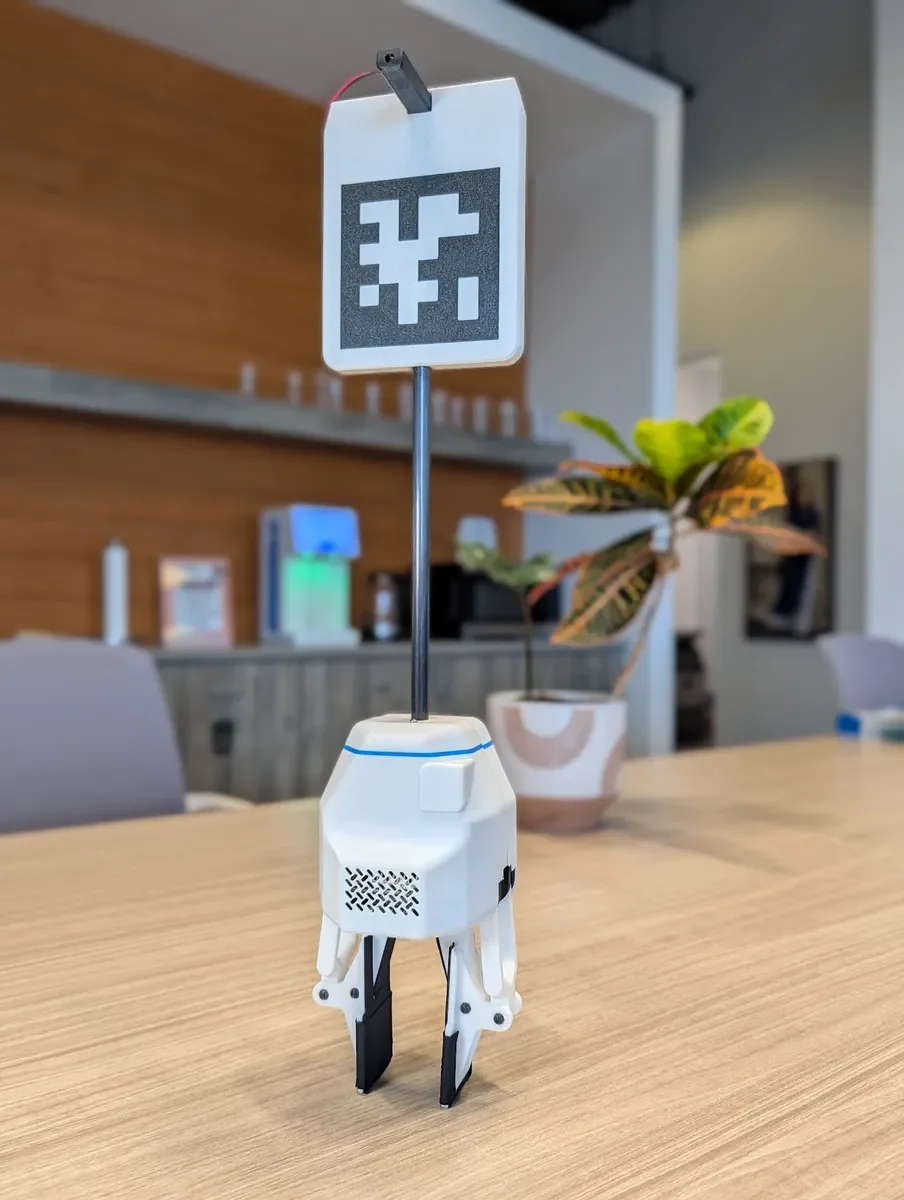
While reducing mechanical complexity, Stringman relies on software for perception and learning. There are also traces of effort in the gripper structure to narrow down physical limitations. It employs a four-bar linkage mechanism, using a single motor to open and close the fingers, designed to grip small objects parallelly while enveloping larger balls like soccer balls.
The robot’s intelligence is based on a diffusion transformer model (DiT), similar to the one used in Boston Dynamics’ Atlas model. This technology applies the principles of ‘Stable Diffusion,’ originally used for image generation, to robot motion control. In the same way the robot generates images, it generates the next motion based on the current view seen by the camera.
Data from laser rangefinders, pressure sensors, and accelerometers attached to the fingers are fed together into the AI model to calculate the distance to the object and the gripping force. Additionally, if April tags (visual markers similar to barcodes) are attached to destinations such as bins or boxes, the camera can recognize them and move to precise coordinates.
With only about 400 training data points, training can be completed within a day on a consumer-grade GPU. Users can directly connect desired AI models using Python API and MCP server, and also add new motions within an open-source ecosystem (OSHWA hardware certification) that publishes mechanics, PCBs, and control code.
Practical Constraints to Check Before Installation
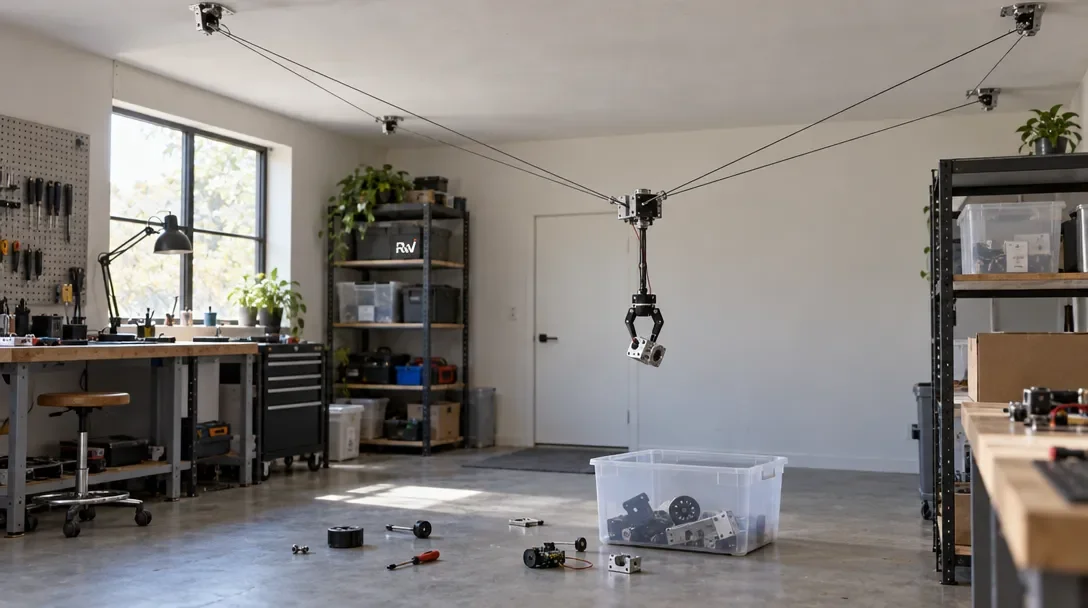
For Stringman to function effectively within a room, several installation conditions must be met.
First, the ceiling structure. Strong anchor points capable of withstanding the tension generated when cables lift objects are required at the four corners of the ceiling. If cable tension exceeds 28N, the motors automatically release force to ensure safety. Second, obstacles in the center of the room. If there are light fixtures or items hanging low in the center, the cable’s movement path is completely blocked, making installation impossible. Third, weight limit. For a 7x7x3m room, the maximum weight that can be lifted near the floor is 2.2kg (average 1.9kg). Fourth, a control computer. The robot itself does not have a powerful device to handle complex AI computations. A separate PC or server is required to handle control and AI inference.
Currently, the most stable automated task performed by this robot is ‘putting laundry (soft fabric) into a basket.’ This can be interpreted as the flat fingertips and rough grip tape being well-suited by design to the action of enveloping soft fabric.
The reason why fingertips that can pick up coins miss books is clear. The maker chose a direction where, instead of adding complex mechanical fingers to perfectly grasp every object, the machine is kept lightweight and software is used to learn the shapes of various objects. Stringman is a product at a stage prior to becoming a perfect all-around helper. However, it demonstrates an interesting case where a ‘design that fills intelligence with data and software instead of weight and motors’ delivers concrete results at the price of 1 million KRW and the specific capability of ‘picking up coins.’