
Engineering teams favor a development rhythm centered on predictable sprints and calm releases. However, as generative AI detects security vulnerabilities at an exponentially faster rate, existing development schedules are being rapidly destabilized. AI is instantly exposing decades-old defects in codebases that existing developers had not yet discovered, causing resources allocated for new feature development to shift massively toward urgent security patches. Ultimately, the increasing speed of LLM vulnerability discovery is no longer just a challenge for security teams; it has become a structural development schedule risk that leads to project release delays and distortions in deployment cycles. This article examines, through concrete case studies, how this change manifests in real projects and how teams can respond at the workflow and pipeline levels to prevent schedule collapse.
The Disappearance of Golden Time and Forced Reallocation of Development Resources
The dramatic acceleration in vulnerability discovery speed is compressing the time buffers inherent in the traditional Software Development Lifecycle (SDLC). In the past, after a vulnerability was discovered, there existed a 'golden time' to analyze it and prepare a patch. However, AI now finds vulnerabilities and generates exploits in just 10–15 minutes, whereas companies’ average patch application cycle is actually lengthening, from 32 days in 2024 to 43 days as of 2026 1. This 'Exposure Window' between discovery and patching has itself become a major intrusion path for attackers (31% of initial intrusion paths) 1. Microsoft’s release of over 570 vulnerabilities, the highest ever, in its July 2026 regular security patches, further exacerbating system burdens, illustrates a facet of this surge in patches 1.
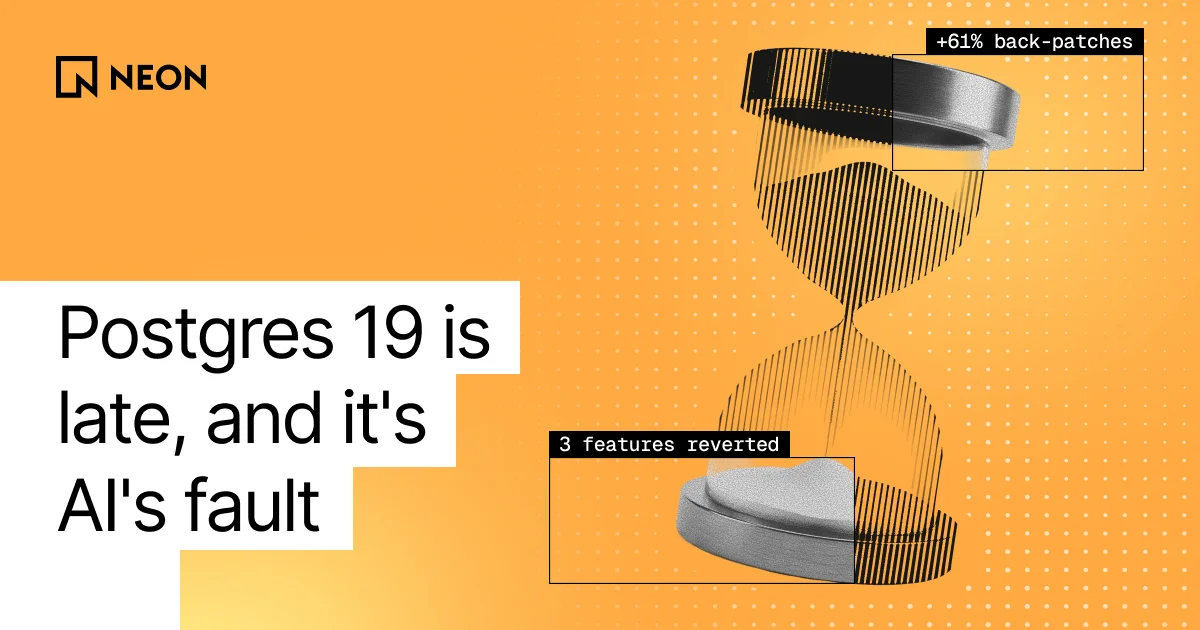
This pressure has directly translated into release delays for large open-source projects. The PostgreSQL project saw an explosive increase in backporting commits (fixes merged into master and stabilization branches) as LLMs discovered a mass of hidden bugs that had existed for 40 years 2. For the REL_19_STABLE branch, commits surged from 724 in April–September 2025 to 1,169 in the same period of 2026, an increase of over 60%, while the REL_18_STABLE branch jumped from 248 to 433, an increase of over 74% 2.
| Branch | Commits (Apr–Sep 2025) | Commits (Apr–Sep 2026) | Trend |
|---|---|---|---|
| master | 1,037 | 1,443 | Slight increase |
| REL_19_STABLE | 724 | 1,169 | Surge of over 60% |
| REL_18_STABLE | 248 | 433 | Surge of over 74% |
Comparison of backporting commits by PostgreSQL branch 2
The fatal scheduling issue suggested by this data is the 'forced reallocation of resources' 2. Engineering resources originally assigned to reviewing and testing new features for the v19 release were diverted to fixing security issues and bugs in previous releases identified by LLMs (addressing 40 years of codebase defects). As a result, PostgreSQL 19 was delayed beyond November, deviating from the existing pattern (September–October), and major features such as UPDATE/DELETE FOR PORTION OF and SQL/PGQ were reverted at the late stages of August 27–September 15, causing confusion 2. This occurred because verification time increased significantly due to bottlenecks where human developers had to directly review LLM-generated draft fixes for standard compliance and accuracy in projects like PostgreSQL 2.
Triage Bottlenecks and Data Discrepancies
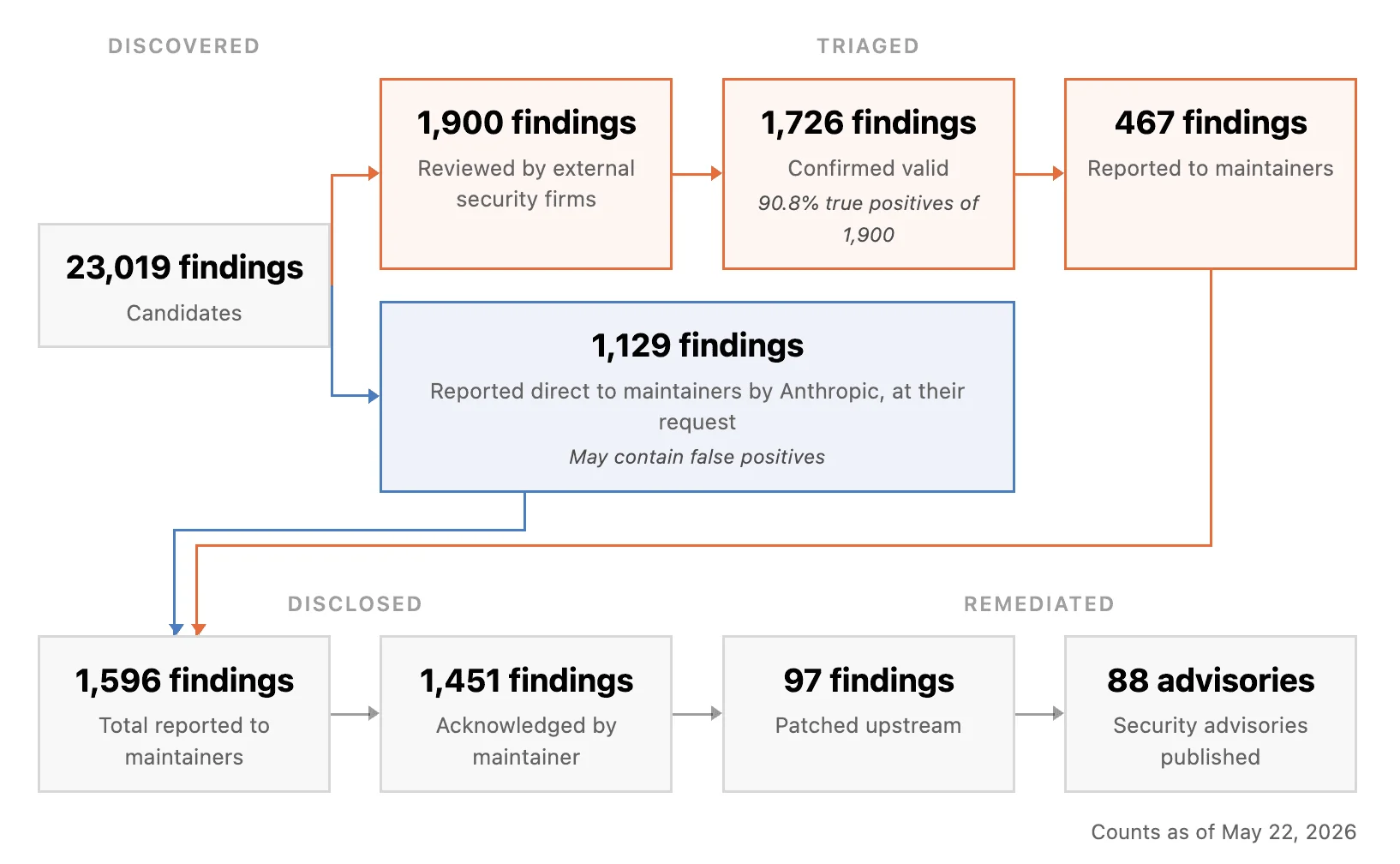
The second reason LLM vulnerability discovery collapses development schedules is that human triage processes, which determine 'where to start fixing' the discovered vulnerabilities, cannot keep up with the speed of automation. Anthropic's Project Glasswing clearly illustrates this. In this project, AI autonomously discovered over 10,000 high-risk vulnerabilities in a matter of weeks, but only 9.8% of total discoveries could ultimately be delivered to actual maintainers 3. Vulnerabilities recorded in the ledger accounted for just 10.5% of the total claims (26,153), and the final completion rate for fixes was a mere 0.8% (202 cases) 3.
There is also a significant discrepancy between the excessive expectations for the accuracy and severity assessments of vulnerabilities suggested by AI models and the actual field data. AI models evaluated 91.5% of vulnerabilities as 'Critical or High,' whereas the severity ratio agreed upon by actual maintainers was only 51.3% 3. In the case of curl founder Daniel Stenberg, a pattern emerged where only 1 out of 5 vulnerabilities reported by AI was actual, with many errors and non-security bugs included 3.
When vast amounts of vulnerability reports generated by AI are fed into development schedules without refinement, engineering teams consume existing operational resources dealing with false positives and non-security bugs. If subsequent data consistency issues arise, such as the mismatch between the number of upstream patches in AI ledger data (421) and actual main ledger records (202), developers are inevitably forced to slow down sprint speeds due to patch verification and duplicate report processing 3.
Building Validation Loop Infrastructure

AI agent-based vulnerability discovery is not solely a cause of release delays. If validation infrastructure to properly filter these findings is built in advance, development teams can maintain productivity while breaking through the limitations of traditional static analysis. The case of Anthropic's AI model Claude discovering 14 vulnerabilities in Mozilla Firefox proves this. These were found in a short period of two weeks, representing about 20% of all high-severity Firefox bugs fixed throughout 2025 4. It was recorded as a successful case in a real production environment, rather than a mere demonstration.
| Test Method | Characteristics | Depth/Context Awareness | Comparison with AI Agent-Based |
|---|---|---|---|
| Traditional Fuzzing | Broad scope | Shallow depth | Weak in detecting logic errors |
| Manual Review | High accuracy | Excellent context awareness | Very slow speed |
| Agent-Based Testing | Fast speed | Finds logic/state machine errors | Simultaneously secures speed + context 4 |
Comparison of security testing approaches
Traditional fuzzing, despite its broad scope, lacks depth and is prone to missing logic errors. In contrast, agent-based testing provides both the context awareness to identify attack surfaces like IPC boundaries or parser logic by analyzing source code and historical CVE data, and fast speed 4.
However, absorbing this into development schedules requires mandatory preparation periods. Due to moderate false positive rates, 'Validation Loop' infrastructure must be established to automatically verify whether actual crashes or violations occur by executing LLM-generated proof-of-concept (PoC) code in sandbox environments like AddressSanitizer (ASAN) 4. Tuning this false-positive filtering and severity scoring logic requires 2–4 weeks of resource investment in advance; without this preparation, the engineering team's speed will be bottlenecked by false positive handling 4. Reflecting resource investments during the initial calibration period in development schedules is key to the success or failure of AI adoption.
Reducing Vulnerability Response Time from Weeks to 48 Hours: Automated Triage Pipelines
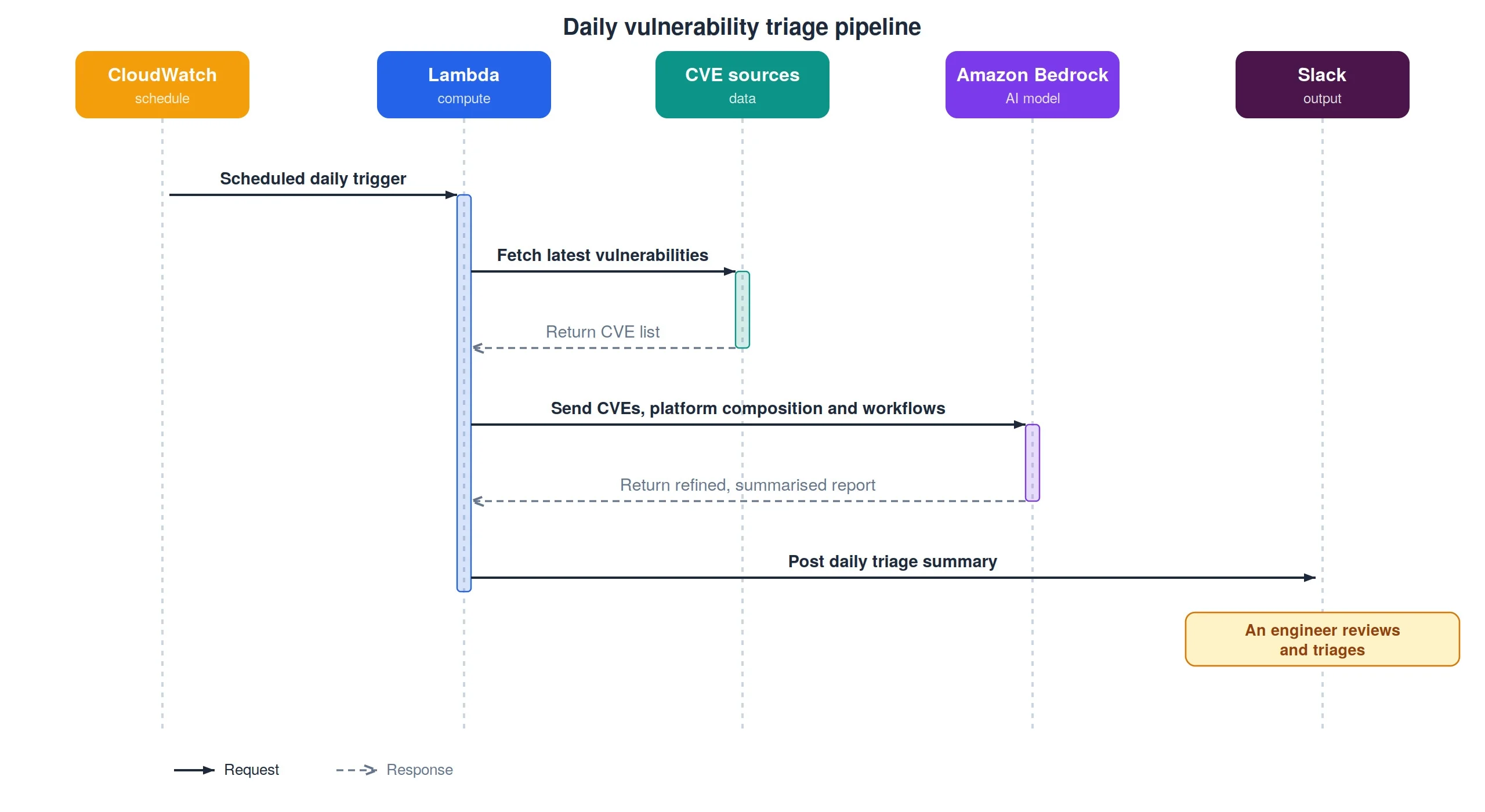
A practical strategy for maintaining development schedules is to build a pipeline that automatically converts LLM vulnerability reports into 'reproducible CI test code' rather than simple issue tickets. A mid-sized SaaS company's automation of an AI-based vulnerability triage pipeline demonstrates its effectiveness.
This pipeline was designed with eight stages: report intake, normalization and deduplication, risk scoring, CI/CD triggering, auto-fixing, and feedback loops. In particular, by implementing a deduplication stage using semantic embeddings and fingerprint hashing, duplicate reports were reduced by 65% 5. When calculating risk scores, factors such as asset criticality (30%) and exploit maturity (20%) are weighted alongside CVSS scores (35%) 5.
Once scores are generated, automatic routing that immediately impacts development schedules takes place. When Critical issues (85 points or higher) arise, hotfix tickets are generated immediately, and the CI/CD pipeline creates an vuln-{id} branch, injects failing test cases, and triggers SAST/DAST and dependency scans 5. Applying this workflow resulted in a significant reduction in the 'median fix time for Critical issues' from weeks prior to automation to 48–72 hours 5. This speed improvement was made possible by rules that restrict human review to only ambiguous or risky items, while using sandboxes and synthetic data for destructive tests 5.
Risk Management Framework for Sustainable Releases
The increasing speed of LLM vulnerability discovery is shaking the foundational premises of development: 'perfect defense' and 'stable releases.' Although AI can now find vulnerabilities and create exploits in 10–15 minutes, the reality that actual corporate patch cycles have stretched to 43 days indicates that human-centric legacy processes cannot cope with this new threat 1.
Engineering team leaders must reflect this new development rhythm in sprint and release schedules. First, to prepare for delays in new feature reviews due to surging backporting commits (e.g., PostgreSQL 19), a 'dedicated resource buffer for AI triage' must be secured in development schedules 2. Simultaneously, automated validation loops (ASAN, sandbox) must be integrated into CI/CD pipelines with a 2–4 week pre-tuning period 4. At this point, pipelines are required that compress the response time for Critical issues 'from months to 48–72 hours' by using a composite scoring system reflecting asset criticality and exploit maturity, rather than relying entirely on the scores suggested by AI for LLM-discovered vulnerabilities (91.5% rated Critical) 315.
References
- AI 보안 취약점 발견 속도, 기업 대응 시스템 추월... ‘안전 마진’ 붕괴 위기 · aeiai.net↩
- Postgres 19 is late, and it's AI's fault · rhaas.blogspot.com↩
- ↩
- ↩
- Automating Vulnerability Triage: Pipeline to Fixes · wecloud.pro↩



