Could AI models trained on different data represent the world in similar ways? The Platonic Representation Hypothesis (PRH), published in 2024, originated from the observation that as vision and language models scale up, their methods for measuring relationships between data converge. It is not a conclusion that all models already share the same representation, and the original paper also addresses limitations and counterexamples. 1
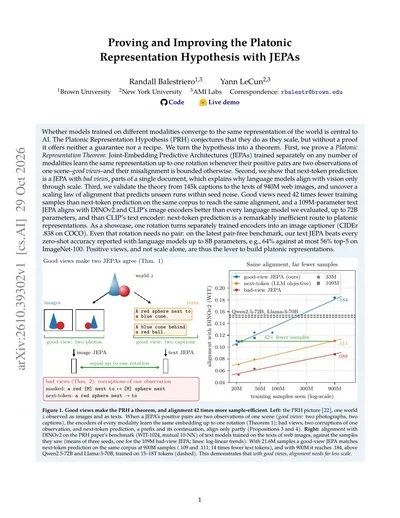
The follow-up paper by Randall Balestriero and Yann LeCun, released on October 29, 2026, analyzes this issue from the perspective of which observation pairs are used for training. The authors present a conditional theorem regarding JEPA and report experiments that reduced the number of training samples required to reach the same level of representation alignment. The figures below are reported values from the paper and the authors' repository, not results reproduced directly by this blog. 2 3
What JEPA Predicts
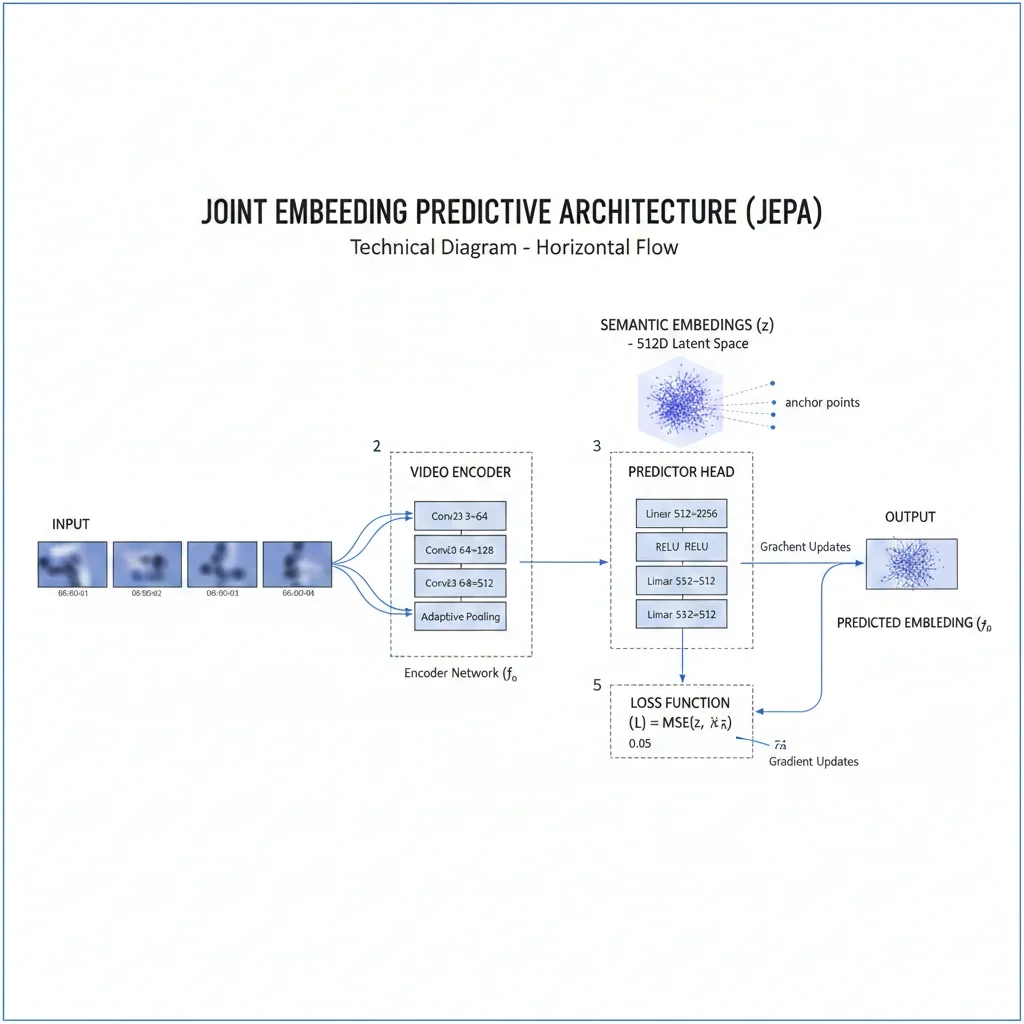
JEPA is a structure that predicts the representation of another observation from the representation of observed data. A key distinction in this study is between good views and bad views. Good views are two data samples that observe the same scene. The authors cite different captions for a single image or two photographs of a single scene as examples. 3
Conversely, pairs created by masking or cropping parts of an observation are classified as bad views in the paper. The authors also interpret next-token prediction from this perspective. Here, the term 'bad' refers to the efficiency of cross-modal representation alignment, not implying that language models generally have poor writing or coding performance. 2
From Hypothesis to Theorem: Conditions Must Be Read Together
The theorem in the follow-up paper addresses how the representations of JEPAs trained separately per modality become identical, except for rotational differences, under the good views condition. It analyzes the bounds of representation mismatch when conditions are not met. Therefore, it should not be interpreted as an unconditional proposition that 'any model eventually acquires identical internal representations.' 2
The authors' repository includes numerical verification of the theorem, training code, evaluation code, and procedures for reproducing the experiments. It is useful because it allows us to distinguish between the theoretical assumptions and the settings of actual experiments. 3
The Comparison Conditions Behind the 42x Fewer Samples Result
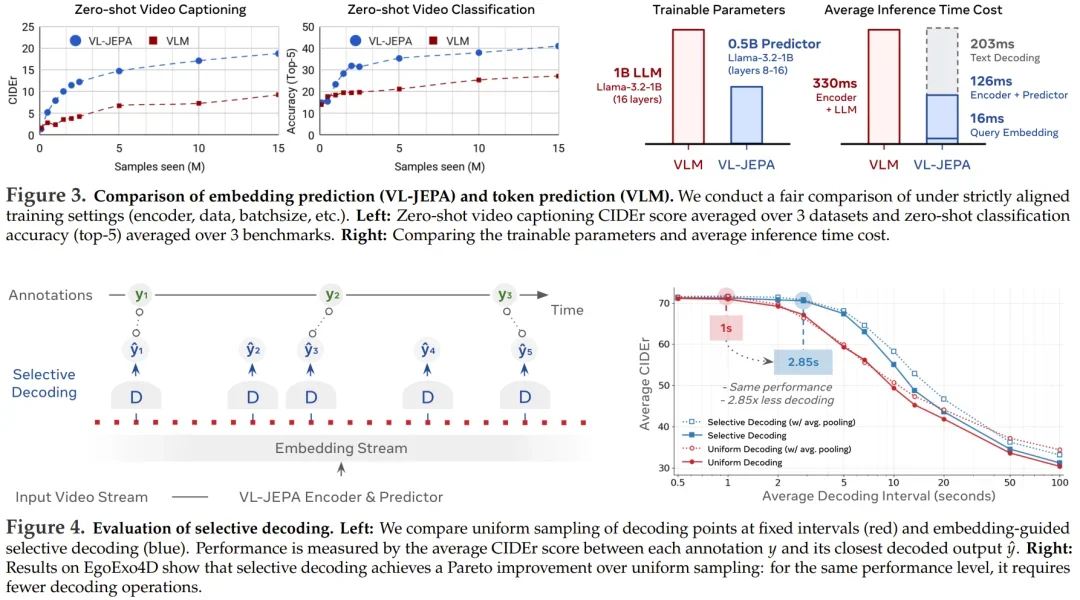
The 42x figure reported by the authors is a comparison of the number of samples required to reach the same alignment level with DINOv2, using the same 109M encoder and the same corpus. The good views method used 21.6M samples, while next-token prediction used 900M samples. This does not mean that the total training cost was reduced by 42x across all conditions. 3
In a separate WIT-1024 evaluation, the DINOv2-B alignment score of the 109M text JEPA was higher than that of the compared language models. 3
| Compared Model | Parameter Scale | Alignment Score with DINOv2-B |
|---|---|---|
| Text JEPA | 109M | 0.184 |
| Qwen2.5-72B | 72B | 0.154 |
| Llama-3-70B | 70B | 0.151 |
The metric in this table is representation alignment. It is not a comparison suggesting that a small JEPA replaces all capabilities of large LLMs. The repository explicitly states both the baseline results and lower scores from additional seeds with different normalization weights, so settings and seeds must be verified together when reproducing results. 3
Captioning and Pairless Alignment Must Be Distinguished
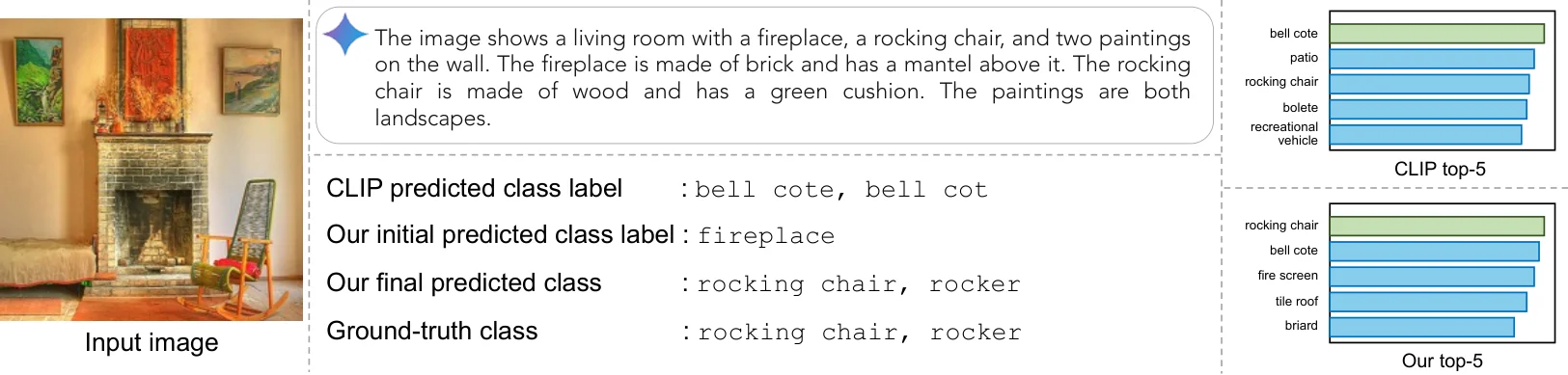
As an application case, the image captioner connects a separately trained image encoder and text representation space via a rotation map, and generates captions using a language model fine-tuned for text. The authors reported a CIDEr score of 0.838 on COCO. This captioner does not jointly train the neural network on image-caption pairs, but it uses pairs during the step of aligning the rotation map. 3
Separately, the paper includes experiments for a benchmark aligning without pairs. It reports approximately 64% top-5 accuracy on ImageNet-100, contrasting with up to 56% reported in comparison papers. Describing the captioner configuration and this evaluation together as 'requiring no pairs at all stages' changes the experimental conditions. 2
Design Variables to Examine Beyond Model Size
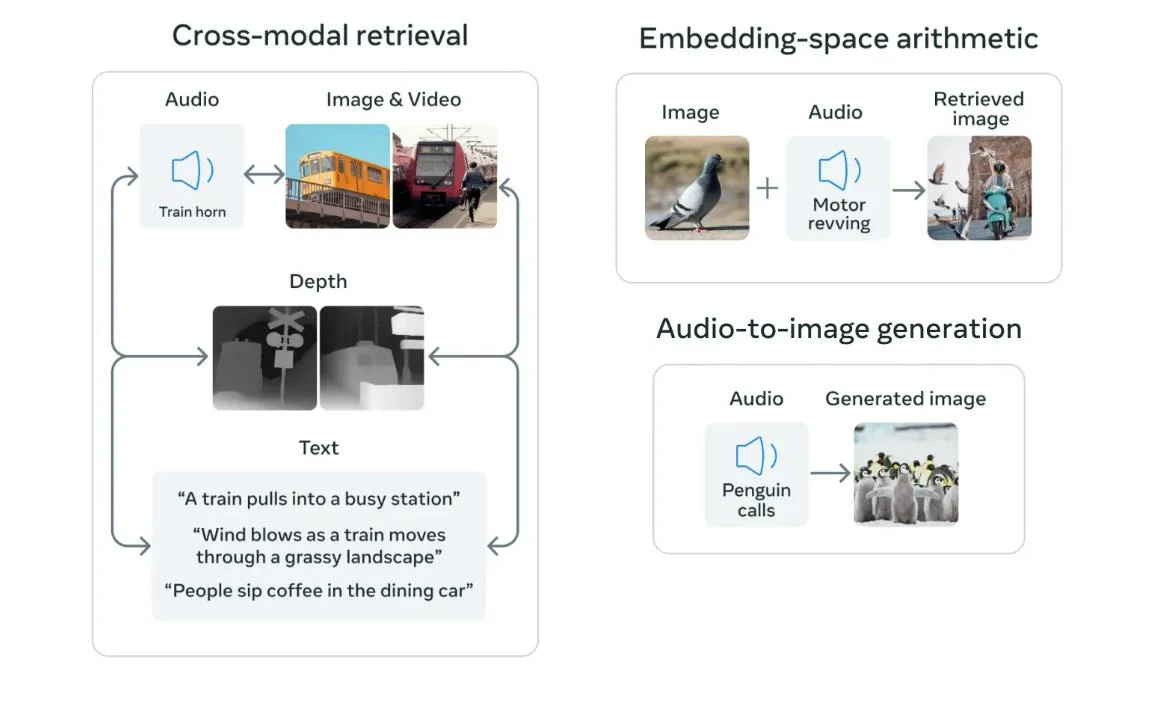
The question worth taking away from this study is simple: Before scaling up models, can we examine how well the two observations used for training share the same world state?
The open code separates procedures for experiments starting with small data and reproducing large-scale experiments. To verify directly, it is better to compare results by aligning the encoders, data, and evaluation metrics for the good views method and comparison methods. The core point is not a declaration that LLMs are being replaced immediately, but rather how crucial the configuration of observation pairs is as a design variable for the goal of representation alignment. 3
References
- The Platonic Representation Hypothesis (2024) · arxiv.org↩
- ↩
- 저자 코드·실험 결과·재현 절차: galilai-group/prh-proof · github.com↩