
"Were you staring blankly at the cursor on the screen while waiting for the AI to generate a response?"
When using Large Language Models (LLMs) like ChatGPT or Claude, you encounter what is known as the "typing effect," where the answer appears one character at a time. No matter how much technology has advanced, what we really want is a smooth and instantaneous response, much like a real-time conversation.
For developers and planners aiming to build enterprise-grade services, this "latency" is a critical issue that can determine the life or death of a service. This is because the user experience varies wildly depending on how many tokens are generated per second.
Today, May 29, 2026, we will take a deep dive into the innovative technology of Kog, which has emerged with the potential to instantly solve this chronic problem.
Why do LLMs make us wait?
The frustration we feel when using LLMs is not just a matter of perception. There is a clear technical bottleneck involved.
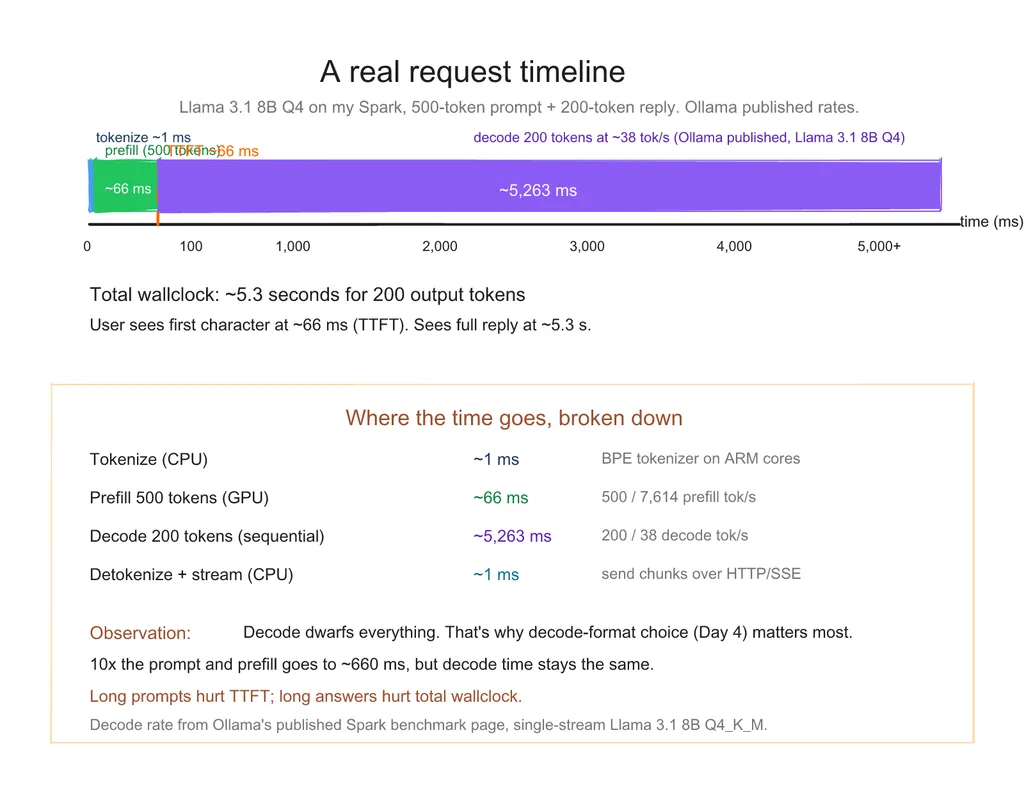
Typically, an LLM does not create a sentence all at once; instead, it generates word fragments called "tokens" one by one. This process is called the "token-generation loop." In traditional methods, every time this loop runs, data must be exchanged back and forth between the GPU and the memory.
It is like a situation where a very fast chef is cooking, but the assistant bringing the ingredients is too slow, leaving the chef standing idly with a knife in hand. The chef (GPU computing power) is fast enough, but the speed of delivering the ingredients (memory bandwidth) cannot keep up.
Furthermore, as the model size increases, this "ingredient delivery" burden grows exponentially. In 2026, we want smarter models, but we find ourselves trapped in a paradox where we must endure even longer waiting times.
Kog's Solution: Unify the Loop
In this context, Kog's announcement today is causing a massive stir in the industry. Instead of creating new specialized chips (ASICs) or bringing in expensive proprietary hardware, they solved this problem by leveraging the standard data center GPUs (such as NVIDIA H200) that we already possess.
The core of their solution is "completely confining the token generation loop within a single GPU context."
Shall we revisit the chef analogy? Kog's method is like placing all the ingredients on a large tray right next to the chef instead of asking the assistant to bring them every single time.
Specifically, they employed the following innovative software optimization techniques:
- Monokernel Deep Dive: Instead of splitting the computation process into tiny pieces, they bundle it into one massive execution unit, minimizing the overhead of data moving back and forth within the GPU.
- Delayed Tensor Parallelism: They intelligently adjust the order of data processing to find the optimal timing so that computing units can work without idle time.
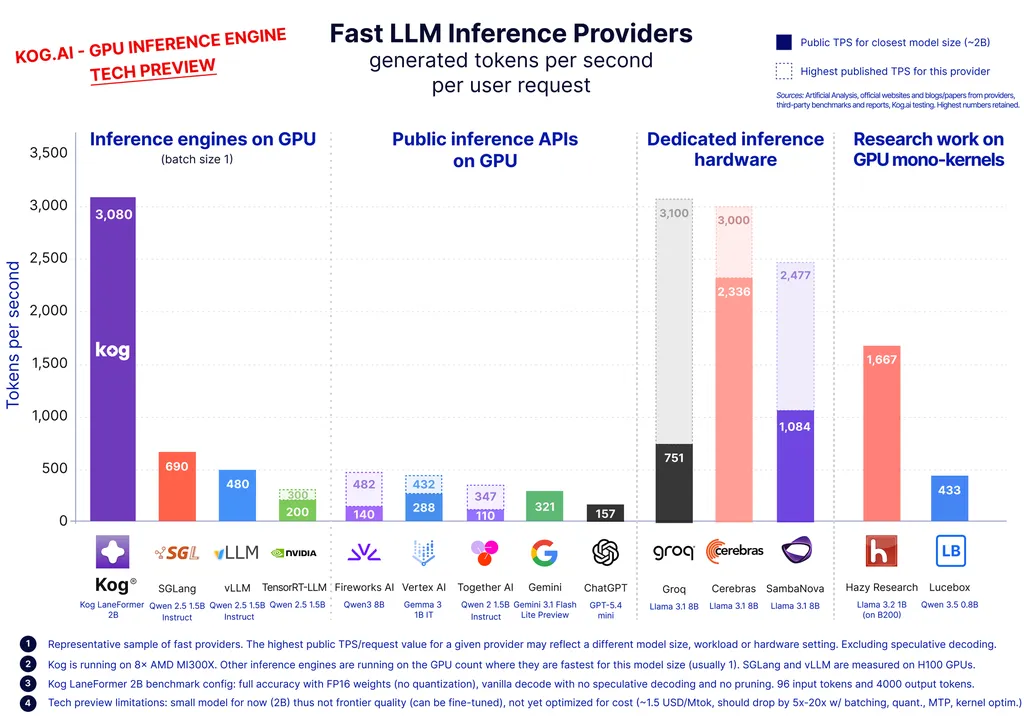
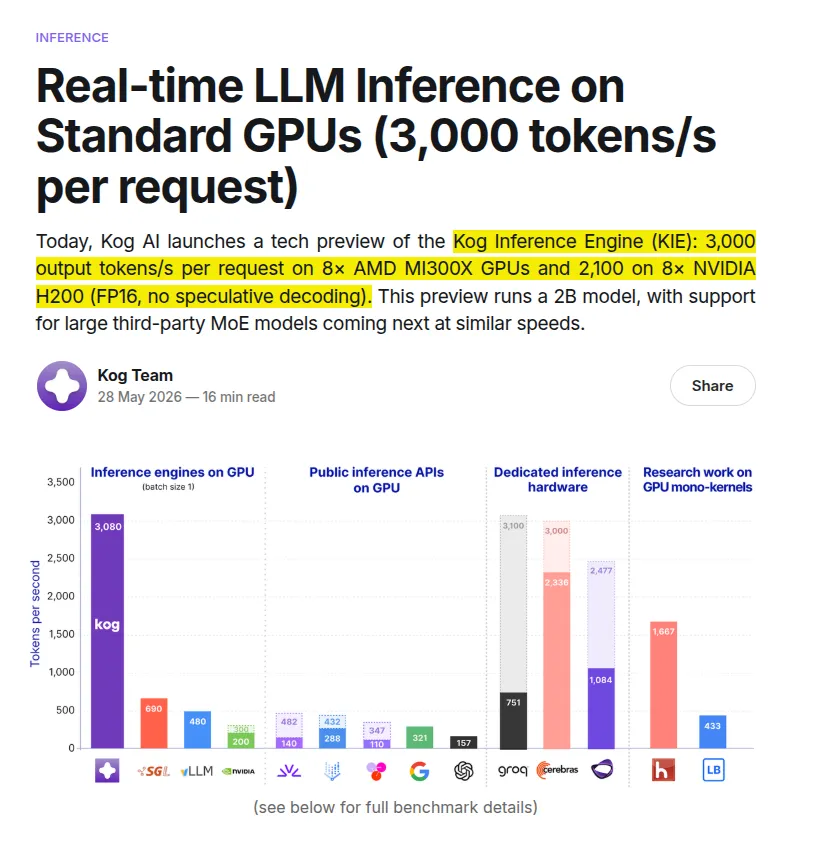
Through this technology, Kog achieved an astonishing speed of 3,000 tokens per second (3k tokens/s) per single request in an environment configured with 8 standard GPUs. This means real-time conversational AI can pour out answers much faster than the human reading speed.
Is everything rosy? A cold analysis and realistic limitations
Of course, every innovation comes with controversy and limitations. Even among experts, a heated debate is unfolding regarding this announcement. Before we accept this technology as an unconditional "cheat key," there are three points we must consider.
First is the issue of fairness in comparison. Since the model used in the initial tests was a very small 2B (2 billion parameter) model, doubts have been raised about whether this speed can be achieved with massive GPT-class models.
In response, Kog's developer, Gaeld, refuted this using mathematical reasoning. The logic is that even if the model size increases, memory occupancy can be maintained at a certain level by adjusting the precision. For example, if a model like GPT-OSS-120B is run with FP8 precision, the memory usage becomes similar to the small model tested, making it sufficiently scalable.
Second is hardware constraints. This achievement was accomplished using high-performance data center GPUs like the NVIDIA H200. On consumer-grade GPUs like the RTX series used at home, it may be difficult to fully enjoy this speed due to the limitations of memory bandwidth. In fact, some tests have reported speeds of around 500 tokens/s on high-end consumer GPUs.
Third is the trade-off between precision and performance. Another company, Taalas, showed an overwhelming figure of 15,000 tokens per second, but this was the result of using an extreme compression technique called 3-bit quantization. In other words, we must remember that we might have to sacrifice some of the model's "intelligence (precision)" for the sake of speed.

The Future of AI Services: An Era Where Anyone Can Use Real-Time AI
Nevertheless, the significance of Kog's achievement is by no means light. Most importantly, this technology works on "standard GPUs."
If we had to buy specialized chips worth billions of won every time we wanted to run an AI, AI technology would have remained the exclusive domain of giant corporations. However, an approach like Kog's, which maximizes existing infrastructure, accelerates the "democratization of AI technology."
Now, small and medium-sized enterprises or startups will be able to implement high-level services—such as financial counseling AI, real-time medical assistant AI, or low-latency game NPCs—using the server resources they already possess.
The AI market in 2026 is moving beyond "who is smarter" to a battle of "who can integrate it into actual services faster and more cheaply." It seems Kog has appeared in that battle wielding a powerful weapon.
Summary: A World Without Waiting
Let's summarize what we have covered today.
- Problem: Memory bandwidth bottlenecks occurring during the LLM token generation process cause response delays.
- Solution: Kog achieved a speed of 3,000 tokens per second by integrating the token generation loop into a single GPU context using optimization technology.
- Significance: The barrier to adopting AI is lowered as real-time AI services become possible even with standard GPUs without specialized hardware.
Technological advancement has always progressed between the question "Is this really possible?" and the counter-argument "Is this really practical?" It remains to be seen whether Kog's technology will become the standard for all AI services or remain a technology limited to specific uses.
How fast does an AI's response speed need to be for you to feel like you are having a "real conversation"? Please share your thoughts in the comments!
What do you think?
References
- Real-time LLM Inference on Standard GPUs: 3k tokens/s per request · news.ycombinator.com
- Kog · x.com