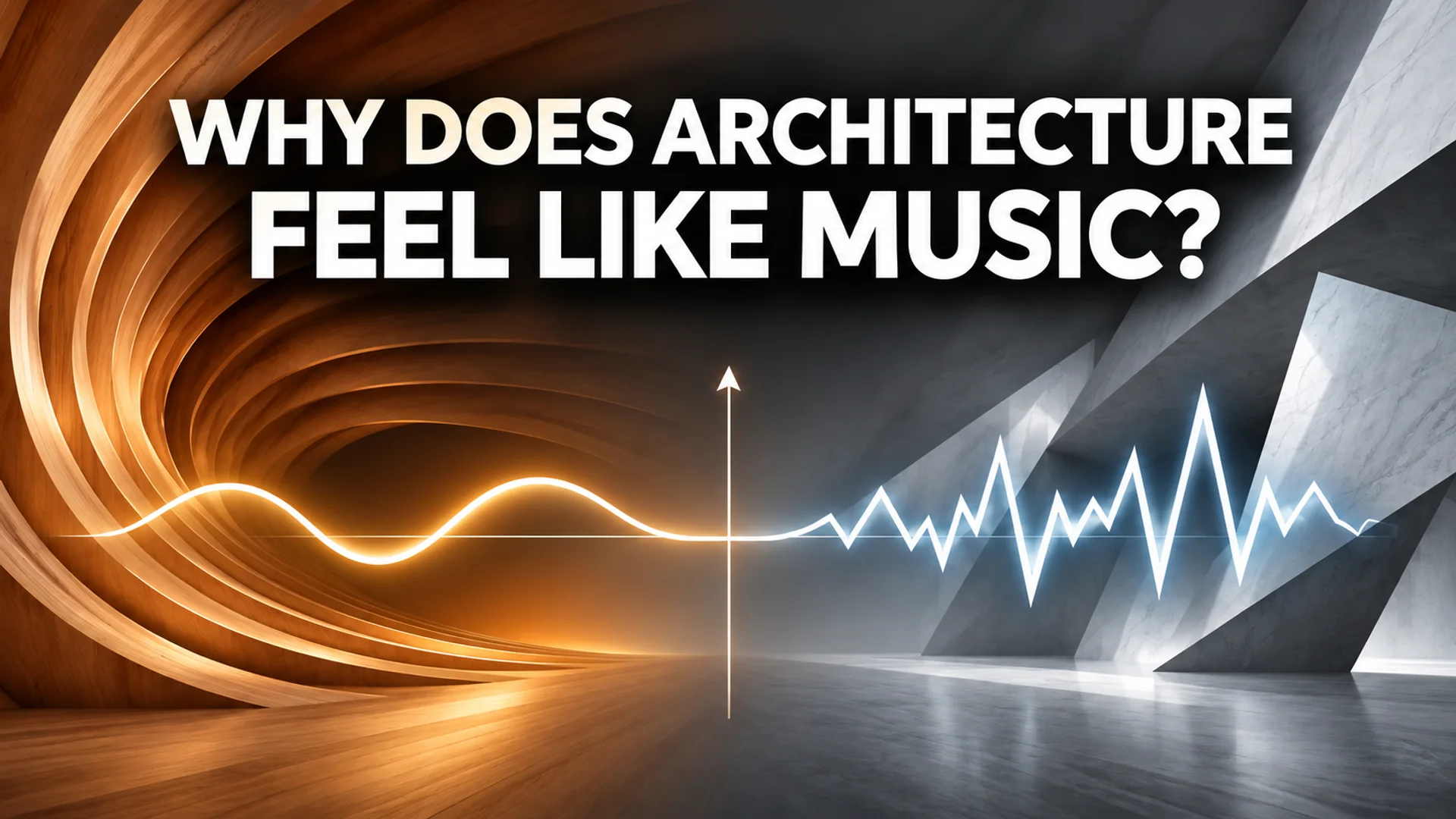
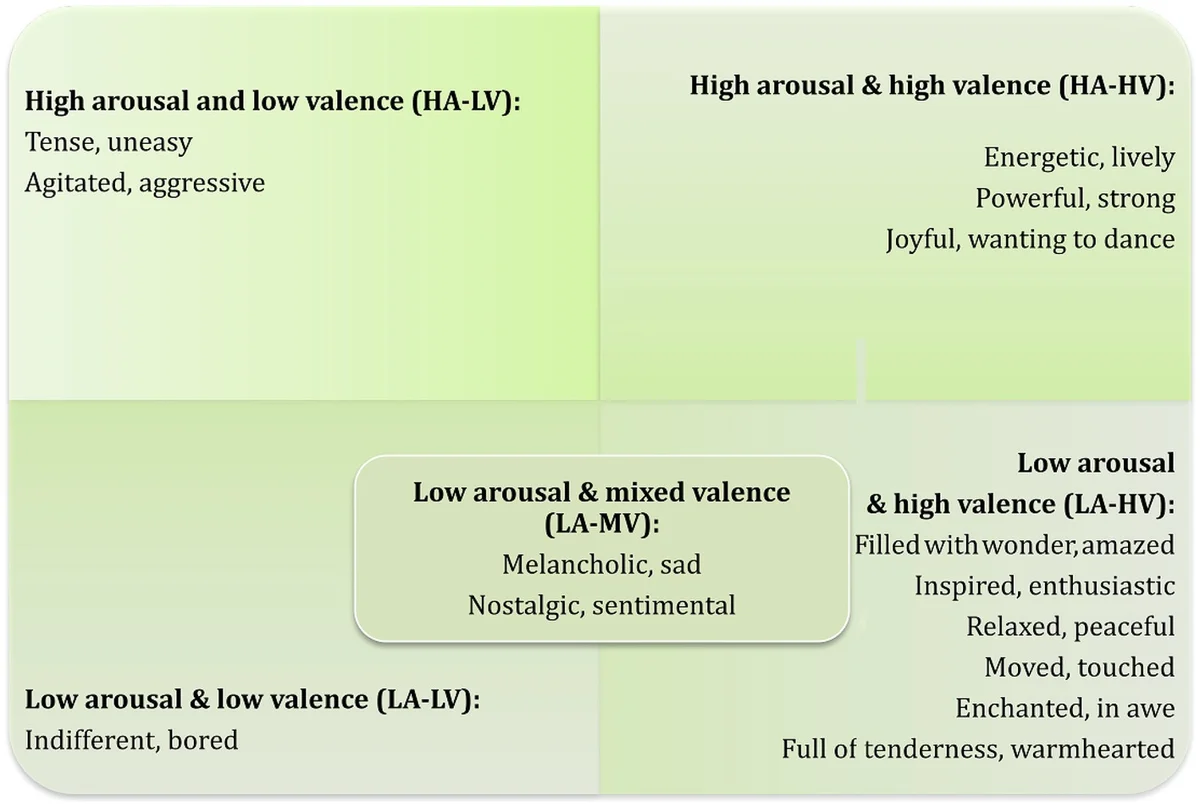
When asked to “choose an image or material that matches your mood” while listening to music, what do people select? A controlled experiment conducted by researcher teams led by Bruno Mesz and Sebastián Tedesco with 176 participants produced interesting results. Based on the visual forms and materials chosen after listening to music, the two basic emotional dimensions of valence (how pleasant a mood is) and arousal (how stimulating it is) were predicted more accurately than specific emotion names such as nostalgia or awe 1.
Participants who chose rounded lines and warm wood grain responded to music states characterized by relaxation and low arousal, while those who chose sharp angles and cold marble responded to music states characterized by tension or high, grand arousal 1. When architects select finish materials and decide on exterior forms, our brains interpret this visual information by connecting it to the emotional properties of sound. The reason spaces sound like music is not due to magical numbers or mysterious design secrets. It is because materials and forms evoke the same levels of valence and arousal as music within the brain.
How the Brain Translates the Senses
The phenomenon where different senses connect in specific ways is called ‘crossmodal correspondences.’ According to a discussion by researcher Marina Iosifyan’s team published in the journal Perception in 2022, such associations are a cognitive trait that appears very widely in the general population 2. This is distinct from ‘synesthesia,’ a neurological condition where senses physically blend. While synesthesia is a rare phenomenon occurring in approximately 4.4% of the population, crossmodal correspondences are a much more universal cognitive trait where individuals clearly recognize the boundaries between senses yet non-randomly link various stimuli; some neuroscientists consider this an essential part of human cognition 2.
The ways in which the brain connects vision and hearing are largely categorized into four types. Structural mediation occurs when the physical energy of different senses is processed into similar neural signals in the brain. This includes cases where the intensity of stimuli is perceived as related, such as loud sounds (high intensity) and bright light (high brightness). Statistical mediation occurs when properties that frequently coexist in everyday environments are learned and linked. A typical example is the environmental rule that small objects produce high-pitched sounds and large objects produce low-pitched sounds, which connects high pitch with small size 12. Semantic mediation involves the similarity of linguistic expressions, such as ‘sweetness,’ and emotional mediation occurs when the mood states induced by two stimuli are similar 12.
The phenomenon of music ‘sounding’ in architectural spaces primarily arises from an overlap of emotional mediation with structural and statistical mediation. The 2023 paper by Mesz’s research team experimentally verified that when participants chose visual forms and materials, they relied on the emotional dimensions of valence and arousal to align sound and visual information 1.

Emotional Curves Permeating Form and Material
By examining which elements of architectural space crossmodal correspondences operate on, we can concretely understand the principle of how spaces are perceived as music. In experiments by Mesz’s research team, morphological features such as curvature or angles were closely linked to levels of valence and arousal 1.
Soft curved forms tend to induce high levels of valence and stability, drawing the same emotional trajectory as music that feels calm due to low registers or slow tempos. In contrast, sharp vertices or complex lines induce tension or high arousal, connecting to music that stimulates arousal through fast, intense rhythms 1.
In the background of their study, Mesz’s research team discussed the role of materials used in concert halls, furniture, and natural environments in constituting multisensory experiences. As revealed in the title of their paper, they suggested that the emotional response evoked by cold marble can be associated with high arousal or negative valence 1. Conversely, visually warm materials are predicted to evoke lower arousal and positive valence. When we look at a specific building and feel it is “quiet like a calm cello melody,” it is because the form and materials stimulate the same levels of valence and arousal in the brain’s emotional circuits.
Architect Seo Hyun, in her book, explained that the points, lines, planes, and proportions that constitute a building give it a unique atmosphere of stability or intimidation, and that the arrangement of these basic elements connects to the attitude of ‘listening’ to architecture in a context similar to musical tuning 3. The emotional mediation mechanism shown by research results supports how such design principles by architects function in actual human cognitive processes 1.

The Myth of the Golden Ratio and the Original Meaning of Pythagoras
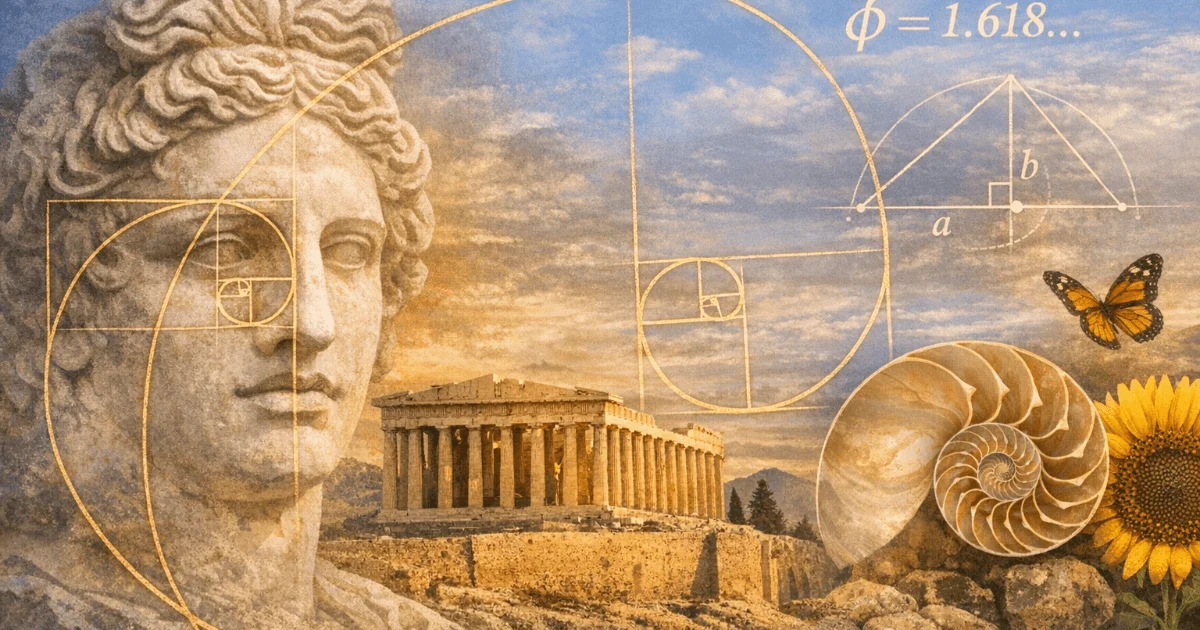
A common misconception when explaining the harmony of space and sound is the ‘golden ratio’ (1.618). Although the claim that the harmony of ancient Greek architecture and music was based on the golden ratio is widely prevalent, recent measurement studies do not support this.
According to a review paper published in 2024 and results from Cambridge Archaeological Journal, the claim that the Parthenon was designed based on the golden ratio is not confirmed by actual measurements 4. The golden ratio is not seen at all in classical Greek architecture, or is rarely confirmed in later cases, and the narrative that the golden ratio is a secret law of ancient art became popular after the mid-19th century 4.
The Pythagorean school discovered that the beautiful resonance of chords derives from the mathematical order of simple integer ratios (1:2, 2:3), such as halving a string producing an octave and reducing it to two-thirds producing a fifth 4. This philosophy of proportions regarding intervals and chords influenced architectural design as an attitude toward viewing the universe and the world 4. Therefore, the common denominator that has united music and architecture since ancient times is not a single magical number, but simple integer ratios and the harmonious rhythm derived from them.
Listening to Time in Space

The emotional connection of form and material, and the visual rhythm created by simple integer ratios, provide physical cues in space. When ‘temporality’ is added to this, the experience expands to the dimension of a musical narrative.
Professor Jo explains that this principle is involved in making us perceive the flow of time accumulated within a space as if it were our internal movement, stating that the emotion felt from old railings or artisan carvings is the product of such internal imitation 5. When this is combined with the emotional mediation mechanism of form and material confirmed by Mesz’s research team 1, the experience of a space’s physical cues ‘resonating’ like music is completed.
Ultimately, a space sounding like music is not due to mysterious ratios hidden within the space. It is because the lines, planes, and materials that make up a building vibrate at the same emotional frequency as sound within our brains. The reassurance provided by rounded lines, the tension provided by cold materials, and even the flow of time provided by worn stone steps are all translated into sound in the brain’s emotional circuits. Architecture and music are processes of the same tuning, flowing into human emotional circuits through different senses.
References
- Frontiers | Marble melancholy: using crossmodal correspondences of shapes, materials, and music to predict music-induced emotions · frontiersin.org↩
- Cross-modal associations between paintings and sounds: Effects of embodiment - PMC · pmc.ncbi.nlm.nih.gov↩
- [서평] 건축, 음악처럼 듣고 미술처럼 보다 : 인문적 건축이야기 - 서현 · m.blog.naver.com↩
- Why Are People Attracted to 1.618? Is the Parthenon Built on the Golden Ratio? The Truth Behind the Romance of Beauty and Mathematics · ukiyo-journal.com↩
- 감동은 공간이 아니라 시간이다 · times.postech.ac.kr↩