
On October 28, 2026, the Economic Ministers’ Meeting—the government’s central command post for economic policy—and the Science and Technology Ministers’ Meeting—the core body for science and technology policy—were held in a joint session for the first time 1, 2. The meeting, held at the Government Complex Seoul, was jointly chaired by Deputy Prime Minister and Minister of Economy and Finance Lee Hyung-il and Deputy Prime Minister and Minister of Science and ICT Bae Kyung-hoon 1, 2. This is viewed as explicitly reflecting the government’s policy direction to operate technological innovation and economic and industrial policies as a single integrated system in line with the era of the great AI transformation.
The meeting discussed major agenda items spanning both livelihoods and growth, ranging from a plan to revamp the retirement pension system to the “7 SEED Projects” for future growth engines. This article outlines the background of the joint holding of the two ministers’ meetings, the main agenda items, and the future policy direction.
Why Were the Two Meetings Held Jointly?
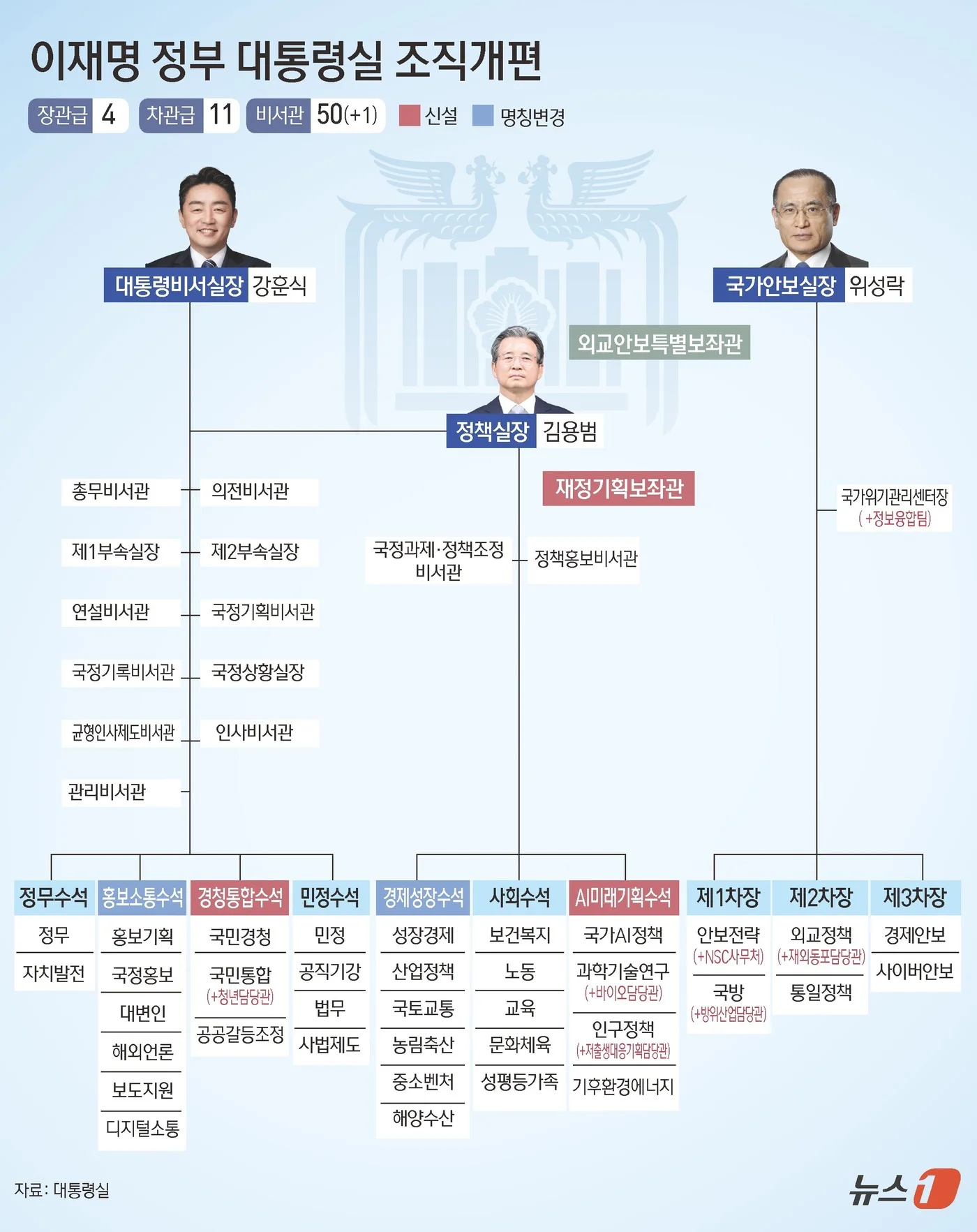
This joint meeting is the first instance where the Science and Technology Ministers’ Meeting was held together with the Economic Ministers’ Meeting since the former’s launch in November of last year 1, 2. This structural change aligns with the shift in the policy environment, which gained momentum with the reinstatement of the Deputy Prime Minister for Science and Technology under the Lee Jae-myung administration 3. Effective October 1, 2025, the Minister of Science and ICT began serving concurrently as Deputy Prime Minister, and the incumbent Deputy Prime Minister for Science and Technology, Minister Bae Kyung-hoon, was appointed 3. Meanwhile, Deputy Prime Minister and Minister of Economy and Finance Lee Hyung-il took office on September 22, 2026, meaning the two Deputy Prime Ministers have been serving as official policy partners in the current framework only since then 3.
In his opening remarks, Deputy Prime Minister Lee Hyung-il emphasized that “the driving force behind our economic growth is scientific and technological innovation,” and stressed that economic policy and science and technology policy must move in unison as a “single body,” spanning from fundamental technology R&D to demonstration and commercialization, and onward to the cultivation of new industries 1, 2. Unlike in the past, this marks the establishment of a system in which the two Deputy Prime Ministers collaborate directly to reduce policy discrepancies and enhance coherence.
Deputy Prime Minister Lee also explicitly stated that the ultimate goal of achieving growth is “the improvement of people’s lives.” He outlined the plan to concentrate whole-government efforts to mitigate potential polarization between industries, regions, and generations amidst the vast changes brought about by the great AI transformation, emphasizing that science and technology policy must lead to balanced national growth 1, 2.
Retirement Pension Reform and Social Policies That Directly Impact Livelihoods
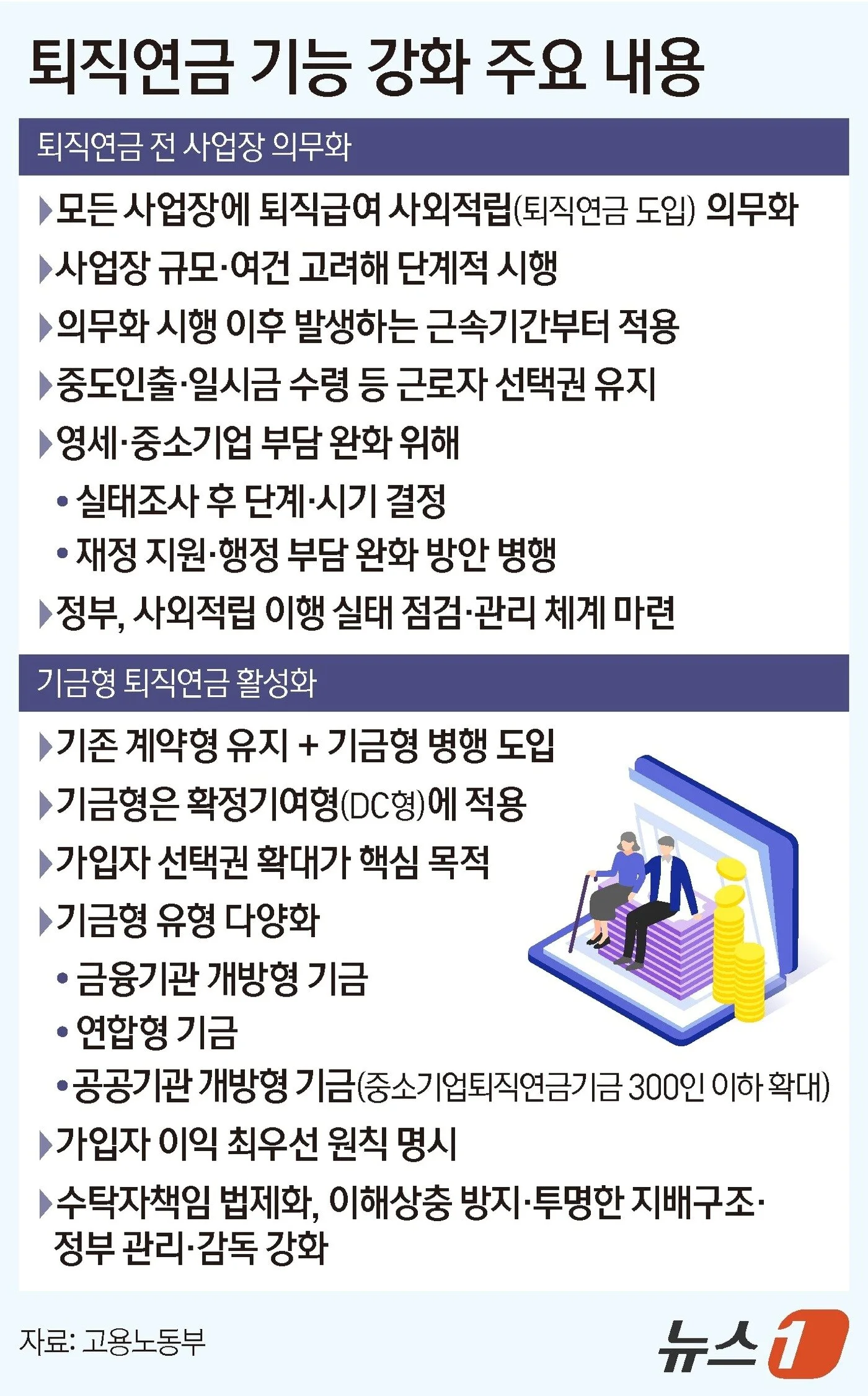
Amid discussions on macroeconomic and future technology, the agenda item expected to have the most tangible impact on livelihoods was the “Plan to Strengthen the Role of Retirement Pensions.” Through the overhaul plan jointly devised by labor, business, and the government, the government is pushing for structural changes, such as the gradual mandatory requirement for off-site reserves of retirement benefits and the introduction of fund-based retirement pensions 1, 2.
The core contents are as follows 1, 2.
| Category | Key Changes | Remarks |
|---|---|---|
| Mandatory Off-Site Reserves | Gradual mandatory requirement for workplaces with 100 or more employees starting in 2028 | Aimed at preventing unpaid retirement benefits and protecting assets |
| Introduction of Fund-Based System | Pushing for transition to fund-based retirement pensions similar to the National Pension Service | Enhancing returns through professional asset management and protecting beneficiaries’ rights |
| Management and Supervision | Establishing a collaborative system between the Ministry of Employment and Labor and financial authorities | Securing expertise and stability in authorization, management, and supervision |
| Evaluation Criteria | Reforming business operator evaluations to focus on pension performance and returns | Inducing competition among operators on returns |
| Default Option | Advancing the application timing to protect workers’ rights | Strengthening the default investment system |
The core of this overhaul is the push to shift the current retirement pension system—where individuals enter into individual contracts with financial firms—to a “fund-based” model, which pools assets into one large fund for professional management, similar to the National Pension Service 2. This is interpreted as an effort to enhance returns while strictly stipulating fiduciary duties to protect workers’ rights as beneficiaries. Detailed specific plans are scheduled for final announcement following a ruling party-government consultation on the 29th 1, 2.
Additionally, the government focused on reviving the livelihood economy by discussing measures to concretize the “3 Core Social Policies” linking housing, jobs, and inclusive finance, as well as plans to swiftly advance the 9th project of the Regional Development Investment Fund 1, 2.
The ‘7 SEED Projects’ and the Frontier Board
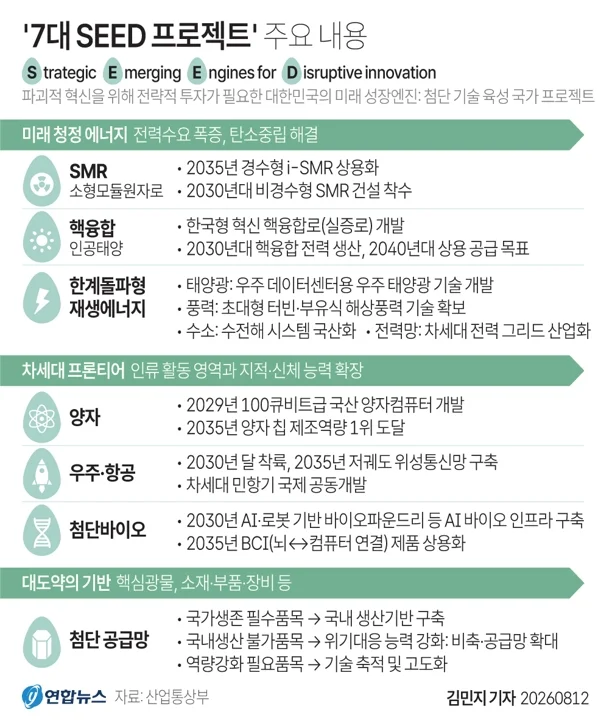
The core pillar of science and technology policy was the “7 SEED Projects.” The SEED Projects are a whole-of-government collaborative initiative centered on seven key future advanced technologies, including space, quantum technology, small modular reactors (SMRs), and nuclear fusion 1, 2.
In his opening remarks, Deputy Prime Minister Bae Kyung-hoon noted that South Korea is included in the top tier of AI leading nations and is highly regarded internationally, ranking first in Asia and fourth in the world in the Global Innovation Index for two consecutive years 1, 2. Based on these achievements, the plan is to secure key future technologies through the 7 SEED Projects.
To this end, the government decided to establish a promotion system that strategically links ministry-specific projects and investments around core missions, moving away from a project-centric approach 1. It also plans to establish the “Frontier Board,” a public-private collaborative platform, to strengthen inter-ministerial cooperation from technology development to demonstration and industrialization, jointly resolving key preconditions such as regulations and permits 1. The government plans to formulate detailed sector-specific implementation strategies within the year and launch full-scale investment and cultivation starting next year, which is read as an intention to provide concentrated government support to the process where technological development leads to commercialization 1, 4, 2.
Major Overhaul of Administrative Systems to AI and Cloud-Based Infrastructures
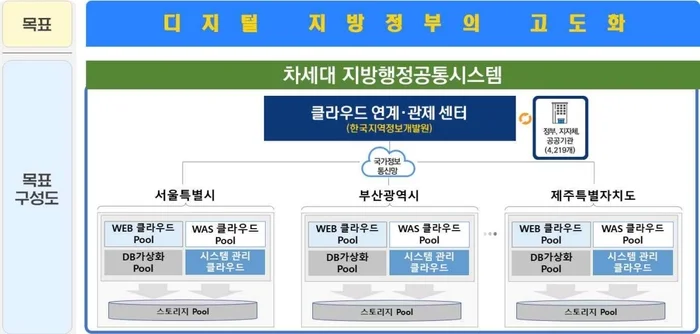
A notable feature is that science and technology policy encompasses not only R&D support but also the modernization of administrative infrastructure. In this meeting, the “Plan for Building the Next-Generation Common Local Administrative System” was a key agenda item, aiming to transform the aging common local administrative system into an AI and cloud-based infrastructure 1, 2.
This work aims to establish a foundation for processing administrative data in real-time on the cloud and enabling AI analysis, expected to enhance the speed and accuracy of local government civil service processing. The discussion of the Ministry of Oceans and Fisheries’ “AX (AI Transformation) Strategy” is in the same context, representing an attempt to integrate AI technology into traditional ocean and fisheries industries to maximize efficiency and create new value-added outcomes 1, 2.
The Intersection of Boosting Economic Growth and Future Growth Engines
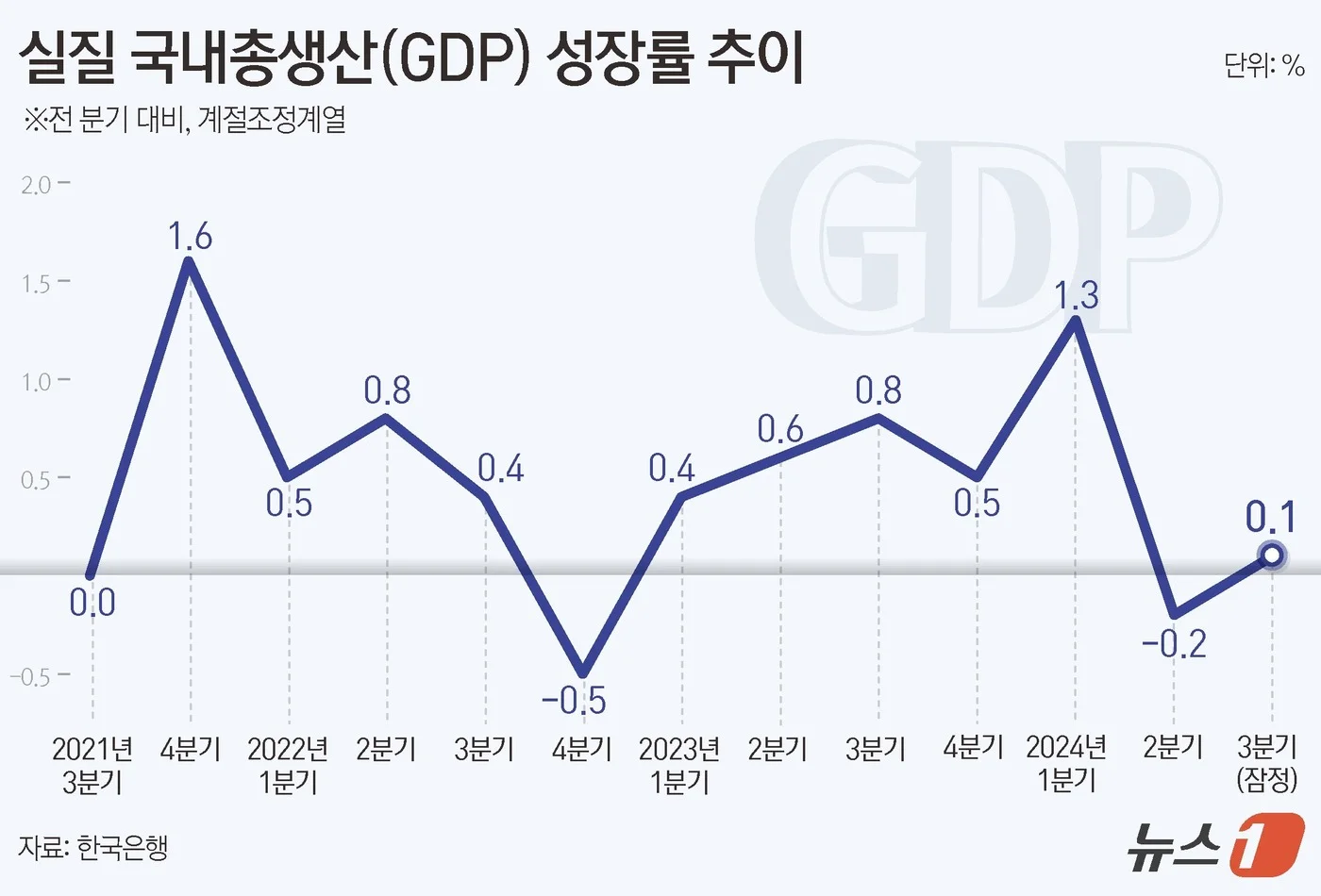
The meeting also shared assessments of the current economic situation. Deputy Prime Minister Lee Hyung-il mentioned that the Bank of Korea reported that the real GDP growth rate for the third quarter exceeded expectations at 1.0%, assessing that this makes mid-3% growth possible for this year and brings South Korea one step closer to achieving a per capita national income of $40,000 1, 2, 5. Such positive assessments suggest that science and technology policy has secured the investment capacity to drive future growth, forming the foundation for policy legitimacy.
In this context, Deputy Prime Minister Bae Kyung-hoon also called for accelerating the nation’s AI transformation 1, 2. In an era where technology is competitiveness, economic policy must support technology development through bold investment and regulatory innovation, while science and technology policy must deliver results in return. This joint meeting has begun to institutionally guarantee this interaction.
Checking responses to external uncertainties such as the Middle East war, and market stabilization measures such as ending the notice banning the hoarding of urea solution and syringes, were also on the meeting’s agenda 1, 2. This joint meeting is close to the government’s declaration to move forward with the two wheels of economy and science as a single entity. Attention will be focused on whether the two-track strategy of strengthening retirement assets through pension reform and creating new growth through the 7 SEED Projects can translate into actual results.
References
- 이형일 "성장 목표는 국민 삶 개선…양극화 완화에 역량 집중" | 연합뉴스 · yna.co.kr↩
- 2028년부터 100인이상 사업장 퇴직급여 사외적립 단계적 의무화 | 뉴시스 · newsis.com↩
- 대한민국 부총리 - 나무위키 · namu.wiki↩
- Google 뉴스 - 개요 · news.google.com↩
- ↩