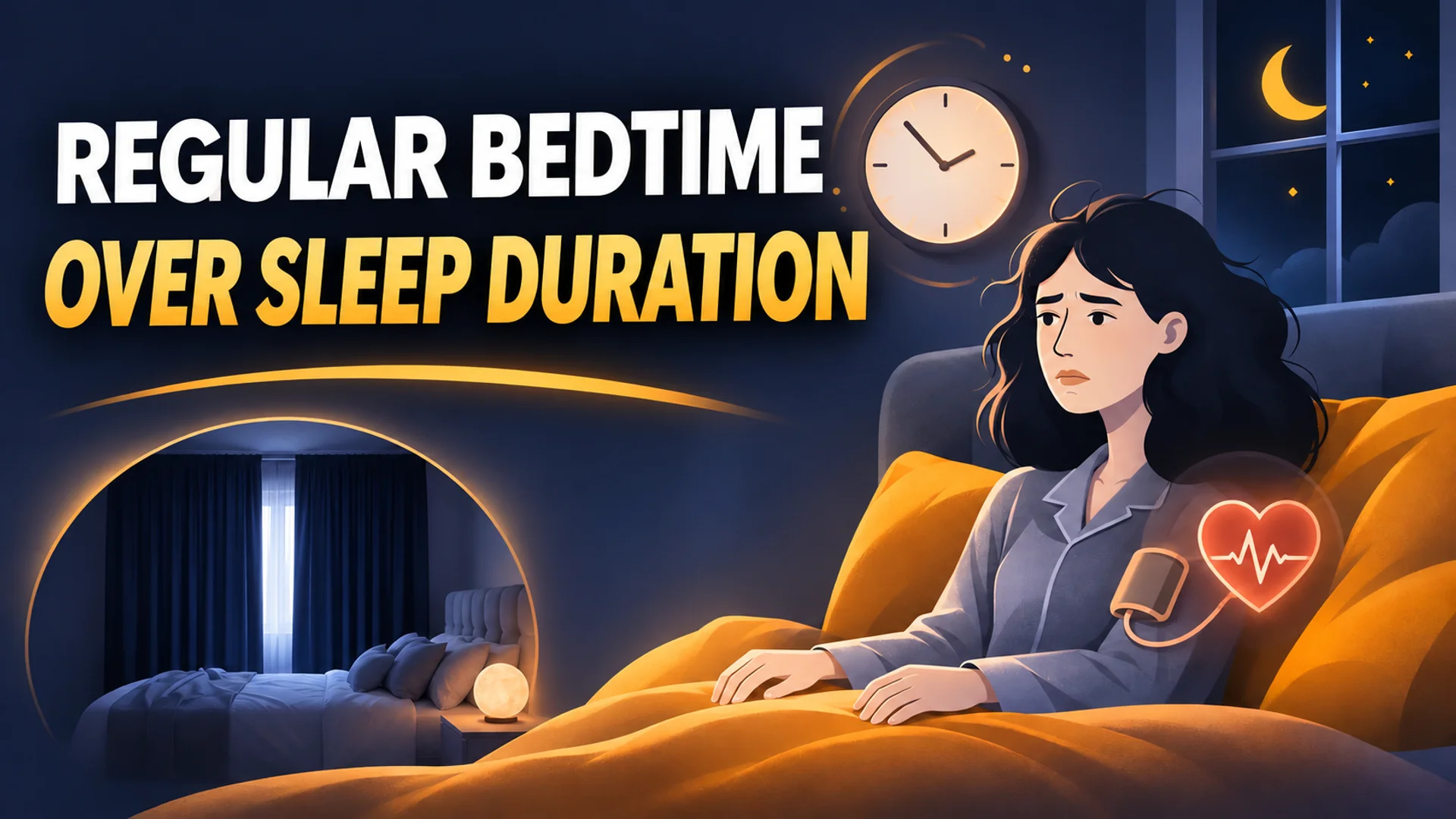
If you have met the target of “7 to 8 hours” of sleep, it is easy to believe your heart is safe. However, recent research suggests that the regularity of the ‘time’ you fall asleep and wake up may be a more important variable than the ‘total amount’ of sleep in predicting heart health. The American Heart Association (AHA) also emphasized in its latest 2025 statement that regularity and timing should be managed alongside sleep duration for cardiometabolic health 1. When the time you go to bed each day fluctuates by several hours, blood pressure does not drop normally overnight, and inflammatory markers rise, increasing cardiovascular risk. This is a problem caused by misalignment of the body’s internal clock, distinct from ‘sleep deprivation.’
Timing Variability Increases Mortality Risk
We often focus solely on how much we have slept. However, research results have emerged showing that ‘sleep regularity’ predicts mortality risk more strongly than sleep duration. A 2024 study published in the journal Sleep, which analyzed over 60,000 individuals, confirmed that the regularity of going to bed and waking up at the same time was more powerful than total sleep time in predicting all-cause mortality and cardiometabolic health 2. According to this guide, the mortality risk for individuals with irregular sleep habits was reported to be 20-48% higher compared to those with consistent sleep times 2. In other words, the disruption of biological rhythms due to night shifts or oversleeping itself acts as an independent risk factor.
The Sympathetic Nervous System Does Not Rest at Night

Why is irregularity in timing harmful to the heart? The core issue is ‘circadian misalignment.’ Humans activate the parasympathetic nervous system, which calms the body, when resting in darkness, leading to lower blood pressure and vascular recovery. However, when the circadian clock is misaligned, the body remains under the dominance of the sympathetic nervous system, a ‘state of emergency response,’ even at night 1.
If this state persists, blood pressure rises, and chronic inflammatory markers increase. Stress hormones increase, and damage occurs to the vascular endothelium (the inner lining of blood vessels), raising the risk of atherosclerosis 3. Particularly dangerous is ‘Nondipping.’ In normal sleep, blood pressure drops overnight, but when the circadian clock is disrupted, this descending pattern disappears. Research published in the American Heart Association journal indicates that people with nondipping, where blood pressure does not fall at night, have approximately twice the risk of myocardial infarction and stroke compared to the general population 4.
Changes in Blood Pressure and Inflammation in Just 8 Days
Physical responses caused by circadian misalignment appear in just days, not years. In an experiment summarized by the US sleep specialist site Sleephealth.org, 14 healthy adults were housed for two weeks under controlled light and dark conditions. For the first 8 days, they maintained a normal rhythm by staying in a dark room from 11 PM to 7 AM. However, for the next 8 days, the light-dark cycle was reversed by 12 hours 1.
It should be noted that this is a controlled laboratory result rather than an individual case, but the outcome was clear. When only the ‘timing’ of sleep was forcibly shifted, rather than the duration, 24-hour average blood pressure rose in healthy adults within 8 days. Additionally, the ‘dipping’ phenomenon, where blood pressure drops during sleep, disappeared, and inflammatory markers increased. This case demonstrates that cardiovascular indicators can change on a weekly basis in people without underlying conditions if sleep timing is unstable.
Three Principles for Protecting Your Heart

To lower risk by correcting irregular sleep timing, attention should be paid to the following three habits.
1. Fix Bedtime and Wake-up Times The most direct way to increase sleep regularity is to establish a routine. It is advisable to reduce electronic device usage one hour before bed and calm the sympathetic nervous system through meditation or deep breathing 2, 4.
2. Maintain a Dark Sleep Environment The circadian clock is sensitive to light. Using blackout curtains or a sleep mask to make the room as dark as possible facilitates melatonin secretion, aiding its natural role as a sleep-inducing hormone 2.
3. Limit Afternoon Caffeine and Check Blood Pressure Caffeine intake should be avoided after 3 PM to prevent increases in heart rate. Also, if you have a history of hypertension or experience severe snoring or daytime sleepiness, it is advisable to use a home blood pressure monitor to check if blood pressure drops properly overnight (checking for dipping) 4.
In conclusion, even if you have slept for 8 hours, if the time you fall asleep fluctuates by several hours each day, your heart and blood vessels cannot escape the ‘state of emergency’ overnight. Large-scale cohort studies from 2024 and controlled experiments suggest that maintaining a ‘consistent start time,’ in addition to managing sleep duration, has an immediate and independent effect on reducing cardiovascular risk.
References
- Heart And Blood Vessel Conditions - Sleephealth.org · sleephealth.org↩
- 더 나은 건강을 위한 최고의 결심: 의사를 위한 가이드 | 웰니스 허브 · au.iherb.com↩
- Circadian Dysregulation in Obesity: Unravelling Its Impact on Cardiovascular Risk and Therapeutic Strategies · chronobiologyinmedicine.org↩
- 수면 중 심장마비: 예방법은 무엇일까요? · vietnam.vn↩