Let us suppose we have a CG rendering that is impeccably clean on screen, perfectly handling 3D modeling, texturing, and lighting. Even so, when composited into a live-action background, it often leaves an impression of looking "unnatural." The problem is not a lack of resolution or detail. According to a guide by Animost, a VFX compositing studio, artists intentionally re-add elements such as film grain, lens distortion, and chromatic aberration in the final stage of compositing 1. In other words, making CG appear realistic is less about removing flaws and more about artificially restoring the physical traces that exist only in filmed footage.
The core principle distinguishing animation or CG from live action is not the precision of object detailing, but the presence or absence of the physical traces left by cameras and light. Images passing through a real lens record motion blur, subtle sensor noise, and optical distortion. In contrast, CG rendered from scratch in a computer is created without these imperfections. Consequently, excessive sharpness can betray a state that is "non-physical."
Sharp Frames Where Motion Blur Vanished
When a moving object is filmed with a real camera, an afterimage appears along the object's edges. This is called motion blur. While the camera shutter is open (for example, for 1/50 of a second), if the object moves, the point where light hits the sensor constantly shifts, recording a smear-like trail along the path of motion.
CG rendering calculates every pixel in a single frame. Because the rendering engine precisely captures a specific 'moment,' the temporal blur caused by the camera's shutter speed is not automatically included. As a result, all object edges are drawn sharp as a blade. Animost clearly points this out, stating, "Without motion blur, CGI looks fake" 1. When a digital character looks sharp as if filmed with a super-fast shutter speed of 0 seconds, human visual perception detects this dissonance as conflicting with the physical laws of the real world.
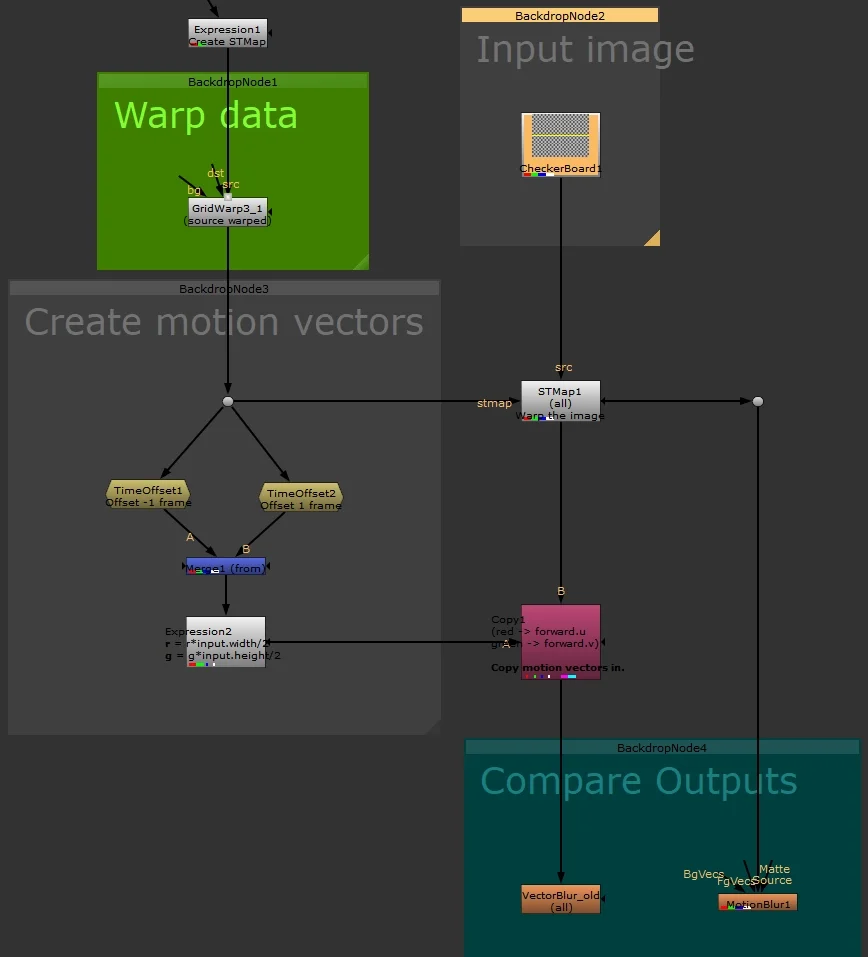
Handling motion blur in compositing is not simply a matter of applying a blur effect. According to Animost’s workflow, compositors use Z-depth (depth information) to create depth of field (DOF) or fog effects, thereby preserving a sense of space. Separately, they use motion vectors data to calculate and apply vector-based motion blur or 3D camera blur 1. This means layering the restoration of depth and motion to recreate the traces of time and space left by a moving real camera.
Color Temperature and Light Wrap: Making Elements Coexist in the Same Air
The traces left by cameras are not limited to motion blur. To blend CG and live-action elements into a single world, compositors must ensure physical consistency across several stages.
| Compositing stage | Physical phenomenon emulated | Main techniques |
|---|---|---|
| Color grading | Color temperature and exposure of on-site lights | Color temperature matching, grading |
| Environmental interaction | Shadows and reflections around the subject | Contact shadows, light wrap |
| Depth representation | Lens focal characteristics and depth of field | Z-depth based DOF |
| Final finishing | Film noise and optical distortion | Grain, bloom, chromatic aberration |
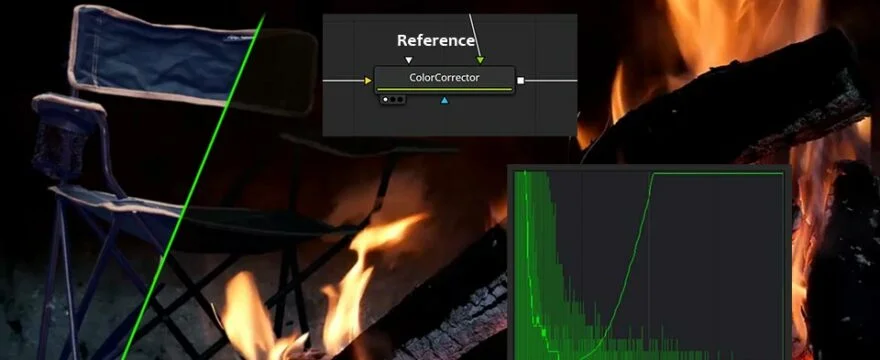
The most common cue is color temperature mismatch. Animost explicitly states, "A warm 4000K light does not blend with a cool 6500K light" 1. Imagine a scene in a room mixing warm incandescent and cool fluorescent lights, where only the specific subject seems to float in a different color. Our eyes perceive these subtle inconsistencies as an impression that objects are not actually placed in the same space.
Additionally, a technique known as 'light wrap' slightly wraps the background light around the edges of the CG subject, allowing the CG element to blend naturally into the live-action plate 1. Digital characters whose interactions with shadows, reflections, and atmospheric effects are not calculated consistently appear separated from the background, looking overlaid on the screen.
According to Mimic Productions, CGI refers to the computer-generated image elements themselves, while VFX is the comprehensive process of integrating these elements into the original filmed footage to create a complete shot 2. The studio explains that the final credibility of a digital character is determined by the entire process from modeling and texturing to lighting and compositing, particularly by physically plausible lighting, measured references, and a well-designed deformation system 2.
Residual Gaps in Physical Interaction

Motion blur and chromatic aberration can be calculated and applied via software. However, the reason live-action filming and special effects (SFX) are still deemed important lies in the difficulty of replicating more fundamental physics. Mimic Productions states that real debris falls "differently," and real smoke scatters light with "natural complexity," explaining that digital work "often tries to emulate" these effects, yet gaps remain in weight, texture, and the behavior of light 2.
The key point lies in the expression 'tries to.' While CG simulation technology has advanced, it cannot be definitively stated that it has completely replaced the complex reflections or subtle gravity responses of actual materials filmed on location. In particular, on-location practical effects retain a unique value that distinguishes them from digital compositing, as they capture the natural reactions of actors.
Principles of Judgment Supported by Cognitive Research
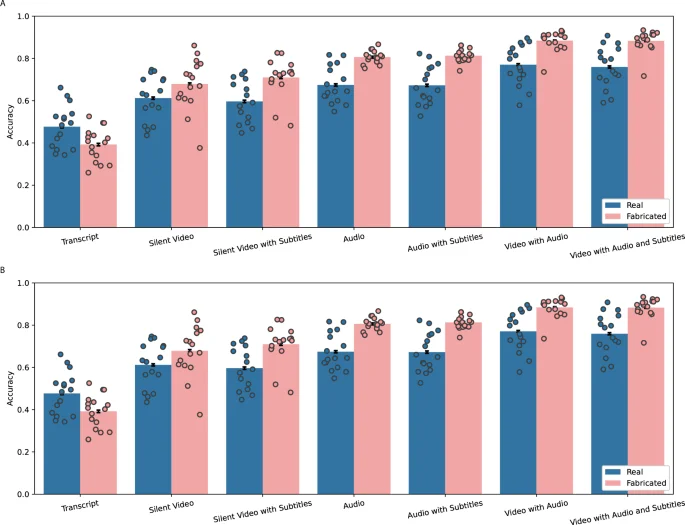
Intuitive judgments in production are also confirmed by cognitive psychology research. A study published in Nature Communications in September 2024 investigated how humans distinguish synthetic videos (deepfakes) among 2,215 participants 3. In this study, participants relied more on 'how' something was said rather than the 'content' of the speech to determine truth or falsehood.
"human discernment relies more on how something is said, the audio-visual cues, than what is said, the speech content" 3
Participants in the main experiment identified manipulation more accurately when presented with audio-visual information than when judging by text alone. As discussed in the paper’s introduction with related research, participants sometimes cited flaws in delivery methods, such as unnatural lip movements, as cues for 'manipulation.' While this study focused on political deepfakes, which is not entirely the same domain as CG animation, there is a common axis: the human visual system discerns truth not from the 'content of information on screen' but from the 'physical properties of the medium carrying the information.' Just as unnatural lip movements serve as cues in deepfakes, CG corners that are sharp as a still frame or color temperature mismatches serve as signals that 'this is not filmed footage.'
The work of VFX compositors adding flaws intentionally in the final stage and the cognitive process by which humans detect truth or falsehood through the presence or absence of such flaws share the same principle. Although technology has advanced to a point where rendering details deceive the human eye, the boundary between real and fake still relies on restoring the consistency of physical flaws left by light and cameras, and on how sensitively the human eye reads the absence of those flaws.