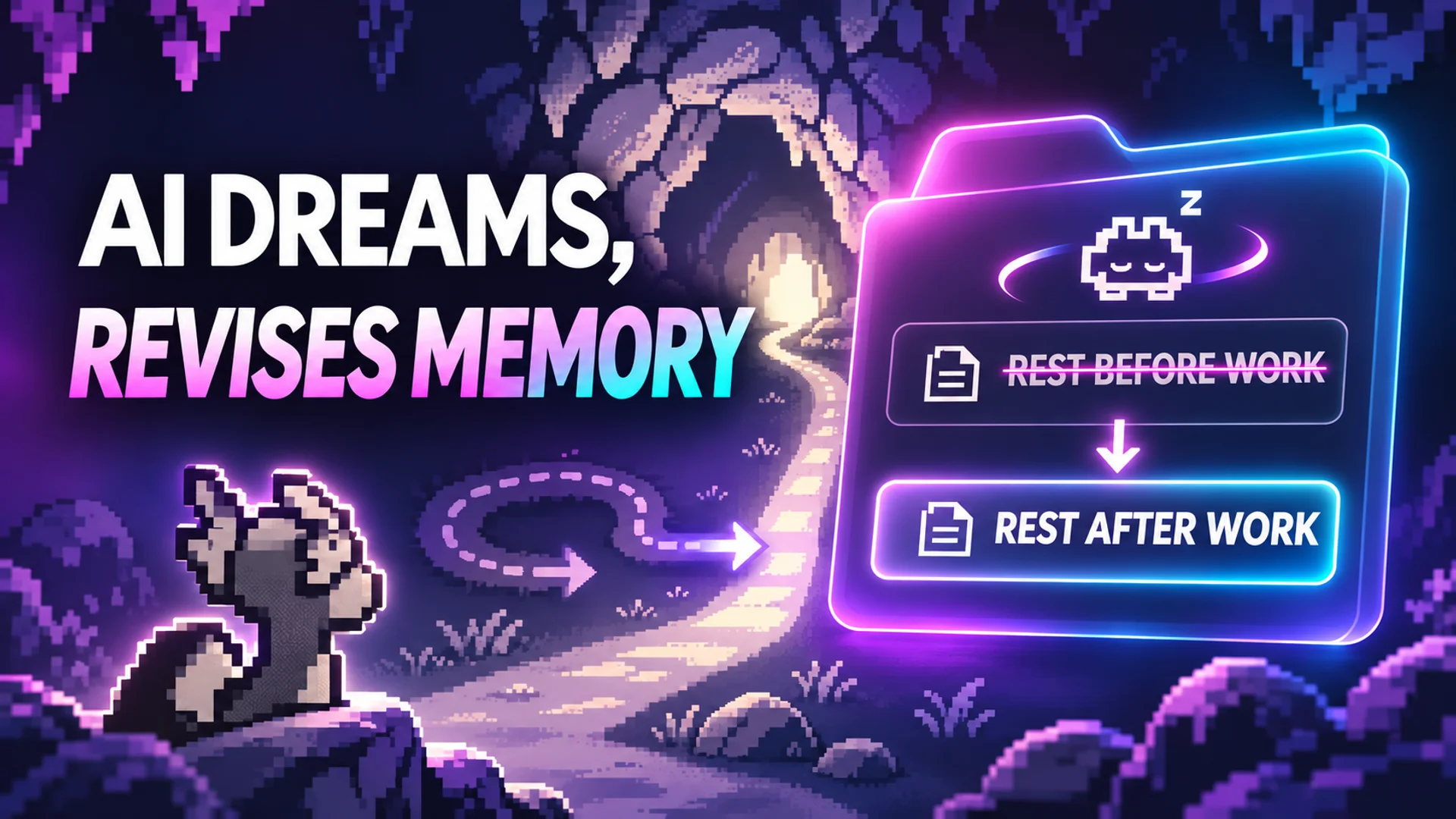
A Pokédex AI agent wandered the same path in Mt. Moon three times before reaching Blue City. This wasn't because the model couldn't compute. The culprit was a one-line memory that listed the Pokémon Center at the cave entrance as 'east' of the mountain. The agent thought it had already passed the mountain when leaving the Center and looped back the way it came three times by heading below the cliffs. When Anthropic applied a 'dreaming' stage to this memory folder, the agent cross-referenced its memory with the original work logs, corrected the location line, and reached Blue City on the next attempt 1.
'AI dreaming' doesn't refer to mysterious consciousness. Here, 'dreaming' is a verification stage where an agent reviews its logs during idle time, rereads its memory, and fixes errors. We'll examine the specific functions Anthropic revealed about 'dreaming' and the actual numerical performance gains from editing and organizing memory.
Simple actions behind the metaphor
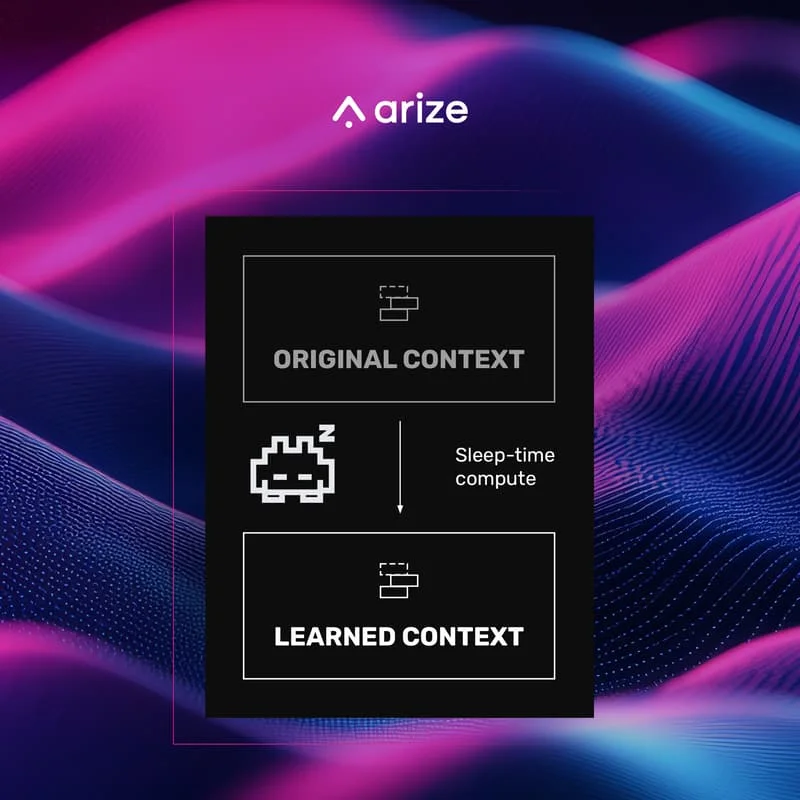
In short, dreaming is a post-task process where an agent checks its memory against its original work logs, fixes errors, and organizes scattered information 1. This concept stems from 'sleep-time compute' proposed by Letta and UC Berkeley researchers. Their April 21, 2025 blog post noted that using idle time for agents to reconstruct information and pre-derive inferences based on persistent memory reduces unnecessary calculations during conversation 2. The core idea is converting 'raw context' into 'learned context' 2.
Anthropic's dreaming applies this concept to agent logs. The structure is: searchable original logs at the bottom, above that a memory summary, a topic-based wiki with linked pages, and information automatically loaded at new session start. Dreaming is the relationship of checking and correcting upper-level logs against the raw logs below 1. The term 'dream' doesn't mean biological sleep-like consciousness but metaphorically represents scheduling memory reorganization between tasks.
The type and habit of memory shape scores
Dreaming first impacts memory quality. Anthropic assessed memory use on CL-Bench 1.0's database queries by requiring new sessions per question, allowing only the previous session's memory folder 1. Agents saw correct answers after each response, enabling them to analyze mistakes and log future aids. Model approaches differed: Sonnet 4.6 scattered unverified wrong-answer guesses across files, while Opus 5 tested causes first, then logged only verified rules and rationale 1.
Scores reflected the differences. Opus 5's average reward score rose from 0.564 without memory to 0.828 with memory organized through dreaming 1. Meanwhile, Sonnet 4.6 rose from 0.330 to 0.364 with unverified guesses 1. There's a notable gap between verified rules and guesses. However, Opus 5.5 and Sonnet 5.5 with verified rules scored 0.838 and 0.833, similar to Opus 5, and outperformed Opus 5 without memory 1. This data shows the dream's advantage comes from fact-checking, not volume.
Well-organized memory is useless if not read. Sonnet 4.6 opened memory files before answering less than half the time, while Sonnet 5 opened them 9 out of 10 times with no extra instructions 1. Forcing Sonnet 4.6 to read memory and test hypotheses boosted its score from 0.364 to 0.641 over three runs 1. Failing to retrieve memory can be a performance bottleneck. Strict logging rules also hurt performance. Opus 5's improvements diminished when instructed to log only failures, suggesting high-performing models work best with judgment left to them rather than forced guidelines 1.
Without dreaming, record-keeping hinders the main task
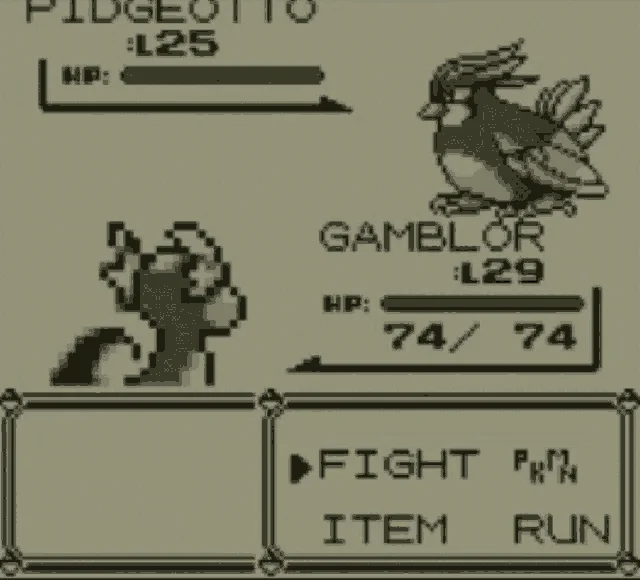
Pokémon Red testing shows why selective logging matters. Anthropic compared Sonnet 3.7 and Fable 5 memory around step 10,000 1. Sonnet 3.7 logged battles, items, and people in 413 files across 225 folders. As game states kept changing, these detailed logs quickly grew outdated, making them more expensive to search, leading Sonnet 3.7 to create a fourth memory folder around step 10,000. In 17 steps, it created six and deleted nine files but couldn't perform any in-game actions 1.
Fable 5 avoided logging things it could see on screen like location and money, keeping only self-discovered strategies and plans, maintaining 10 files across two folders and a global.md. This let it collect four gym badges versus Sonnet 3.7's one 1. This contrast shows why dreaming is necessary: without a step to cross-reference and prune outdated logs, managing bloated logs eats into the main task time. Claude's three loops in the cave happened because one incorrect memory was repeatedly used for judgment 1.
Wiki dreaming stitches scattered files into one
Dreaming extends from individual notes to topic-linked wikis. Anthropic tested it on ~350,000 internal documents (~420M tokens) from its acquired company, Stainless 1. They had Opus 5 agents build wikis across up to 128 sessions, picking up previous links, adding pages, merging duplicates, and checking sources. Increasing wiki-writing sessions from 2 to 128 raised rubric satisfaction on wiki-only questions from 13% to 48% 1.
Unlike search, which scored 53%, wiki-plus-search improved scores from 54% to 61% 1. This shows rubric satisfaction across 25 questions. The wiki excelled at cross-document queries, validated on a 24-question acquisition test, where it scored 87% for synthesis and judgment tasks versus 73% for search 1. Anthropic noted that using wiki and search together saves about 20k tokens per question in answer retrieval, though this requires computing to build and maintain the wiki 1.
Wiki quality relies on writing guidelines. A legal review task testing contract term accuracy showed that initial guidelines didn't require term preservation. This caused multiple agents to overwrite each other's entries on shared sheets, resulting in only ~72% (41 of 57) of target facts appearing in the review 1. When agents were assigned separate pages and instructed to quote source terms verbatim, the new wiki preserved all 57 facts and met all task guidelines 1.
Conclusion: Dreaming is about 'verification rules,' not magic
Reported improvements in dreaming come from the reading and organizing of memory and wikis. The uncorrected Pokémon Red memory looped three times to Blue City, while dreaming corrected this and reached Blue City. In CL-Bench database tasks, Opus 5's average reward score rose from 0.564 without memory to 0.828 with a memory folder. Opus 5.5 and Sonnet 5.5 scored 0.838 and 0.833, similar to Opus 5, and outperformed Opus 5 without memory. In Stainless documents, increasing wiki sessions from 2 to 128 raised wiki-only rubric satisfaction from 13% to 48%. Wiki-only 128-session scores were lower than search-only 53% scores, but wiki-plus-search improved from 54% to 61% 1. Thus, improvements are tied to verification stages in dreaming, not a single mechanism of opening raw logs 1.
However, as dreaming involves rereading, fixing, and linking memory rather than creating new records, design choices are needed. For instance, memory is useless if not read, and one model stalled its main task for 17 steps managing outdated data 1. Anthropic notes that memories may be wrong or outdated due to environment changes, and suggests adjusting check cycles for volatile or frequently used information as a future task 1.
References
- 꿈을 꿔서 장기기억 달성하는 클로드 새로운 기능 소개 · gall.dcinside.com↩
- Sleep-time Compute · letta.com↩