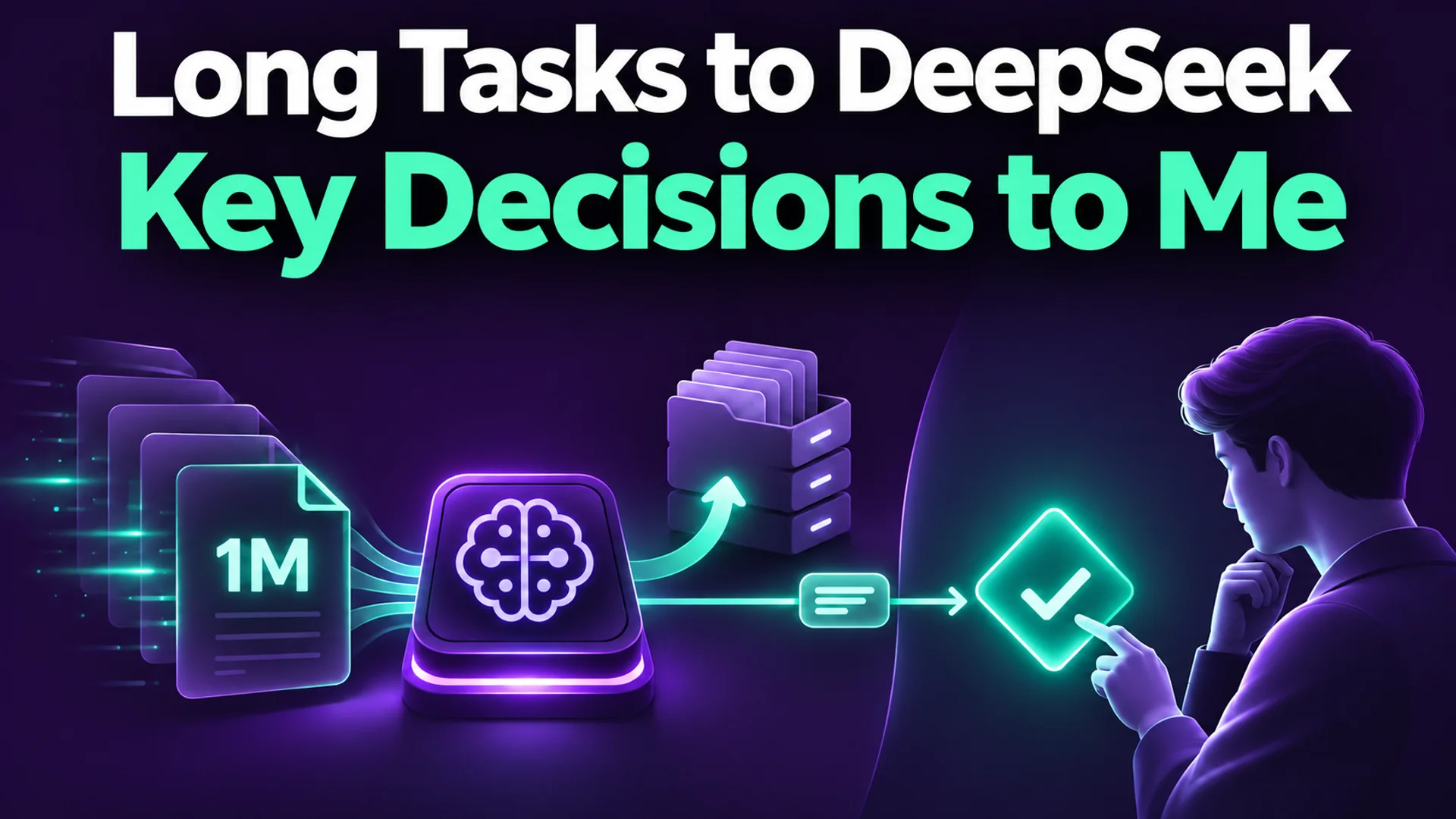
Where is the balance point between cost and efficiency in AI-based development workflows? Recently, approaches that maintain performance while reducing token waste in workflows that use large language models (LLMs) as auxiliary tools have been gaining attention. At the center of this trend is the integration of the DeepSeek model using the Model Context Protocol (MCP). The core concept is simple. It involves establishing a role-division strategy (HITL, Human-in-the-Loop) where long tasks with clear specifications are delegated to DeepSeek, while crucial decision-making and fine-tuning are handled directly by the host client (such as Claude).
Why double consumption occurs when calling DeepSeek via MCP
The most common issue encountered when connecting AI agents to external models is 'double consumption.' When connecting DeepSeek models (such as deepseek-flash) to a host client like Claude, configuring the MCP server merely as a gateway for API calls causes the long output tokens generated by DeepSeek to be sent back as input tokens to the host, resulting in redundant consumption 1. In other words, even if DeepSeek perfectly executes a long task, pasting its results directly into the host wastes the host's context window and incurs unnecessary costs.
To prevent such token waste, the MCP server must be designed in an optimized manner that either 'saves' the long outputs generated by DeepSeek 'to a file' or returns only a minimal summary and the status of the results, which the host can understand 1. In an actual development case, the developer explicitly instructed Claude to "create an MCP in a way that saves tokens," thereby adopting an approach that encouraged saving DeepSeek's responses to files or processing them in an optimized format. This allowed for precise resource management by adding a module to monitor DeepSeek's call frequency, token consumption, and account balance 1.
Utilizing DeepSeek's 1M context window and cost structure

The advantage of delegating long tasks to DeepSeek lies in its powerful context processing capabilities and low token pricing. The DeepSeek V4.1 Flash model (deepseek-flash) offers a vast context window of 1 million tokens 2, 3. This is highly advantageous for processing documents hundreds of pages long or very long conversation sessions at once. By leveraging this characteristic to delegate the handling of long contexts itself to DeepSeek and receiving only the final deliverables (such as saved files), one can fundamentally prevent the host client's context from being occupied 2, 3.
The benefits of this role division are also clearly evident in terms of cost. The DeepSeek deepseek-flash model charges 1.20 per million output tokens during peak hours (half price during off-peak hours) 2, 3. In contrast, the token pricing for the latest premium models like Claude Opus 5.5 reaches 20.00 per million output tokens 3. Given the nature of bulk generation tasks involving the creation of long texts or the analysis of long documents, the proportion of output token costs is inevitably large. A structure where this burden is shared by DeepSeek, which has pricing at roughly one-tenth the level, is thus established.
Role division strategy: 'Long tasks' to delegate to DeepSeek
When introducing AI as an auxiliary tool using MCP, clear criteria are needed to determine which tasks should be delegated to DeepSeek. According to community cases, bulk generation tasks with clear specifications best suit DeepSeek 1. Representative examples include boilerplate code, writing bulk test code, simple data conversion, and code generation requiring long outputs. By assigning independent and verifiable tasks to DeepSeek, Claude can focus solely on complex design and specification writing, allowing for much more efficient resource distribution 1.
The success of this strategy was confirmed in a project converting a 2D HTML Canvas tree animation into 3D (2.5D skinning). Modules with clear specifications, such as generation algorithms, packing, and mesh generation, were implemented by DeepSeek, resulting in nearly perfect generation quality with only one error out of a total of 740 lines of code 1. During this process, DeepSeek completed the long task while consuming approximately 37,000 tokens, but since it goes through the previously mentioned MCP optimization structure, it does not consume the host's context.
'Crucial judgments' that the host (Claude) must handle directly
All tasks should not simply be thrown to auxiliary models. Judgments involving high failure costs or requiring advanced contextual understanding must be handled directly by the host client (Claude). In a role division strategy established by a developer, Claude was set to directly handle small-scale code modifications and design, identifying relationships and hidden rules across multiple files, and tasks with high error costs such as root cause analysis, security, data deletion, and calculations 1. Additionally, financial code writing and parts involving security issues were also left within the host's judgment domain 1.
In particular, screenshot-based visual verification and detailed fine-tuning are areas where the host model must be directly involved. In the previously mentioned 3D tree animation conversion project, although DeepSeek excellently generated the base code, actual visual fine-tuning of shapes, lighting, and shadows required repeated screenshot-based verification, so Claude directly controlled this process 1. Furthermore, to compensate for Claude's 'search capabilities,' which have been pointed out as a weakness, a hybrid strategy was also employed by incorporating DeepSeek's web search function, allowing DeepSeek to utilize search tools when necessary 1.
Components and security of the DeepSeek MCP server
The open-source ecosystem supporting such workflows is also rapidly growing. Notably, the DMontgomery40/deepseek-mcp-server project is an MCP server that integrates with DeepSeek V4.1 Flash and V4 Pro APIs, providing a total of 11 tools to the host client 2. This server includes various functional tools, such as chat_completion for simple chat, create_response for handling stateless Responses API calls, and get_user_balance for checking account status 2.
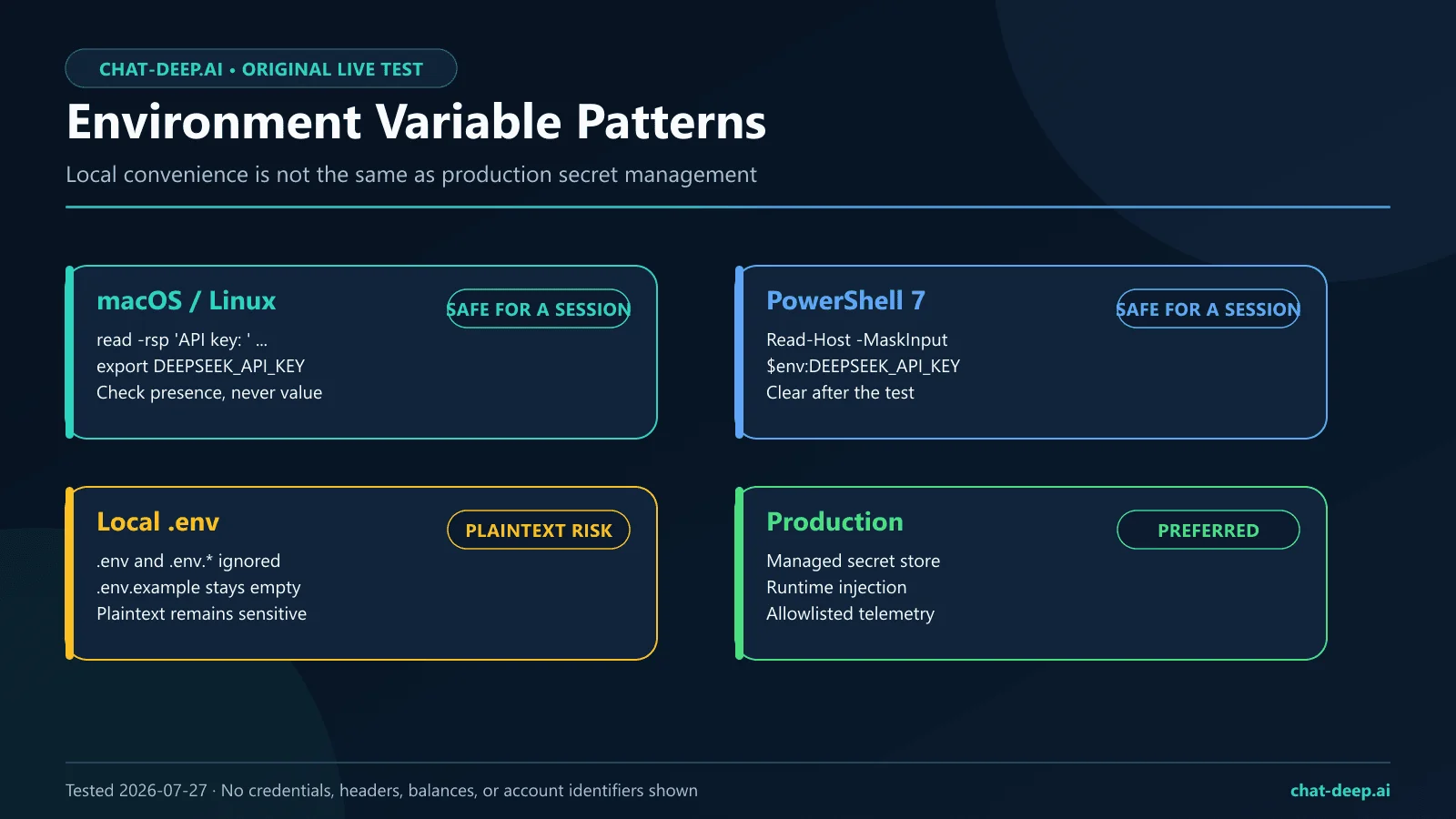
Utilizing the MCP server's file management tools (upload_file, list_files, retrieve_file, delete_file) allows the vast output results generated by DeepSeek to be safely saved and managed outside the host, playing a key role in preventing double consumption 2. Meanwhile, in terms of security and management, essential security measures are required when running in HTTP mode, such as configuring MCP_HTTP_AUTH_TOKEN to apply bearer token authentication and restricting browser origins with MCP_HTTP_ALLOWED_ORIGINS 2. Also, when integrating, note that deepseek-v4-flash is currently provided as a temporary alias for deepseek-flash, and the server's default model setting is specified as deepseek-flash 2.
Tips for building a practical workflow
Ultimately, to increase token efficiency by more than two times through DeepSeek MCP integration, the role definition of 'what to assign to which model' must be addressed first. DeepSeek charges $0.75 per 1,000 requests separately from model token costs upon launching its Search and Fetch APIs, making it important to control and optimize these external API calls through the MCP server 2.
For practical application, it is recommended to design the MCP architecture in the following order.
- Step 1: Set up result bypass paths: Explicitly instruct the MCP server in the host client's prompt to "save results to a file or return only a minimal summary" 1.
- Step 2: Delegate bulk generation: For text conversion tasks or code exceeding 700 lines with clear specifications, such as test code and boilerplate, utilize DeepSeek's 1M context window and
deepseek_batchfor parallel processing 1. - Step 3: Preserve host resources: Do not load the generated files directly into the host's context; instead, pass only indicators such as 'file location' or 'error codes of execution results' to Claude and request judgment 1.
- Step 4: Human/Host intervention (HITL): Only involve the host client or user when screenshot-based visual verification is necessary or when fine-tuning of security and financial logic is required 1.
This system goes beyond simply saving on API unit costs. It prevents the context windows of expensive models from being unnecessarily inflated by low-cost bulk generation tokens, creating a structure where the most expensive and intelligent resources are used solely for 'judgment.'
Ultimately, efficiency in AI development environments is not a matter of choosing a single good model, but a matter of architectural design that precisely divides 'generation of long tasks' and 'crucial judgments' among models and tools using standard protocols like MCP. The moment you design DeepSeek MCP not as a simple alternative API but as an 'independent work hub that bypasses results to files and clears the host,' you will be able to achieve both token cost savings and processing speed improvements.
References
- 클로드 코드에 딥시크MCP 붙였어 · gall.dcinside.com↩
- GitHub - DMontgomery40/deepseek-mcp-server: Model Context Protocol server for DeepSeek's advanced language models · github.com↩
- LLM API Pricing 2026: OpenAI, Gemini, Claude & Grok | IntuitionLabs · intuitionlabs.ai↩