The importance of portals, which once served as gateways to news, is significantly diminishing. According to the 2026 survey by the Reuters Institute for the Study of Journalism at the University of Oxford, only 61% of Koreans cited 'search engines and news aggregation services' like portals as their primary news pathway. This figure represents a gradual decline from 76% in 2019, while only 8% of respondents reported directly visiting news organizations’ websites or apps1. Social media and AI chatbots are filling the void. In 2026, the proportion of Koreans consuming news via social media reached 21%, a significant increase from 9% in 2019, while the usage rate of AI chatbots doubled from 7% the previous year to 14%, exceeding the global average of 10%1. News consumption has thus transformed into a 'multi-path' model relying on platform algorithms.
Facing an information flood, literacy in accurately selecting 'necessary information' has emerged as a crucial task, rather than simply consuming large volumes of news. As media formats diversify—from short-form video content to answers summarized by AI chatbots—the potential for information distortion and excess grows. Consequently, an active news consumption methodology called 'AI curation' is gaining attention, which involves cross-verifying and interpreting AI responses rather than blindly trusting them.
Decline in News Trustworthiness and Generational Differences Amidst Platform Diversification
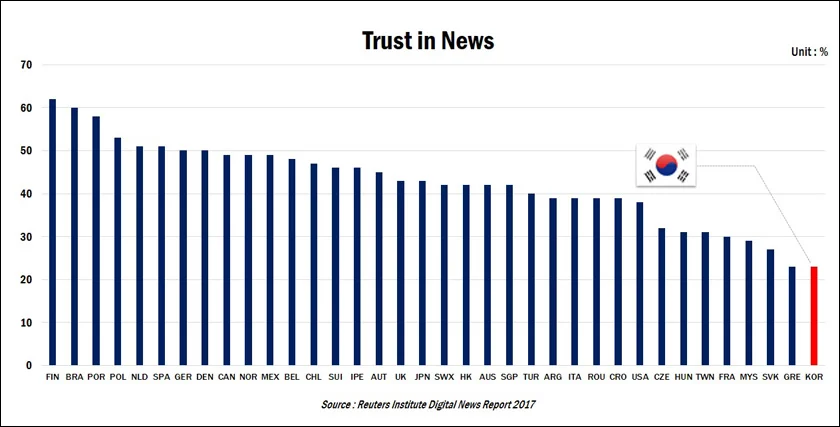
As news access pathways diversify, public trust and attitudes toward information are also changing. According to the 2026 survey in Korea, overall trust in news stood at 30%, falling below the global average of 37%. Concerns regarding online misinformation rose by 4 percentage points from the previous year to 59%, with distrust being particularly pronounced among both conservative respondents (74%) and progressive respondents (61%)1. These results suggest that while the channels for information distribution have increased, readers’ trust in media or in mechanisms for verifying information has not kept pace.
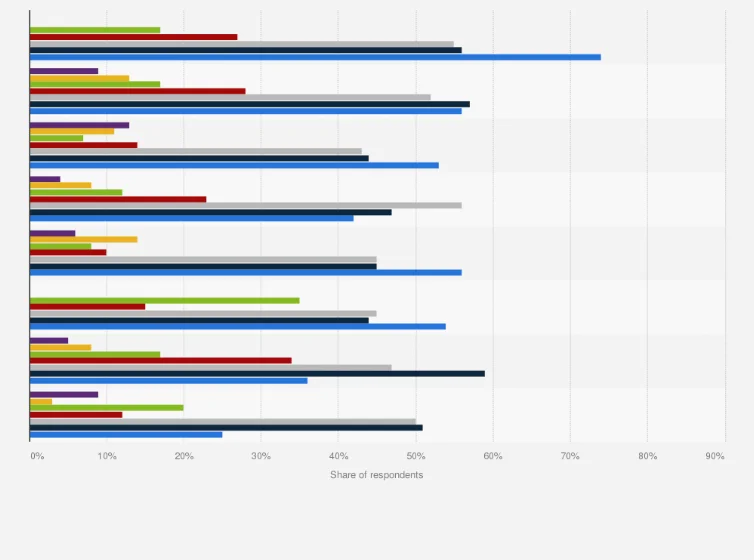
The rise and frequent use of social media-based 'news creators' align with this trend. According to the 2026 survey, 64% of Korean respondents reported using YouTube or social media-based news creators, exceeding the global average of 55%. They evaluated creator content as 'easy to understand and providing up-to-date information'1. A 2024 domestic survey also showed that the experience rate of watching short-form content rose by 13.8 percentage points from the previous year, indicating that short-form content has become a mainstream format2.
However, unconditional trust in these channels remains elusive. According to the 2026 Digital News Report sub-study by the Heinrich Böll Foundation in Germany, only 10% of respondents who use news influencers reported that these influencers fully meet their news needs. Additionally, the trustworthiness of news influencers was measured at 11%, significantly lower than the 46% trust level for established news organizations3. News consumption via platforms like YouTube also reveals a generational gap. YouTube news usage is active among those aged 60 and older (59%) and those in their 50s (57%), while recording relatively lower rates among those in their 20s to 40s1.
AI Chatbot-Centric News Exploration and Information Distortion
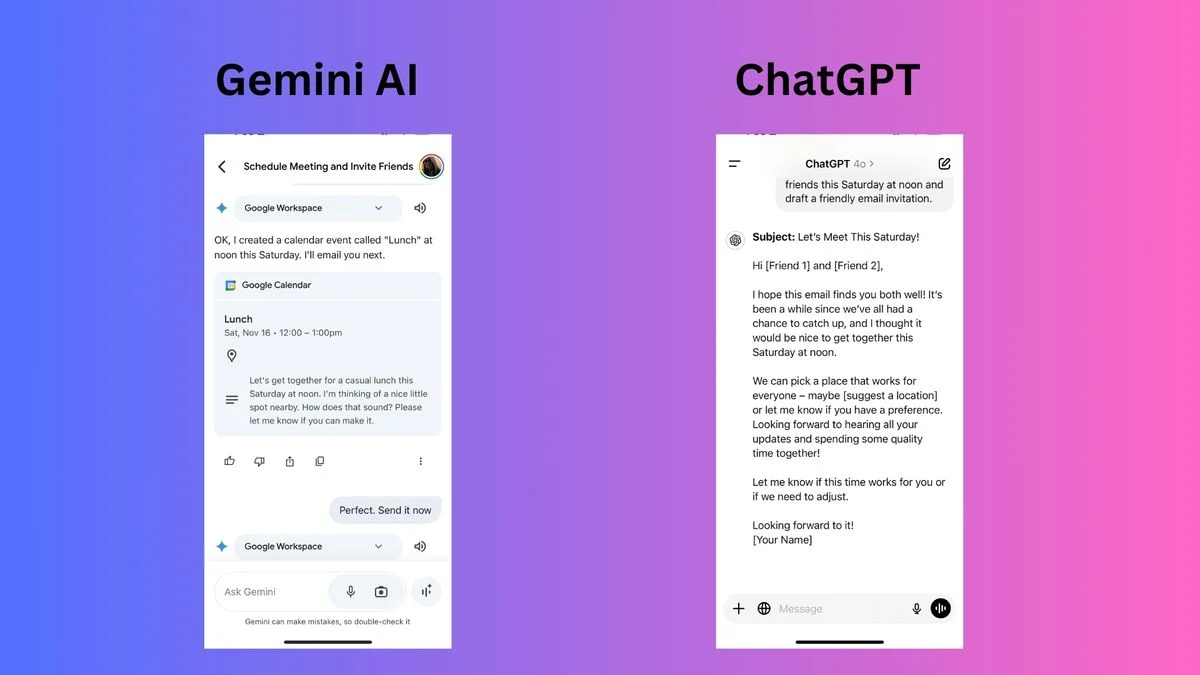
The phenomenon of turning to AI chatbots for news has also become a distinct trend. The 2026 Korea survey results showed that news usage via AI chatbots rose to 14%, with ChatGPT, Gemini, Copilot, and Meta AI being the most frequently used tools in that order1. Another study released by the Reuters Institute in October 2026 provides an in-depth analysis of the process by which generative AI is transitioning from a simple tool to an 'information infrastructure' of the news ecosystem. This aligns with industry discourse questioning the lifespan of traditional search engine optimization (SEO) strategies centered on existing platforms due to the influence of AI search4.
As rapid information exploration based on AI and short-form content becomes routine, issues regarding accuracy have surfaced. AI chatbots can distort information by omitting specific contexts or causing hallucinations. Professor Kim Jang-hyun of Sungkyunkwan University pointed out the phenomenon of AI services providing contradictory answers regarding new technologies or social issues5. For example, in a marketing scenario, when multiple AIs were asked to analyze the market for new product planning, each AI reportedly provided completely different interpretations, such as 'value consumption by women in their 20s' or 'practicality for single-person households'5.
It is difficult to grasp the essence of events with information consumed merely as summarized text or short videos. In fact, short-form content has expanded into a 'short-ping' (Short + Shopping) culture that eliminates the user's information search process, leading directly to immediate purchases or reactions2. While short-form content enhances the immediacy of information acquisition, it carries the risk of leading to oversimplification or errors in news that requires complex background knowledge.
'AI Curation': Combining Cross-Verification of Multiple Responses and Human Interpretation
To secure accurate knowledge without being engulfed by technology, Professor Kim Jang-hyun of Sungkyunkwan University introduced the concept of 'AI curation.' This involves a systematic process of posing core questions to at least four or five AIs, comparing and analyzing their responses, and using tables to organize the differences in premises, evidence, and conclusions5. This is followed by cross-verifying misinformation or inconsistencies caused by AI hallucinations through expert insights and reliable sources. The entire process—deriving appropriate interpretations tailored to the user's unique organization, policies, or field based on verified facts, and correcting errors—is defined as AI curation5.
This five-step methodology is utilized as a validated information acquisition tool in both business and academic research fields. Since AI can subtly distort information through summarization, strict verification, such as cross-referencing with original texts from the National Assembly Library, is essential in academic research5. This process asserts that the 'human' is once again the final editor of information.
Global data from the Reuters Institute also captures this shift toward reader-centric attitudes. As tendencies to intentionally avoid or ignore news intensify (3), concerns about judging information online are increasing. Therefore, it is time to develop the ability to collect fragmented answers from various sources and reassemble them using human critical thinking, going beyond merely accepting the 'conclusions' delivered by AI chatbots or short-form content.

In Summary
Ultimately, the role of portals and media companies is shrinking in the 2026 news ecosystem, as we enter an era where users directly navigate between short-form content and AI chatbots to carve out multiple pathways. Instead of maintaining its previous 61% usage rate, the portal is on a downward curve, while AI-based information infrastructure and news creators, recording usage rates of 14% and 64% respectively, are forming new axes of information distribution1. With overall trust in news dropping to 30%1, relying solely on media formats and platforms for trust can only increase information distortion and fatigue. To fully enjoy the speed of short-form content and the convenience of AI chatbots, 'AI curation' literacy—which involves cross-verifying discrepancies among diverse responses and adding one's own interpretation—becomes an essential survival tool.
References
- "뉴스 소비 경로 다변화…포털 줄고 소셜미디어·AI 이용 늘고" | 연합뉴스 · yna.co.kr↩
- 숏폼 성장이 바꾼 트렌드…쇼핑? 아니 '숏핑' - 반론보도닷컴 · banronbodo.com↩
- News Consumption through Social Media Is Increasing · leibniz-hbi.de↩
- Digital News Report 2026 · reutersinstitute.politics.ox.ac.uk↩
- [김장현의 테크와 사람] 〈108〉 생성형 AI 시대, 'AI 큐레이션'이 필요한... · m.etnews.com↩