A complete rewrite of legacy systems is risky, but neglecting them demands even greater costs. The Strangler Pattern, proposed by Martin Fowler, has become the standard strategy for resolving this dilemma. Inspired by observations made in 2001 of strangler figs growing around host trees in the rainforests of Queensland, Australia, this pattern serves as a methodology for gradually replacing existing systems and has a revised edition published in August 2024 123.
As of 2026, this pattern is evolving beyond mere theory into zero-downtime transitions within large-scale enterprise environments and integration with AI-based automation tools. This article examines the core mechanisms of the Strangler Pattern and real-world application cases, analyzing key pitfalls that can lead to project failure—such as data consistency issues, the permanent entrenchment of temporary infrastructure, and distributed monoliths—along with practical strategies to avoid them.
Core Mechanism: Traffic Routing via Facade
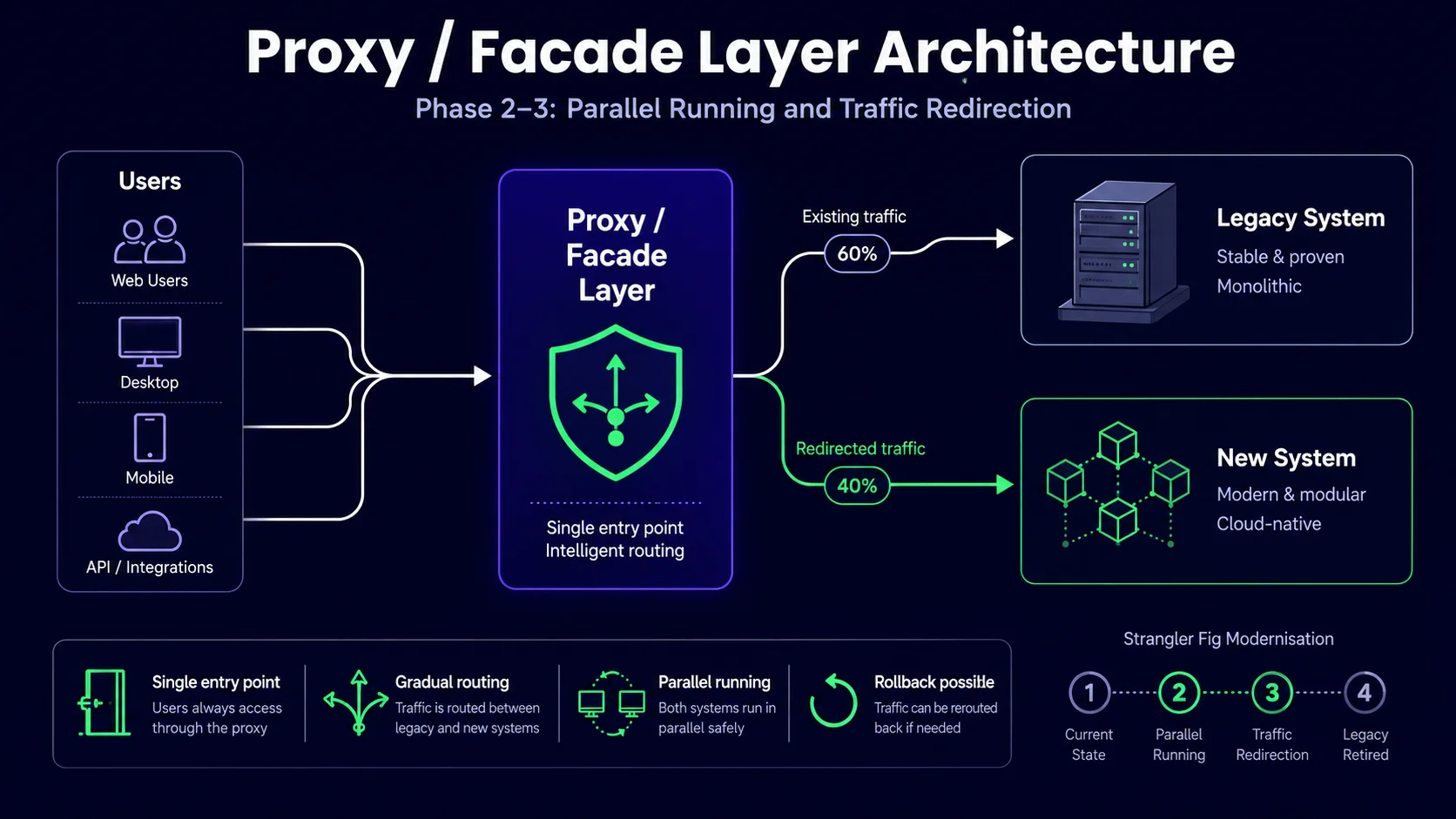
The working principle of the Strangler Pattern lies in placing a 'Facade or Proxy' between the legacy and new systems to intelligently route requests 145. In the initial phase, 100% of traffic is directed to the legacy system, while newly developed features are routed to the new system.
Using proxies like NGINX or AWS API Gateway to intercept traffic and extracting new microservices by domain to replace the legacy system is a typical execution stage 5. Once the new service stably handles traffic, it is validated by gradually increasing the ratio starting from 5% using Canary routing 5. It is also recommended to apply an anti-corruption layer to ensure the new system does not inherit structural flaws from the legacy system 4.
If this process is successful, the legacy system gradually empties out like a 'host tree' losing its function. Finally, when all functions of the legacy system have been migrated, the existing system and the facade itself are removed to complete modernization 4.
Large-Scale Migration Cases and Organizational Continuity

In practical application, continuous ownership is as important as technical implementation. The UK Government Digital Service (GDS) utilized a routing facade called 'Bouncer' to integrate over 300 institutional websites into a single platform (GOV.UK) in approximately 15 months 2. The key to completing this project was a design ensuring each department maintained its responsibility until the end 2.
Often, organizational capability rather than technical challenges determines success or failure. If the person in charge is reassigned to another project three months after migration begins, it is a danger signal that the project may never be completed. If the facade is routing more than half of the production traffic, it indicates it has become entrenched as a 'second legacy system' 2.
eBay minimized risk by conducting pilot projects in highly profitable areas during architectural redesign, achieving gradual separation and loose coupling of its monolithic system 3. In eBay's case, they maintained the APIs of existing services while implementing new features in the new architecture, ensuring flexibility to pause migrations while continuing to utilize the deployed system 3.
Technical Architecture for Zero-Downtime Migration: A 28-Month Record
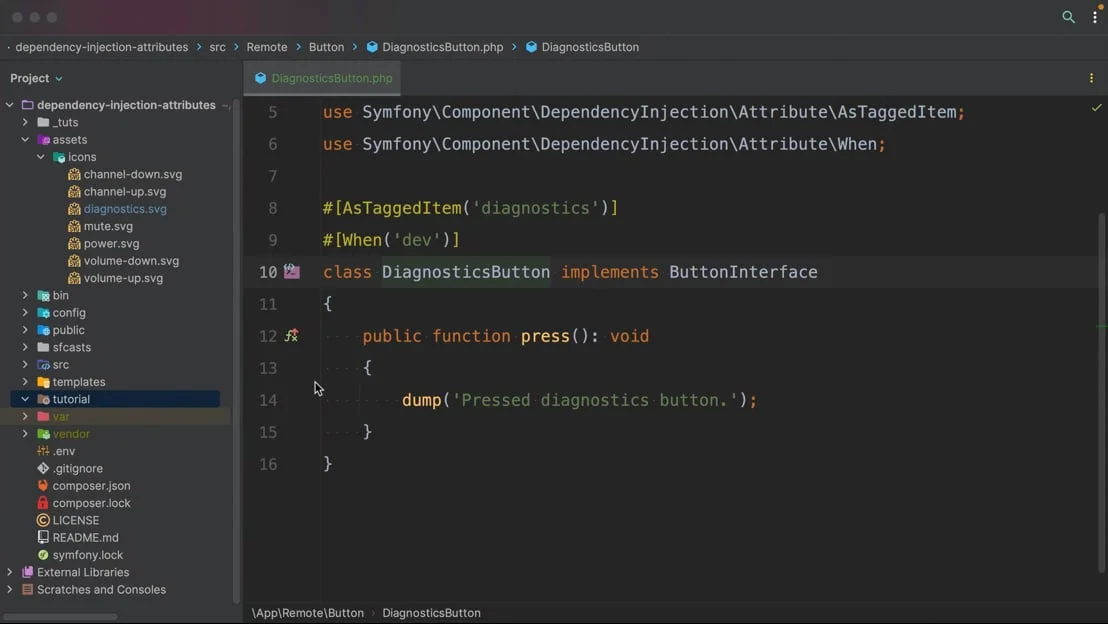
An e-commerce platform case reported in December 2025 demonstrates a specific technical strategy for gradual replacement. During the migration from Magento 1 to Sylius, the development team applied abstractions based on Symfony interfaces to replace seven backend APIs without downtime over 28 months 6. The core was designing controllers to depend only on interfaces rather than implementations, enabling backend replacement and immediate rollback solely through changes in dependency injection configuration 6.
In situations where only the backend needs to be replaced without changing the frontend, combining the Backend-for-Frontend (BFF) pattern with the Strangler Pattern is effective 7. By having the BFF absorb the complex 'Adapter Hell' between clients and actual services, the backend internals can be converted into microservices without modifying frontend code 7.
Regarding performance optimization, there is also a case where authentication overhead, which occurred hundreds of times per session, was significantly reduced to once per hour through 59-minute caching aligned with a token expiration time of 60 minutes 6. This architecture adhered to the principle of progressive enhancement, ensuring purchases remained possible even with JavaScript disabled 6.
Pitfall 1: The Trap of Data Consistency and Dual Writes
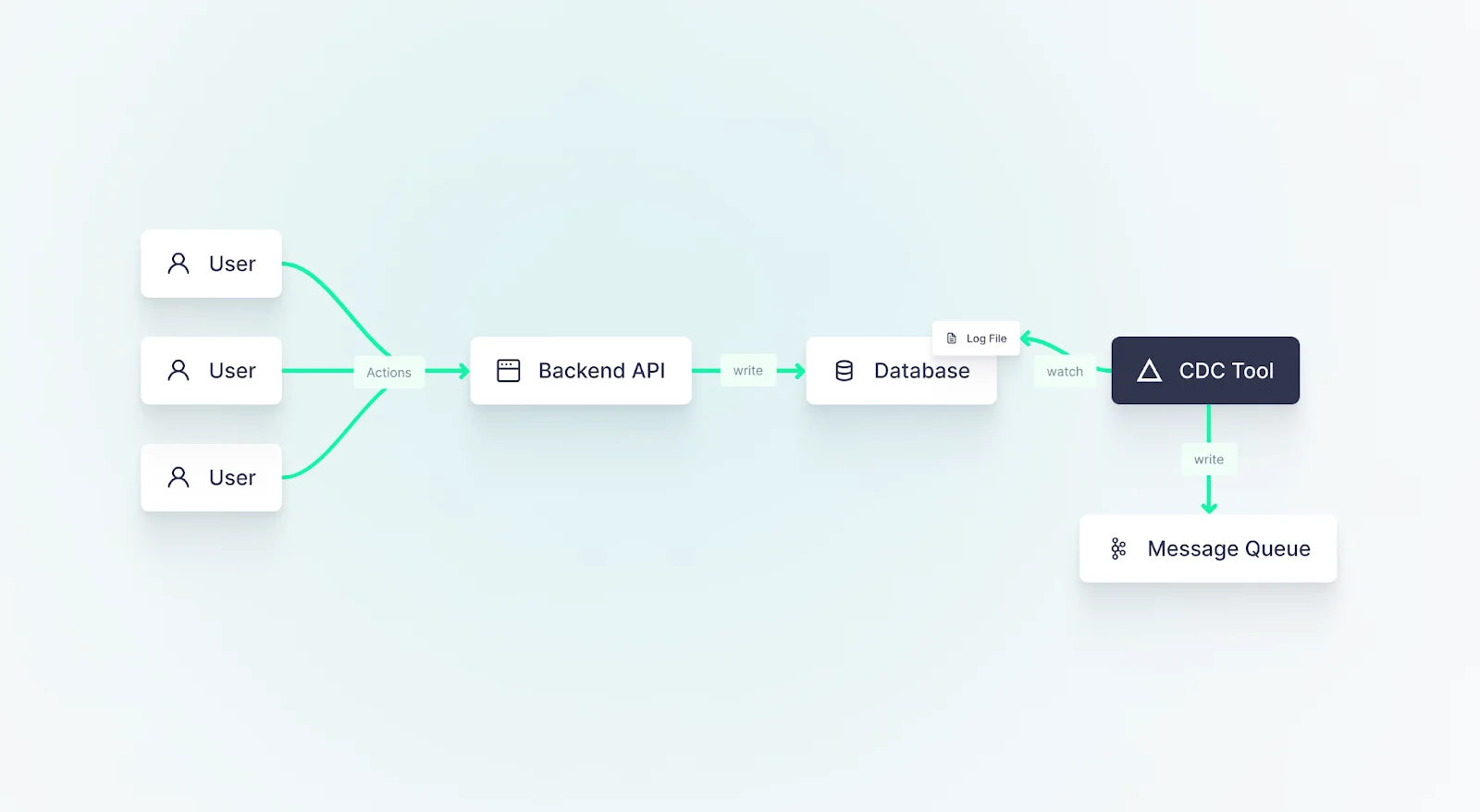
One of the most fatal failure factors is data consistency issues that arise when the legacy and new systems each have their own databases 258. Although Change Data Capture (CDC) technologies based on Debezium or Kafka are widely used, AWS designates them as a 'tactical solution,' pointing out that they do not guarantee complete synchronization and may result in eventual consistency states 258.
Accesto's practical case illustrates this problem well. During a three-year modernization of a SaaS application, the new and legacy systems shared a single database for quick validation, but this was close to an anti-pattern. This occurred because boundaries in the data model became ambiguous, causing unnecessary dependencies and resulting in existing table structures hindering new optimizations 88. During large-scale data migrations, feature flags should be used to create an environment allowing immediate rollback to avoid directly reading legacy DB tables 5.
Pitfall 2: Permanent Entrenchment of Temporary Infrastructure
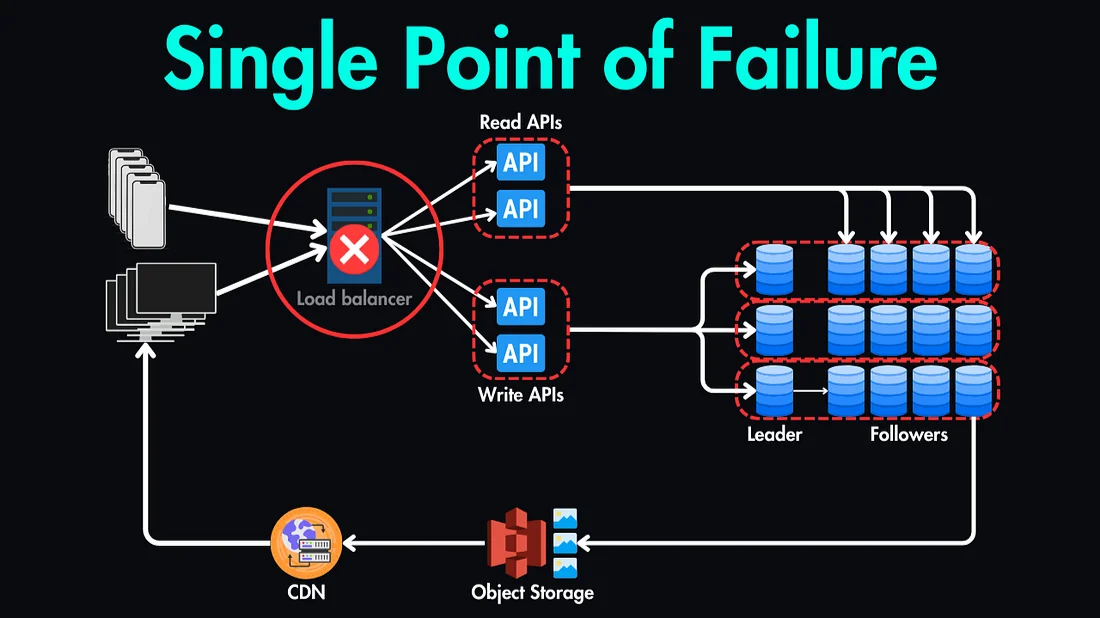
The phenomenon of transitional architecture used for migration becoming permanent is also a frequent pitfall 24. The facade and proxy layers serve as system seams and are essential initially, but they must not become performance bottlenecks or single points of failure (SPOF) 24. If the facade is not removed after migration is complete, you face the worst-case scenario of having two systems to maintain 4.
To prevent this, distributed processing capabilities must be considered from the initial system design to ensure the facade does not become a single point of failure, and a clear plan for the end point is necessary 24. Additionally, in large-scale environments, circuit breaker and rate-limiting settings must accompany preparations for network isolation and latency 5.
Pitfall 3: Failure in Domain Boundary Setting and Distributed Monoliths
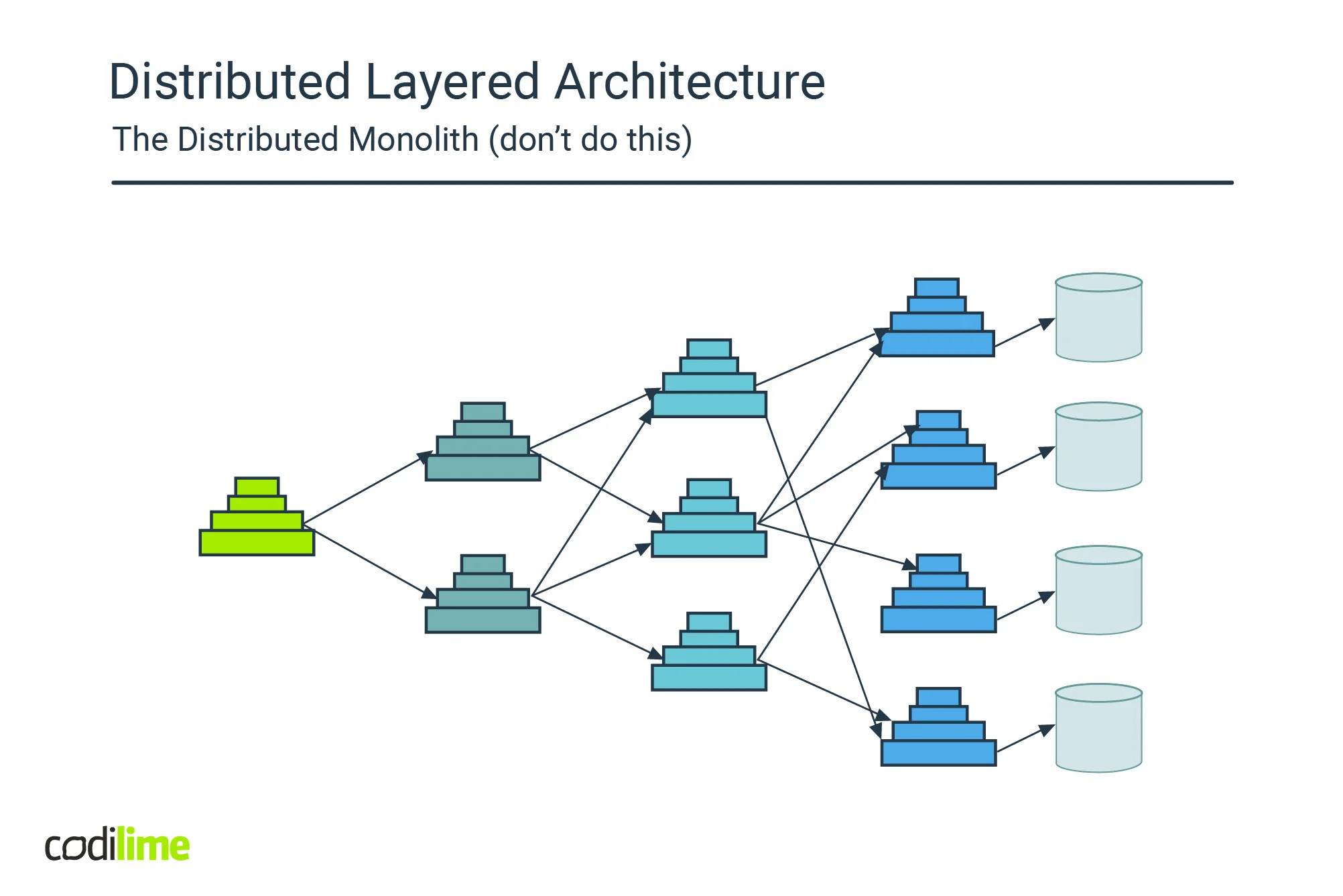
Poorly defined domain boundaries create 'distributed monoliths.' A state where multiple microservices must constantly communicate to function properly implies a structure that is physically distributed but logically monolithic 2. To prevent this, AWS recommends identifying actual boundaries in advance through Domain-Driven Design (DDD) and Event Storming 2.
If boundaries are not clearly set, data pipeline inconsistencies and cascading delays occur, necessitating countermeasures such as scaling frontend replicas and blocking downstream calls 5. Isolating incorrect payloads using Dead Letter Queues (DLQ) has also become a practical technique for managing side effects arising from the complexity of distributed systems 5.
The 2026 Variable: AI Agents and Quantitative Prioritization
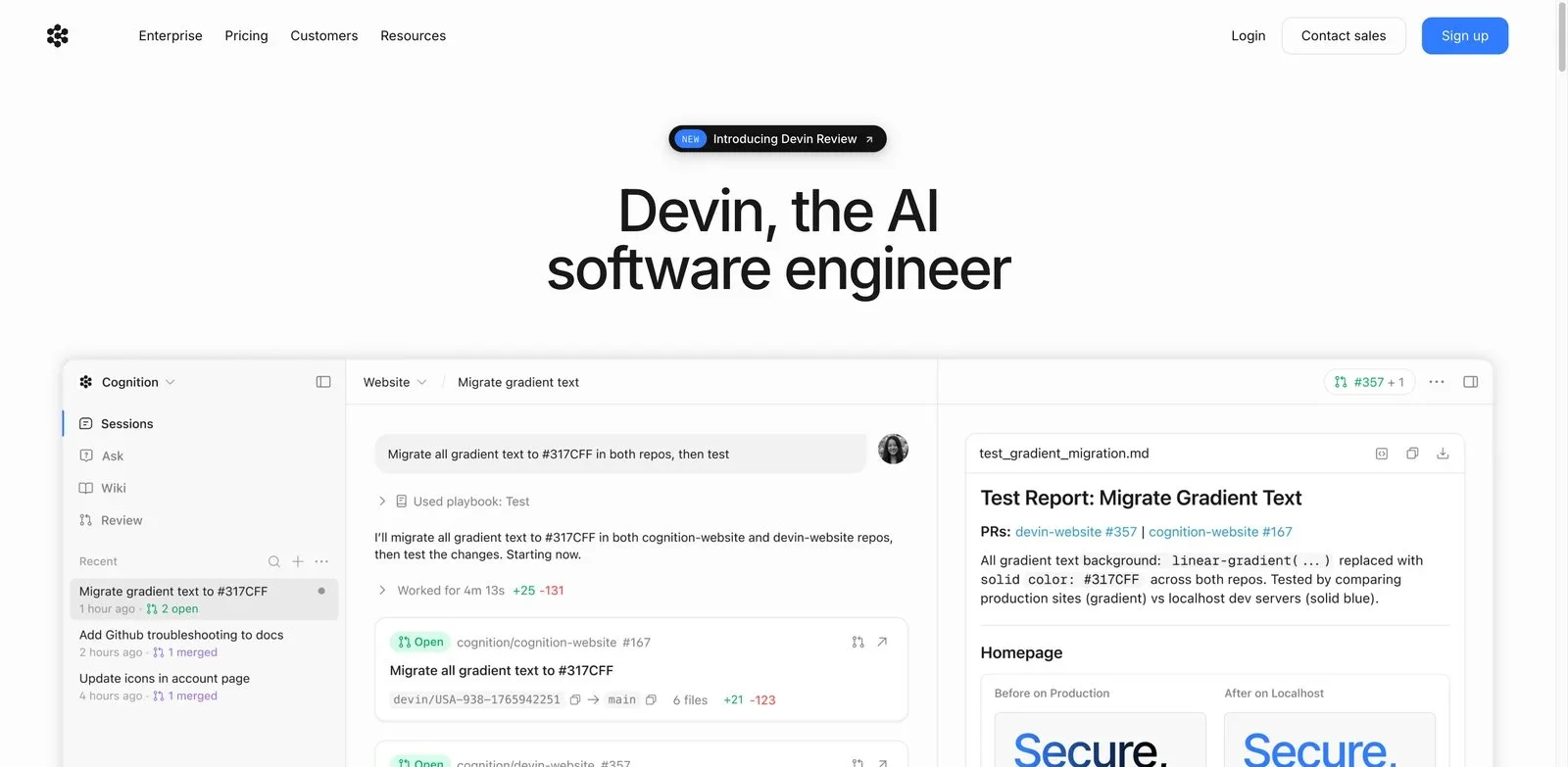
One of the biggest changes in the 2026 migration environment is the introduction of autonomous AI coding agents. Mercedes-Benz reduced a legacy codebase migration that took eight months to just eight days using AI, while Nubank cut the cost of migrating 6.1 million lines of code by twenty-fold 9. AI demonstrates highly specialized capabilities in resolving repetitive technical debt or updating dependencies, predicated on human judgment and PR reviews 9.
To maximize ROI when prioritizing migrations, one should rely on quantitative metrics rather than 'technical preference' 10. The most efficient strategy is to process modules sequentially starting with those high in bug rate, code quality, and change churn rate 10. In a case involving a switch from Angular to React, strict quality gates were operated by writing E2E tests beforehand to guarantee functional equivalence before deployment 10.
The Strangler Pattern of 2026 takes an advanced form combining the automated processing capabilities of AI and quantitative, data-based strategic routing atop the principle of gradual replacement from the past 109. The final destination is a state where the new system survives alone, requiring cool-headed design regarding data integrity and the courage to remove temporary infrastructure 34.
References
- Strangler Fig · martinfowler.com↩
- Strangler Fig: 6 Signals It's Not Finishing - Growin · growin.com↩
- 교살자 패턴, 스트랭글러 패턴 (strangler pattern) - 기계인간 John Grib · johngrib.github.io↩
- Strangler Fig (pattern) - Tech Dictionary | Nextsoft Corp · nextsoftcorp.com↩
- ↩
- Strangler Pattern Symfony Migration Case Study · edmondscommerce.co.uk↩
- Refactoring Monoliths to Microservices with the BFF and Strangler... · wundergraph.com↩
- Strangler Pattern in practice | Accesto Blog · accesto.com↩
- 8개월 레거시 마이그레이션을 AI가 8일에 끝낸다 — Devin, 자율 AI... · working-ref.com↩
- Angular 1에서 React로 — Strangler 패턴으로 1년간 점진적... · tera-log.pages.dev↩



