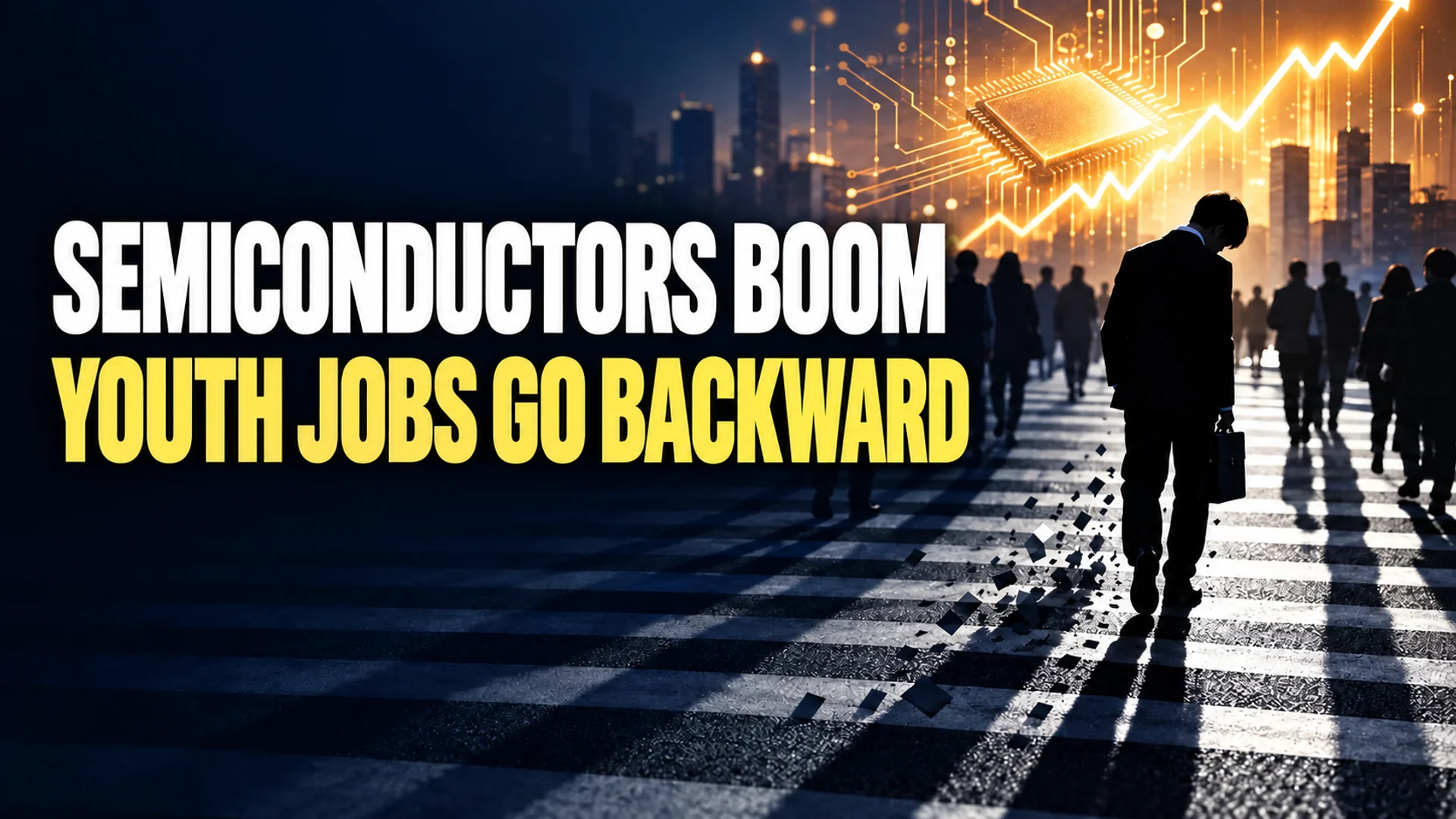
In 2026, South Korea's economy soared to new heights, with nominal GDP growth reaching its highest level in 50 years thanks to a semiconductor boom. However, this improvement in macroeconomic indicators did not translate into a recovery in the youth employment market. The Bank of Korea (BOK) analyzed that during the four-year period when youth jobs declined significantly, 94% of the decrease occurred in industries heavily exposed to AI, diagnosing that automation driven by the spread of AI has further raised barriers for young people entering the early stages of their careers. Amid the era-defining trends of the semiconductor industry and AI technology growth, this article objectively examines why the employment structure for young people is moving in the opposite direction.
The Employment Paradox Hidden Beneath the Highest Growth in 50 Years

In the first half of 2026, South Korea’s economy recorded exceptional high growth, centered on expanded semiconductor exports. According to data from the Bank of Korea and the National Data Agency, nominal GDP in the first quarter of 2026 grew by 10.5% quarter-on-quarter, driven by the semiconductor boom, marking the largest increase since reaching double digits for the first time in 50 years, or since the first quarter of 1976 1. Nominal Gross National Income (GNI) also rose by 11.0%, showing the largest increase in 50 years 1. Overseas investment banks (IBs) also projected that South Korea’s annual growth rate would exceed 3%, citing this expansion in semiconductor exports 1.
However, despite the simultaneous surge in these economic indicators, a severe recession persists in the labor market. According to the May 2026 Employment Trends report released by the National Data Agency, the total number of employed persons in May stood at 29.12 million, a decrease of 40,000 (0.1%) compared to the same month in the previous year, marking the first decline in 17 months 1. In particular, the youth employment rate for ages 15–29 fell by 2.4 percentage points from the same period a year earlier to 43.8%, the largest drop in 5 years and 4 months since January 2021, immediately following the pandemic 1. The youth employment rate has declined for 28 consecutive months, and the youth unemployment rate in August stood at 5.4% 2. In contrast, the employment rate for those aged 30 and over remained stable or showed an upward trend, clearly illustrating a pattern of "growth without employment" with widening intergenerational employment gaps 1.
Structural Limitations of the Semiconductor Industry and Youth Employment
The first reason why youth jobs fail to increase during periods of high economic growth lies in the structural absorption capacity of the semiconductor industry for employment. Despite the growth of the semiconductor industry, total employment in the manufacturing sector plummeted by 140,000, because semiconductor workers account for only 4% of total manufacturing employment 1. In other words, even when the semiconductor business cycle improves, the industry’s small share of the overall labor market means it faces structural limitations that prevent it from directly leading to widespread youth job creation 1.
This phenomenon is further highlighted by differences in industrial ecosystems. As of June 2026, South Korea and Taiwan, both benefiting simultaneously from the semiconductor boom, showed diametrically opposed employment outcomes 3. In Taiwan, employment increased by 27,000 in April, maintaining an upward trend for 39 consecutive months, and the youth employment rate for ages 25–29 reached 87.4% 3. Conversely, youth employment indicators in South Korea deteriorated significantly 3.
According to the analysis by Kim Ki-bong, a senior researcher at the International Finance Center, this gap stems from industrial structures 3. Taiwan has formed a thick system semiconductor value chain involving design, production, and advanced packaging through companies like MediaTek, TSMC, and ASE, meaning work generated by increased exports is distributed among many small and medium-sized enterprises, resulting in high employment absorption capacity 3. In contrast, South Korea’s structure is vertically integrated, with Samsung Electronics and SK Hynix focused on memory semiconductors such as DRAM and HBM 3. As a result, even when semiconductor exports surge, profits and jobs are concentrated in specific large corporations, leaving limited effects on diffusion to small and medium-sized enterprises and youth job creation 1, 3.
Entry-Level Youth Jobs Hit Hard by the Spread of AI
With the limited employment impact of the semiconductor boom, the spread of AI technology has acted as a key factor maximizing the decline in youth jobs. According to the "BOK Issue Note (No. 2026-19)" report published by the Employment Research Team of the Bank of Korea’s Survey Department on August 18, 2026, youth jobs (ages 15–29) decreased by a total of 285,000 over the four-year period from June 2022 to June 2026 4, 5. Notably, 94.0% of this decline, or 268,000 jobs, occurred in industries with high AI exposure 4, 5.
By industry, among sectors with high AI exposure, information services saw the sharpest decline in youth employment, dropping by 31.4% 4, 5. This was followed by publishing (27.4%), computer programming and systems integration management (16.6%), and professional services (11.6%) 4, 5. Oh Sam-il, head of the BOK’s Employment Research Team, clarified the concentration of AI’s negative impact on youth, stating, "AI primarily replaces manualized tasks, which corresponds to the replacement of younger workers" 4, 5.
During the same period, jobs for those in their 50s increased by 230,000 4, 5. Of these, 75.2% (173,000 jobs) were found to have increased in industries with high AI exposure 4, 5. The Bank of Korea analyzed that this is because while AI tends to replace entry-level and standardized tasks, it is difficult to replace the specialized work of older workers, which requires an understanding of organizational context 4, 5.
Diverging Outcomes Based on AI Application: Automation vs. Augmentation
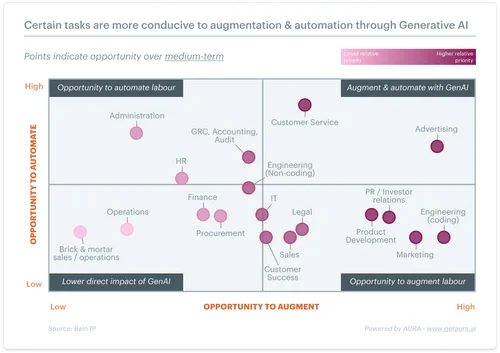
According to the Bank of Korea’s analysis, the negative impact of AI technology on youth employment varies distinctly depending on how AI is utilized. Industries with a higher proportion of "automation," where AI is directly assigned to perform tasks themselves, experienced larger declines in youth employment 4, 5.
In contrast, industries with a higher proportion of "augmentation," where AI assists human work such as drafting or verification, did not show a distinct trend of declining youth employment 4, 5. This suggests that youth jobs are not disappearing wherever AI is introduced, but rather that automation is progressing primarily in repetitive, manual-focused entry-level tasks.
As AI automation erodes entry-level jobs, career entry paths for young people are also narrowing. In industries with high AI exposure, the average monthly outflow of youth workers increased by 32% (from 3,700 to 4,900), while inflows decreased by 11% (from 32,600 to 29,100), indicating deepening job hopping and attrition 4, 5. The unemployment rate for highly educated youth also rose; since November 2022, following the launch of ChatGPT, the average unemployment rate for university-graduate youth stood at 7.0%, 1.6 percentage points higher than that of those with high school or associate degrees (5.4%), significantly widening a previously negligible gap 4.
The Weakening 'Career Ladder' and the Need for Policy Response

The Bank of Korea diagnoses that it is difficult to attribute the sluggish youth employment solely to the influence of AI. It interprets this as the result of combined factors, including delays in hiring normalization after the COVID-19 pandemic, corporate preference for experienced hires, reduced in-house corporate training, and the spread of remote work 5. However, it analyzes that while these existing environmental changes made it difficult for young people to build skills and enter careers, the combination with the spread of AI has greatly accelerated the weakening of the 'career ladder' that allows youth to gain experience and continue their careers while working 5.
To tackle this phenomenon, the government is pushing for structural policy shifts. Deputy Prime Minister and Minister of the Ministry of Economy and Finance Lee Hyung-il stated during the October 2026 National Audit that he seriously recognizes the situation of youth employment declining for 28 consecutive months despite the semiconductor boom and robust exports 2. The Ministry of Economy and Finance presented the 'Corporate-Centered Training-Employment Linkage' scheme, which allows youth to simultaneously build AI-related competencies and work experience in training institutions directly operated by companies, naturally leading to hiring, and an 'AI Training Program' as core policy alternatives 2.
The Bank of Korea also recommended a policy shift to redesign the career ladder, rather than simply artificially preserving entry-level jobs. This includes introducing mentoring support and a performance-linked 'Career Formation Subsidy' to enable youth to gain practical experience and skills by utilizing AI 4, 5. According to the report, the youth cohort inherently has high adaptability to AI, and thus cannot be ruled out as potential major beneficiaries of AI adoption in the long term 4, 5. To transform the era-defining trends of the semiconductor boom and AI technology into opportunities for youth employment, it is essential to have a refined response that recognizes the structural limitations of the industrial ecosystem and carefully designs paths for skill accumulation.
References
- 한국경제, 50년 만의 고성장…반도체 호황 속 청년은 고용한파 | 중앙일보 · joongang.co.kr↩
- [2026 국감] 이형일 "청년 일자리 심각"...野 "민생경제지표 최악" 질타... · m.newspim.com↩
- [경제 포커스] ‘반도체 호황 쌍둥이’ 한국과 대만, 고용 성적표는 정반대 · v.daum.net↩
- 한은 “청년 일자리 감소 94%가 AI 고노출 업종” | Daum | 중앙일보 · v.daum.net↩
- AI 확산에 청년 일자리 4년간 28.5만개 …"경력 사다리 약화 더 빨라졌다" · ajunews.com↩