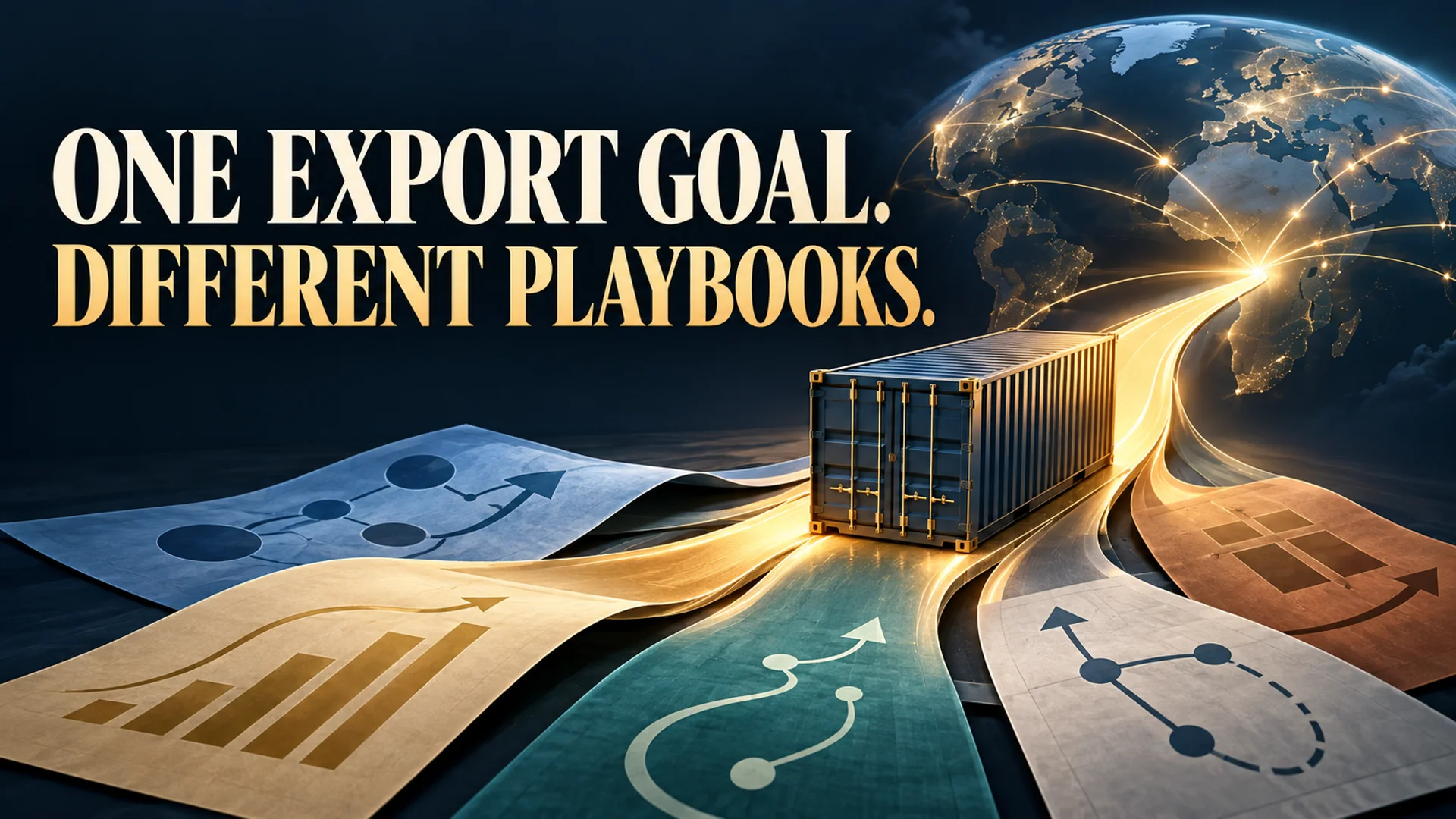
“Our company’s situation doesn’t match this policy at all.”
This is the most frequent—and most disheartening—remark I’ve heard when talking with export companies in Gyeonggi Province.
Haven’t you experienced knocking on support doors only to be handed the same uniform application form and standardized subsidy list?
When One-Size-Fits-All Becomes Poison
Over the past few years, listening to the concerns of small and medium-sized business owners, I’ve come to realize how abstract the word “export” truly is.
For some, advice like “Go to the U.S.” becomes a golden goose. For others, it transforms into an insurmountable wall called “local certification costs,” triggering the first domino that brings down their company.
What we commonly call “export support policies” are often treated like cold medicine. The assumption is naive: anyone can catch a cold, so anyone who takes this medicine will get better. But the reality on the ground is different.
The company supplying semiconductor parts to Japan, the company trying to place organic snacks in American supermarkets, and the company seeking to license its proprietary software technology to the Egyptian market—each faces fundamentally different realities.
On October 23 last year, when Vice Chair Oh Nam-seok of the Future Science and Cooperation Committee of the Gyeonggi Provincial Assembly visited an export company in Suwon City, his conversations starkly illustrated this point.
That day, Vice Chair Oh, along with officials from the Gyeonggi Institute for Science and Technology Promotion (GIST), carefully reviewed the operations of the Gyeonggi Business Center (GBC), overseas exhibition dispatch programs, and trade promotion mission services. Yet, the final verdict from the business owners was a cold assessment: “support that is out of touch with reality.”
In particular, Vice Chair Oh sharply pointed out the sense of isolation felt by companies adopting unconventional market entry methods such as technology transfer or local production.
Loading finished goods onto a ship and planting “intangible assets” like technology abroad are issues of entirely different legal and administrative difficulty. At this juncture, uniform support becomes more than just disregard—it becomes a thorn that stabs the innovative spirit of companies.
Three Minefields Crying Out for Attention
Among the difficulties Vice Chair Oh directly heard during his field visit, the three most critical are “certification costs,” “buyer verification,” and “customs clearance and post-management.”
If a small or mid-sized company stumbles over even one of these, it faces suffocating pressure. Large corporations have dedicated legal teams and certification management personnel, but in companies with fewer than 50 employees, the CEO is simultaneously the salesperson, logistics manager, and accountant.
Indeed, the representative of one agricultural machinery parts manufacturer voiced a lamentable complaint, saying, “We secured an overseas buyer’s quote, but obtaining a single local safety certification (such as CE) wiped out two years’ worth of operating profits.”
Uniform support policies often turn a blind eye to such “detailed expenditure items.” They offer “10 million won in overseas marketing support,” but by the time the company uses that money to obtain certifications, there’s no budget left for airfare to meet buyers or shipping costs for samples.
Another issue is “verification of overseas buyers.”
Determining whether an online acquaintance is a fraudster or a genuinely financially capable partner is overwhelming for small businesses to handle alone. Non-financial services such as “credit investigations” or “legal counsel,” which could help, often fall outside the scope of current support programs.
This is why Vice Chair Oh emphasized strengthening non-financial services such as professional consulting, overseas buyer matching, and legal support for trade dispute resolution.
At this point, policies that “walk alongside” companies are more urgent than those that simply scatter money.
Teaching SMEs the ‘Aesthetics of Collaboration’ Learned First by Large Companies

The line from Vice Chair Oh Nam-seok’s speech that has stuck with me the longest is: “Share the know-how of senior companies with younger ones.”
Gyeonggi Province already has quite a few mid-sized companies that have successfully entered global markets. The lessons from their failures, their understanding of local cultures, and their customs clearance tricks are vivid assets that cannot be obtained from books or reports.
However, our current export ecosystem is a jungle of self-reliance.
While mentoring systems where successful companies share their experiences with newcomers exist outside formal frameworks, official channels remain inadequate.
Vice Chair Oh’s mention of an ecosystem of cooperation and networking among companies within the province is not merely a slogan. He knows that a single phrase like, “This is how our company survived,” can be the key that opens new export pathways.
To build such an ecosystem, an administrative coordinator at the provincial level is needed.
Instead of forcing gatherings, incentives or platforms must be designed to create a “space” where companies can naturally meet and exchange know-how through voluntary interaction. This is the core of the “field-oriented” policies demanded by Councilmember Oh Nam-seok.
2027: When the Budget Moves, Words Will Follow

All policy changes ultimately require “budget” as fuel, and the sincerity of policy makers is revealed during budget reviews.
Vice Chair Oh pledged to reflect the opinions gathered during this field visit in the 2027 budget review. This is a strong signal that his visit was no mere formality.
When uniform support disappears, budgets can become capable of “precision strikes.”
For example, dedicated sessions could be created for “companies pursuing local production,” or a separate legal support pool could be established for “technology transfer disputes.” Gyeonggi Province’s promise of “precise policy design” reflecting these type-specific characteristics can be understood in this context.
However, one point must be addressed. As policies become more segmented, administrative procedures become more complex, potentially increasing the “administrative burden” on companies.
The process of companies categorizing and applying for these segmented supports must not become another source of pain. To address this, Councilmember Oh Nam-seok’s proposal for “regularized field visits and roundtable meetings” is a crucial mechanism. Policy makers must first learn the language of the field, creating an environment where business owners don’t have to memorize administrative jargon.
Moreover, diplomatic exchanges like those between Governor Chu Mi-ae of Gyeonggi and the Governor of North Brabant, the Netherlands, should serve not as a “shade” but as an “umbrella” for individual company support.
It is through improved inter-state cooperative relationships that customs and certification barriers faced by companies can be lowered. The differentiation of support emphasized by Vice Chair Oh can only generate synergy when such macro-level diplomatic activities and micro-level field support are organically linked.
What is the ‘Real Medicine’ Your Company Needs?

Exporting is not a game of conquest, but a game of adaptation.
And the speed of adaptation differs for each company. The reason Councilmember Oh Nam-seok’s remarks resonate is that they directly challenge the bureaucratic laziness hidden behind the name “support.”
Uniform support is convenient for the administration but imposes inconvenience on companies.
The “customized support policy” proposed by the Gyeonggi Provincial Assembly may involve a complex design process and increased administrative burden, but in the long run, it is akin to physical training that strengthens the constitution of Gyeonggi’s exporting companies.
You, reading this, or your company—what is the most concrete difficulty you are facing in exporting?
Beyond simply saying “there is no cost,” isn’t it one of these: “the pain of obtaining certifications,” “the anxiety over fraudulent buyers,” or “the despair of recruiting local staff”?
Have you ever imagined that a medicine perfectly tailored to your company would be prescribed?
As we anticipate what kind of “custom prescription” the Gyeonggi Provincial Assembly will unveil in its 2027 budget proposal, we must continue to watch the field closely.
What do you think? If you have episodes of struggles caused by standardized support policies, or specific support items you hope will change, please let us know in the comments.
References
- 세계로컬타임즈 - 경기도의회 오남석 의원, “수출기업마다 다른 어려움, 지원도 달라져야” · help.naver.com
- 오남석 의원, “수출기업마다 다른 어려움, 지원도 달라져야” · ggc.go.kr
- 기업별 수출 여건 고려한 정책 개선과 도내 기업 간 협력 강화 강조 · vision21.kr
- 경기도의회 오남석 의원, “수출기업마다 다른 어려움, 지원도 달라져야” · ggfocus.co.kr
- 경기도의회 오남석 의원, “수출기업마다 다른 어려움, 지원도 달라져야” · gninews.co.kr