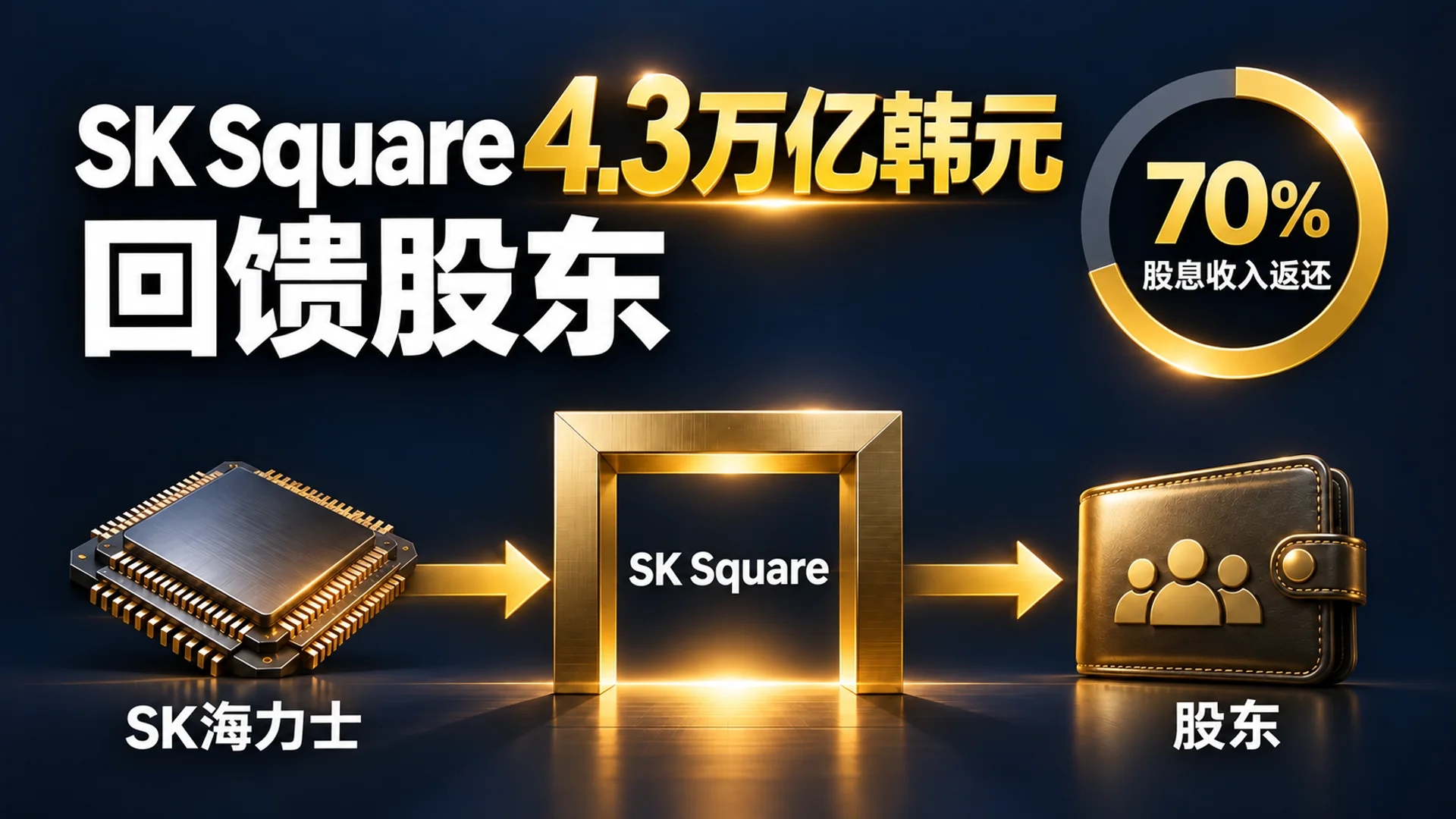
SK Square announced a total shareholder return policy worth 4.3 trillion won, returning 70% of the dividend income it receives from its subsidiary SK Hynix directly to shareholders 12. This represents a significant increase in the return ratio compared to the commitment made at the shareholders' meeting in March to "return at least 30% of dividend income" 32.
The reason for market attention is that this measure reflects the company's determination to utilize cash generated during the semiconductor boom as a core tool to narrow the holding company's NAV discount rate (undervaluation of share price relative to assets). Since approximately 98% of SK Square's net asset value (NAV) consists of its stake in SK Hynix, the efficiency with which subsidiary cash generation is converted into returns for parent company shareholders is a key variable in this policy.
From 30% in March to 70% in October: Background behind the surge in return ratio
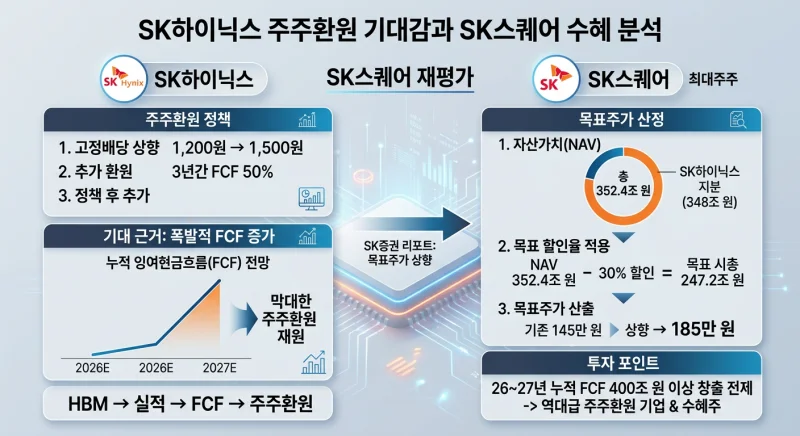
SK Square's shareholder return policy underwent significant changes between March and October 2026. At the March shareholders' meeting, the company proposed returning at least 30% of recurring dividend income under its medium-term policy for 2026–2028, with the initially set return scale for 2026 estimated at around 310 billion won 3.
However, the new policy announced on October 28 significantly raised the return ratio to 70% of dividend income and expanded the total scale to 4.3 trillion won 124. This change is understood to have been made possible because SK Hynix announced its largest-ever shareholder return plan on October 28, with earnings and dividend capacity significantly exceeding previous forecasts.
Cash inflow structure from Hynix: How is SK Square's dividend income generated?
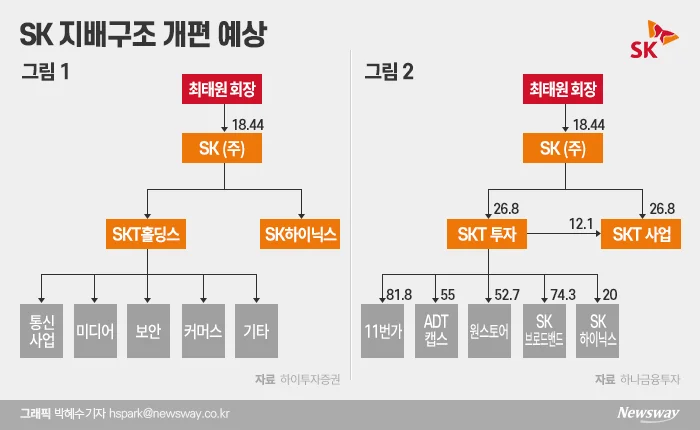
The cash underpinning SK Square's shareholder returns originates from its largest subsidiary, SK Hynix. SK Square is the largest shareholder of SK Hynix, holding approximately 20.5% of its shares, and 98% of its NAV consists of the value of its SK Hynix stake 5.
On October 28, 2026, SK Hynix disclosed annual shareholder returns of approximately 100 trillion won (cash dividends exceeding 30 trillion won + share buybacks and cancellations exceeding 60 trillion won) 4. Notably, in the third quarter, it approved a cash dividend of 20,000 won per share, which includes 10,000 won reflecting earnings improvement and 10,000 won as a special dividend reflecting gains from the sale of its Kioxia stake 4.
According to analysis by SK Securities, SK Square's estimated dividend income for this year is expected to reach approximately 6 trillion won due to SK Hynix's substantial dividend expansion 5. A point of note is the effect of SK Hynix's share cancellations. Every time SK Hynix cancels treasury shares for shareholder return purposes (excluding those for employee compensation), SK Square's stake naturally rises from 20.5% to a maximum of 21.7% 5. This has the effect of broadening SK Square's asset value and dividend income base without additional share purchases.
Reducing NAV discount: Aggressive cancellation strategy to narrow the 'discount'
The specific metric investors need to identify in the 4.3 trillion won policy is the 'NAV discount rate.' As of March 24, 2026, SK Square's NAV discount rate stood at 46.4% 3, while analysis data as of October 29 shows it at 46.5% 5. This indicates that the actual share price is trading at an undervalued level compared to the value of subsidiary stakes held by the company (NAV).
SK Square appears likely to consider share buybacks followed by cancellations as one method for executing this policy. Share cancellation is one of the most powerful tools to increase per-share value by reducing the number of outstanding shares. SK Securities set a target price of 1.85 million won for SK Square, noting that dividends and cancellation benefits will act as direct factors for valuation uplift 5.
Checkpoints for investors: Visibility and sustainability
While SK Square's policy of returning 70% of dividend income is attractive, there are structural characteristics that require scrutiny.
1. Dependence on a single subsidiary
SK Square's shareholder return funds are heavily dependent on SK Hynix's dividends 5. While massive cash inflows are expected at present with the AI memory super cycle maintaining momentum, changes in semiconductor market volatility could affect SK Hynix's dividend capacity 51.
2. Specificity of execution method
Depending on whether the announced 4.3 trillion won is paid immediately as 'cash dividends' or used for 'share buybacks' to enhance per-share value, investors' after-tax returns and liquidity effects differ 6. In the March plan, cash dividends and share buybacks were conducted in parallel to find a balance in shareholder returns, but the specific timing and methods of future execution will be finalized through board resolutions.
3. Establishing financial foundation: Transfer of capital surplus to retained earnings
SK Square has already transferred 5.89 trillion won of capital surplus to retained earnings at its March 2026 shareholders' meeting 3. This is evaluated as a measure taken in advance to create a 'financial foundation' capable of sustaining large-scale returns by expanding the scope of legally distributable profits 6.
Conclusion: Transition of an asset-holding holding company to a 'shareholder-friendly corporation'
SK Square's 4.3 trillion won policy is difficult to view simply as a one-time dividend increase. It is interpreted as a declaration to dispel controversies over the undervaluation of a 'pure holding company' and to maximize cash flow from subsidiaries to the parent company, and from the parent company to shareholders 6. With a certain cash generation engine secured in AI and semiconductors, SK Square has chosen a strategy of leveraging this as the driving force for shareholder returns.
It would be effective for investors to monitor leading indicators such as SK Hynix's quarterly dividend sizes and the speed of treasury share cancellation execution, while simultaneously confirming the trend of SK Square's NAV discount reduction.
参考资料
- 비즈니스포스트 | 사람을 통해 경제를 읽다 · admin.businesspost.co.kr↩
- 매일경제 마켓 · stock.mk.co.kr↩
- SK스퀘어 "3년간 배당수입 30% 이상 환원"…내년 초까지 3100억 쏟는다 · v.daum.net↩
- SK하이닉스, 주당 2만원 현금배당…연간 총 100조원 푼다(종합) | 연합뉴스 · yna.co.kr↩
- [모닝 리포트] "SK스퀘어, 하이닉스 배당·자사주 소각 수혜"…목표가 185만원 · newspim.com↩
- 배당까지 얹었다… SK스퀘어 주주환원 판 바뀐다 · pinpointnews.co.kr↩