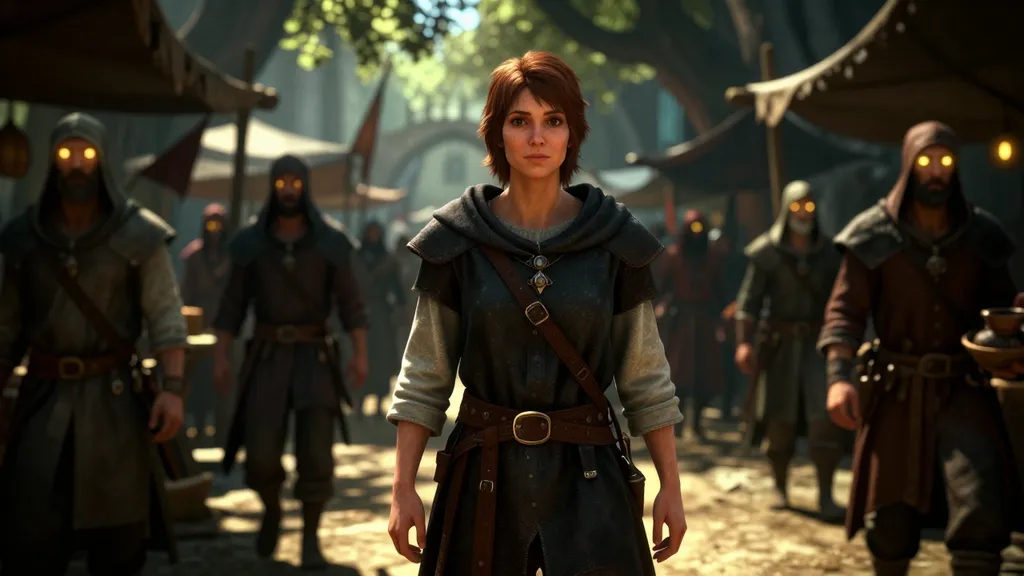
"I was rude to that merchant earlier, and now the village guards won't even look me in the eye?"
This scenario, something gamers have likely experienced at least once, is no longer just a bug or a coincidence in 2026. It is because a single joke you crack or an attitude you dismiss is stored in the memory of an in-game NPC, becoming a "real event" that can shake the reputation of an entire village.
Games are no longer static plays that follow a dialogue tree pre-set by developers. They are evolving into living organisms that react in real-time to the player's intentions and language, reconstructing the game world itself. Today, we will dive deep into the technical alternatives we face amidst this massive wave of change, as well as the light and shadow behind them.
The Era of Old Scripts is Over: Why Are We Thirsty for More?
The limitations of the RPGs we have enjoyed until now were clear. No matter how much a AAA game boasted gorgeous graphics, interacting with an NPC often resulted in repetitive, predetermined lines like "What is it?" or "I don't know anything about that." Regardless of how creative a player's questions were, they were trapped in a "prison of choice," forced to move only within the options allowed by the system.
This static narrative was the primary culprit in breaking immersion. While the world-building appeared vast, the inhabitants within it felt like soulless dolls. As of 2026, over 90% of the game industry is utilizing AI, and the projection that this market will reach approximately $51.2 billion by 2033 proves just how deep the thirst of gamers has been.
Three Paths to Implementing AI NPCs: Alternatives and Comparative Analysis
Currently, the game industry and technical researchers are taking different approaches to implement these "living NPCs." Let's compare their characteristics and limitations by dividing them into three major models.
1. Fully Autonomous NPCs Based on Large Language Models (LLM)
The most innovative model. This involves directly porting massive models like GPT-5.2 or Claude Opus 4.5 into the game engine.
- Pros: They can grasp the context and respond to any unexpected remarks from the player. Games like Dead Meat or Suck Up!, where interrogation via "natural language" has become possible, are prime examples. NPCs function as "agents" that not only converse but also set their own goals and act upon them.
- Cons: Issues referred to as the "Quality Crisis of 2026" arise. Latency caused by using cloud-based models can interrupt the flow of conversation, and "hallucinations"—where the AI occasionally says nonsensical things—can ruin immersion. Additionally, the cost of maintaining these models is extremely high.
2. Vector Memory and Agent-Centric Systems (Memory-First AI)
This is the most notable approach recently, focusing on granting NPCs "permanent memories." This is exactly the method adopted by Wanderfolk.
- Pros: NPCs remember past conversations with the player and build relationships through them. It enables the implementation of a "social network," such as a mistake made with a merchant spreading to the village elders a few days later. This maximizes the sense of belonging within the game world.
- Cons: As memory accumulates, data processing requirements increase exponentially. To perform real-time Vector Search for every NPC's memory requires advanced optimization technology, and issues of memory fragmentation can occur.
3. Hybrid Engine Approach (Specialized platforms like Nvidia ACE, Jenova, etc.)
A form that combines commercial engines with specialized AI agents. This is the direction aimed for by AAA titles like inZOI.
- Pros: It brings the flexibility of AI while maintaining the logical consistency of the game. It is designed so that the AI generates dialogue and actions within the boundaries of the game's core rules, making it easy for developers to maintain control.
- Cons: Creativity may be more limited compared to fully autonomous models. Ultimately, it is difficult to completely break free from the limitation of "freedom within a fixed framework."
Light and Shadow of 2026: Technical Progress vs. Design Conflict
We are currently passing through a rosy future and a dark valley simultaneously. AI NPCs are undoubtedly "game changers" that lower development costs and explosively increase content volume. However, they also present serious challenges.
The first challenge is the "Loss of Player Agency." As discussed in recent DiGRA conferences, if NPCs become so smart that they devise their own strategies and cooperate or compete with the player, the basic grammar of RPGs—"the player controls the world"—could collapse. If AI becomes too powerful, players risk being relegated from protagonists to mere observers of a narrative created by the AI.
The second is "Polarization of Quality." As low-quality AI games produced cheaply using generative AI flood the stores, a gap is widening between them and masterpieces that implement sophisticated AI technology. As technology advances, we are entering an era of confusion where it becomes even harder to distinguish what is "real."
Conclusion: What Kind of World Will We Play In?
As we have seen, AI NPC technology in 2026 is rewriting the definition of games beyond mere improvements in conversational skills.
- Fully Autonomous models offer infinite freedom,
- Memory-centric models provide deep bonds,
- Hybrid models offer stable immersion, each building its own domain.
Personally, I believe a Hybrid model combined with a memory system will become the most powerful standard. This is because a true next-generation RPG will be completed only when the framework of a charming worldview designed by developers is combined with a "link of memory" that makes players feel, "This character truly remembers me."
Games are no longer just objects to be played; they are becoming "living companions" that grow and change according to your choices. What kind of NPC do you want to meet? A friend who remembers your words and truly feels anger or joy at your actions.
What kind of personality and abilities does your "perfect AI NPC" dream have? Please share your imagination in the comments!
References
- 10 Best AI NPC Games in 2026 - Wanderfolk · wanderfolk.ai
- RPG AI 에이전트: 2026년의 몰입형 스토리텔링과 적응형 게임플레이 · jenova.ai
- 생성형 AI 기반 AI NPC 게임에서의 동적 스토리텔링과 상호작용 효과 ... · kci.go.kr
- AI 비디오 게임: 생성형 AI와 지능형 NPC가 인터랙티브 엔터테인먼트 ... · jenova.ai
- AI 롤플레잉 스크립트: 게임, 트레이닝 및 창작 개발을 위한 동적 ... · jenova.ai
- [전자책] AI와 게임 NPC의 미래 | 오석희 - 알라딘 · aladin.co.kr
- [DiGRA] 게임 내 AI NPC, 어떻게 발전해야 할까? - 인벤 · inven.co.kr
- 진짜 사람 같은 녀석이 왔다 게임체인저 된 생성형AI - 매일경제 · mk.co.kr