There is a common misconception that game development is the exclusive domain of skilled programmers, but in reality, game logic is closer to the process of logical judgment and assembly than to memorizing complex syntax. As of 2026, tools that allow users to handle this logic through graphical blocks or node connections have become widespread, opening a path for people with no coding knowledge to complete commercially viable 2D games. Indeed, there are confirmed cases of games created in this manner being released on major platforms like Steam and being used in brand collaboration projects.
No-code development methods are stratified into layers depending on the tool and difficulty level. A guide released by the Unity Team in May 2026 categorizes no-code development paths into four stages. The most basic stage is the pure no-code method, which involves assembling pre-made feature blocks like in GDevelop. Above that lies the AI prompting method, where prototypes are created solely through natural language descriptions, followed by the assisted development method, where AI writes the code on behalf of the user, and finally, the visual scripting method, where complex logic is designed using visual nodes. The choice of tools and the level of the final product one can reach depend on the scale and complexity of the game the reader wishes to create 1.
Completing Game Logic with Blocks Instead of Text Syntax

In the past, the biggest barrier to game development was mastering the syntax of specialized languages like C# or C++. Recent tools have omitted this step, adopting an approach where rules are combined as naturally as describing a situation in human language.
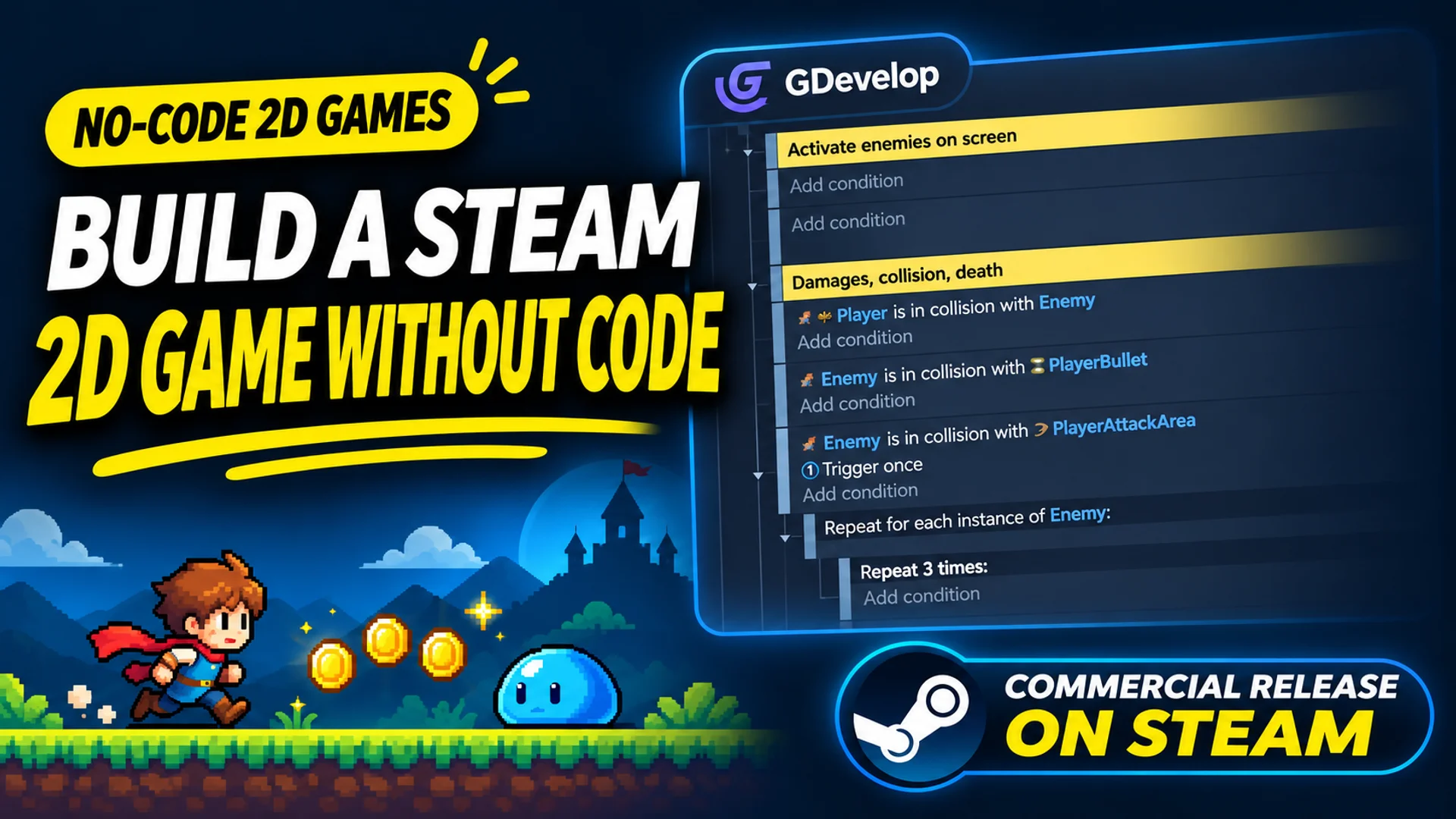
GDevelop’s “Event System” is the most intuitive example of this approach. According to official GDevelop documentation, developers create game logic by placing “Conditions” on the left side of the screen and “Actions” on the right. For example, to create a rule that says “When the player collides with an enemy, reduce health by 20,” one simply connects a “Player and Enemy collision” condition block with a “Player health reduction” action block. This process yields the same operational result as typing text-based code like JavaScript, and the engine is provided free of charge and open-source 2.
This block-assembly method is not limited to simple practice features. According to a fact-check report by the independent review media Zekai in October 2026, games created with GDevelop have recorded over 5 million cumulative plays. Representative titles such as ‘Bullet Bunny’ were featured in Steam Next Fest, and ‘Vai Juliette!’ won the Brazil Mobile Game Award in 2021. Additionally, these tools were used for promotional titles associated with Amazon Prime Video series ‘The Boys’ and ‘Invincible’ 3.
Distribution platforms themselves do not prioritize how a game was made. The Unity Team guide explains, “Steam does not care how a game was programmed; as long as the final output functions normally as an executable and is fun as a game, it is acceptable.” In other words, whether the logic was assembled in blocks or written directly in code, commercial distribution is possible as long as the product runs smoothly 1.
Implementing a Physics Engine by Adjusting Three Numbers
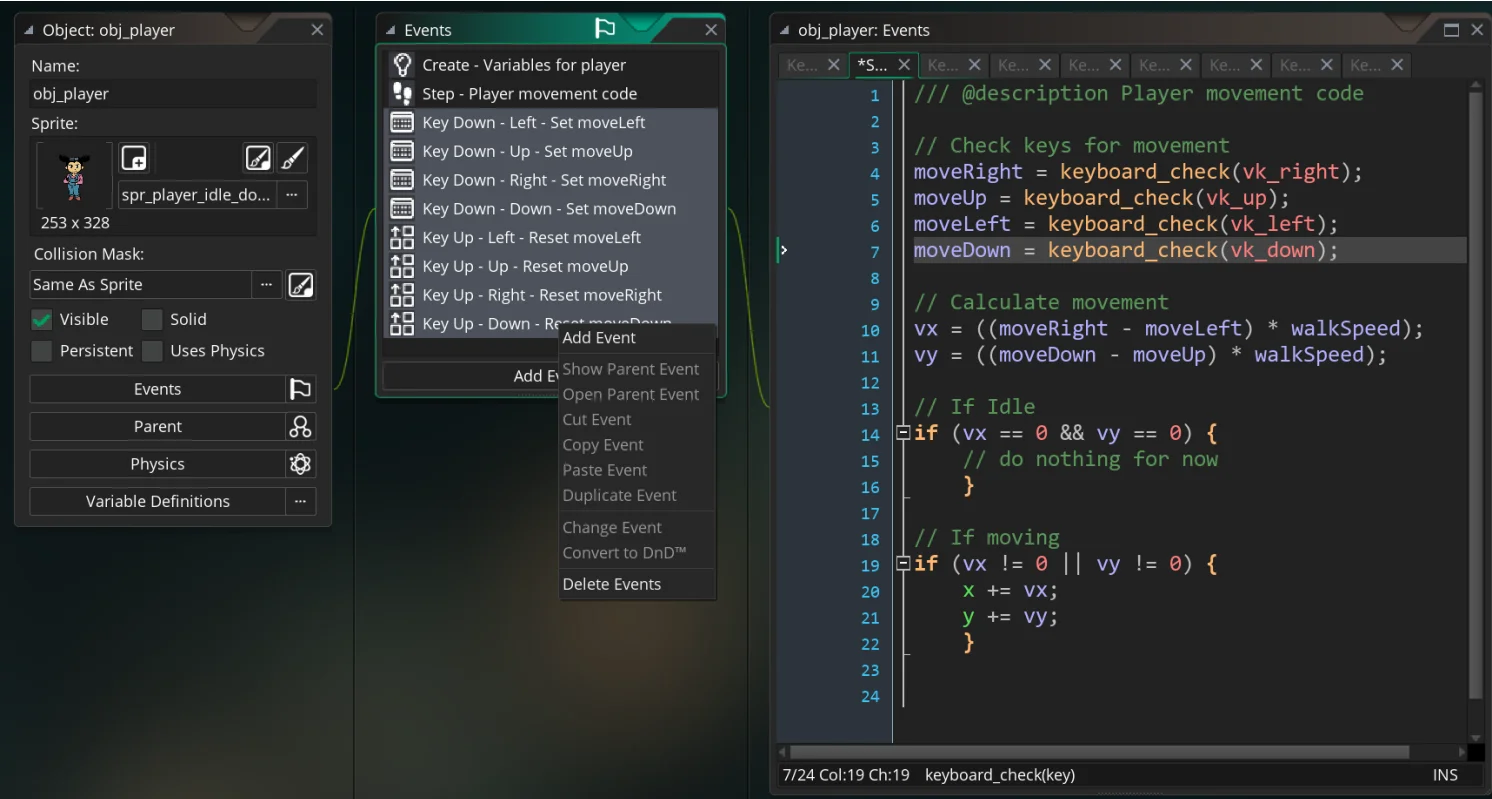
The “physics” elements that bring life to a game can also be handled without coding knowledge. In 2D platform games, the process of a character jumping and falling due to gravity was traditionally an area requiring the direct implementation of complex physics functions, but modern engines provide these as pre-set “Behaviors.”
According to a 2025 guide by the developer tutorial platform Generalist Programmer, physics handling in GDevelop is completed by adding the “Platformer character” behavior to the player character object and inputting just three numbers: a jump speed of 900, gravity of 1500, and a maximum movement speed of 250. Increasing the jump speed makes the character jump higher. Instead of writing code, developers can focus on the task of “designing the feel of the game” by tweaking these values incrementally. GDevelop also supports exporting the assembled game to file formats for various platforms such as Android, Windows, Mac, and Linux with a few clicks, enabling the distribution of a game created once across multiple channels 2, 4.
Visual Scripting and Scaling Complex Logic
Block assembly methods are optimized for simple 2D games. However, as the scale of the game grows and interactions become more complex, visual scripting tools like ‘Blueprints’ in Unreal Engine or ‘Visual Scripting’ in Unity become useful. These methods involve drawing logic by connecting nodes (boxes) with wires instead of using text-based code.
According to a June 2024 report by the online learning platform Codefinity, while Blueprints are fast for prototyping or designing simple interactions (such as opening doors), they may incur computational performance overhead compared to code written directly in C++. As projects become extensive, the network of connected nodes becomes complex and difficult to manage; therefore, it remains common practice to implement core engine systems or parts requiring performance optimization using text-based code 5.
Network and High-Spec 3D: Areas Requiring Coding
To clearly understand the limits achievable without coding, it is necessary to address the current technical limitations. The Unity Team guide states that MMO network synchronization, high-spec 3D memory optimization, and complex crowd AI design are not yet reliably handled by automation tools. In scenarios where multiple users connect simultaneously to share status in real-time, or in 3D rendering that pushes hardware resources to their limits, direct code intervention remains essential 1.
However, Kim Jin-ho, team leader of the Algorithm Research Team at Nexon Korea’s Intelligence Labs and chairman of the NYPC (Nexon Youth Programming Challenge), emphasized in an interview regarding coding education plans by the Nexon Foundation, “AI does not fully grasp the questioner’s intent; it cannot provide answers beyond the questioner’s level.” He stressed that judging whether the output aligns with the intent is ultimately up to humans. This implies that behind the convenience of tools, the ability to “ask clear questions about what one wants” must be present 6.
In conclusion, even without knowing a single line of code, one can complete a 2D game that can be launched on Steam simply by assembling condition and action blocks and adjusting a few numerical values. Such examples exist, and the barrier to commercial distribution is lower than one might think. However, dealing with large-scale multiplayer network synchronization or top-tier 3D graphics memory optimization requires precise systems implemented in text-based code. Game development is changing into a field that demands planning capabilities to identify the goals and scope of the game one wishes to create and select appropriate tools, rather than merely memorizing coding syntax 1.
References
- ↩
- ↩
- Is GDevelop Free? Yes — Limits, Pricing & 8.5/10 Review · zekaiwork.com↩
- GDevelop Tutorial: Complete No-Code Game Development 2025 · generalistprogrammer.com↩
- Codefinity: Courses with certificates | Online Learning Platform · codefinity.com↩
- AI만 있으면 저도 개발자가 될 수 있을까요? · nexonhands.tistory.com↩