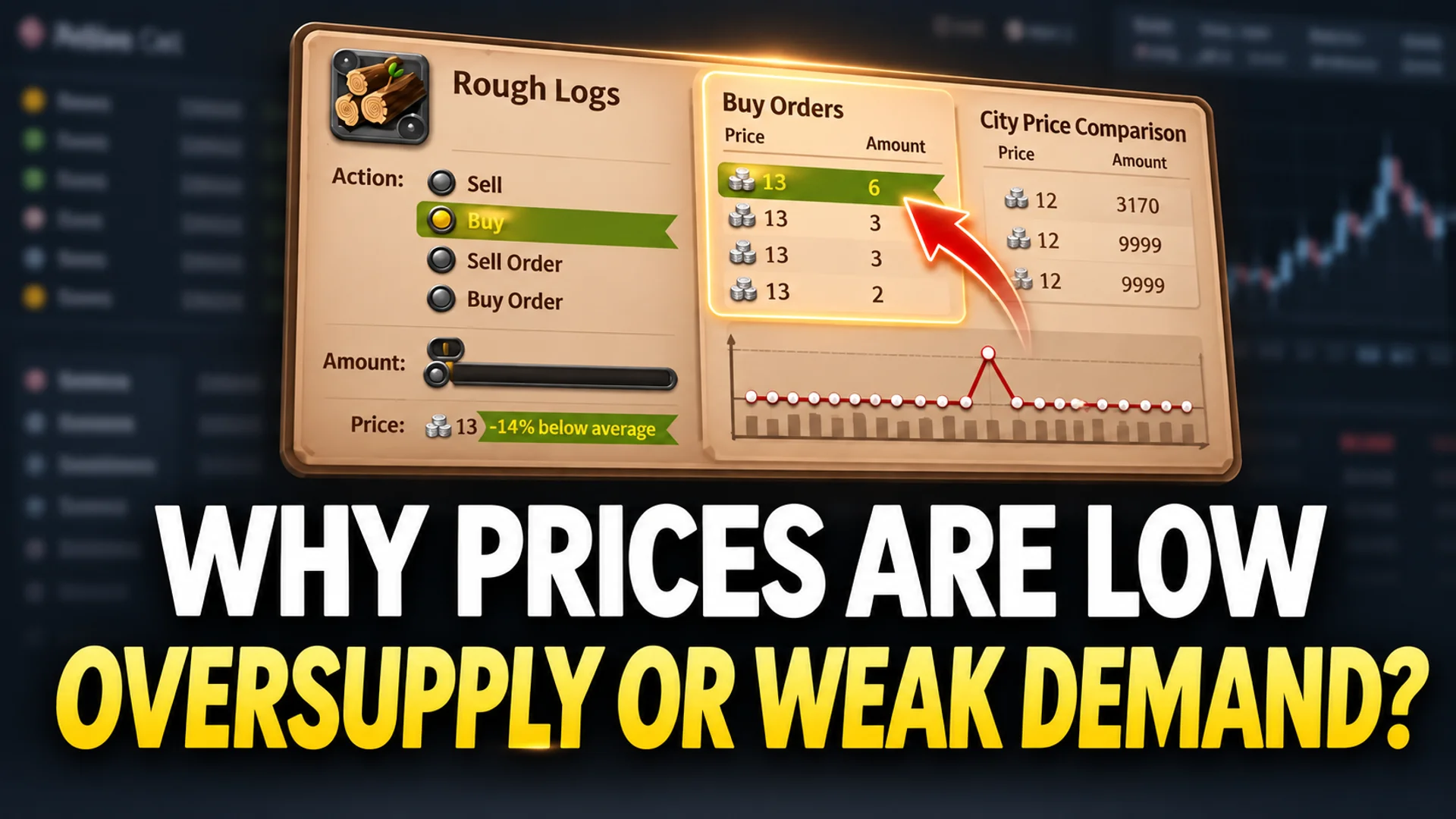
When trading items in Albion Online, players often first open a market comparison site to view city-by-city prices side by side. If they see a large difference, such as 350 Silver in Caerleon versus 100 Silver in Lymhurst, they assume that buying in the cheaper city and transporting to the more expensive one will yield a profit. However, if they believe the ‘buy price’ (immediate purchase price) in the price table is the final amount they pay to purchase items, they will struggle to understand why prices are low in that particular city. The FAQ for the transport profit calculator at newbie-albion.com explains that this benchmark exists “because buying directly in a city requires purchasing sell orders placed by sellers” 1.
This statement implies that the ‘minimum buy price’ displayed on market comparison sites can simultaneously represent two entirely different situations. One is a case where there are many sellers looking to unload items, causing asking prices to drop. The other is a case where there are few buyers, leading sellers to undercut each other’s prices. A single number alone cannot distinguish between these two scenarios 2, 1. This guide explains what data market comparison sites actually display, its limitations, and how to independently trace the reasons why specific cities appear cheap.
Two Numbers Displayed by Market Comparison Sites
Market comparison sites like AlbionTool aggregate current market prices for major cities into a single view 2. The two main values users typically focus on are the ‘minimum sell price’ and the ‘maximum buy order price.’ The minimum sell price indicates the lowest asking price among the current ‘Sell Orders’ in that city. If this number is unusually low in Lymhurst, it means “someone is currently selling very cheaply in Lymhurst,” not that “buyer demand in Lymhurst is extremely high” 1.
The second value, the ‘maximum buy order price,’ shows the highest bid among players who have placed orders to buy items in that city 2. Comparing these two numbers together allows players to infer market activity. If the gap between the minimum sell price and the maximum buy price is narrow, it suggests that sellers and buyers are aligned, indicating a liquid market with active trading. Conversely, if the gap is wide (for example, asking prices are low but bids are even lower), it may indicate a situation where many people want to sell but few are willing to buy 1. In other words, a single row in a price table does not represent the overall market status; it is merely a snapshot of the actions taken by players who placed orders at a specific moment 3.
Two Directions for Low Price Indicators
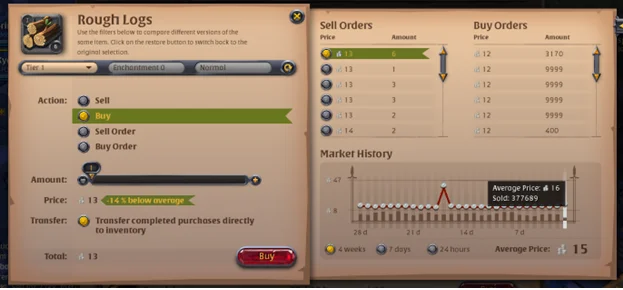
The reasons for a city’s low price display generally fall into supply-side and demand-side factors. On the supply side, the specialization bonuses provided by each city play a crucial role. Cities in Albion Online offer benefits when processing specific resources. For instance, Fort Sterling yields more results when refining timber into planks 2. In cities with such bonuses, structural demand arises to buy and process raw materials. Conversely, if large quantities of resources flow into a specific city, causing an oversupply, sellers will competitively lower their asking prices. In such cases, a low number may not mean “it is cheap because it is popular,” but rather “it is cheap because there is too much of it” 2.
On the demand side, the absence of buy orders can drive prices down. In cities where crafting or combat content requiring specific resources is absent or declining, thick layers of buy orders do not form. If there are many sellers but few buyers, minimum sell asks may continue to drop, yet actual transactions remain scarce. The FAQ at newbie-albion.com explicitly states that the ‘immediate sell price’ in a selling city is based on buy orders and advises that large quantities may not sell out completely during transport if buy orders are sparse 1. Therefore, without distinguishing whether low prices are caused by oversupply or weak demand, it is difficult to accurately calculate transport profits.
Price Tables Are Only Observations at a Given Moment
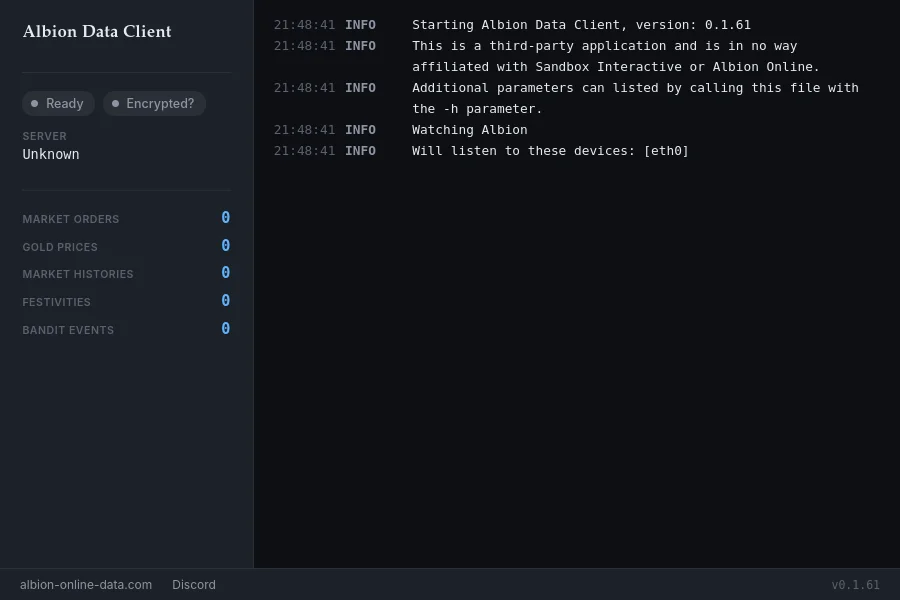
It is also essential to understand how data on market comparison sites is generated. Albion Online does not have an official market API. Most market sites follow a crowdsourcing method, where data clients run by players read network traffic generated when the in-game market window is opened to collect information 4, 3. Guides such as The Albion Online Data Project and albionmarket.gg note that these clients upload data only from pages players have “actually opened in-game” 3, 4.
This structure creates significant limitations. The numbers in price tables are not complete market realities but merely “observations taken when someone opened that window.” If no one has opened the window for a specific item in a specific city, that information may not be updated or may remain as an outdated value 3. Consequently, when a price appears unusually low in a specific city, distinguishing between a structurally low price and a temporary minimum observed in a recently opened window requires checking the recency of the data and the depth (quantity) of orders 4.
Criteria for Judging the ‘Why’
To trace the reasons ‘why’ prices are low using market comparison sites, several clues must be synthesized. First, examine the spread between the minimum sell price and the maximum buy price. If the spread is thin and has persisted for a long time, the low price is likely structural, backed by stable supply and demand. Conversely, if the spread is wide and data points are sparse, the low price may indicate a thin market formed due to lack of buy pressure, or it may be a temporary phenomenon. In such cases, it is necessary to check price trend graphs to determine whether the number has persisted for days or was just recently observed 2.
Additionally, consider the city’s specialization structure. For example, if timber prices in Fort Sterling are higher than elsewhere, it likely stems from structural demand created by refining bonuses 2. Conversely, if only a specific city is inexplicably cheap, verify whether genuine buyer demand exists by checking the ‘maximum buy order price’ in the price table. While market comparison sites provide city-by-city price placements, trend graphs, and calculators, they do not offer a feature that explains in a single line why a specific city’s price is lower than others 2. They display the arrangement of numbers, and players must connect these numbers with their gaps, trends, and city characteristics to find the answers.
In conclusion, the ‘buy price’ on market comparison sites represents the lowest current sell ask, not buyer demand 1. Therefore, this single number alone cannot definitively confirm weak demand or oversupply 2. However, by analyzing the spread between buy and sell asks, the data update frequency, and city specialization bonuses together, players can determine whether a price difference represents a sustainable transport profit or a gap lacking transactions. Market price tables should be used not as machines that provide answers, but as maps that help specify questions.
References
- 알비온 도시간 운송 수익 계산기 · newbie-albion.com↩
- 📈 Americas Market Prices Live | Albion Market Tool · albiontool.com↩
- The Albion Online Data Project · albion-online-data.com↩
- 알비온 마켓 데이터 클라이언트 설치 가이드 (2026): 설치부터 실행까지 · albionmarket.gg↩