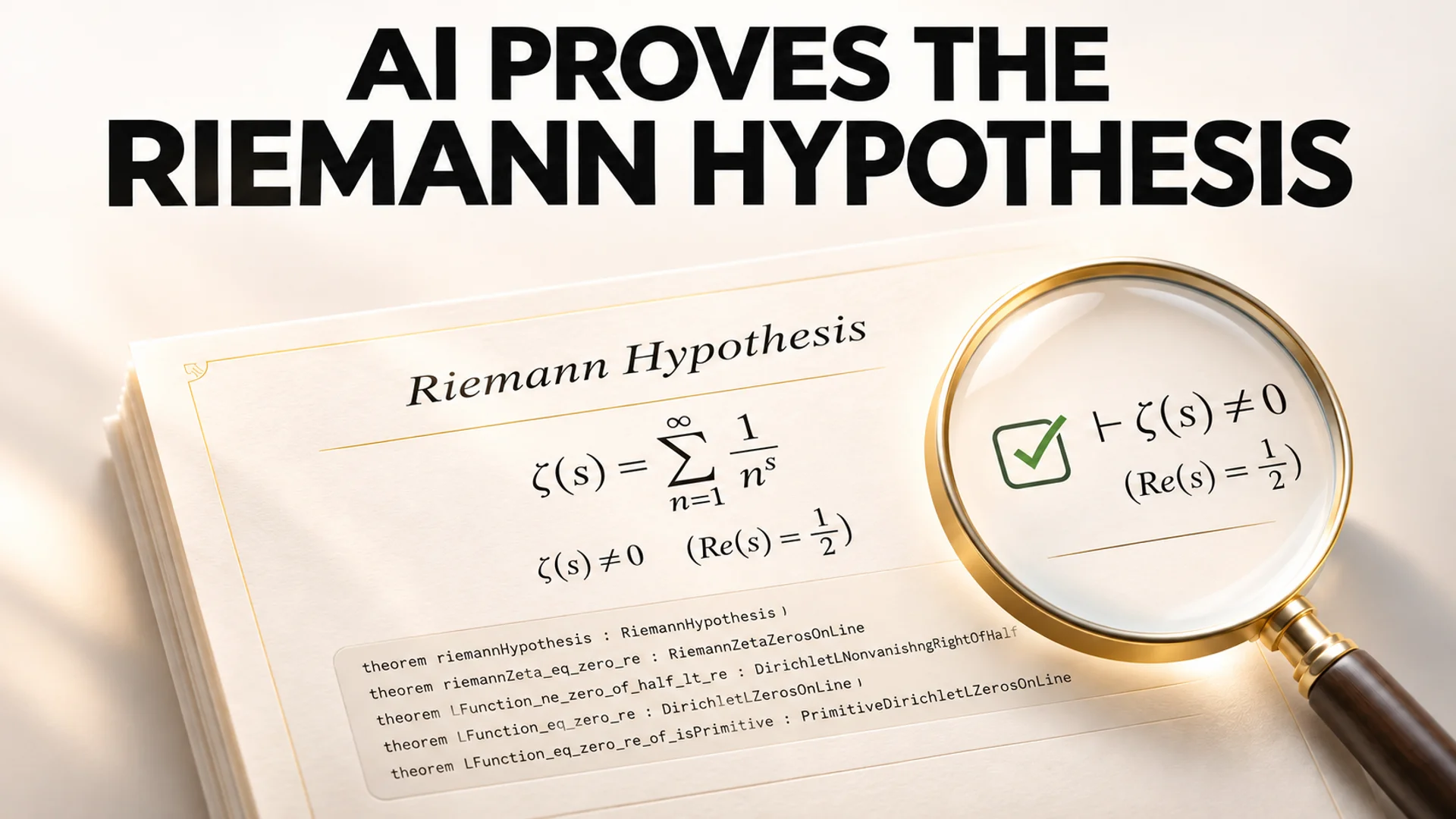
A New Proof of the Riemann Hypothesis Has Been Announced
A new proof has been announced for the Riemann hypothesis, a longstanding unsolved problem related to the distribution of prime numbers. On November 20, mathematician Levent Alpöge and the AI Claude announced proofs of the Riemann hypothesis and the generalized Riemann hypothesis, written in Lean 4, a language for checking mathematical proofs. On the 25th, a shorter version created by Claude and Anthropic colleagues was released. The repository contains both a roughly 300,000-line version organized for human readability and a compressed version of about 76,000 lines. 1, 2, 3
The Riemann hypothesis is a longstanding mathematical problem related to the distribution of prime numbers. The way the proof was verified is just as interesting as the announcement itself. The repository states that the proof passed machine checking only, that no mathematician has read it in its entirety, and that there is no accompanying paper. So what did the verdicts from the various checkers actually confirm? 2, 4
First, what is claimed to have been proved?
The Riemann hypothesis is a claim about the points where a mathematical function called the Riemann zeta function equals zero. It says that, except for the known zeros at negative even integers, all the other zeros lie on a line in the complex plane whose real part is 1/2. You can think of a complex number as a number represented by a real part and an imaginary part. 1
The five theorems checked this time include the Riemann hypothesis and related claims, as well as claims about the zeros of a function called a Dirichlet L-function. The generalized Riemann hypothesis referred to here is the version for Dirichlet L-functions. It does not mean that a generalization covering every kind of L-function has been proved. 1, 3

Image source · mrubinst.github.io
There is a reason it matters exactly what is being checked. Lean checks proofs of propositions written in code, but it cannot determine for itself whether a proposition means the same thing as the problem a person originally intended to solve. For example, if a condition is missing or a function is defined differently, even a valid proof may not answer the original question. 5
How were the same five theorems checked again?
Andrew Sutherland of MIT published the results of checking the two shorter versions with Claude Code. The page was last updated at 02:50 UTC on November 26, or 11:50 a.m. in Korea. The check was performed on the shorter versions released on the 25th, separately from the check of the original proof, which was about 17 million lines long. 3
Both versions built without errors. Building is the process of turning source code into an artifact that can be checked. Then Lean’s core checker, the kernel, rechecked each module and accepted all 803 modules in the human-readable version and all 794 in the compressed version. In other words, the completed proof terms were checked again, separately from the work used to construct the proofs. 3, 1
The checks also used checkers written independently of Lean. According to Sutherland’s record, both versions passed checks by nanoda, con-leche, con-ron, and others. A tool called comparator also compared the five propositions in the submitted proofs against predefined problem files, checked the permitted axioms and the verdicts of several checkers, and returned passing results for both versions. 3, 5

The files containing the proposition definitions in the two versions were byte-for-byte identical. In addition, four definitions in those files were textually identical to the corresponding definitions in the original proof. This provides a point of comparison for establishing what the shorter versions prove. 3
There was also a resource issue during verification. The independent checker lean4lean completed its run on the human-readable version on a large computer, but the run was interrupted on another computer with 128 GB of memory, so no verdict was returned. The interruption does not mean the checker refuted the proof. 3
Does a shorter version make for a more certain proof?
The two versions contain the same theorems, but the cost of checking them differed. The figures below are measurements from checking each version’s exported proof data with the independent checker lean4lean on the same large computer. 3
| lean4lean check | Human-readable version | Compressed version |
|---|---|---|
| Source code | About 300,000 lines | About 76,000 lines |
| Check time | 2 hours 35 minutes | 28 minutes 39 seconds |
| Maximum memory | 332 GB | 7 GB |

According to Sutherland’s record, checking a single definition, tiltTheory, in the human-readable version took about 2 hours and 12 minutes. The compressed version expressed this definition differently. However, these figures compare the cost of running a particular checker on particular computers. They are not a measure of whether the compressed version is mathematically truer or more certain. Both versions passed the checker in question. 3
The five theorems in both versions were also checked to depend only on Lean’s three standard axioms—that is, principles accepted as starting points without proof. This means they did not rely on extra assumptions representing unfinished proofs or on new axioms introduced to solve this problem. It does not mean they use no axioms at all. 3, 5
Multiple independent checkers reduce the risk of relying on a single program that may contain a bug, but they do not eliminate assumptions such as the correctness of the logical framework or the problem files used for comparison. 5
In closing
In this case, the two shorter versions passed checks by multiple checkers for the same five theorems, but the human-readable version used far more time and memory than the compressed version in one check. Machine verification is not about the length of a proof file or how fast it can be checked; it is about confirming that a specified proposition follows from the permitted axioms. 3, 5
When you hear that AI has solved a difficult problem, what verification result would you most want to know about?
References
- GRH Lean Check · mrubinst.github.io↩
- ↩
- Shorter GRH Lean proof: verification files · math.mit.edu↩
- RH Lean proof: verification files · math.mit.edu↩
- Validating a Lean Proof · lean-lang.org↩