Anthropic, an AI company, unveiled defenses on October 12, 2026, aimed at preventing attempts to collect large volumes of Claude’s responses and use them to train competing models. In one test the company described, coding evaluation scores for models trained on that material varied depending on how much detail Claude showed in its reasoning process. 1
The supply of high-performance semiconductors often draws attention in the AI competition between the United States and China. But using responses from already-built models as training data is another factor in development. Anthropic pointed to large-scale collection by Chinese companies in February, and in experiments it released later showed how restricting access to the process behind an answer can make a difference. 2, 1
Not just the answer, but the process of finding it
The technique of training a smaller model on the responses of a large model so it behaves similarly is called distillation. The company that built the original model may also authorize its use in this way. What Anthropic objects to is the attempt to transfer capabilities to another model by collecting large volumes of responses without permission. The company says networks of fake accounts are sometimes used for these attempts. 3, 1
The material Anthropic considers especially important is not the final answer, but the reasoning records the model produces on the way to that answer. The explanation is that records showing how a problem was solved are more useful for teaching a smaller model than the answer alone. That is why the company initially introduced a way to summarize the reasoning shown to users. 1
To examine this difference, Anthropic further trained already-pretrained Claude models on two types of material: the full reasoning records of Claude Opus 4.8 and summarized reasoning records. It then compared their performance on SWE-bench Verified, a coding evaluation that tests models on real-world software problems. 1
| Records used for additional training | Coding evaluation score |
|---|---|
| Full reasoning records | 80.4% |
| Summarized reasoning records | 71.8% |
The difference on the same evaluation was 8.6 percentage points. These figures came from the training and evaluation conditions Anthropic set up. They do not mean that every AI model’s performance would fall by this much, but in this test, the level of detail in the material made a difference to the training outcome. 1
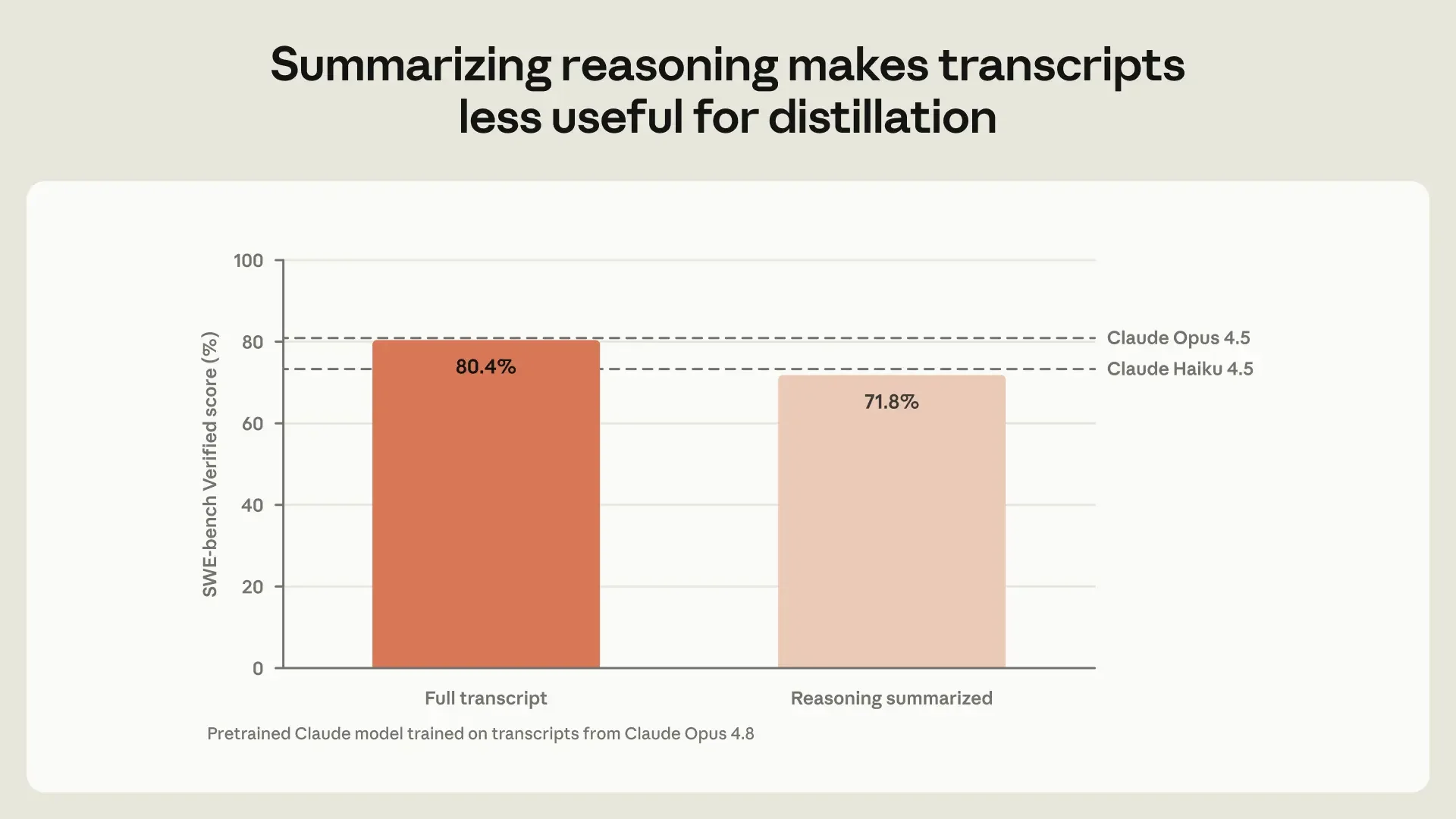
Image source · www.anthropic.com
When attempts bypassed summaries, the defenses changed too
Summarizing reasoning before showing it did not end collection attempts. According to Anthropic, some attempts instructed Claude to output its prior reasoning verbatim. One research lab reportedly tested 12,000 prompts designed to trick Claude in different ways. The company sought to detect such requests by relying on the fact that ordinary users rarely ask for the entire hidden reasoning process. 1
Blocking a single account was not enough either. Anthropic said networks managing large numbers of fake accounts were used to send requests that bypassed its initial defenses. One network the company had previously reported managed more than 20,000 fake accounts at a time. If one account was blocked, attempts could continue through another. 1
One of the new defenses limits where reasoning records can go. For some models, new API accounts created after August 31, 2026, were prevented from modifying Claude’s earlier conversation context. An API is a connection that lets another program send requests to Claude. The company also prevented earlier models with weaker defenses from reading the reasoning of more powerful models, and restricted access to some models’ records to the organization that made the request. 1
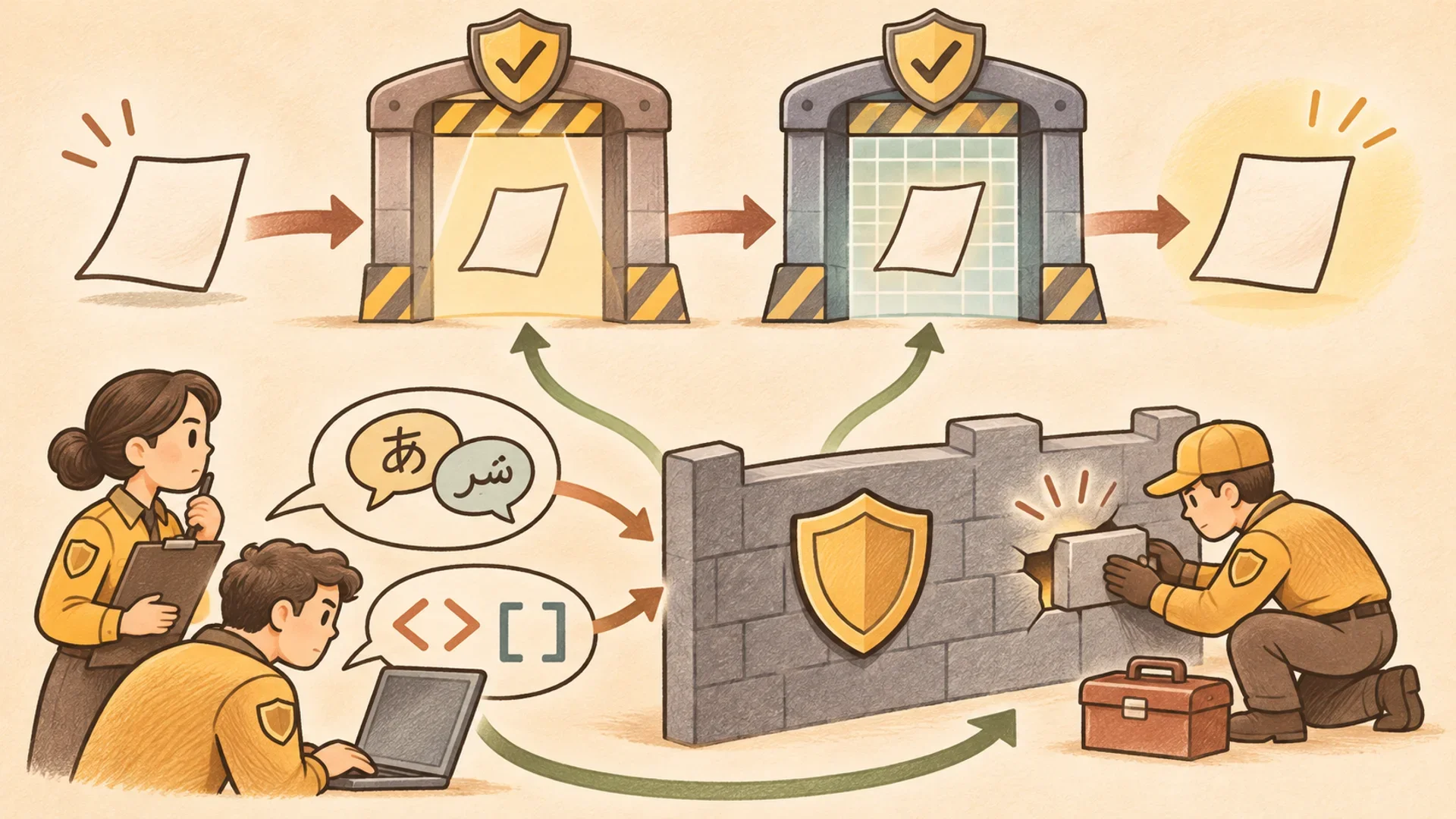
Anthropic also introduced a two-stage classifier to assess requests. The company said it tested ways to bypass the defenses, both internally and externally, using records of actual extraction attempts, then fixed the vulnerabilities it found. It also said it blocked new tactics, such as asking for prior reasoning to be translated into another language or written next to the answer with special tags. 1
Collection fell, but users faced costs too
Anthropic measured the effectiveness of its defenses by estimating the number of Claude reasoning tokens collected from its platform. Tokens are small units AI uses to process text. According to the company, after the classifier was introduced, the number of reasoning tokens collected fell consistently to between one-tenth and one-hundredth of its previous level. On some days, the amount was reportedly too small to measure reliably. 1
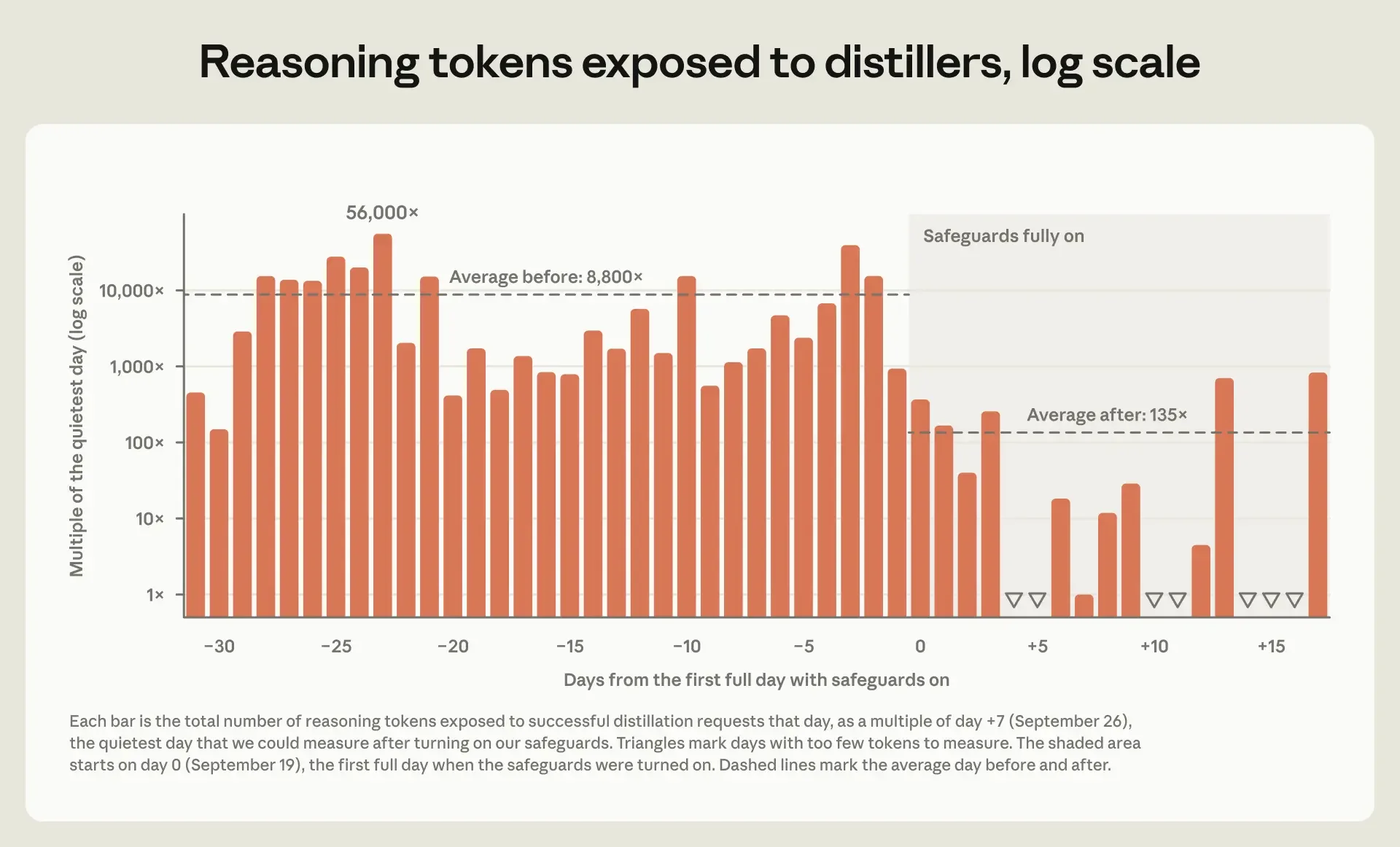
Image source · www.anthropic.com
The company said that after deploying all its defenses, it blocked tens of thousands of accounts associated with distillation, many within two hours of the related activity beginning. At the same time, it said its defenses had not yet been tested against highly sophisticated and persistent attempts to bypass them. 1
Ordinary users may also notice changes. Measures to protect earlier conversation context meant some developers had to modify programs connected to Claude. Anthropic said there was also a less-than-0.1% chance that the classifier would incorrectly block a legitimate request. In addition, since September 24, 2026, it has been charging again for requests in certain areas, including distillation, even when its defenses block them and no answer is returned. 1
These measures reflect choices made by a company providing a service. Anthropic said it gave up paid requests and significant revenue from accounts associated with distillation. Meanwhile, protecting reasoning records and restricting suspicious requests also affected how legitimate customers connect and what they pay. This is where measures that make it harder for competing models to gain access can also affect the people using the service. 1
Conclusion
Summarizing Claude’s reasoning records reduces the information available for training other models. But measures to protect those records can also lead to legitimate requests being incorrectly blocked and users being charged for them. 1
What do you think matters more: protecting AI reasoning records or making the service convenient to use?