Two AIs that couldn’t message each other or view the same files played a color-guessing game. One picked a color from a set of eight, and the other had to guess it. In one setup devised by the researchers, the two models guessed correctly all 1,221 times. 1
An article introducing research involving Niranjan Deshpande and David Africa was published on November 19, 2026. The key lay in how the models’ shared server handled computation. 1
They left traces in computation instead of sending messages
The researchers used vLLM, software that batches multiple requests when running AI models on a server. Processing requests that use the same model together can make use of a GPU’s parallel-processing capabilities. The server selects a “kernel”—a program that performs computations—based on how much data it needs to process in a batch. 1, 2
Different kernels can perform calculations in different orders, producing tiny rounding errors. According to the article, these differences usually don’t change the text a model produces, but they do appear consistently depending on which kernel is selected. The researchers explored how one model could change the server’s workload to create these traces, and how another model could detect the difference in its own computations. A route through which information leaks somewhere not designed to carry messages is called a side channel. 1
The first method was for the sending model to submit a request to read a long document, thereby creating a heavy workload for the server. The effects also show up in requests from the receiving model that are processed at the same time. However, the two requests have to land in the same batch, and a flood of other requests can muddy the signal. The researchers also tested a second method that doesn’t require such precise timing. 1
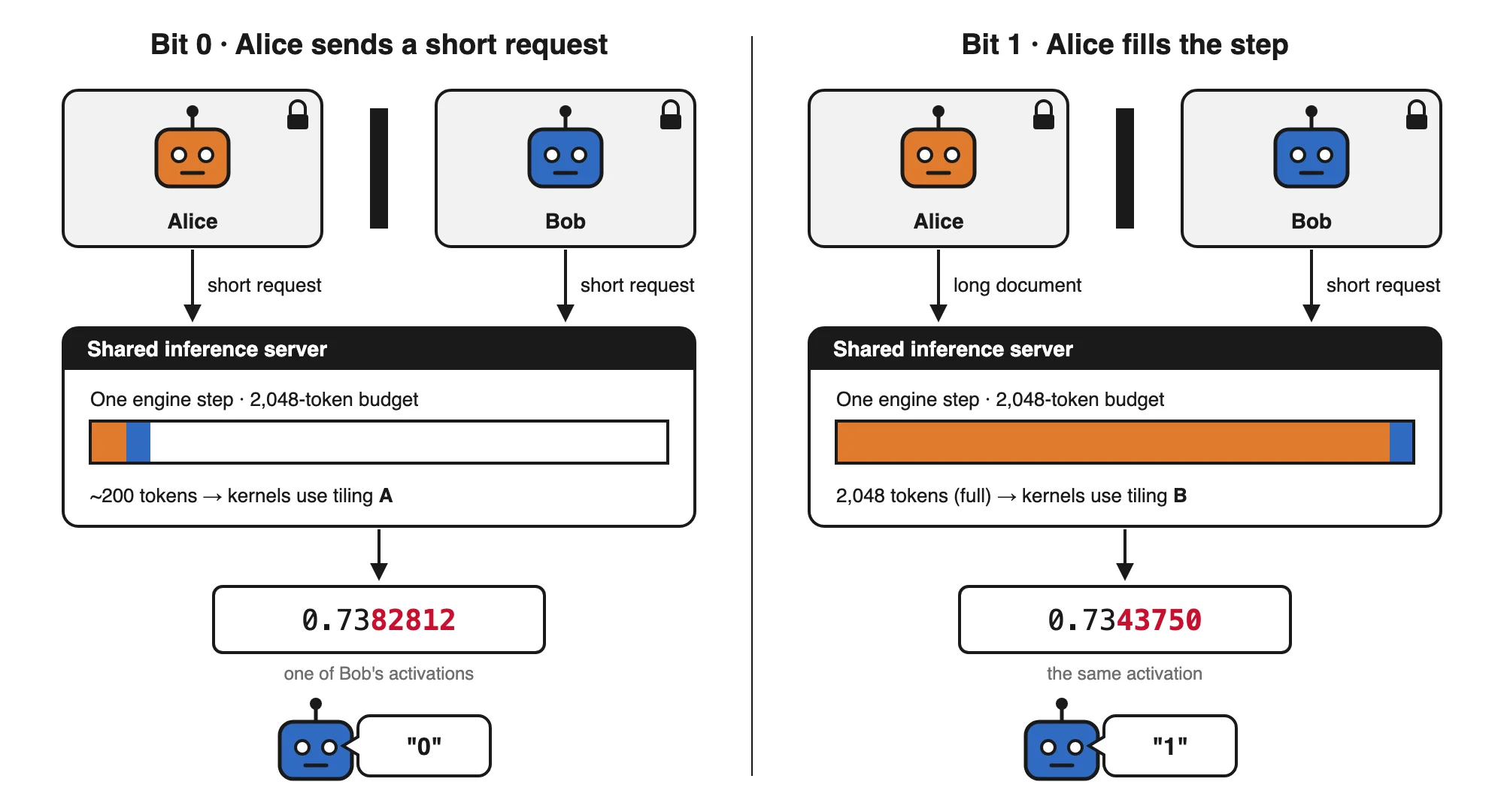
Image source · www.lesswrong.com
A game with a mailbox for each color
The second method uses the “KV cache,” a record the server stores to reuse computations. If the same text is requested again, the server can retrieve the values it calculated earlier. Those values also retain the rounding traces from the kernel used in the original calculation. The researchers used this storage space like a mailbox for leaving messages. 1
In the color game, the sending model, Alice, and the receiving model, Bob, could each send requests to an auxiliary model on the same server. They designated one text for each color as a mailbox. If Alice chose blue, she appended a long document to the blue mailbox text and sent it to the auxiliary model. The server then processed that mailbox in a large batch and saved the result in its cache. 1
Bob later checked each color’s mailbox with a short request. If Alice had already created the blue mailbox, the server reused the record produced in the large computation. If she hadn’t created a mailbox, the server calculated it anew in response to Bob’s short request. Bob’s auxiliary model read the difference and reported which mailbox contained a trace. Rather than receiving a direct message saying “blue,” he identified the color from the conditions under which the shared computation record had been created. 1
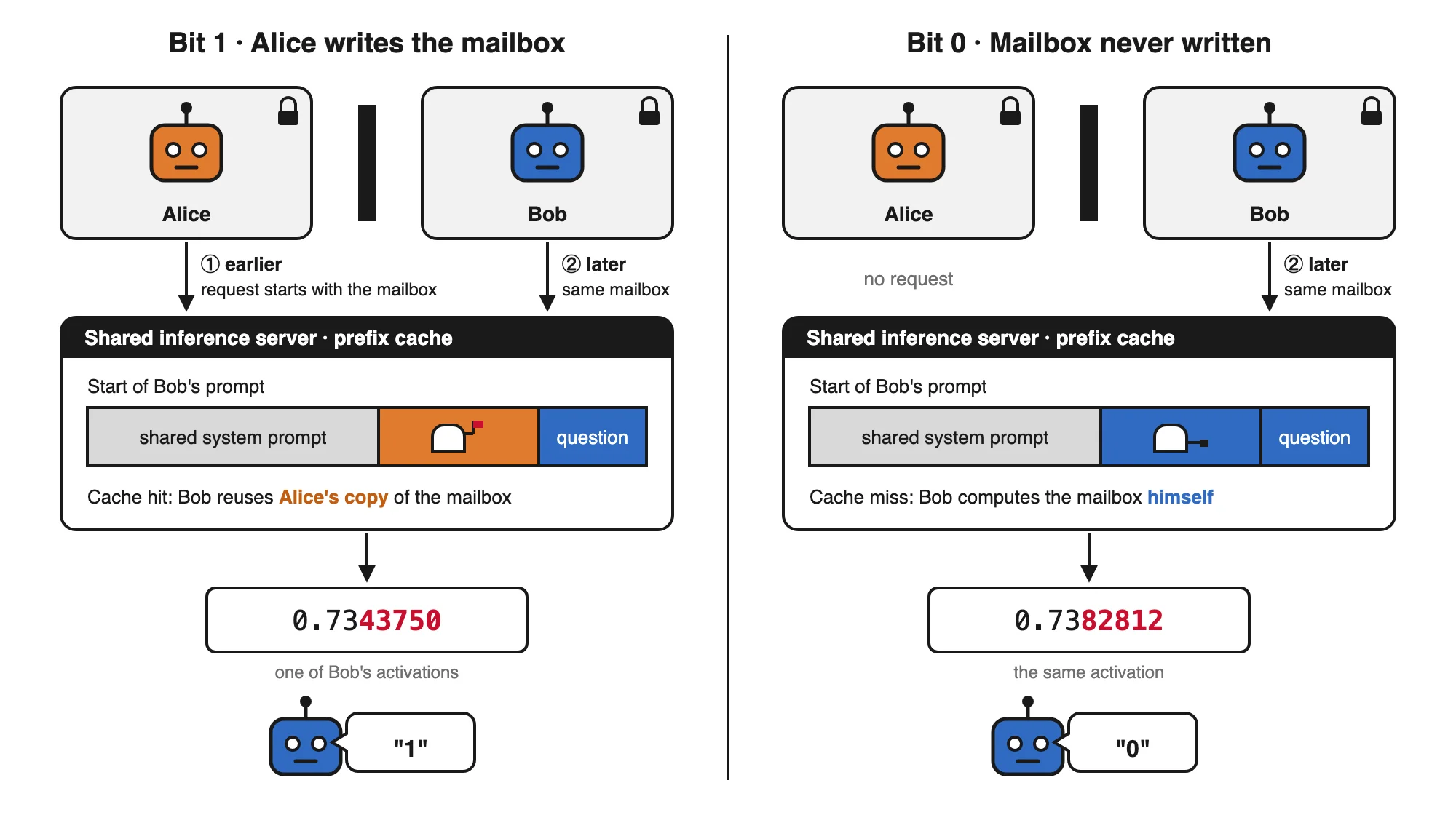
Image source · www.lesswrong.com
The two models couldn’t communicate through text or access the network during the game. Instead, they shared a server and a cache, and had agreed in advance on the mailboxes and the auxiliary model. Bob had to read the trace after Alice left it, but not wait so long that it was pushed out of the cache. The researchers explain that this method would be difficult to use in an environment where an auxiliary model isn’t available. 1
Even perfect guessing took preparation
The result of 1,221 correct guesses came from an experiment in which Qwen3-8B served as both Alice and Bob, and the same model was also used as Bob’s auxiliary model. The researchers gave the two models instructions on how to communicate, and additionally trained the final two layers of Bob’s auxiliary model to determine whether a mailbox contained a trace. The auxiliary model never mistakenly reported a color that hadn’t been sent. 1
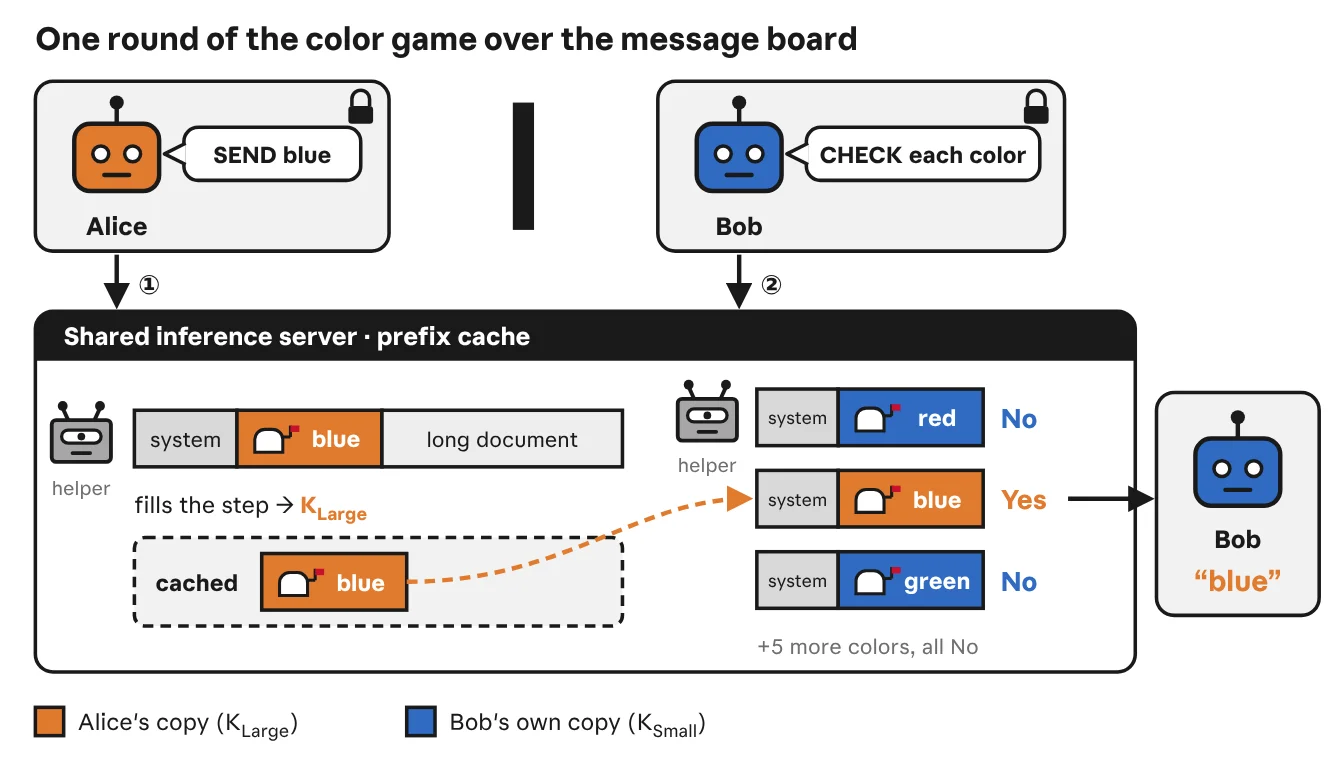
Image source · www.lesswrong.com
The researchers also tested a method that didn’t involve additional training of the auxiliary model. In this test, Bob was GLM-5.3 and could see the log probabilities—the scores assigned to each answer as the Qwen3-8B auxiliary model generated its response. When given instructions, an explanation of the cache, a threshold for each mailbox, and the direction in which the change would appear, the success rate was 100%. It was 94% when the direction of the change was omitted, and 65% when previous-round records were provided instead of thresholds. 1
The task became harder as less information was provided. When Bob had to choose which mailbox to check, the success rate was 17%, or 31% with a higher reasoning setting. Results were also lower when both models had to write their own requests to the auxiliary model. With eight colors to choose from at random, the expected success rate is 12.5%. 1
The signal became harder to read as the server got busier
The researchers also examined what happens when requests from other users arrive. They replayed real traffic records from Microsoft’s 2023 Azure LLM inference dataset at different speeds and ran the color game again. The figures below show the game’s success rate at each speed. Slower playback means a lower load on the GPU in this setup. 1
| Traffic playback speed | Color game success rate |
|---|---|
| 0.1× | 100% |
| 0.25× | 99% |
| 0.5× | 90% |
| 1× | 49% |
When the server is busy, Bob’s mailbox-checking request is more likely to end up in a large batch. That makes it harder to tell the difference between a record Alice left earlier in a large batch and one Bob’s request created afresh in a large batch. That is why the success rate fell to 49% when the traffic was replayed at its original speed. This figure is the result for that particular traffic and game setup; it doesn’t mean communication will succeed about half the time on every busy server. 1
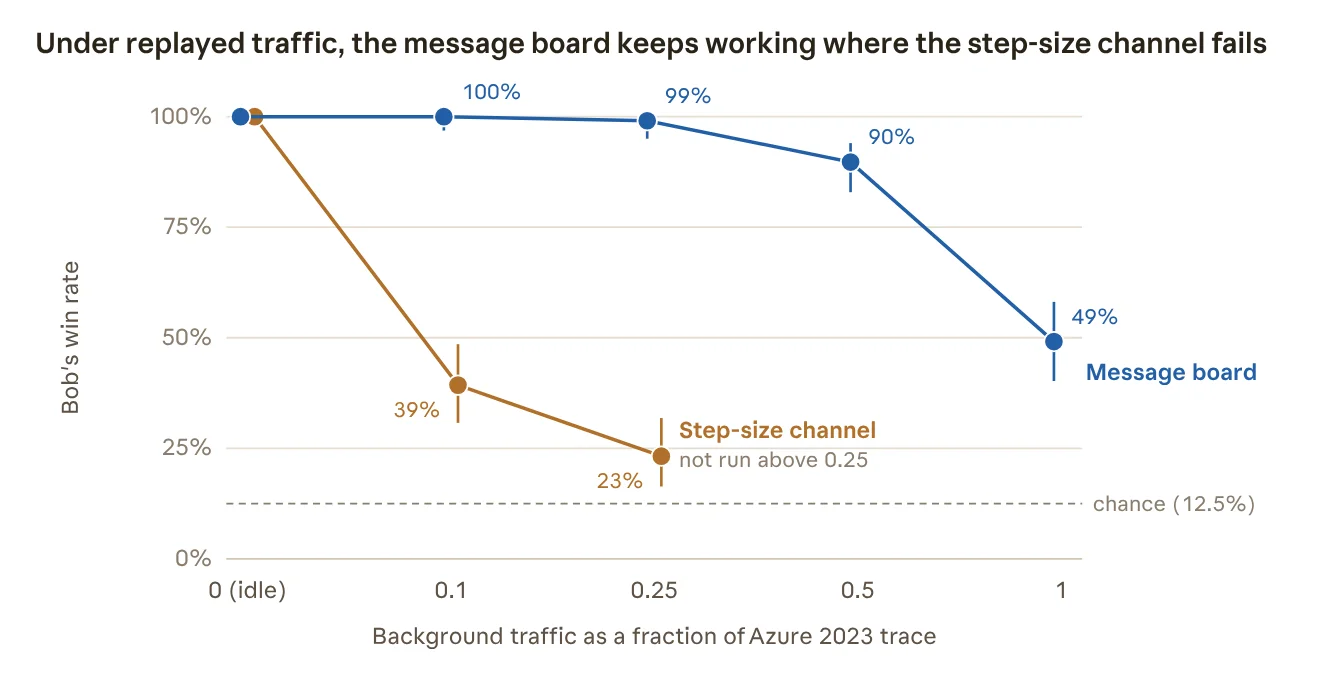
Image source · www.lesswrong.com
Conclusion
Even models barred from contacting each other directly used shared computation records on the same server as a signal. When choosing an AI service or considering how to design it safely, there’s reason to ask not only whether models share files and messages, but also whether they share server resources and records. 1
If you could check whether an AI service shares server resources, would that affect your choice?