A development manager named Daniel at an enterprise software company was weighing a custom feature for one customer. He didn’t want to reject the deal outright. He wanted management to understand, though, that even after winning the contract, the feature would need to be tested and maintained for years. To explain the dilemma, his mentor laid out a hypothetical calculation comparing a €300,000 contract with the cost of additional staff. 1
The company maintains an SDK—a set of development tools that lets other software use its features. Because multiple customers use the same tools, supporting one customer’s special way of using them means checking that the customer’s feature still works whenever a shared feature is changed later on. The contract money up front and the work required down the road run on different timelines. 1
When a Shared Tool Gets Customer-Specific Paths
The customer had asked to have a feature in the shared SDK opened up so it could be used in a different way. The work doesn’t end when the feature is first added. The team has to test the separate path created for that customer and maintain it so the existing way of using it keeps working in new versions. Before changing shared code, they also have to check that the path still works. 1
The mentor said he didn’t yet have the company’s actual figures, so he made up numbers to illustrate the point. He assumed the sales team wanted three custom SDKs a year and that the contract under discussion was worth €300,000. He expressed the maintenance burden in full-time equivalent (FTE) units. One FTE is the workload of one person working full time. 1
| Compared on the same basis | Standard SDK | Custom SDK |
|---|---|---|
| Maintenance workload per SDK | 0.15 FTE | 0.47 FTE |
| Maintenance workload for 3 new SDKs that year | 0.45 FTE | 1.41 FTE |
| Additional workload compared with the standard approach | — | 0.96 FTE |
Across the three SDKs, the difference is 0.96 FTE—almost the workload of one full-time employee. This figure is not the result of actual measurements; it comes from a calculation that assumes each custom path requires additional testing and compatibility work. 1
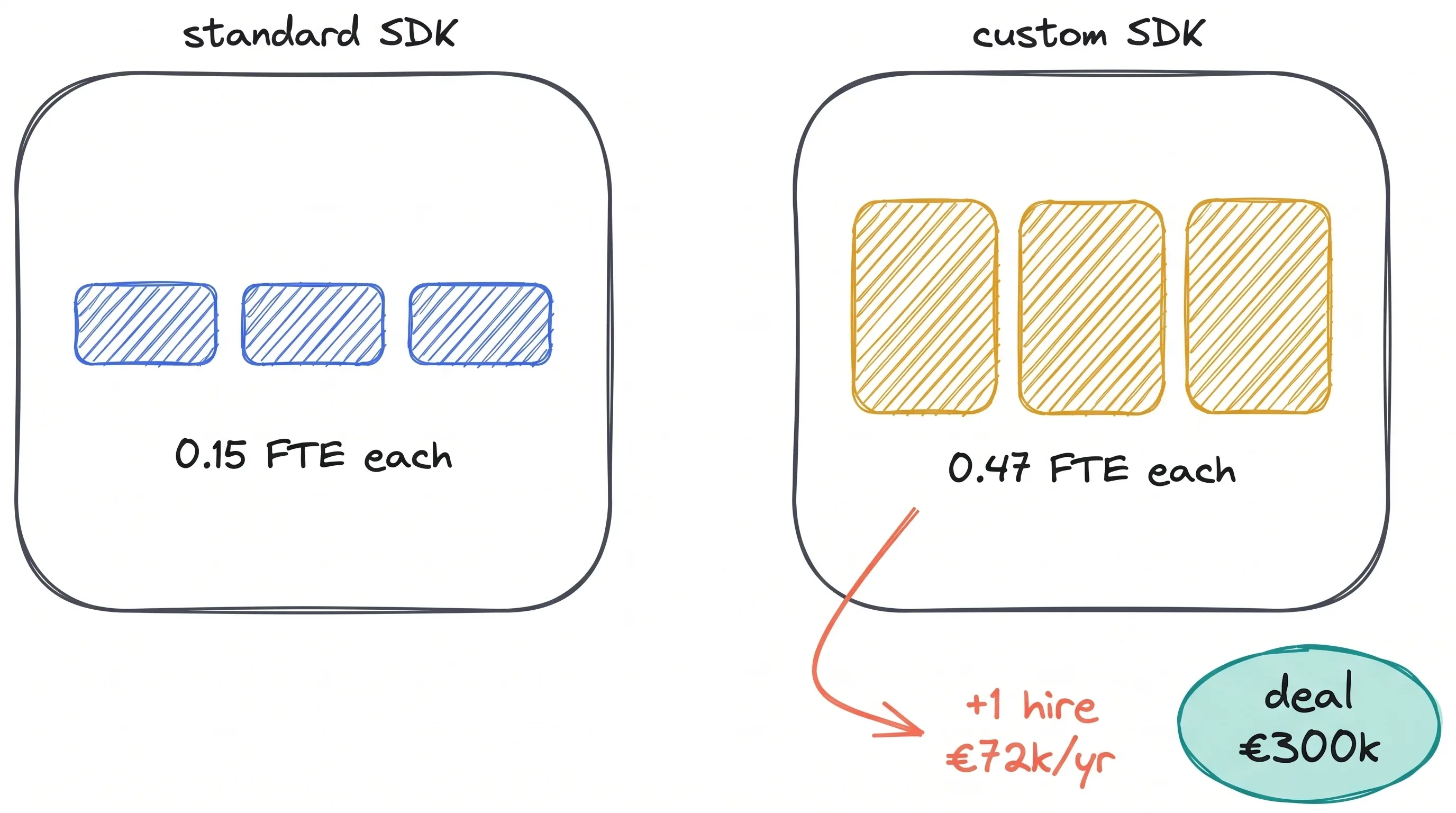
Image source · www.marian.coach
Comparing €300,000 with Hiring Costs Over the Same Period
The mentor estimated that hiring one person to cover the additional workload would cost €6,000 a month, or €72,000 a year. This was a rough estimate based on the salary of a mid- to senior-level developer in Prague, plus the employer’s social and health insurance contributions. It’s not a figure that can be applied as is to other regions or companies; it needs to be replaced with the actual costs in the relevant market. 1
Under those assumptions, the mentor wasn’t suggesting they walk away from the deal. His proposal was to go ahead with the custom contract, while also deciding to hire one additional person. This would let management treat the maintenance workload above and beyond the standard approach as part of the contract’s terms. 1
The picture changes when you factor in time. If the €300,000 is paid just once and the additional employee stays on, four years of salary would cost €288,000—almost as much as the contract payment. The comparison changes, however, depending on when and how often the money is paid. That’s why the mentor said to discuss the contract term and payment terms together. 1
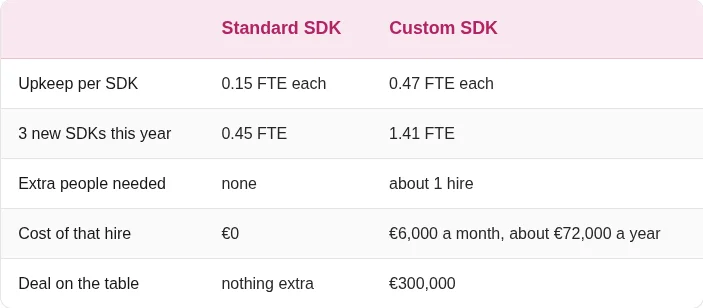
Image source · www.marian.coach
This calculation does not determine the contract’s net profit. The example compares the contract payment with the ongoing cost of additional staff. It doesn’t put a dollar value on the initial development work or on losses caused by delays to other work. It also puts the additional staffing needed to maintain three custom SDKs a year alongside the €300,000 contract under discussion. For an actual decision, the scope of the contract needs to match the scope of the maintenance being considered. 1
Delays to Consider Alongside Staffing Costs
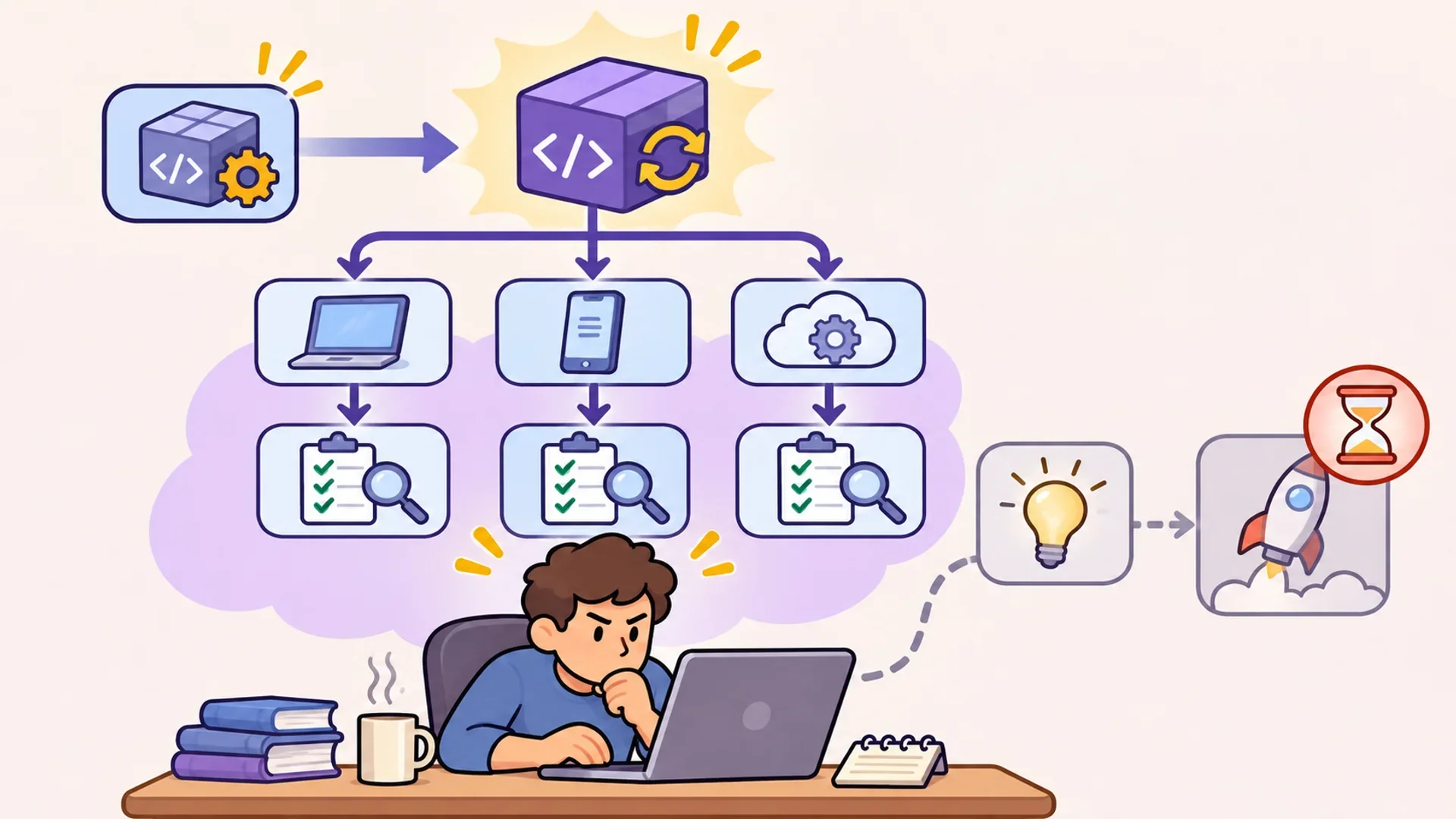
The burden of a custom feature may not be limited to one person’s salary. Every time the shared SDK is changed, the team may have to recheck the customer-specific usage scenarios, which can slow down the next change. While the same development time is spent on that work, the release of other features may be pushed back, too. The original text doesn’t put a dollar value on these delays, but recommends discussing them alongside staffing costs. 1
In an interview, product development expert Don Reinertsen explained that when deciding the order of work, it’s important to consider both the cost of each task being delayed and the time it ties up scarce development resources. The cost of delay isn’t simply the money spent to get urgent work done sooner; it’s the value lost because a schedule slips. For example, if a week’s delay is worth 500 spent to save that week isn’t the cost of delay itself; it’s the cost of shortening the schedule. 2
Applied to Daniel’s case, this perspective raises the question: “Which work is delayed by the custom feature, and by how much?” Without a known delay or estimate of the loss, he shouldn’t subtract an arbitrary figure from the contract payment. Instead, showing which upcoming work would be affected and the expected schedule would give management a starting point for comparing the contract revenue with the value of work they would have to give up or postpone. 1, 2
Turning Hypothetical Numbers into Company Records
Daniel asked his mentor how he could arrive at and defend figures like 0.15 or 0.47. The mentor’s answer was to look at records from the past two or three years, such as project duration, incidents, and time spent on custom paths. If there wasn’t enough data, he also suggested writing down the best- and worst-case scenarios for each option and estimating a value in between. 1
Daniel’s specific assignment was to pick five changes from the past year that had touched custom paths and record how many hours each one took. These records would be a starting point for assessing whether the example’s 0.47 also applied to his company. Five cases alone wouldn’t establish the staffing requirement, so the estimate should make clear which tasks were selected and what work was included. 1

Image source · blogs.businesscompassllc.com
Rather than arguing for an immediate decision in the meeting, the mentor also suggested saying that Daniel would analyze the effects on value, cost, and risk and come back with the results. Then he could lay out the figures for both options, along with the best- and worst-case scenarios for each, and lead with a recommendation such as, “Let’s proceed with the custom SDK, but hire one more person.” 1
At the time the mentor wrote about it, Daniel was planning to review five tasks that had touched custom paths and compare the two options using actual figures. 1
Conclusion
Rather than rejecting the custom contract, Daniel’s mentor suggested deciding on an additional hire alongside it. If the contract payment is made just once, the additional labor costs would come close to that amount in about four years. It’s a reminder to consider major revenue together with how long the work needs to be maintained and how many people that will require. 1
When you consider a custom request, what cost do you check first besides the contract payment?
References
- How to Talk to Executives: Price It Before You Argue · marian.coach↩
- Cost of Delay – interview with Don Reinertsen | Lean Magazine · leanmagazine.net↩