"If I buy an EV, won't I end up losing tens of thousands of dollars later because of the battery?"
For anyone considering purchasing an electric vehicle (EV) or already driving one, this is a question that makes your heart sink. It stems from a vague fear of battery degradation—the anxiety that battery performance might drop so sharply that you'll have to scrap the car.
However, looking at recently released real-world driving data, strong evidence is emerging that much of the worry we've had might have been "excessive apprehension." Today, we will dive deep into the truth about EV batteries, from the case of a Tesla that traveled 610,000km to essential tips for buying a used EV.
A Tesla that traveled 610,000km: The battery is still "in service"
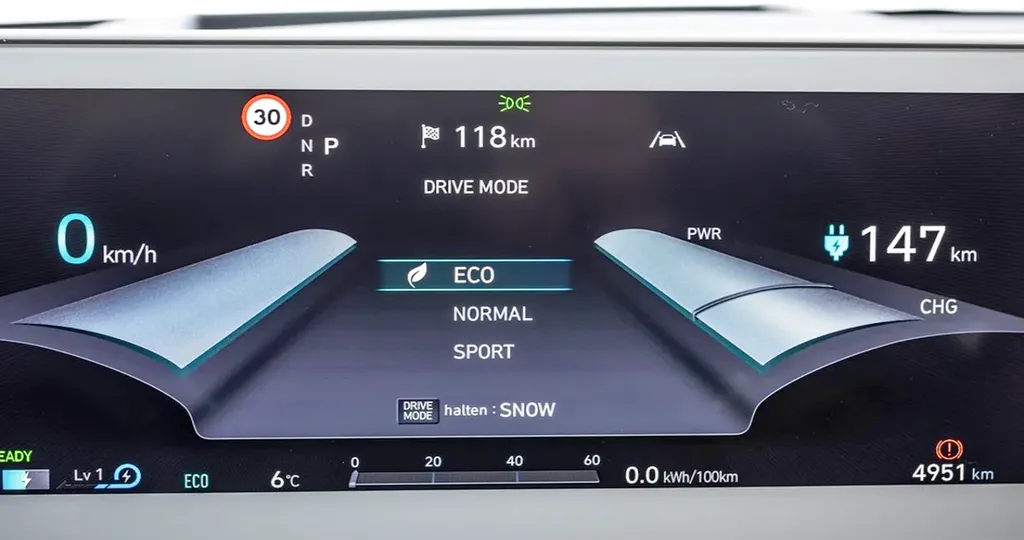
First, let me introduce a truly amazing piece of data. This is the story of a 2019 Tesla Model 3 tested by Canada's 'Drive Protected.' This vehicle has traveled an incredible distance of 610,000km (380,000 miles). For a conventional internal combustion engine vehicle, this is a distance where one would already be considering the junkyard.
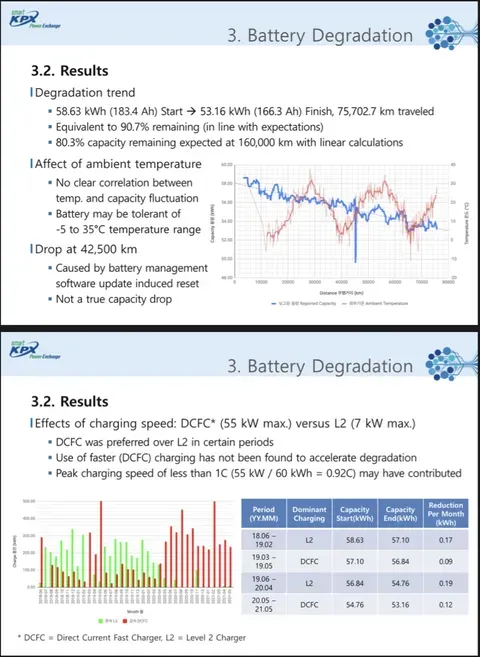
What were the results? Surprisingly, this vehicle was still cruising on the road with its original battery pack intact. Of course, the battery performance is not identical to when it was new. When fully charged, the driving range was approximately 254km, which is about a 34.2% decrease compared to a new car.
The point we should focus on here is not the "margin of decrease" itself. Experts note that considering the massive cumulative mileage of 610,000km, the fact that the State of Health (SoH) has not dropped below 70% is significant. Even in actual highway driving, it recorded a respectable average efficiency of 6.8km per kWh, proving it is still an excellent means of transportation. In other words, even as the battery ages, it causes no hindrance to daily driving.
The truth told by data: Even after 5 years, 95% remains?
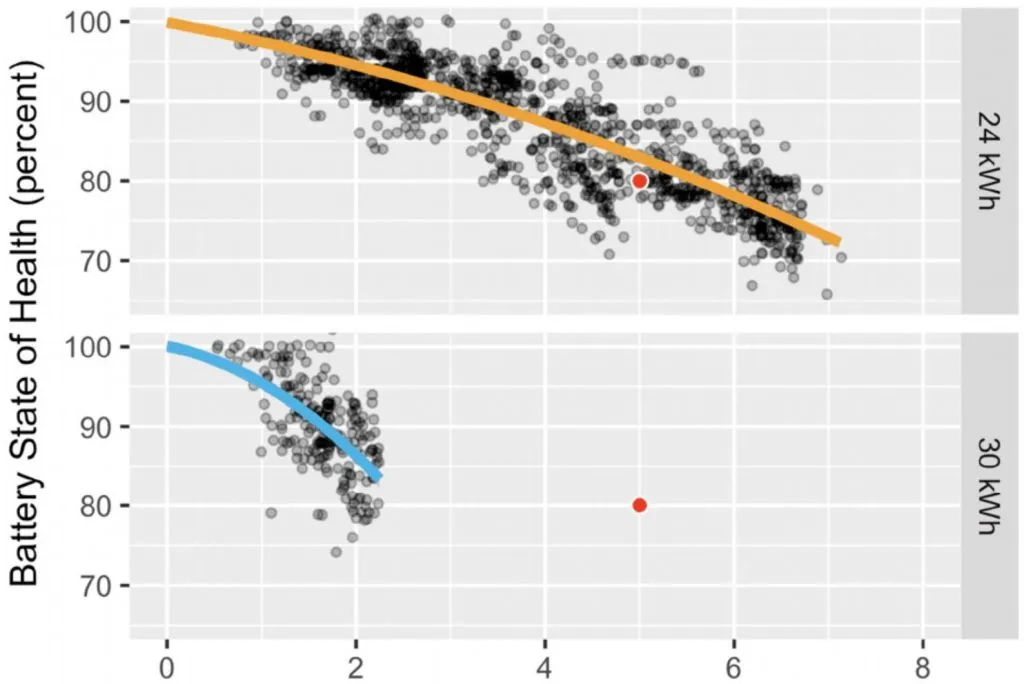
Have you ever heard the claim that "the driving range is cut in half after just 5 years"? To get straight to the point, it is highly likely that this is not true. After analyzing a vast amount of real-world driving data exceeding 1.6 billion km, the US-based EV data analysis firm 'Recurrent' confirmed startling figures.
Current EVs on the market maintain, on average, 97% of their range after 3 years and 95% after 5 years. For example, if a car could travel 480km when first purchased, it is calculated that it can still travel about 460km even after 5 years.
Why is such incredible durability possible? It can be summarized into two main reasons:
- The Magic of Software (OTA): Manufacturers continuously improve the Battery Management System (BMS) through Over-the-Air (OTA) software updates. They constantly update algorithms to enhance battery efficiency.
- Buffer Capacity: Manufacturers design batteries so that the total capacity is not used 100%. They leave a sort of "reserve capacity." As the battery ages, they gradually activate this hidden capacity to minimize the reduction in driving range felt by the user.
In particular, Tesla demonstrated unrivaled durability with a range retention rate of over 96% at the 3-year mark, while Hyundai and Mercedes-Benz also provide confidence by recording high retention rates.
Used EVs: A "Great Value" or a "Time Bomb"?
Now, let's move on to a more realistic concern. You might think, "If battery performance is that good, wouldn't it be a profit to buy a cheap used EV?" You are correct. In fact, the used EV market can be an attractive option.
However, we must face the "uncomfortable truth." Recently, the market price of used EVs has been dropping sharply compared to new cars. Even popular models like the Tesla Model Y or Hyundai IONIQ 5 are seeing price drops every month. Why is this happening?
The biggest reason is the fear of battery replacement costs. The cost of replacing an EV battery can range from 10 million to 25 million KRW, accounting for 30-40% of the vehicle's price. If you buy a used car with an expired warranty and encounter a battery problem, you might face a situation where you have to spend half the car's value on repairs.
Therefore, when buying a used EV, you should not approach it simply because it is "cheap." Rather than being lured by price discounts, you must consider the Total Cost of Ownership (TCO). You should first check the charging environment, maintenance costs, and, most importantly, how you can verify the battery condition.
A 'Battery Checklist' for a Successful Used EV Purchase
So, how can we avoid "time bombs" and secure "great value" when buying a used EV? Here are three methods for checking State of Health (SoH) recommended by experts.
1. Check the SoH value
- 95-100%: Like-new condition. You can rest easy.
- 85% or higher: Normal range. No issues for daily driving.
- 75% or lower: Caution is required. The driving range may have noticeably decreased, and it is advisable to reconsider the purchase.
2. Verify with three methods
- Official Service Center Diagnosis: Request an official diagnosis report issued by a Hyundai (Bluehands) or Tesla service center. This is the most accurate way to see cell balancing status and charging history.
- Utilize an OBD2 Scanner: If you want to check yourself, you can plug an OBD2 device into the car and check the SoH and voltage deviation between cells using a smartphone app. If the voltage difference between cells is more than 0.05V, it is a warning sign that a specific cell is degrading.
- Calculate the Range Reduction Rate: An indirect method is to calculate how much the range displayed at full charge has decreased compared to a new car.
3. Check the Warranty Period Domestic manufacturers usually provide battery warranties based on 8 years or 160,000 km. When choosing a used car, how much of this warranty remains is the most important safety net that can save you tens of thousands of dollars.
'Wise Habits' to Extend Battery Life
Finally, for those who are already driving an EV or are about to purchase one, here are some tips to extend battery life. Battery life depends on how you manage it.
- The 20-80 Rule: Try to keep the battery level between 20% and 80% at all times. Completely discharging it (0%) or always keeping it full at 100% puts stress on the battery.
- Slow Charging over Fast Charging: Fast charging is convenient, but it generates high heat and current, which can accelerate battery degradation. Make slow charging a habit whenever possible.
- Avoid Extreme Environments: It is best to avoid leaving the car in places that are too hot or too cold for extended periods.
In conclusion, EV batteries are not as fragile as we fear. Technology is advancing, and manufacturers are defending battery performance through both software and hardware. If you understand and know how to manage the battery variable, an EV will definitely become the best economic means of transportation.
To summarize:
- According to actual data, the performance decline of EV batteries is very gradual even after 5 years.
- When buying a used EV, always choose a vehicle with an SoH (State of Health) of 85% or higher.
- Checking the manufacturer's battery warranty period is a necessity, not an option.
It seems we are past the stage of hesitating about EVs due to vague fears. What concerns you most when considering an EV purchase? Or if you are already driving one, how are you managing your battery? Let us know your thoughts in the comments!
References
- 61만km 주행한 테슬라 모델 3, 배터리 성능 34% 하락에도 '현역' 건재 · v.daum.net
- 벌써부터 걱정할 필요 없었네… 5년 탄 전기차, 실제 주행거리는 이 정도 · news-wa.com
- 전기차 배터리 성능 저하, 브랜드별 극명…테슬라 '96%' 유지 · digitaltoday.co.kr
- "값 떨어진 전기차, 지금이 기회일까" 중고 EV의 불편한 진실 · mauto.danawa.com
- “전기차 사면 호구냐?” 사자마자 중고가 반값 뚝…배터리 교체비만 ... · v.daum.net
- 중고 전기차 구매 시 '배터리 상태' 확인 방법과 유지비 예측 · good-economy.co.kr
- 7000대 연구결과, EV 배터리가 예상보다 오래 지속? - 임팩트온 · impacton.net
- 전기차 배터리 교체 비용과 교체 주기, 경제성 분석 · good-economy.co.kr