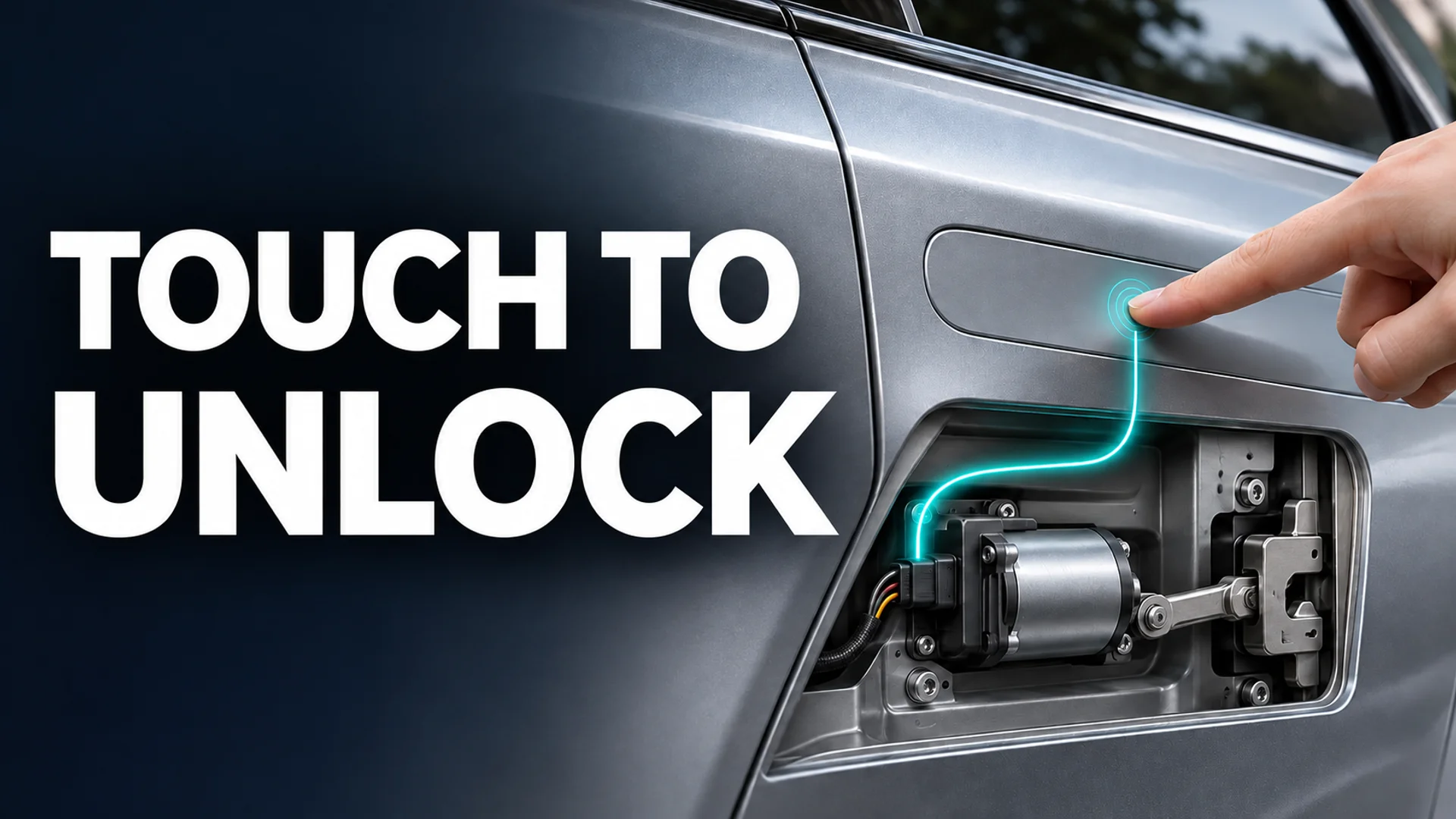
You may have seen vehicles in which the protruding door handles have been eliminated to create a smoother vehicle profile. This is not simply an aesthetic change, but rather a transition to electronic systems that enable opening car doors by touching the surface of the door with a finger or by simply carrying a smart key. In the past, physical force applied to pull a handle released the internal locking mechanism known as the 'latch.' However, in recent systems, sensors recognize occupants and send signals to activate an electric motor.
The core of this change is that even though the physical shape of a handle may disappear, the principle of opening and closing remains clear. According to a video released by CNET Korea on October 30, 2018 (Korean time), the smart door latch from automotive parts manufacturer Kert uses a smartphone or a touchpad on the door surface as an input device 1. The input signal is transmitted to an internal servo motor (an electric motor that moves accurately according to specified commands), and the door opens electromechanically through the motor's operation 1.
The most concerning scenario is when an electronic signal is interrupted due to an accident or error. However, Kert’s system is designed to automatically switch to mechanical mode when a significant collision occurs 1. This safety mechanism ensures that physical opening and closing remain possible even while relying on electronic signals 1. While electronic systems are replacing the role of physical levers, physical operation is guaranteed in emergency situations.
The Genesis GV60 from Hyundai Motor Company presents a transitional case where electronic recognition has been added as a condition for unlocking, even if the handle shape remains. According to the vehicle manual, the door handle contains a sensor that detects locking and unlocking actions 2. However, it does not open unconditionally; the sensor operates only when the smart key is within 1 meter of the front door handle 2. The manual also specifies that the sensor may fail to operate in situations such as low smart key battery levels, low temperatures, or blocked radio waves 2. Furthermore, the manual instructs users to pull the handle after locking the door to confirm the locked state, indicating that physical verification actions have not been completely eliminated 2.
The GV90, unveiled by Genesis on October 28, 2026, suggests that such electronic control technologies are being applied to large vehicle structures as well 3. The GV90's 'coach doors' feature a pillarless structure, in which two latches positioned at the top and bottom are released simultaneously by an electronic control unit 3. 'Soft closing,' which gently shuts heavy doors, also falls under the domain of electronic control 3.
Ultimately, rather than pulling a handle, confirming a touch or carrying a smart key activates a servo motor via electronic signals to unlock the door. In this process, physical opening and closing are guaranteed by a mechanical switch-over during significant collisions; however, routine opening and closing are determined by the limitation conditions of the electronic system, such as 1-meter recognition range, battery status, and radio wave environment.
References
- “손잡이가 없는 문?!” 흥미로운 자동차 부품 기술 · youtube.com↩
- 스마트 키 사용하기 · ownersmanual.genesis.com↩
- 제네시스, GV90 핵심 기술 공개…코치 도어·루프 에어백으로 차별화 · newspim.com↩