Picture this: you are driving on a highway, and a pebble kicked up by the tire of the vehicle in front of you strikes your windshield with a sharp thud. You are startled and look up, only to see cracks spreading across the glass like a spiderweb, yet not a single shard falls to the floor. While such an impact would have shattered ordinary window glass into a million pieces, why does a car windshield remain in place, forming a 'spiderweb' pattern rather than crashing down in a shower of glass?
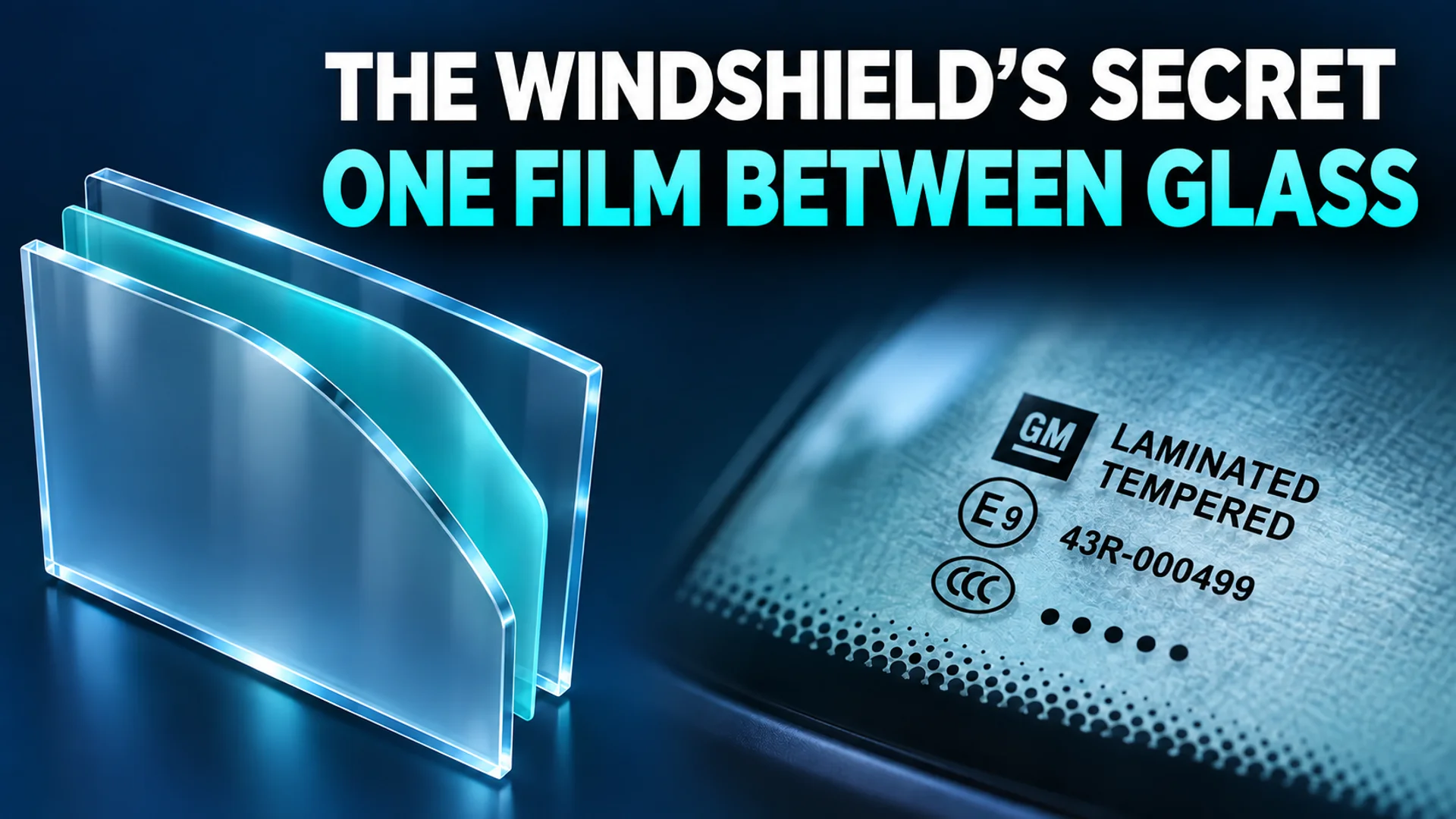
The answer lies not in the glass's 'hardness' but in its 'structure.' A car windshield is not a single sheet of glass; it is 'laminated glass,' a sandwich-like structure composed of two thin layers of glass bonded together by a special film (PVB) in the middle. Even if the outer glass layer cracks upon impact, the middle film holds the fragments together, preventing them from scattering and absorbing some of the impact energy. Therefore, the spiderweb-shaped cracks are not a sign of glass failure but evidence that the safety mechanism is working as intended 1, 2.
Glass Must Break to Be Safe: The Technology Controlling 'How It Breaks'
'Automotive safety glass' does not simply refer to hard glass that resists breaking. Its core function is to control the shape and location of fragments upon breakage to prevent passenger injury. Interestingly, the type of glass used varies entirely depending on its role and location within the vehicle.
The windshield, which must protect the driver’s vision and head, requires a structure that 'must never shatter and scatter.' Conversely, side and rear windows, which need to be broken to allow for emergency egress, require the characteristic of 'breaking quickly and easily.' Due to these conflicting safety requirements, windshields and side windows are designed in different ways 3, 1.
The Secret of the Windshield: The Laminated Structure of Two Glass Layers and a PVB Film
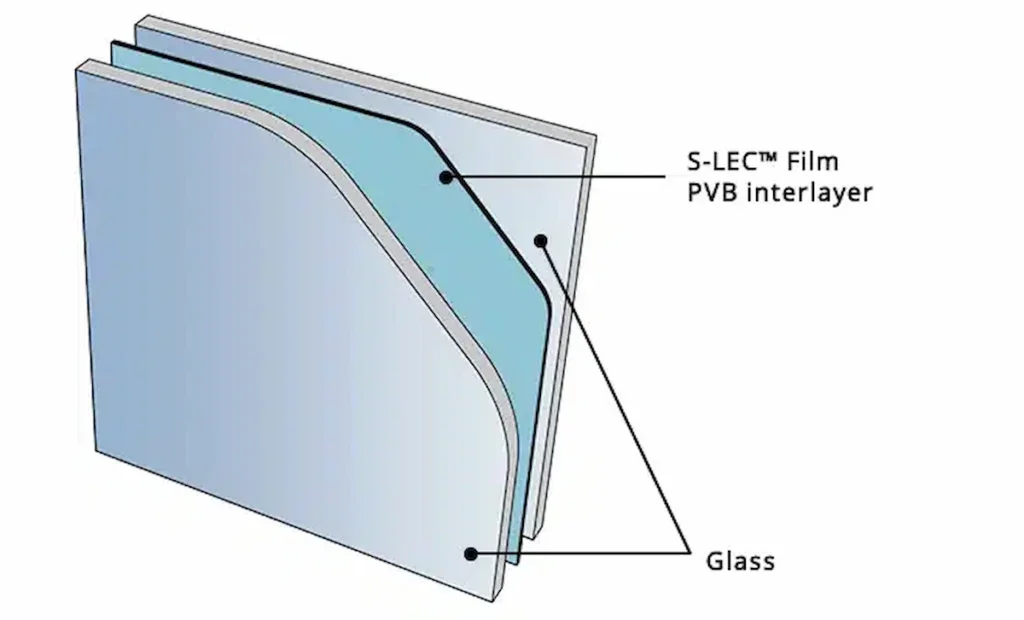
A car windshield consists of a three-layer structure: two glass layers, each 2–3mm thick, with a polymer film called 'PVB (polyvinyl butyral)' pressed between them 2, 1. While it may look like a single sheet of glass under normal conditions, it is actually a composite structure where materials with different properties work in harmony.
In this structure, the glass layers provide a hard surface and contribute to the vehicle’s rigidity. In contrast, the middle PVB film, unlike the brittle nature of glass (which is hard but cracks easily), possesses the property of deforming flexibly under force. Even if the glass layer begins to crack upon impact, the PVB film does not break easily and firmly holds the shattered fragments in place. As a result, the 'scattering' phenomenon, where fragments fly in all directions, is prevented, and the spiderweb pattern remains in place 1, 2.
Penetration Resistance and Structural Integrity: The Role of the Windshield
The windshield’s ability to hold fragments together and maintain its shape is a safety feature that goes beyond simple damage prevention. This structure protects occupants by preventing external objects from penetrating into the vehicle cabin 2.
The windshield is a component that forms part of the vehicle’s overall structure. If the windshield were to completely detach during an accident, passengers would face a greater risk of being exposed to the exterior, and glass fragments could fly into the cabin, causing secondary injuries. This is the fundamental reason why the windshield must remain in place even when broken 1.
Difference from Side Windows (Tempered Glass): Breakage Patterns Observed in Experiments
Unlike the windshield, side and rear windows primarily use 'tempered glass.' Tempered glass is strengthened through heat treatment to create compressive stress on its surface. When this glass exceeds its limit, internal stress is released all at once, shattering it into 'small, round granules' rather than large shards. This design reduces the risk of lacerations from large glass pieces while making it easier to create an emergency exit 1, 2.
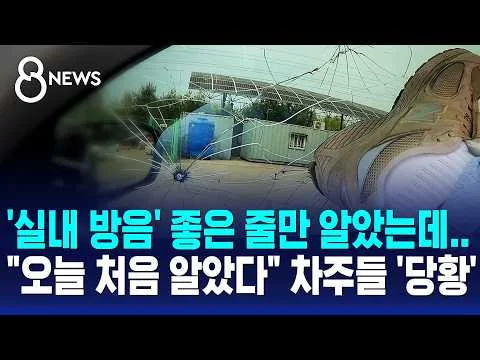
These differences have a significant impact on actual emergency egress times. In an experiment conducted by SBS 8 News reporters in November 2026, windows fitted with laminated glass only cracked even after being struck repeatedly with an emergency hammer, and it took more than three minutes and dozens of strikes with a headrest and feet to break them. In contrast, tempered glass shattered easily with a single drop of a 2kg steel ball or a single strike from an emergency hammer 3.
Experiments by the YouTube channel 'Iron Doctor TV' yielded similar results. When tempered glass was struck with a spring-action hammer, it shattered instantly, whereas laminated glass only developed a hole at the impact point and minor cracks around it, without collapsing completely. The production team explained that to create an exit in laminated glass, one must punch several holes and then kick out the entire glass pane. This shows that the safety features of the windshield can translate into difficulty during emergency egress 4.
How to Immediately Identify Your Car’s Glass Type by Text
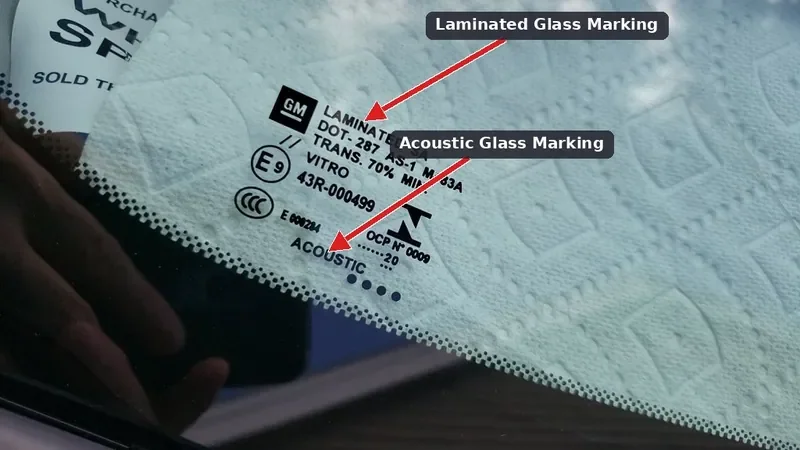
Recently, the number of vehicles using laminated glass for side windows to enhance sound insulation has increased. A survey of 47 vehicles sold in Korea by the Korea Consumer Agency found that 12 models used laminated glass for both front and rear seats 3. If you consider emergency evacuation, it is helpful to know your vehicle’s glass structure in advance.
Glass types can be easily distinguished by markings at the bottom of the window or the shape of the cross-section 3.
- Laminated Glass: The text 'LAMINATED' is printed on the edge of the glass, and when the window is rolled down, the cross-section (the edge) appears concave.
- Tempered Glass: The text 'TEMPERED' is printed on the edge, and when the window is rolled down, the cross-section appears convex outward.
If you see spiderweb-like cracks in your windshield, do not interpret it as glass failure; understand it as a sign that the film is holding the fragments together to protect you. The next time you enter your car, check for 'LAMINATED' or 'TEMPERED' markings in the corner of the window. You will immediately know how your car is protecting you and what response is required in an emergency.
References
- 자동차 앞유리는 왜 깨져도 일반 유리와 다르게 부서질까? 안전유리의 원리 - 생활의 발견 · lifegoodtip.com↩
- 자동차 유리의 종류 및 구별 방법 · m.blog.naver.com↩
- '실내 방음' 좋은 줄만 알았는데.."오늘 처음 알았다" 차주들 '당황' / SBS 8뉴스 · youtube.com↩
- 요즘 광고 많이 나오는 차량용 비상탈출망치, 유리가 잘 깨지는지 테스트 해봤습니다!! · youtube.com↩