One of the most remarkable aspects of an operating room scene is that, although medical staff and instruments fill the entire field of view, the patient’s surgical site remains brightly illuminated. Even when a surgeon’s hand directly blocks the light, no deep shadow appears beneath it. This can easily be mistaken for "magical illumination," but a surgical shadowless lamp is not simply a single light bulb made extremely bright. The core lies in a geometric design that arranges light sources thickly in a circle, ensuring that no object can simultaneously block light coming from all directions.
Understanding this principle changes the actual meaning of the term "shadowless." It does not mean that light obstruction does not occur at all physically; rather, it means that the "umbra," which signifies complete darkness, disappears, leaving only a faint "penumbra" that is too subtle to be noticed. Through a candlelight experiment reproducible at home and definitions of terms, we will verify step by step how a complex medical device eliminates shadows.
Visualizing Shadow Elimination through a Candlelight Experiment Next to a Teapot
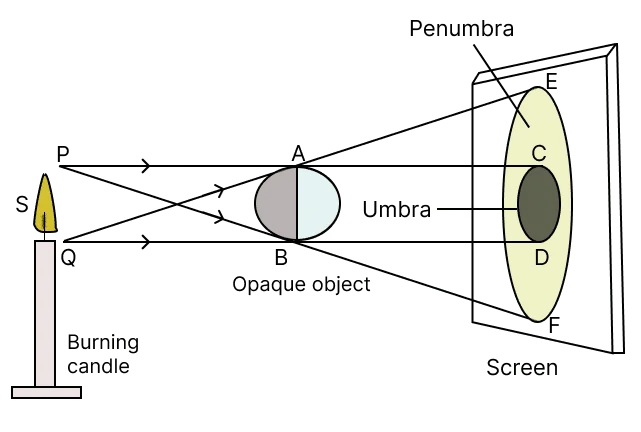
Ming Feng, a manufacturer of surgical shadowless lamps, explains the principles of complex surgical lamps using a simple experiment on a desk. If you place a cylindrical teapot in the center of a desk and shine a candlelight from one side, a clear shadow forms behind the teapot. The center of this shadow is exceptionally black, and the darkness fades as you move outward 1.
If you light two candles, the shadows begin to overlap. The central area, where light from both candles is blocked, remains completely dark because the light is fully obstructed, but the surrounding areas, where only one of the candles is blocked, do not appear dark; instead, they show only faint shadows. As you increase the number of candles to three or four, the black central area shrinks progressively, while the surrounding blurry gray areas layer and expand 1.
Continuing the experiment, if you light many candles until they completely surround the teapot in a circle, the darkest central part disappears entirely. Even the grayish shadows remaining at the periphery become so faint that the human eye finds it difficult to distinguish them. According to Ming Feng’s explanation, the higher the density of light sources surrounding an object, the more the umbra continues to shrink 1. This candlelight experiment condenses the core reason why the field of view does not darken even when a surgeon’s hand covers the surgical site. Light coming from different positions is not simultaneously blocked by the same object; therefore, as the number of light directions increases, the completely dark space narrows and eventually fades to a level difficult for the human eye to distinguish.
Separating Umbra and Penumbra Reveals the Answer

To accurately understand the phenomenon of shadow elimination, one must examine shadows by dividing them into two regions. The Wikipedia entry for "Umbra, penumbra and antumbra" clearly defines the terminology used to describe shadows.
The region where light is completely blocked by an object and does not reach at all is called the "umbra." It is the innermost and darkest part of a shadow. In contrast, the region where only part of the light source is blocked, allowing light to reach partially, is called the "penumbra." An observer experiences partial obstruction, rather than complete blockage, in this region 2.
In the aforementioned candlelight experiment, the "black center" corresponds to the umbra, while the "faint gray edges" surrounding it correspond to the penumbra. What a shadowless lamp aims for is not physically eliminating light itself, but eliminating the umbra that obstructs the view and extremely lowering the contrast of the penumbra.
Shandong Grand Medical Equipment, which operates a medical device technology blog, agrees with this. They explain that because the light sources of surgical shadowless lamps are not point sources, no matter how many light sources are arranged, only the umbra disappears; the penumbra remains but becomes relatively very bright. Therefore, the expression "no shadows" should be interpreted not literally as a "light-free state," but as the ability to minimize shadows in the field of view even when a worker partially obstructs the path of light 3.
Implementation of Shadowless Lamps by Extending the Candlelight Experiment into a Circle

Due to this structural design, a column of light formed 80 cm below the lamp panel extends deep into the surgical area. According to Ming Feng’s explanation, even when a doctor’s shoulder, hand, or head partially blocks the light, illumination remains very uniform within this column of light 1.
There is a point to be cautious of here. Thinking that "shadows are not visible because the light is shone strongly" is incorrect. The stronger the light becomes from a single direction, the more clear and intense the black area (umbra) behind the object becomes. The core of a shadowless lamp lies not in the "intensity" of light, but in the "diversity of paths" achieved by arranging light sources widely in a circle and using reflectors to overlap light from multiple angles onto the same surgical site. Even if a doctor’s hand obstructs some paths of light, light coming from other directions continues to illuminate the same location, preventing the formation of an umbra region.
Shadows Remain but Become Invisible
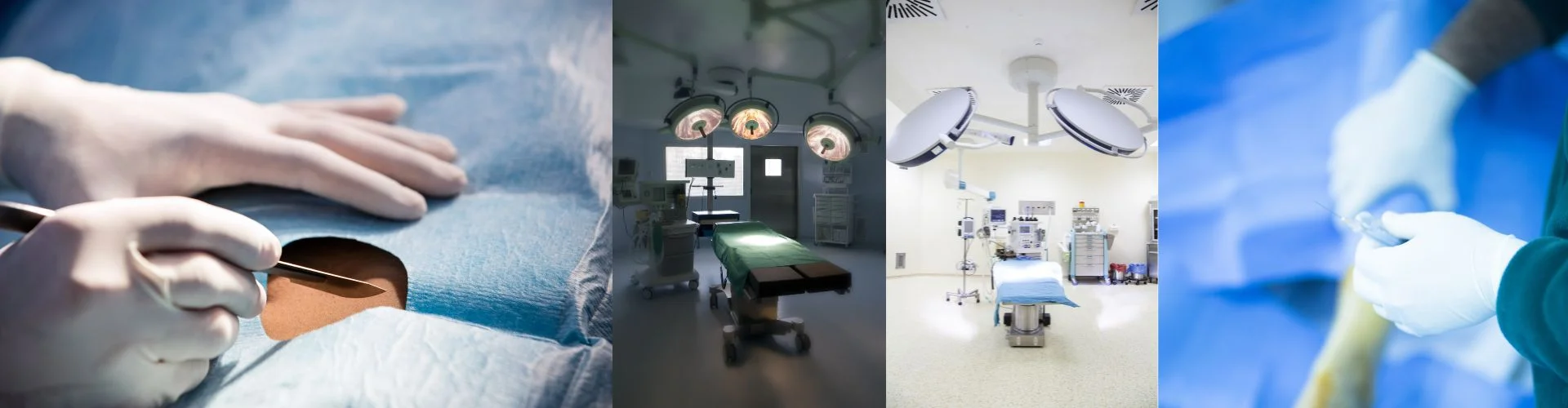
The name "surgical lamp" sounds as if there are absolutely no shadows. However, even in Ming Feng’s materials, it is explicitly stated that "shadowless lamps cannot be truly 'shadowless'; they merely dilute the main shadow to make it unnoticeable" 1. Shandong Grand Medical also expresses this phenomenon as a state of "infinitely approaching" shadowlessness 3.
In other words, it does not mean that the path of light is not obstructed at all physically. Rather, the amount and direction of the obstructed light become diverse enough that a black center is not created before one's eyes.
The reason the surgical site remains bright even when a doctor’s hand blocks the light is not because the doctor’s hand creates no shadows at all. The hand still partially obstructs the paths of light. However, because multiple light sources arranged in a circle and precise reflected light illuminate the same surgical site from all other remaining directions, an "umbra" where light is completely blocked does not form. As a result, only the remaining "penumbra" becomes extremely faint, causing the human eye to perceive no shadow. Ultimately, a shadowless lamp is not a device that erases light, but a geometric lighting device that maximizes the number of light paths and directions reaching the area to seamlessly erase shadows from view.
References
- Quality Shadowless Operating Lamp Manufacturer | Ming Feng · mflighting.com↩
- Umbra, penumbra and antumbra - Wikipedia · en.wikipedia.org↩
- 수술 용 그림자없는 램프가 어떻게 그림자 없는지 아십니까-지식-Shandong Grand Medical Equipment Co., Ltd · ko.grandmedicalgroup.org↩