
Consider a standard cubic die that has been slightly pressed and shaved along one axis. This reduces the surface area of the four faces parallel to the pressed axis, making the two faces at opposite ends of that axis (for example, the faces marked 1 and 6) relatively wider. As a result, the probability of the die landing on one of the two faces perpendicular to the pressed axis increases, while the probabilities for the other four faces decrease.
The reason the numbers '1 and 6' share this same fate is not merely because their sum is 7. It is because, on a standard cubic die, 1 and 6 are physically located on opposite ends of the same axis. The 'opposite faces sum to 7' rule engraved on dice is not simply an aesthetic symmetry; it is a convention that numerically identifies which faces are physically paired. We examine how this rule is utilized in probability calculations, and why the die became a starting point for probability theory, through specific examples.
The Significance of 'Sum 7' in Identifying Physical Pairs
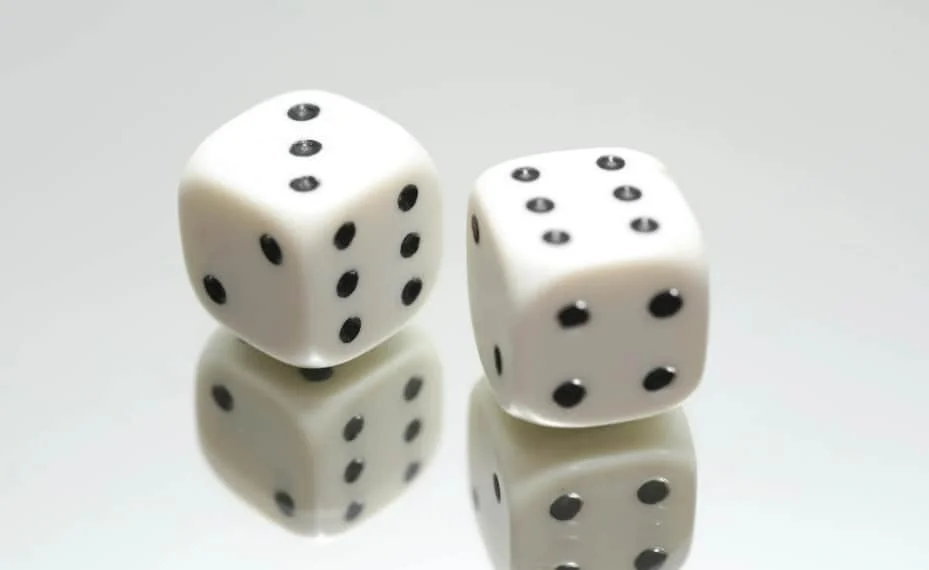
On a standard cubic die, opposite faces share the same physical axis. The 'Gambling and Probability' section in the probability educational material randomservices.org explains this relationship between physical structure and probability using the variant case of a 'flat die' 1.
Consider a flat die, which is shorter than a standard cubic die along one axis. The surface area of the two faces perpendicular to that axis becomes slightly larger than the remaining four faces. This leads to a slight increase in the probability of the two paired faces compared to the other four. To clearly convey this property, randomservices.org sets illustrative pedagogical probabilities of 1/4 for the paired faces and 1/8 for the remaining faces 1.
When classifying such distorted dice, the author uses the numbers on the paired faces as the basis. If 1 and 6 are paired, it is called an 'ace-six flat'; if 2 and 5 are paired, a 'two-five flat'; and if 3 and 4 are paired, a 'three-four flat' 1.
The 'opposite pips sum to 7' rule applied to standard dice clearly indicates which numbers are located at opposite ends of the same physical axis. Thanks to this rule, we can logically distinguish specific physical distortions (which axis was pressed) by numerical combinations and calculate the resulting changes in probability.
The Premise of 'Fair Randomness' Created by Symmetry
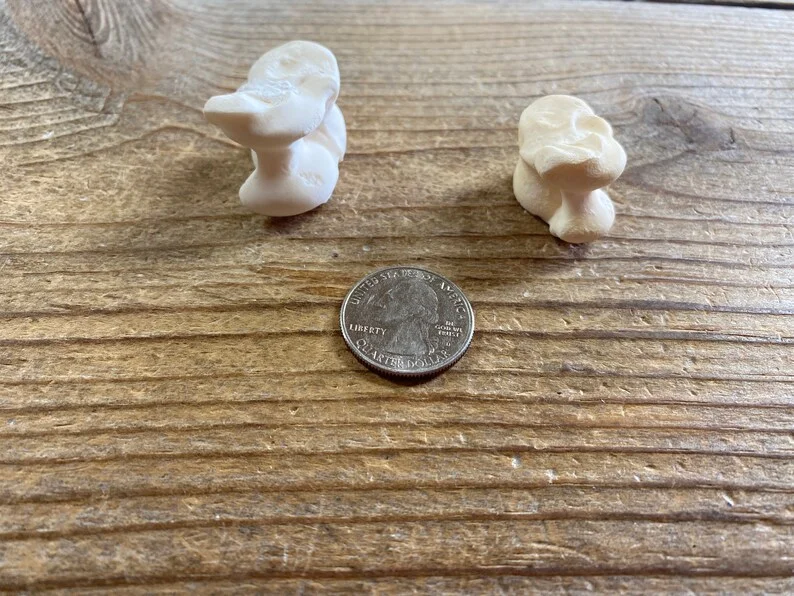
For a die to be used as a probability model, the probability of each face appearing must be uniform. Examining how early random devices were adopted as the standard for probability helps us understand why this condition is important.
According to the SADARI blog, the ancestor of the die was the 'astragalus,' or animal anklebone 2. Because this bone has an irregular shape, the probability of each face appearing differed, and it was physically difficult to balance. To create a more uniform probability environment, people began carving cubes with six congruent faces. The oldest known cubic dice unearthed to date are said to be approximately 5,000 years old 2.
A cube has geometrically identical surface areas and centers of gravity for all six faces. This physical symmetry blocks biases that favor specific faces, providing the foundation for maintaining the probability of any number from 1 to 6 appearing at exactly 1/6 2. Only when the geometric symmetry of physically fair six faces is established can a simple probability model based on 'equally likely events' be formulated.
Simplifying Probability Calculations Using Axis Structure
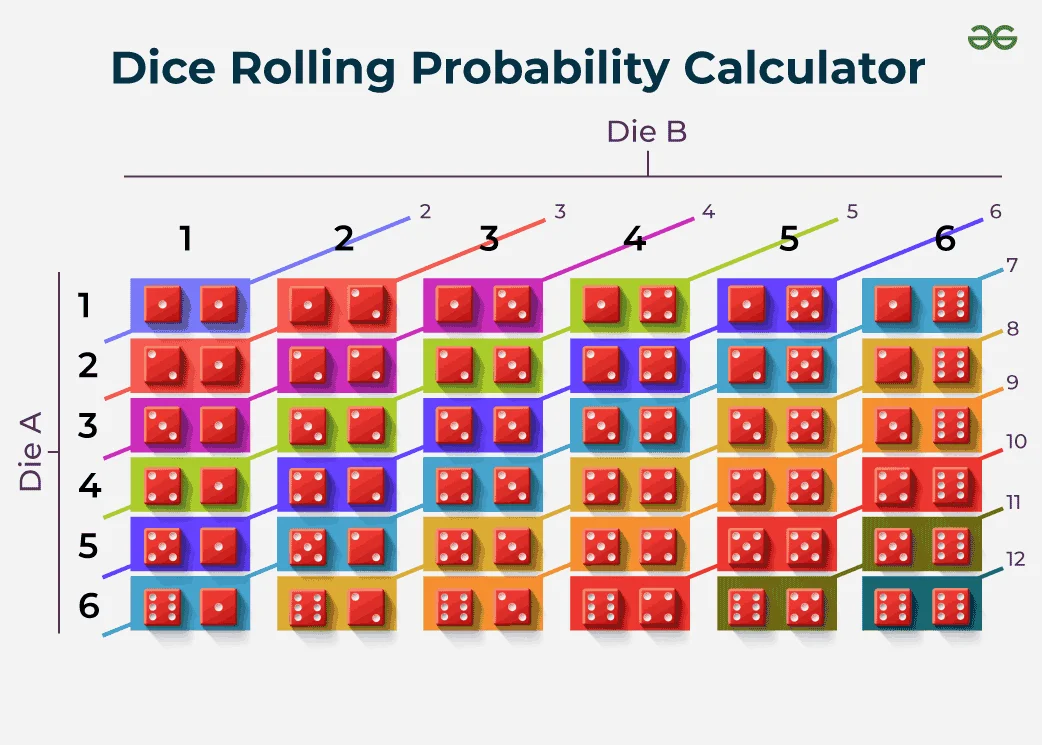
If symmetry guarantees uniform probabilities, the 'opposite faces sum to 7' rule acts as a tool to simplify complex combinations. A probability problem from the 2021 Indian Joint Entrance Examination (JEE Mains) is a case where this principle dramatically reduced the computational workload 3.
The problem deals with a biased die where the probability of one face is and the probability of its opposite face is . The probabilities of the remaining four faces are uniformly each. The task is to find the magnitude of the physical bias given that the probability of the sum of two rolls being 7 is 3.
There are 36 possible outcomes when rolling a die twice. However, utilizing the physical structure of a cubic die allows specific conditions to be grouped into much simpler events. The combinations where the sum of two pips is 7 are (1, 6), (2, 5), and (3, 4). These combinations only occur when the two faces of a single die are in an 'opposite' relationship 3.
In other words, the result of 'a sum of 7' can be physically equated to 'the event of opposite faces appearing.' Applying this physical pairing rule allows the 36 combinations to be grouped into three axis pairs (1-6, 2-5, 3-4) to set up an equation. The formula for calculating the cases involving the biased faces and the two other pairs is as follows 3.
2 × [((1/6) − x)((1/6) + x) + (1/6) × (1/6) + (1/6) × (1/6)] = 13/96Expanding and calculating this equation yields a bias value of 3. If physical pairs had not been identified via the 'opposite faces sum to 7' rule, one would have had to match cases where 1 appears with cases where 6 appears, and so on, performing complex combinatorial operations. A clear pairing rule serves as the basis for logically classifying random events, thereby lowering computational complexity.
Dice as a Standard Model in Probability Theory

Thanks to this structural simplicity, dice have become the starting point for logically analyzing randomness. The author of randomservices.org notes that gambling games provide 'some of the clearest and cleanest examples' for understanding random experiments 1.
The early development of probability theory also took place through the analysis of such gambling problems. Gerolamo Cardano's Liber de Ludo Aleae (Book on Games of Chance) and Abraham de Moivre's (or Montmort's) Essay d'Analyse sur les Jeux de Hazard (An Essay on Games of Chance) laid the foundational stones for modern probability theory by analyzing gambling problems like dice 1.
Rolling a die reduces outcomes to a limited set of six controllable states, making it easy to verify and digitize randomness itself. randomservices.org explains that if you generate a random number following a uniform distribution between 0 and 1, and apply the formula , you can generate uniformly distributed samples from 1 to 6 identical to a real die 1.
Digital dice on a screen have no shaving or weight biases, so each face appears with exactly 1/6 probability. This creates an ideal environment for observing the 'Law of Large Numbers,' where the proportion of each number converges to the statistical average as the number of trials increases. The SADARI blog also describes this digital environment, emphasizing that dice do not have 'memory' to balance themselves out, but rather naturally converge to the average as trials accumulate 2.
Ultimately, the arrangement of pips on a die and the rule that opposite faces sum to 7 are not merely aesthetic designs for engraving numbers. This rule is a structural convention that allows us to identify physically paired faces and classify probabilities. Because physical symmetry guarantees uniform probabilities and clear pairing rules simplify the combination of events, the die functions as a standard model in modern probability theory and statistics.
References
- Introduction · randomservices.org↩
- 주사위의 역사와 확률 · sa-da-ri.com↩
- ↩