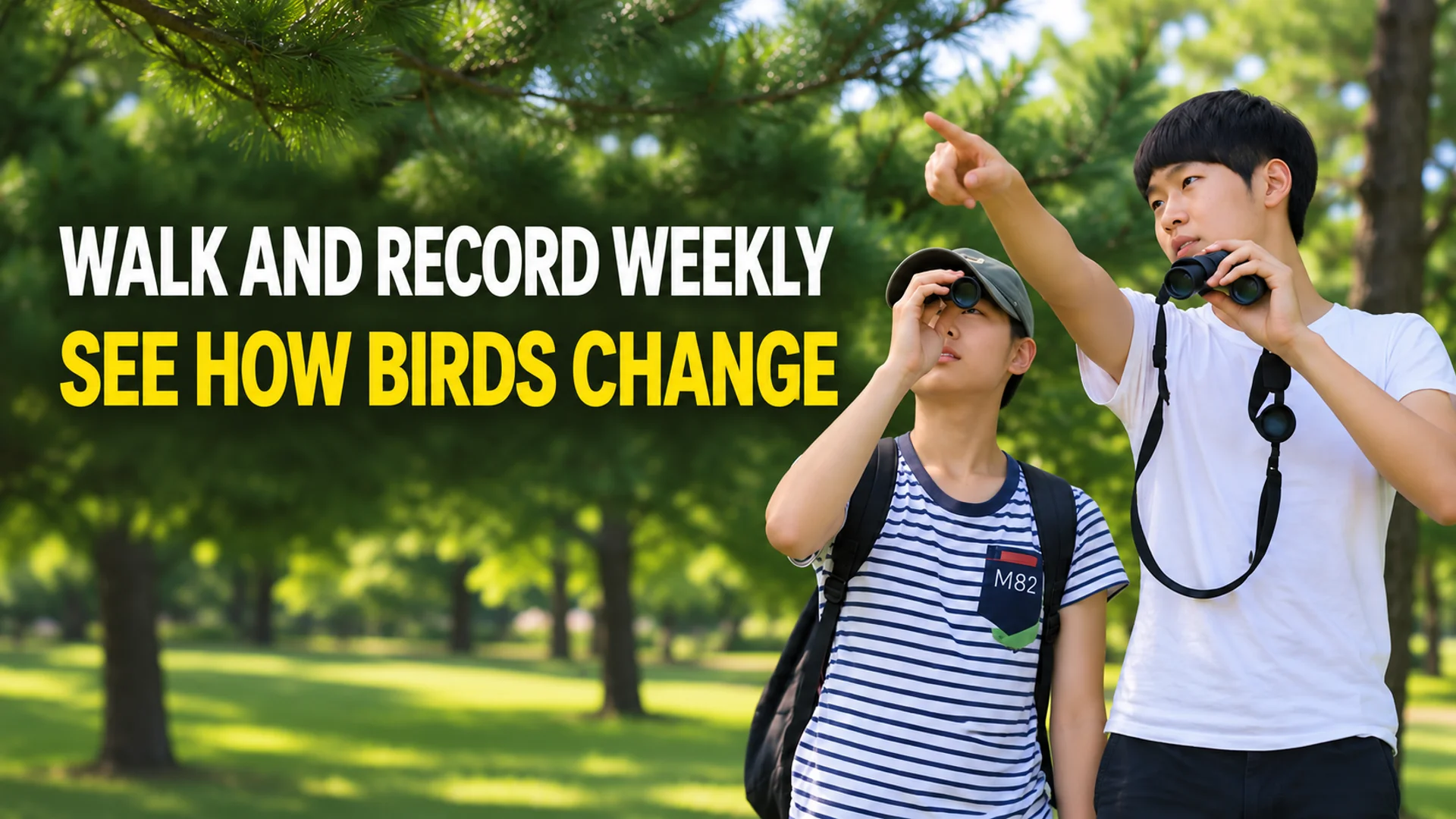
In 2018, a pair of Eyebrowed Thrushes, a rare bird species seldom seen domestically, were discovered in children’s parks in Seoul and Olympic Park. Subsequently, as citizen birdwatchers who walked the same parks every Thursday recorded their observations, an intriguing change emerged. The initial pair of Eyebrowed Thrushes increased to two, then three pairs, and they chose to overwinter in Seoul, abandoning their seasonal migration. Had reliance depended solely on regular scientific surveys conducted four times a year, it would have been difficult to capture such subtle behavioral shifts 1.
The Neighborhood Birdwatching Class is not merely a birdwatching club. It serves as a prime example of a process where repeated observations and records become scientific evidence revealing hidden changes in local ecosystems. This article examines how the Neighborhood Birdwatching Class operates and why participants’ records constitute vital ecological data.
Distancing and Recording: Basic Principles of the Neighborhood Birdwatching Class
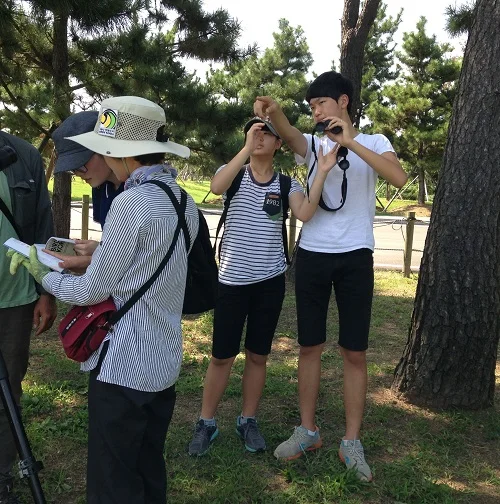
The Neighborhood Birdwatching Class is an open ecological gathering accessible to anyone interested in birds. According to a Freshian report on 'Birds of Seoul' published in April 2022, the class attracts participants ranging from their twenties to their sixties. The group includes diverse occupations such as university students, office workers, middle school teachers, and ecological coordinators, demonstrating that it is not an activity monopolized by a specific expert group 1.
One key principle when operating the birdwatching class is "watching from a sufficient distance to avoid disturbing the birds." Rather than approaching birds directly, birdwatchers ensure an adequate safety distance and utilize binoculars, telescopes, or camera lenses for observation. They communicate their positions to one another while carefully seeking out birds perched within the gaps of trees 1.
Information such as the species identified, observation location, and time is shared on citizen science platforms like Nattering or eBird. It is only when individual observation notes are aggregated into a database on these platforms that a simple hobby transforms into systematic scientific data for understanding local ecosystems 1.
The Shift in Ecological Awareness Created by Continuity
The true value of the Neighborhood Birdwatching Class lies in "continuous observation and consistency." The detailed tracking of complex behavioral changes, such as the overwintering and population expansion of resident Eyebrowed Thrushes, was possible thanks to the persistent and meticulous records of participants who walked the same path every week 1. Such neighborhood-level records serve as a crucial foundation for detecting actual environmental changes and conducting in-depth research.
For instance, the Citizen Survey Team of the Seoul Migratory Bird Sanctuary confirmed and announced a decline in the number and species of winter migratory birds along the Jungnangcheon and Anyangcheon streams. The survey team identified river maintenance projects as the cause of this decline 1. Additionally, over 112,320 records uploaded by citizens to Nattering have been utilized in the National Institute of Biological Resources’ citizen-participatory monitoring (K-BON) to identify biodiversity-vulnerable areas affected by climate change and predict future species distribution 1. These cases prove that observation and recording extend beyond personal activity, serving as an important pathway to capture ecological contexts that professional researchers might easily overlook.
A Program Structure Linking Observation and Thinking
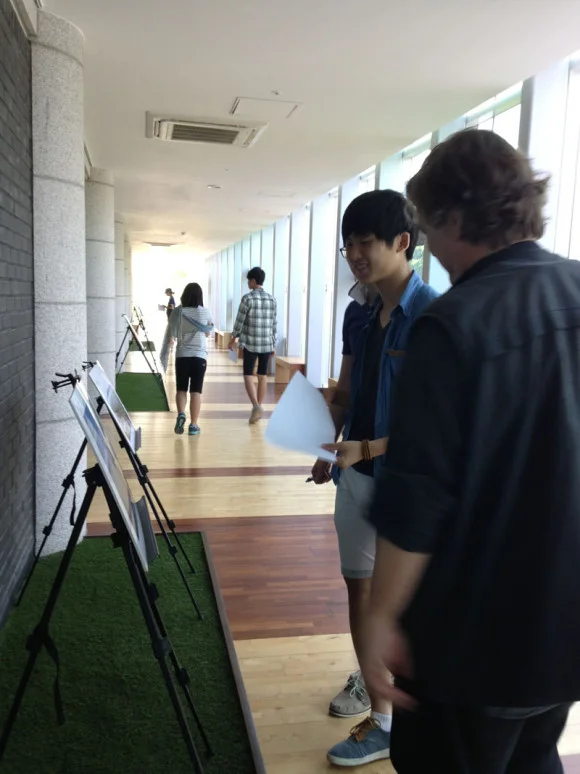
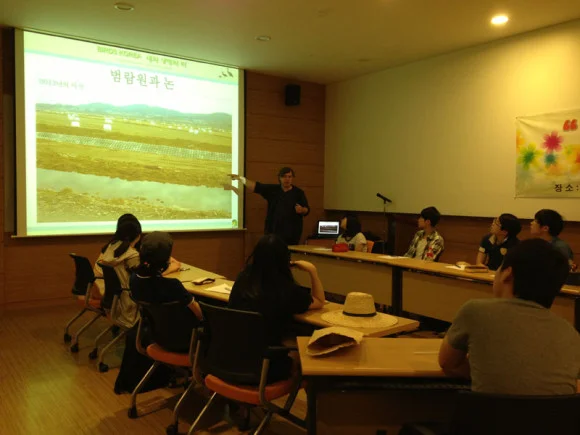
The birdwatching class extends beyond simple outdoor observation, inducing participation through a structure deeply integrated with ecological thinking activities. The birdwatching class held at Eulsukdo as part of the Korea Water Resources Corporation’s educational donation program exemplifies this. The program began with a seminar addressing the "Connection" between humans and nature. Participants viewed displayed environmental photographs, selected and presented "optimal habitats" and "worst habitats" for plovers and sandpipers in groups, and deliberated on the conditions for habitat selection 2.
Subsequently, participants went outdoors to observe geese, White-faced Plovers, and Common Kingfishers directly through telescopes, connecting the theory learned in the morning with actual ecosystems 2. This three-stage structure of lecture (learning connections) → judgment activity (habitat assessment) → field observation (empirical verification) clearly demonstrates an educational purpose not merely to "see" birds, but to make participants "think" about the connections explaining why those birds live there.
Evidence of Ecosystems Created by Repetition
Ultimately, the core of the Neighborhood Birdwatching Class lies in participants repeating the same route weekly, simultaneously practicing observation and recording. The recorded changes in the Eyebrowed Thrush’s residency behavior and the confirmation of migratory bird decline in the Jungnangcheon and Anyangcheon streams as environmental threats are both results of long-term observation accumulated by separate citizen science groups. Anyone interested in birdwatching can join such groups and add a single line to this vast record 1.
The accumulated repeated steps of walking the same path each week reveal facts such as the increase in a rare pair of birds and the significant change of choosing to winter in Seoul. Recognizing the sound and presence of birds on a walking path and recording them accurately is not merely a leisure activity, but one of the practical and sustainable methods to capture changes in rapidly transforming local ecosystems.
References
- 서울 올림픽공원에는 대륙검은지빠귀가 산다 · pressian.com↩
- 을숙도 탐조교실에 다녀왔습니다 | Birds Korea Blog · birdskoreablog.org↩