
Advertisers running campaigns on large platforms such as Instagram can easily check metrics like “100,000 people reached” in their dashboards. However, the situation changes if the same campaign is also run on a small news blog or an individual online store. It becomes difficult to grasp at a glance “who saw the ad and actually purchased the product,” because data is collected through entirely different pathways in these two worlds.
This data fragmentation is identified as a core factor threatening the revenue model of the open web (the internet space accessible to everyone). Evelyn Mitchell-Wolf, an analyst at the global digital advertising research firm eMarketer, defined measurement as “the fuel that powers smart decision-making” in a November 2024 webinar. She explained that evaluating advertising performance across platforms and the open web requires not a single tool, but a multi-layered measurement system 1.
“Walled Gardens” and the “Open Web”: Differences in Data Structures
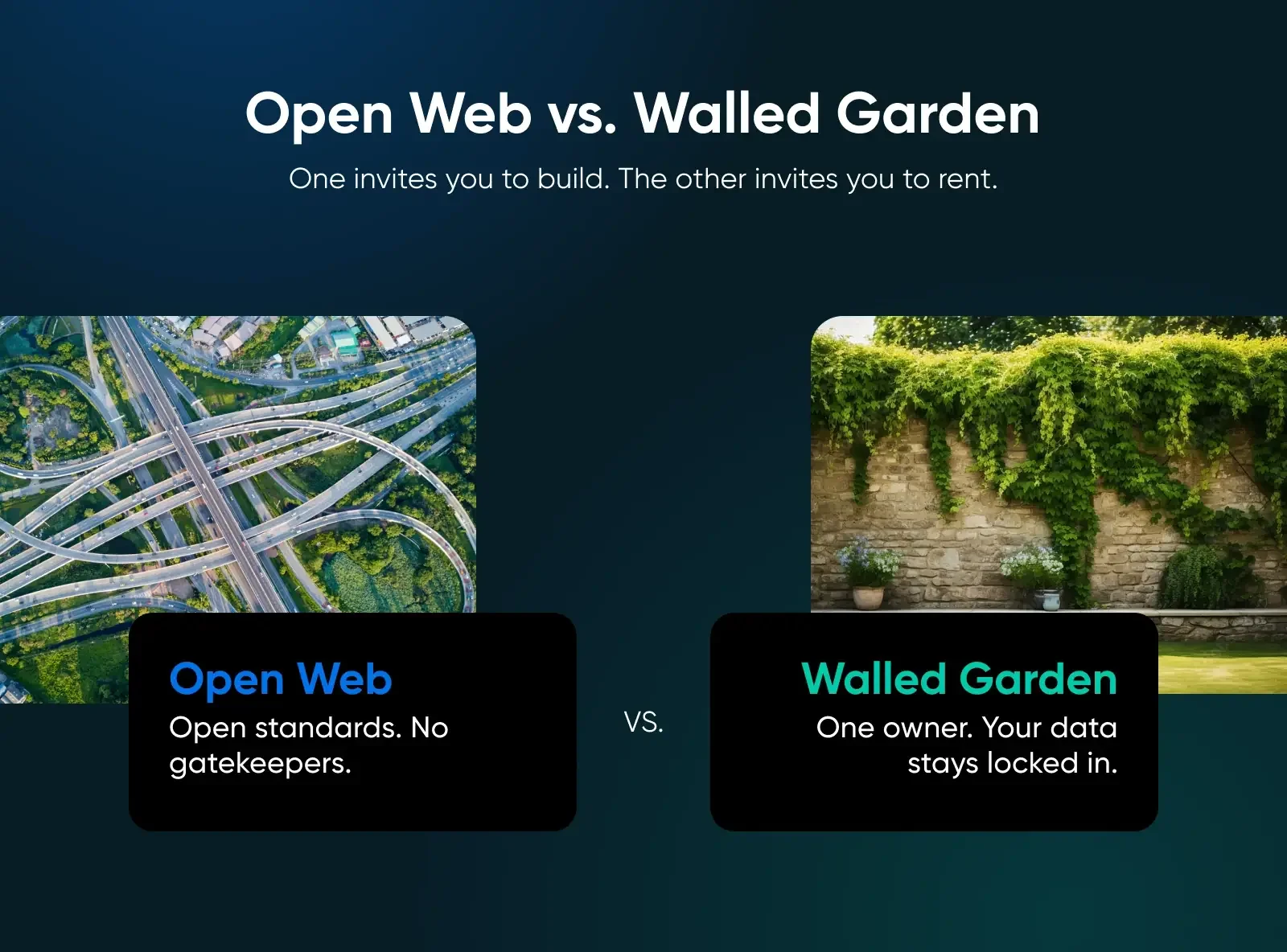
The advertising industry refers to the structure in which platforms keep member and advertising data within their own systems and do not release it externally as “walled gardens.” Search, social media, and commerce platforms fall into this category. Conversely, the broad, freely accessible areas of the internet, such as individual blogs, news sites, and small online stores, are categorized as the “open web.”
eMarketer diagnoses that because of the differences in characteristics between these two environments, campaign performance must be viewed comprehensively 1. In walled gardens, platforms provide reach, impression, click, and purchase figures through their own dashboards. However, the raw data underlying these metrics is often not disclosed in detail.
On the open web, on the other hand, records of visits, clicks, and conversions remain scattered in server logs of individual sites. The very process of tracking where and how much an ad was exposed is complex. Mitchell-Wolf recommended building a “multi-layered measurement stack” to combine data from different environments to address this issue 1. This does not refer to a specific software name, but rather an approach that layers dispersed data sources to analyze performance.
Examples of Lowering Barriers to Measurement and Execution

There are cases where lowered complexity in measurement and ad execution has actually increased participation by small and medium-sized business owners. In a press release dated November 2, 2026, NAVER stated that 78.5% of advertisers in its “Digital Out-of-Home Advertising” segment were executing ads themselves without agency assistance 2. Digital out-of-home advertising refers to a method of delivering digital content to physical spaces such as city digital signage or bus stop screens.
The press release did not explicitly state that direct execution increased because complex procedures were eliminated. Therefore, while the result that an environment facilitating direct execution has been created is confirmed, it is difficult to attribute the cause to a single factor. Furthermore, since 78.5% is a result specific to the digital out-of-home channel, it should not be generalized as the participation rate for NAVER’s entire online advertising or the broader internet advertising ecosystem.
On November 5, 2026, NAVER announced it would revamp its existing Advertiser Center into “Naver Ads” and use AI technology to support small and medium-sized advertisers 2. The direction is for AI to alleviate the burden of reading data for users new to advertising. While NAVER aims to lower the entry threshold for small and medium-sized business owners through this initiative, this is a service plan presented by NAVER, not an independently verified performance outcome.
Why a Multi-Layered Approach Is Needed
Advertising performance measurement that encompasses both large platforms and the open web cannot be completed with a single tool. To connect platform-specific dashboards with the dispersed data of the open web, multi-layered measurement is necessary.
As seen in the NAVER case, when platforms simplify measurement and execution paths and provide AI tools, users with little advertising experience gain the opportunity to participate in the ecosystem. However, these changes are not a sufficient condition to solve the data fragmentation problem across the entire open web. Technical challenges regarding reliably connecting dispersed open web data remain.
Consequently, to properly verify advertising performance, a system that uses both data provided by platforms and independent measurement tools is required. While attempts by platforms like NAVER to reduce measurement burdens may expand participation by small and medium-sized business owners, this does not guarantee the recovery of the entire open web ecosystem.
References
- Measuring ads amid walled gardens and the open web · emarketer.com↩
- NAVER Corp. · navercorp.com↩