The first place where a beginner guitarist typically gets stuck is the F major chord. It feels like a barrier because, unlike C or G chords that require spreading your fingers, the F chord requires pressing all six strings with a single index finger. Guitar instructor Lee Hwa-gyun of the HappyM Guitar channel explains in a video that this situation is not about learning the F chord as something entirely new, but rather about shifting an already well-known E major open chord up by one fret1. He demonstrates the 'barre' technique, where the index finger presses all the strings at a specific fret to prevent the naturally resonating open strings from sounding1.
In other words, the F chord is not a sudden piece of new knowledge. It is simply shifting the physical position of a chord shape you already know by one space. Although the guitar fretboard may appear to have countless chords, understanding the CAGED system transforms the fretboard from a 'massive grid of notes to memorize' into a 'map where five familiar finger shapes flow across the neck'2. Let’s take a step-by-step look at how this system simplifies the fretboard’s complexity and offers the freedom for improvisation.
The Language of Fingers: Dividing the Fretboard into Five Zones
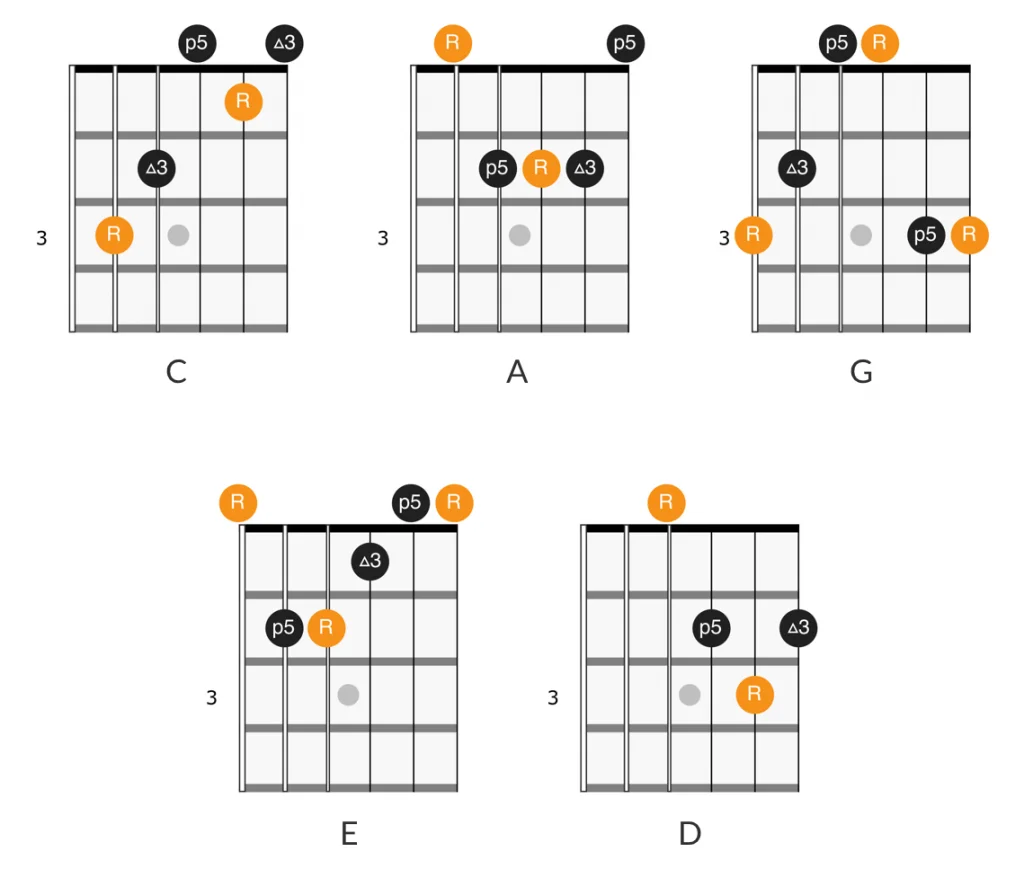
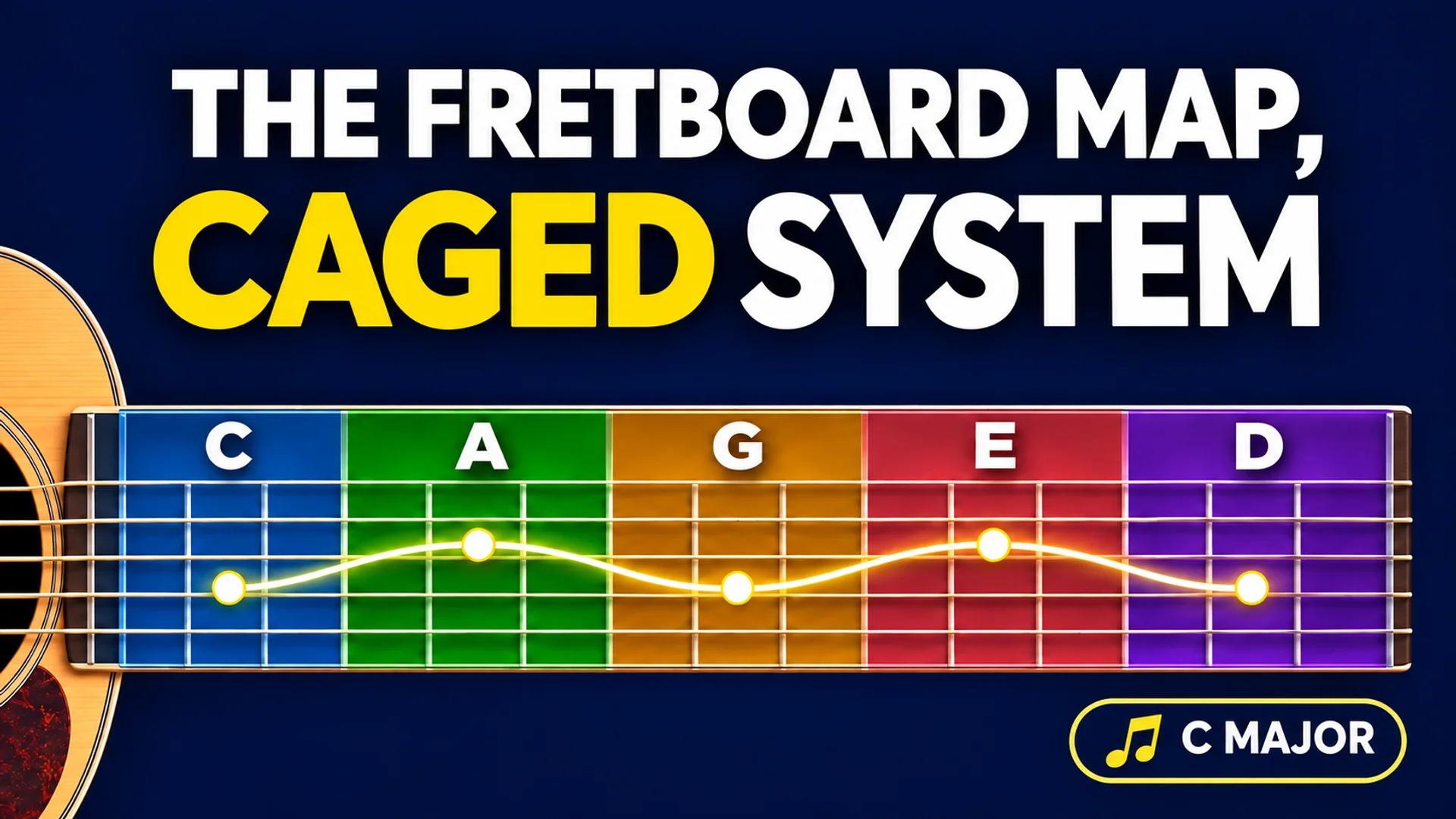
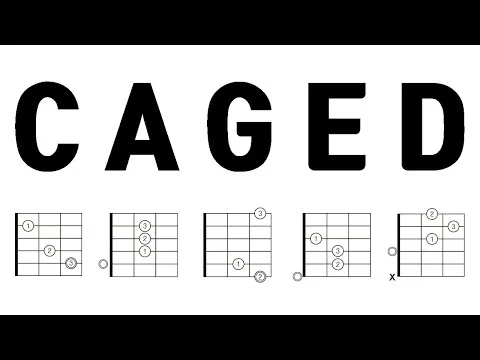
The name CAGED system comes from combining the names of five basic open chords: C, A, G, E, and D in order2. Unlike the piano, where notes are arranged in a straight line, the guitar’s notes are laid out in a grid, making it difficult to intuitively grasp the structure of the fretboard2. To resolve this challenge, the CAGED system divides the fretboard into five sections (C, A, G, E, D) based on a specific root note (the reference note that gives the chord its name) and visualizes the interval structure of each section2.
The most fundamental principle behind this system is the physical fact that 'moving up one fret raises the pitch by a semitone'1. For example, moving an open A chord up to the 1st fret with an index finger barre creates a B♭ major barre chord, and moving it to the 2nd fret creates a B major chord13. Using this principle, you can push the five open chords up the neck to find chords at any position.
However, this movement is only valid when the guitar is in standard tuning4. Also, the C, G, and D shapes, which require wide finger spacing or skipping frets, can become physically awkward to play when moved to higher frets. Specifically, for the G and D shapes, there is a practical tip that leaving one fret open between the index finger barre and the remaining fingers can help reduce errors41.
The Principle of Adjacent Chords Connecting Through Shared Notes
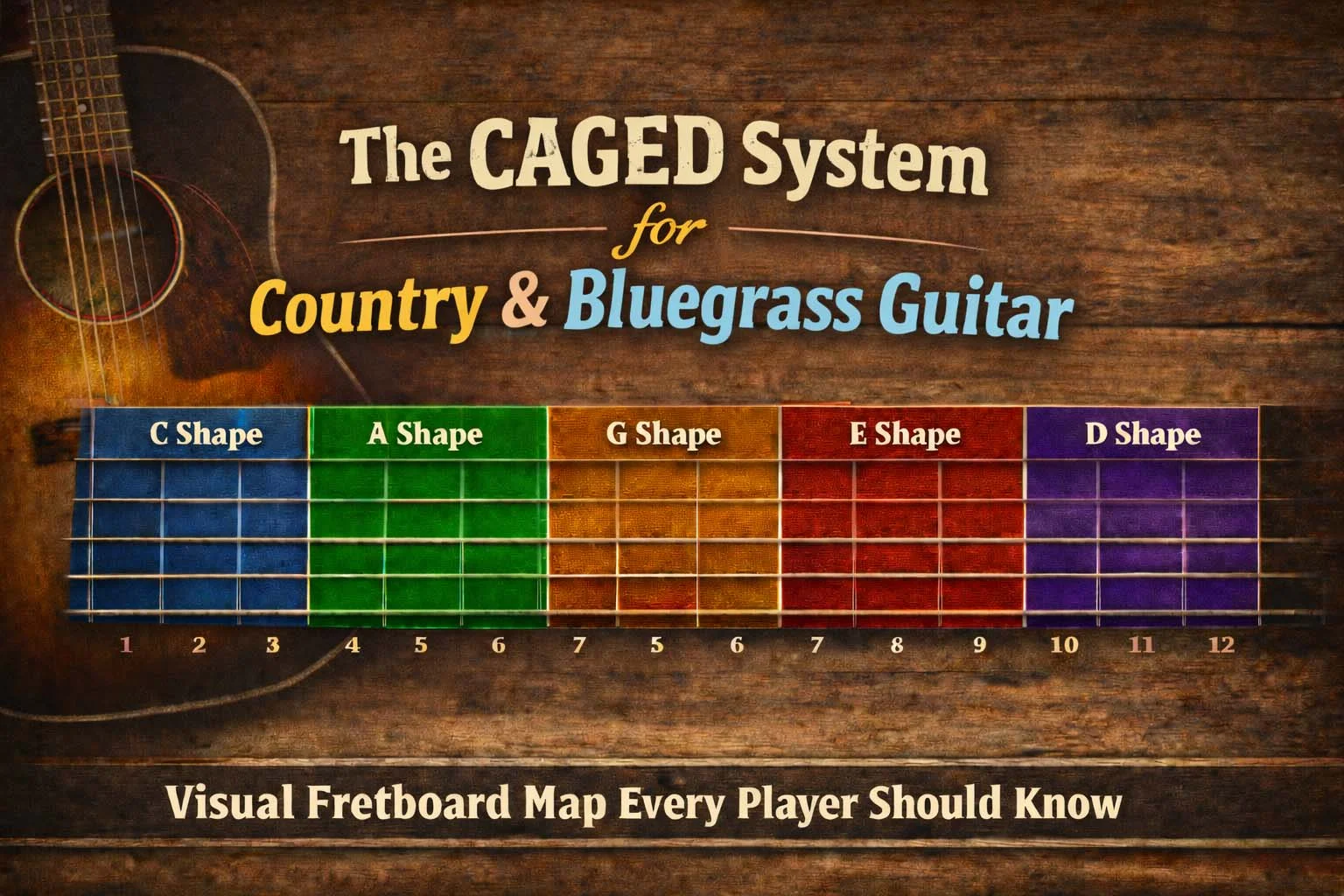
The true value of the CAGED system lies not merely in creating barre chords. The core point is that these five shapes are not connected in a random order on the guitar neck, but link together in a precise cycle: C→A→G→E→D→C2.
The secret to this connection is that adjacent shapes physically share certain notes. The guitar theory education site 'Applied Guitar Theory' points out that the root note on the 5th string of the open C shape is exactly the same note as the root note of the A shape located just below it2. Using this shared note as a bridge, the C shape naturally connects to the A shape2.
The 'On The Track' educational material explains this connection more vividly. It states that one end of the G shape coincides with the opposite end of the E shape, and the other end of the G shape overlaps with one end of the adjacent A shape5. In other words, when moving a chord to the next position, you do not memorize and form a new chord from scratch; instead, half of the previous chord shape and half of the next shape overlap, allowing you to glide smoothly across the fretboard5.
A Map of the Entire Fretboard Viewed Through C Major
The structure becomes much clearer when you draw this principle as a fretboard map for the C Major chord. Let’s trace in order how to find the same C Major chord in five different positions.
| Position | CAGED Shape | Fret and Fingering Characteristics | Shared Note (Connection Point) |
|---|---|---|---|
| 1 | C Shape | Open chord (0th fret) | Enters A shape via the C note on the 5th string |
| 2 | A Shape | 3rd fret barre | Shares with G shape via 5th, root, and major 3rd notes on the 4th, 3rd, and 2nd strings |
| 3 | G Shape | 5th fret barre | Leads to E shape at the 8th fret via the C root note on the 6th string |
| 4 | E Shape | 8th fret barre | Connects to D shape at the 10th fret via the C note on the 4th string |
| 5 | D Shape | 10th fret barre | Circulates back to the next C shape via 5th, root, and major 3rd notes on the 3rd, 2nd, and 1st strings |
[Table basis: 2]
When playing the open C shape at the 0th fret, if you use the root note on the 5th string of the same fret as a reference and stretch your index finger to barre the 3rd fret, your hand shape transforms into the A shape, resulting in a C Major chord at the 3rd fret position2. If you then maintain the upper string notes of the A shape (the 5th, root, and major 3rd notes on the 4th, 3rd, and 2nd strings) and overlap them with the next shape, the G shape at the 5th fret emerges, with a new root note on the 6th string2. Following the root note on the 6th string to the 8th fret barre leads to the familiar E shape C Major chord2. Then, using the C note on the 4th string as a stepping stone, you connect to the D shape at the 10th fret, creating an infinite loop that circulates back to the original C shape2.
The country guitar educational institution 'Country Guitar Online' advises practicing using this principle. Instead of trying to memorize everything at once, they suggest holding one shape, strumming the chord, identifying the root note within it, and then repeating the process of sliding to the next shape6.
The Key to Improvisation Where Chords and Scales Overlap
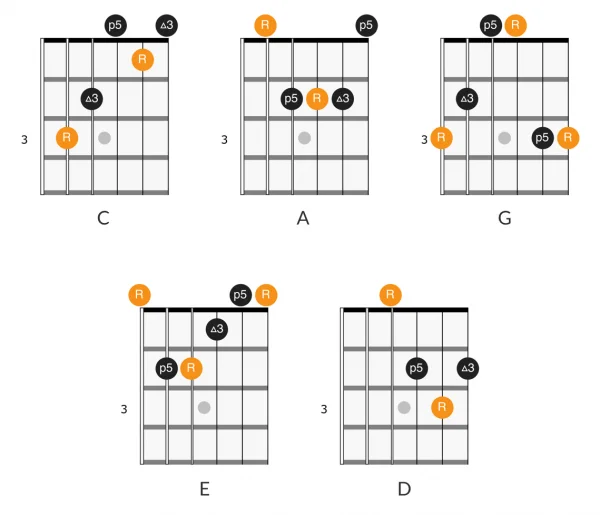
While freely moving chords across the fretboard is remarkable, the reason guitarists need the CAGED system is its connection to improvisation. Inside each CAGED chord shape are built-in intervals (arpeggios) that constitute the chord’s components, as well as scale notes2.
The guitar theory site 'Applied Guitar Theory' emphasizes that accurately identifying the root note positions in each C, A, G, E, and D shape is the key. The root note serves as an anchor point for scales and arpeggio patterns as well as chords, allowing you to quickly find chords, scales, and arpeggios anywhere on the fretboard2. Guitar Quarter also stresses identifying root note positions as a crucial step in mastering CAGED4.
In practice, guitar instructor Lee Hwa-gyun shows three blocks corresponding to the A, G, and E shapes in the C Major scale in a video, pointing out that the finger placement for each block is very similar to the C Major chord shape at the same position. He then summarizes that the five scale blocks covered in previous lectures ultimately have the same structure as CAGED1.
However, relying solely on the system has limitations, as you may get trapped in specific boxes and repeat pattern-based playing. CJ, author of the guitar education platform 'Strings of Rage,' recommends simultaneously learning 'intervallic functions'—internalizing the relationship of all intervals relative to the root note—to overcome this pattern dependency7.
Ultimately, the CAGED system is not a tool that magically simplifies complex theory. Rather, it relieves the burden of having to memorize countless chords individually and offers a clear strategy to push the five finger shapes already familiar to your hands around the fretboard. If you can identify the connections created by open chords and barrés, you take the first step toward moving freely across the guitar fretboard and choosing the notes you want.
References
- 기타 CAGED 시스템에 대해서 알아봅시다 · youtube.com↩
- CAGED System for Guitar · appliedguitartheory.com↩
- CAGED System for Guitar: a Simple 6-Step Guide · stringkick.com↩
- 🎸 CAGED system for guitar: play chords across the entire fretboard. · guitarquarter.com↩
- The CAGED System Part 4: The E shape - On The Track · onthetrackofficial.com↩
- The CAGED System for Country & Bluegrass Guitar (Simple, Visual Fretboard Map) · countryguitaronline.com↩
- Fretboard Visualisation: The Ultimate Guide » Strings Of Rage™ · stringsofrage.com↩