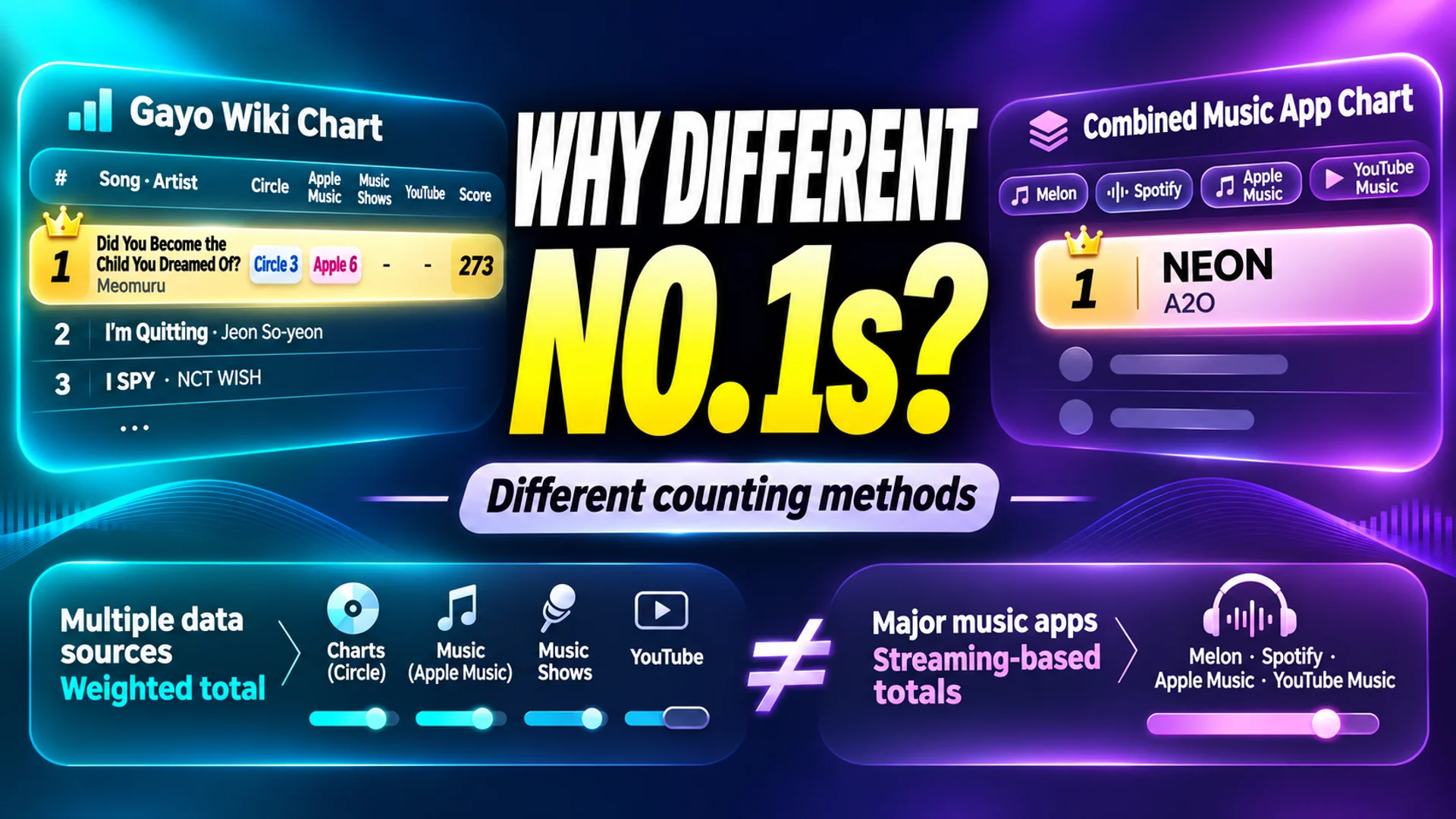
On November 5, 2026, the number one song differed completely between two music aggregation charts announced on the same day. The top spot on "Gayo Wiki TOP100" went to Murmur's "Did You Become the Adult You Dreamed Of?" while "Music-Chart-Tracker" placed A2O's "NEON" at first place. The rankings of the two songs also diverged significantly. The song ranked first on Gayo Wiki stood third on Music-Chart-Tracker, and the track at number one on the latter chart placed ninth on Gayo Wiki 12.
This discrepancy is not due to an error. The two charts aggregate data from different sources. The key clue to this difference is stated at the bottom of the Gayo Wiki aggregation criteria page.
Unused data — individual service charts such as Melon, Genie, and Bugs, votes, and social mention counts 1
Data from Melon, Genie, and Bugs, which we commonly refer to as music streaming apps where we check number one rankings, are entirely excluded from the Gayo Wiki TOP100 aggregation. Since different data sources yield different aggregation results, the top song can vary even on the same day. This post examines how the two aggregation mechanisms—what a chart "includes" and what it "excludes"—are reflected in actual rankings and scores.
Differences in What the Two Chart Sites Count
Gayo Wiki TOP100 aggregates six rankings into a score based on weights. It is updated daily at 5:35 AM and aggregates 383 songs per day. The sources and weights used by this chart are as follows 1.
| Ranking (Data) | Role | Weight or Calculation Method |
|---|---|---|
| Circle Chart | Official Weekly Digital 200 | 1.0 |
| Apple Music KR | Official Top 100 | 0.8 |
| TJ (Karaoke) | TJ Popular 100 / TJ Trending 100 | 0.6 / 0.4 |
| Kyoungyoung (Karaoke) | Kyoungyoung Weekly Chart | 0.5 |
| Music Broadcasts | Number one records on 6 broadcast programs | +0.5 for each number one within 14 days |
| YouTube | Official channel MV/audio video velocity (views ÷ time) | No. 1 within 7 days: 0.5 → No. 20: 0.025 |
Among these, the karaoke data from TJ and Kyoungyoung, along with music broadcast number one records, are notable. Karaoke data reflects consumption alongside accompaniment in homes or karaoke rooms, representing a context entirely different from streaming app data. When music broadcast number one records are added, "Did it achieve number one on TV?" becomes a score. Conversely, a song's ranking within the Melon app has no impact on the Gayo Wiki score 1.
In contrast, Music-Chart-Tracker has an entirely different structure. As of November 5, 2026, this site normalizes South Korean public rankings from four platforms—Melon, Apple Music, Spotify, and YouTube Music—to calculate an integrated score. According to the site’s explanation, this score is a metric converted from rankings rather than actual streaming counts, and the data reference dates for each platform may differ. In fact, the aggregation as of November 5 reflected data from November 4 for Melon, Spotify, and Apple Music, and data from November 3 for YouTube Music 2.
Ultimately, Music-Chart-Tracker addresses the issue of "how to weave together the rankings of four music and video apps," while Gayo Wiki TOP100 addresses "how to blend official aggregations, overseas apps, karaoke, broadcasts, and YouTube velocity by excluding music app rankings." The only overlapping source between the two charts is Apple Music.
Ranking Reversal Illustrated by One Song: "Did You Become the Adult You Dreamed Of?"
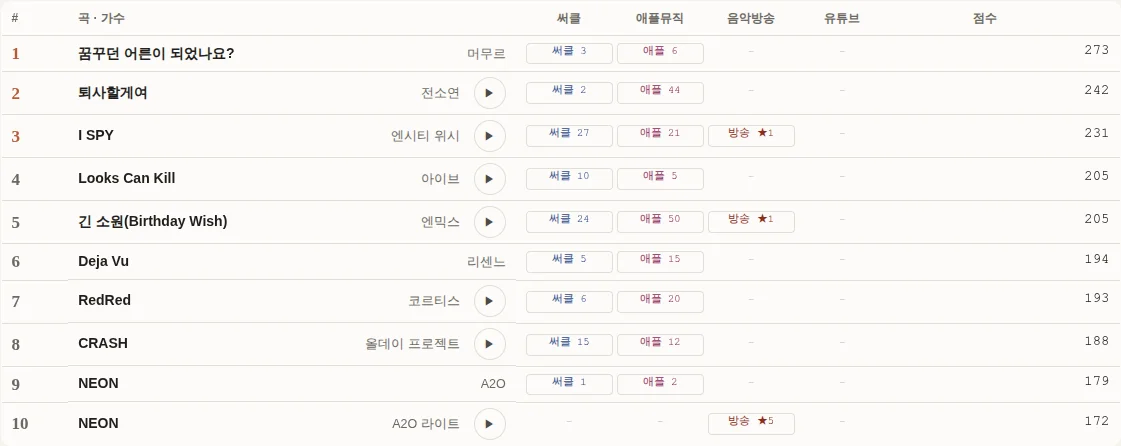
Differences in aggregation rules can be intuitively verified through the ranking of a specific song.
Murmur's "Did You Become the Adult You Dreamed Of?" has held the number one spot on Gayo Wiki TOP100 for four consecutive days as of November 5, 2026. It recorded a score of 273 points, with the ranking table citing Circle Chart at number 3 and Apple Music at number 6. No music broadcast number one records or YouTube category scores were displayed for this song. As Gayo Wiki indicated that this song’s record resulted from "aggregating 3 out of 6 rankings," three of the six sources contributed, but only two of them (Circle, Apple Music) were disclosed in the table. TJ or Kyoungyoung karaoke data may have contributed additionally, demonstrating that high rankings in heavily weighted sources can lead to an overall number one spot with contributions from only a few items 1.
On the same day, the song ranked third on Music-Chart-Tracker with a score of 96.5 points. Platform-specific rankings were Apple Music number 5, Melon number 3, Spotify number 5, and YouTube Music number 1 2. In other words, the Melon and Spotify rankings excluded from Gayo Wiki acted as significant variables within this chart's scoring system, altering the ranking.
The reverse situation also holds true. A2O's "NEON" took first place on Music-Chart-Tracker with a score of 99.5 points, recording Apple Music number 2, Melon number 1, Spotify number 1, and YouTube Music number 2 2. However, on Gayo Wiki TOP100, the song reached only ninth place with 179 points, with only Circle number 1 and Apple Music number 2 displayed in the table 1. Unlike Murmur's case, an indication of "how many of the 6 contributed" is not confirmed for this song, so it cannot be determined from the Gayo Wiki original text alone whether broadcast, YouTube, and karaoke sources actually did not contribute or whether they were reflected in the score but not displayed in the table.
What can be confirmed from this case is that neither side represents "true popularity." Depending on the lens of aggregation rules, a single song appears on a different scorecard.
"Invisible Rankings" Created by Karaoke and Broadcast Number Ones
A unique dimension existing only in Gayo Wiki TOP100 is the inclusion of karaoke data and music broadcast number one records. This information, absent from music app charts, creates new rankings.
A representative example is A2O LIGHT's "NEON." This song appeared at number 10 on the Gayo Wiki score table (172 points). The Circle, Apple Music, and YouTube categories were empty, and the only item displayed in the table was "Music Broadcast ★5" 1. Since Music Broadcast ★5 corresponds to 2.5 points under the 14-day additive score criteria 1, the remaining approximately 169.5 points are estimated to be contributions from TJ and Kyoungyoung karaoke data, whose columns are not displayed in the table. Gayo Wiki's TODAY RECORD lists "「NEON」 conquers 5 out of 6 broadcasts," and number one records for Show! Music Core on October 31 and Inkigayo on November 1 are confirmed 1. If this were a music app chart excluding karaoke and broadcast sources, there would be no basis for the song to reach number 10.
Similarly, NCT WISH's "I SPY" reached third place with a score of 231 points by aggregating Circle number 27, Apple Music number 21, and one music broadcast number one record (★1). NMIXX's "Long Wish (Birthday Wish)" also recorded fifth place with a score of 205 points by adding broadcast ★1 to Circle number 24 and Apple Music number 50 1. Under Gayo Wiki's weighting, Circle (1.0) and Apple Music (0.8) are the main contributing items, while broadcast ★1 acts as an additive score of +0.5 for each number one within 14 days 1. The music broadcast number one record provides additional additive points, having the effect of subtly raising the ranking within the same group of music track rankings.
This structure applies equally to trot and ballad genres. Jang Min-ho's "Life, A Friend" music video recorded 34,000 views within one day of release, and appeared on the "Speed · 72 hours" record list with MV speeds of 949 and 431 views per hour on a 72-hour basis from Jang Min-ho's official channel and Kakao M channel 1. Considering TJ and Kyoungyoung weights (0.4–0.6), trot genres frequently sung in karaoke rooms can form an overall score regardless of streaming rankings.
However, YouTube velocity does not overwhelm everything. Treasure's "SHOCK" was recorded in the "Title of Today" corner with an overwhelming MV growth rate of 398.1K per hour 1, but since the maximum weight for the YouTube category (0.5) is half that of the Circle Chart (1.0), it is difficult to occupy the overall top ranks with this speed alone. The magnitude of each source's weight determines what the respective chart evaluates as more important.
Why a Team Dominating Melon's Top 1–5 Stays at Gayo Wiki No. 6 (One Song)
At this point, one might wonder, "The team that dominates music app rankings 1–5 will likely be number one on the integrated chart as well." However, data from November 5, 2026, disproves this.
According to a report by YTN Star, RESCENE set an unprecedented record with all five new songs occupying positions 1 to 5 on the Melon chart 3. Even in Music-Chart-Tracker aggregation, RESCENE placed multiple songs in the top ranks, including "LOVE ATTACK" (5th place, score 89.5), "Deja Vu" (8th place), and "With" (10th place). However, for "With," only rankings from three platforms—Apple Music, Melon, and Spotify—were reflected, and the YouTube Music score was marked as provisional, showing differences in reflection status by item 2.
"Deja Vu" recorded sixth place with a score of 194 points based solely on Circle number 5 and Apple Music number 15. "Baekhwaryoran" and "MEME" were not shown in the top 10 of the score table. The broadcast and YouTube columns in the table were empty, and TJ and Kyoungyoung columns were not displayed, so whether karaoke items contributed cannot be confirmed from the original text alone 1.
This is not evidence that Gayo Wiki "ignored" RESCENE. Both charts feature them in the upper ranks, and the difference arises simply from "which sources are included." In a chart where Melon is excluded from aggregation, dominating Melon's top 1–5 does not yield points. Conversely, in a chart lacking broadcast and karaoke sources, achieving number one in five broadcasts does not yield points. Each chart shows only one aspect of popularity explainable by its own sources.
Individual music app charts essentially have a structural characteristic of aggregating only the consumption patterns of "their own users." According to a 2018 Seoul Shinmun report, Kakao Melon held over 60% of the domestic music market share at the time 4. Even if a specific app has a high market share, its chart is merely a popularity ranking within that platform and cannot perfectly represent a cross-section of the entire music market. Integrated charts emerged to compensate for this limitation, but the design choice of which data to select inevitably arises when adding sources. Gayo Wiki TOP100's inclusion of karaoke and broadcast data and exclusion of Melon, and Music-Chart-Tracker's composition solely of streaming apps without karaoke data, are all results of these structural choices 12.
One Thing to Check When Reading Integrated Charts
The reason two integrated charts announced on the same day show different number one songs is that the sources and weights of the aggregated data differ. Gayo Wiki TOP100 explicitly excludes individual music app charts like Melon, Genie, and Bugs, and calculates a weighted sum of the Circle Chart, Apple Music, TJ/Kyoungyoung karaoke, music broadcast number ones, and YouTube MV velocity. In contrast, Music-Chart-Tracker normalizes and aggregates the public rankings of four apps: Melon, Spotify, Apple Music, and YouTube Music.
When karaoke and broadcast data are included in the sources, the strength of trot and ballad genres or music broadcasts rises in the rankings. Conversely, if sources consist only of streaming apps, the strength of an idol group dominating Melon's top 1–5 becomes the score directly. Murmur's "Did You Become the Adult You Dreamed Of?" being number one on one chart and third on another, and A2O's "NEON" being number one on one side and ninth on the other, are products of these design choices.
When encountering integrated chart news, the first thing to check before the ranking numbers is "what the chart included and what it excluded." Some charts, like Gayo Wiki, specify a list of excluded data, while others, like Music-Chart-Tracker, notify differences in platform reference dates 12. Checking this information allows you to grasp the structure, noting, "This chart was set up centering on these data sources," instead of questioning "Why is this song number one here?" when looking at the ranking table. Ranking differences are not errors but records of the aggregation side's design results regarding "what constitutes the basis of popularity."
References
- ↩
- Music-Chart-Tracker 뮤직 차트 트래커 | 국내 음원 차트 트래킹 서비스 · music-chart-tracker.com↩
- 연예 | YTN star · star.ytn.co.kr↩
- 음악도 빌려듣는 시대… 플랫폼 선점 나선 음원시장 강자들 · seoul.co.kr↩