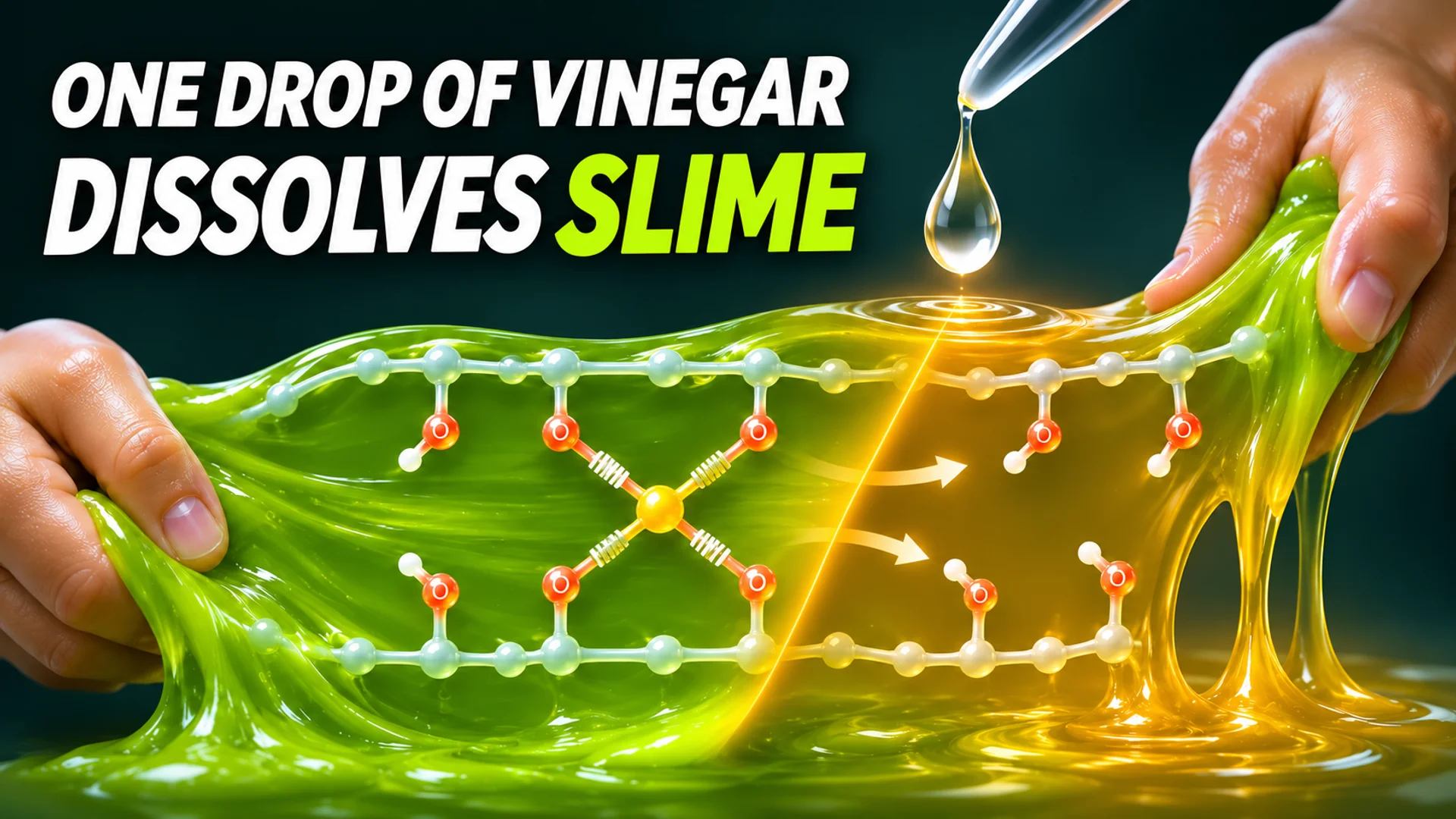
What happens when a single drop of kitchen vinegar falls onto finished slime? The area where the vinegar touches slowly dissolves the slime, returning it to its original sticky glue consistency. This phenomenon occurs not because the substance itself—the slime—has changed, but because the 'cross-linking points' that connect the polymer chains have broken apart.
Common PVA (polyvinyl alcohol) glue dissolves in water, existing as chains, but because these chains slip freely past one another, the glue flows loosely. When borax is added, the chains link together, transforming the mixture into a solid with elastic properties. However, adding vinegar (an acid) breaks these links again. In other words, vinegar is not an ingredient for making slime but acts as a switch that breaks cross-links and reverts the material to a liquid state. This article examines how the same PVA glue transitions between a hard solid and a flowing liquid depending on borax and vinegar, and explores the nature of 'viscoelasticity' felt by the fingertips between these states.
Cross-Linking Networks vs. Chain Entanglement
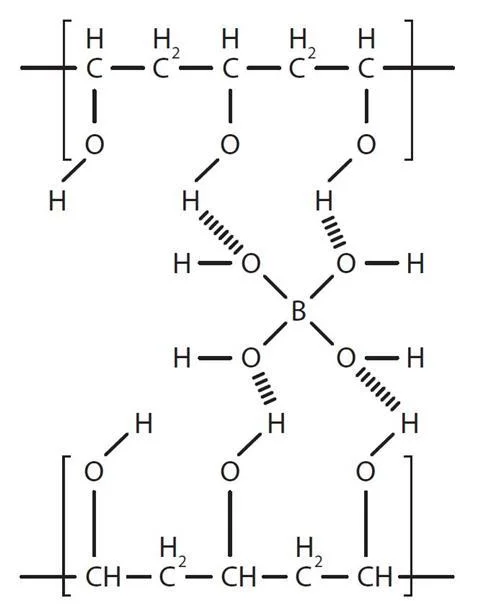
PVA, the backbone of slime, exists as long chains when dissolved in water. In polymer science, the points where these chains connect are called 'cross-linking.'
According to explanations by science expert Seol Hyo-hoon, when parts of the PVA chains form hydrogen bonds with borate ions (B(OH)4−) from a borax solution, a large network structure is created. Water molecules become trapped within this mesh, resulting in a hydrogel (a gel-like solid holding moisture), which produces slime's characteristic elasticity 1.
However, this entanglement only hinders the chains from sliding past each other to a certain extent; it does not chemically bind them at specific points. Looking only at basic physics, there is no difference between cross-linking and general entanglement. The distinction becomes clear only when the chains are stretched significantly, at which point the cross-linked areas exhibit elasticity by trying to return to their original shape, like a rubber band 2. Thus, the elastic recoil felt when stretching slime becomes distinct only when cross-links act as fixed points that truly bind the chains.
Number of Cross-Links and Viscoelasticity: The Answer to Semi-Solids Felt by Fingertips
The number of cross-links is a key factor determining slime's physical properties.
Science expert Park Sung-hak defines slime as a 'viscoelastic' object that possesses both the viscosity of a liquid and the elasticity of a solid 1. The sensation of slime resisting like a hard solid when squeezed tightly, then flowing like a liquid when released, is this viscoelasticity.
This is directly related to the number of cross-links. According to Seol Hyo-hoon, slime as commonly known is a state where borate ions bind moderately to form an appropriate network structure. Conversely, if there are too few cross-links, the network becomes loose, causing the slime to stick easily to hands and flow loosely. If too many borate ions are added, increasing the number of cross-links, the elasticity becomes excessive, resulting in a hard, bouncy ball 1. Thus, polymer cross-linking serves as a switch that allows the unique physical property of viscoelasticity to be designed through precise adjustment.
The Effect of Salt and Ions on Viscosity (Reference)
Understanding the role of salt in comparison to slime manufacturing can help grasp how ions affect interactions with polymers or colloids. However, salt does not act via the same mechanism as vinegar in that it does not function as a primary factor in directly creating or breaking the cross-links in PVA slime.
According to the cosmetic formulation practical blog Chemists Corner, adding salt to shampoo (anionic surfactants) raises viscosity, a phenomenon known as the 'Salt Curve' 3. Sodium ions lower the charge density on the surface of 'micelles' (aggregates of surfactant molecules), causing the micelles that previously repelled each other to pack tightly, thereby increasing viscosity. However, if the amount of salt exceeds the appropriate range, the mixture becomes thinner, requiring control 3.
This example does not mean that salt works on the same principle as vinegar breaking PVA slime's hydrogen-bond cross-links. Instead, please refer to this as a supplementary case to understand the general principle that ions can alter interactions between particles or polymer chains in a liquid.
Breaking and Reversing Cross-Links with Vinegar (pH)
The most interesting aspect of slime is the ability to transition between states using acids and bases.
Appropriate alkaline conditions are required for PVA chains and borate ions to bind. In cases where non-basic boric acid is used, such as in lens cleaning solutions, baking soda must be added to adjust alkalinity for cross-linking to occur effectively 1. Conversely, pouring vinegar, an acidic solution, onto finished slime breaks the hydrogen bonds between PVA and borate ions 1.
As the network structure where vinegar touches collapses and the cross-links disappear, the previously bound chains slide freely again, reverting to a state dominated by liquid properties. At this point, the slime does not turn into water instantly; rather, at the boundary where vinegar has seeped in, a middle state is created where cross-links are only partially broken. Because hard and soft parts exist side by side in these boundary areas, when touched with fingertips, elasticity is more strongly felt where cross-links remain, and viscosity is felt where they are broken, making it easy to distinguish the two components of viscoelasticity simultaneously.
Conclusion: Polymer Chemistry Verified in the Kitchen
Vinegar is not an ingredient of slime but a switch that dissolves already formed PVA cross-links, reverting the material to its original flowing liquid state.
Prepare a lump of slime at home and lightly wet it with vinegar. It is expected that the area where the vinegar has seeped in will thin out as cross-links break, while areas not yet reached by the acid will maintain elasticity. This demonstrates a chemical reaction where cross-links are broken by acid happening right before your eyes. By gradually mixing in baking soda solution or borax solution to restore alkalinity, the broken bonds may reform, and elasticity may return (based on the principles of acid–cross-link breaking and alkali–cross-link formation from 1).
Polymer physics is not complex theory. Within the changes in firmness and flowability felt by the fingertips while alternating between a drop of vinegar and a spoonful of baking soda, you can directly verify the network structure where polymer chains are bound and released.
References
- 장난감중 슬라임은 무슨 원리인가요? | 궁금할 땐, 아하! · a-ha.io↩
- Polymer Physics | Practical Solubility Science | Prof Steven Abbott · stevenabbott.co.uk↩
- Why does salt thicken shampoos? · chemistscorner.com↩