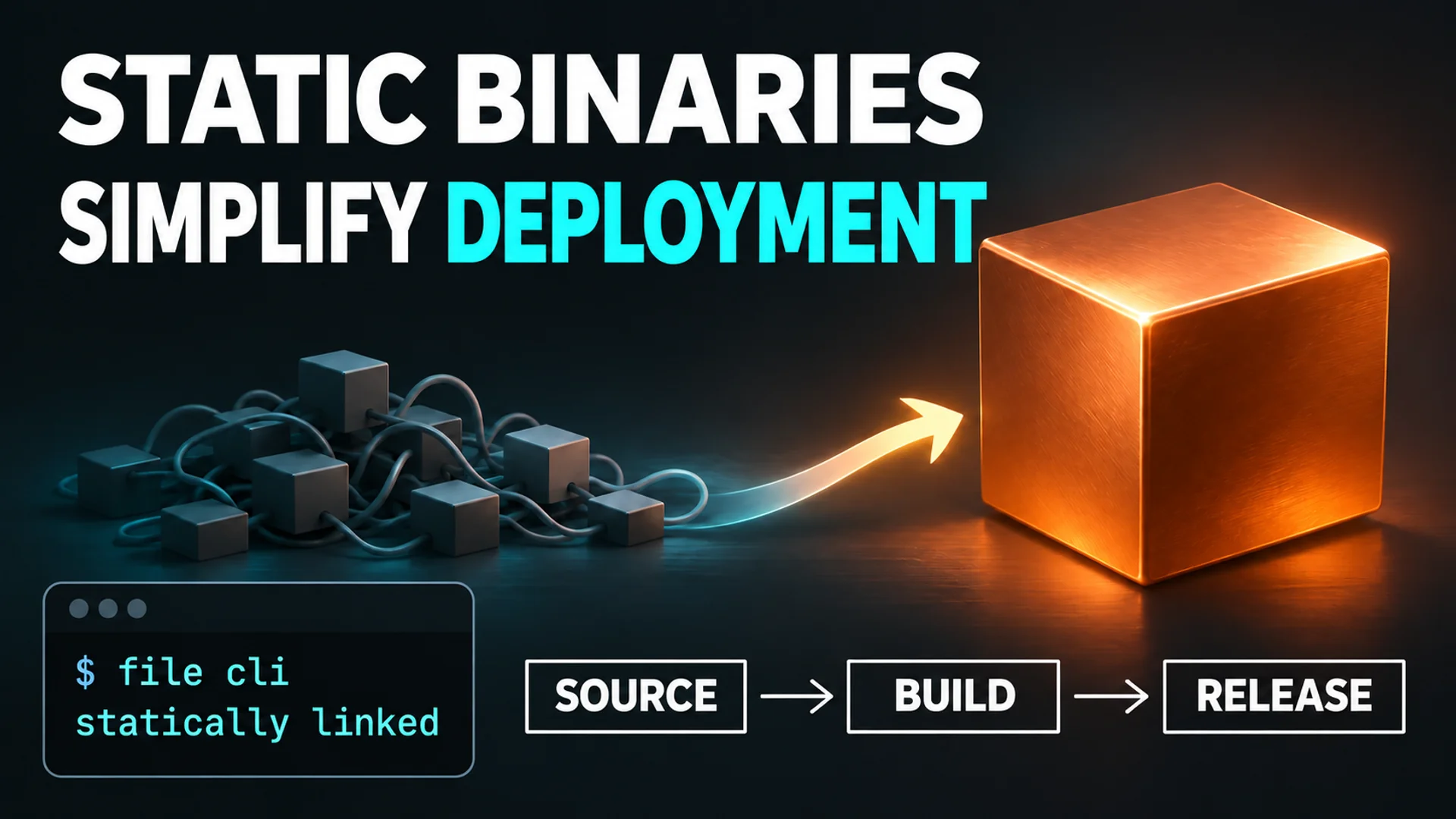
When deploying CLI tools developed in interpreter-based languages, users often encounter "Dependency Hell," caused by dependency installation failures and exponentially growing disk usage. Rust statically bundles all Rust dependencies and the C runtime at compile time to produce a single executable, thereby fundamentally eliminating the unnecessary complexity of runtime environments. As a result, the Rust-based uv can be distributed as a single binary of just 35 MiB, in sharp contrast to the Python-based aider, which requires over 3 GiB of disk space at installation 1.
To apply the benefits of static binary deployment to real-world work, one must go beyond simply executing build commands and understand linking strategies suited to the characteristics of the target environment. In particular, using the *-linux-musl target eliminates runtime dependencies such as glibc, enabling the creation of tools that can run in ultra-lightweight container environments 2, 3. However, note that the linking method may vary depending on the build host environment 4. This article analyzes the structural causes of dependency problems and examines the principles of generating optimal binaries by controlling the Rust compiler's linking behavior. It also reviews the realistic limitations of static compilation based on large-scale ecosystem survey data and presents practical solutions for automatically building multi-platform release pipelines using GitHub Actions.
Deployment Risks from Interpreter Environments and the Structural Advantages of Static Linking
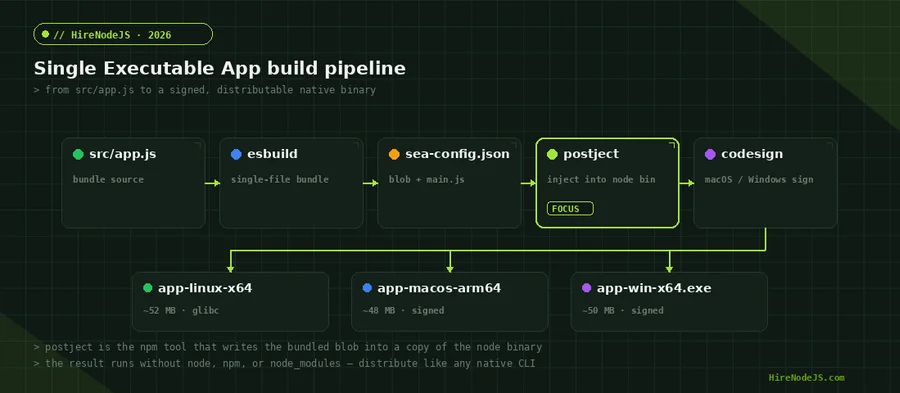
Dependency hell refers to the management and security burdens that arise when a program excessively references external packages. Despite the intention to enrich the ecosystem, a structure where a specific package's transitive dependencies require yet more dependencies complicates the build environment. For instance, installing Gatsby in the JavaScript ecosystem is recorded as a single dependency in package.json, but the actual project's node_modules directory ends up with 1,889 packages installed, occupying approximately 348 MB of space. The package-lock.json file, generated to ensure consistency in the build tree, easily exceeds 15,000 lines, making it essential to accurately pin dependencies to prevent unexpected errors during production deployment 5.
Tools based on runtime languages are highly vulnerable to environment configuration. For example, the popular coding assistant aider, when installed via Homebrew, requires 51 additional packages and inflates disk usage to over 3 GiB 1. The Python-based Google Cloud CLI is so heavily dependent on its runtime environment that cases occur where it becomes unexecutable due to post-deployment environment changes. Furthermore, OpenAI's Codex project has over 200 total direct and indirect dependencies, representing a dangerous attack surface where the entire service can become paralyzed due to dependency version pinning failures or the removal of a single specific package 1.
Rust leverages the characteristics of a compiled language to solve this problem. The default bin crate type generated by the Rust compiler fully includes all Rust and native dependencies in the output 2. Consequently, when the executable runs, development toolchains or specific language interpreters are no longer required. The burden of reinstalling due to dependency installation or upgrades disappears, and application stability is maintained even if the external environment changes post-deployment 1. Demonstrating this, uv, a package management tool written in Rust, installs lightly as a single 35 MiB binary 1.
Rust Compiler Crate Linking Methods and C Runtime Control
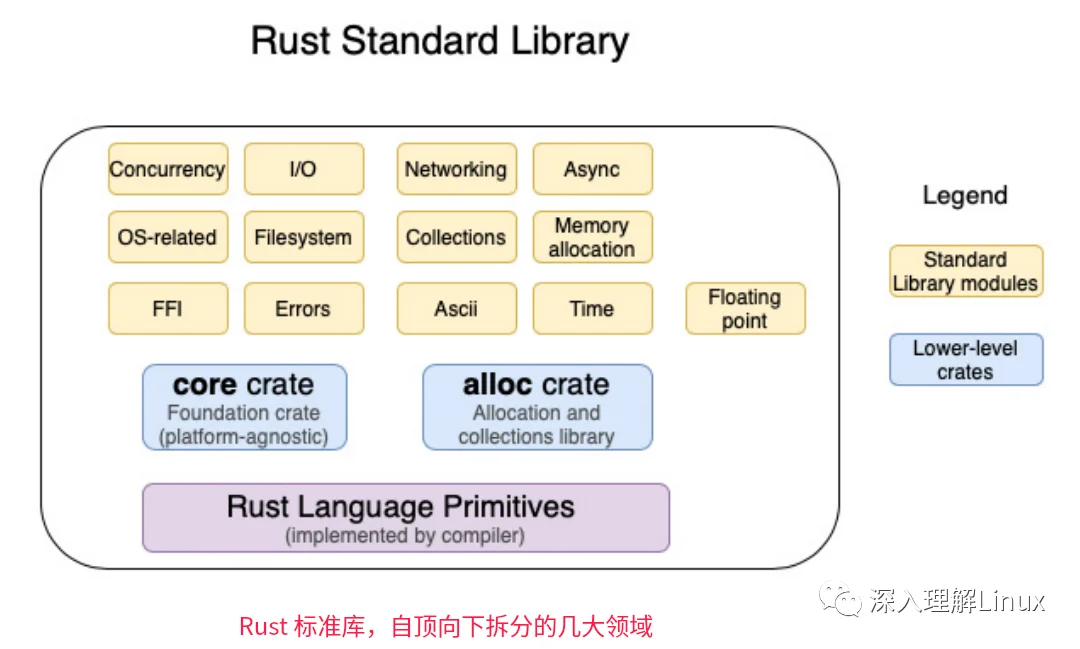
While Rust's complete static binaries are guaranteed by architectural defaults, there are times when developers need to precisely control compiler behavior to match specific environmental requirements. According to the official Rust reference, the compiler supports the --crate-type command-line flag or the crate_type attribute to select a crate's linking method. During this process, rules for output formats are strictly applied. When generating an executable for an bin target, the rlib format, which includes dependencies, is prioritized by default. When generating libraries like the lib format, the compiler's primary design goal is to ensure that dynamic library code is not duplicated across outputs 2.
The standard library is designed to respond flexibly to the linking method of the C runtime. While most targets default to dynamically linking the C runtime, if you want to statically link the C runtime and eliminate the dependency, you must explicitly specify the -C target-feature=+crt-static flag as a compile option 2. According to Rust RFC 1721, this feature was not implemented as a grand change to the target specification itself, but rather as an internal target feature achieved by extending the LLVM-based CPU feature control system 6.
The linking state of the C runtime is designed to be detectable at both the build script and code levels. The Cargo build environment converts the cfg value output by the compiler into environment variables such as CARGO_CFG_TARGET_FEATURE and passes them along. By checking this value in the build script (build.rs), one can determine whether the current mode is static linking. When compiling external C code, logic can be implemented to preemptively prevent linker errors by appropriately switching between static compilation options (/MT) and dynamic compilation options (/MD), similar to the gcc-rs crate 6. Conversely, if you wish to build a special scenario that dynamically references the musl library within Alpine Linux, specifying -C target-feature=-crt-static in RUSTFLAGS provides a sufficiently flexible solution 6.
musl Target Strategy for Alpine Linux and Container Environments
The Rust ecosystem actively utilizes musl targets, which pair well with minimal base container images like Alpine Linux or distroless, aiming for ultra-lightweight deployments. Setting x86_64-unknown-linux-musl as an explicit target and building statically integrates C libraries that would otherwise be dynamically depended upon during compilation, establishing an environment where the binary can run independently 3, 7.
In response to the demand for modernizing time-processing operations, the Rust project team updated the default library for Linux musl targets from version 1.1.24 to musl 1.2.3 starting with Rust 1.71. This change made the precise time-processing features supported by 64-bit operations available on all platforms. However, to ensure backward compatibility with existing applications, the musl ABI (Application Binary Interface) specification has been strictly maintained, meaning existing codebases do not need modification. This target broadly encompasses architectures such as x86_64, armv7, and aarch64, optimizing for diverse hardware 8.
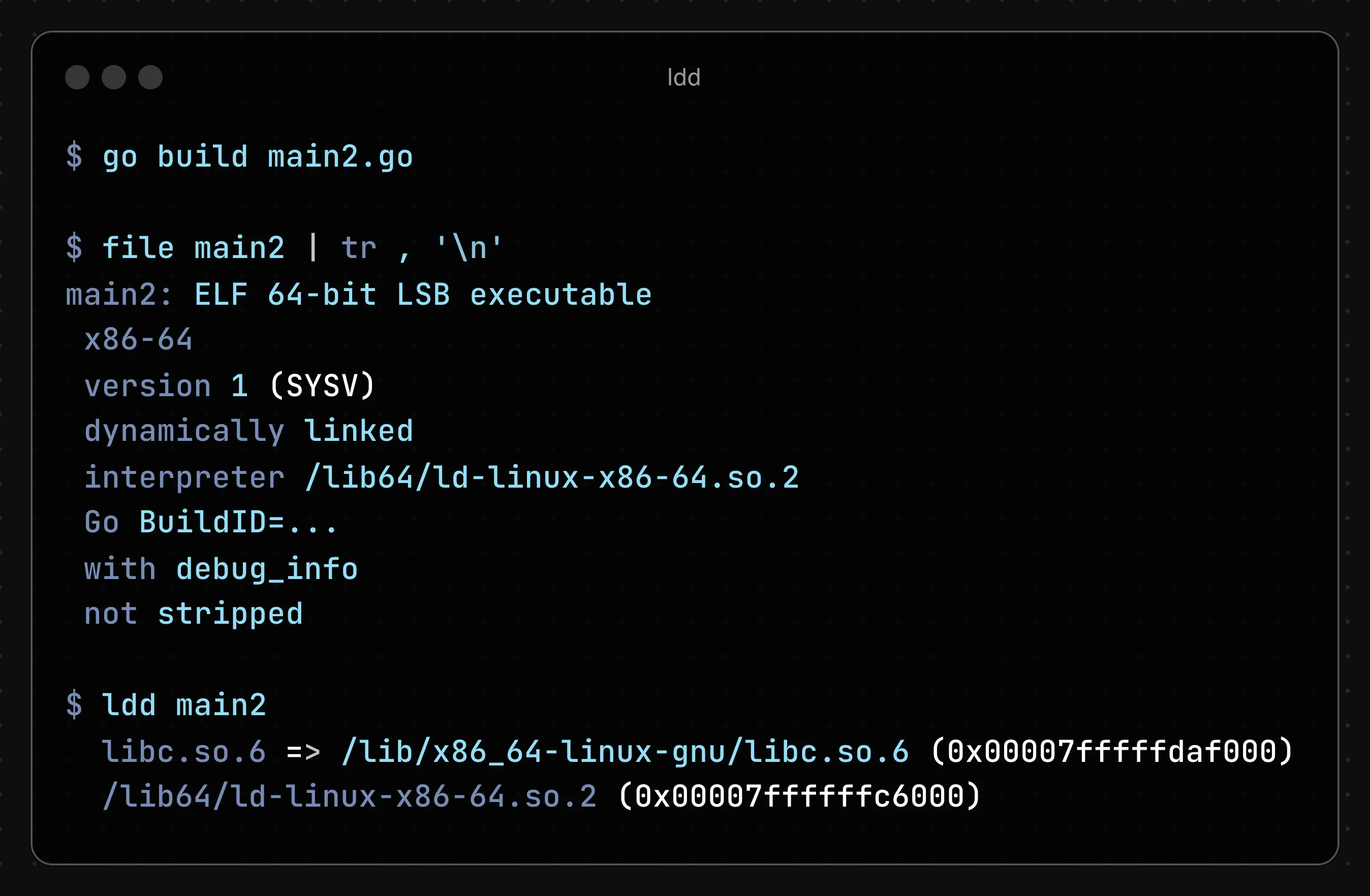
However, there are practical caveats requiring an understanding of subtle toolchain differences in containerized build environments. Real-world tests by Rust users revealed unexpected phenomena when building and verifying within an rust:1.46.0-alpine image using Alpine Linux as the host system. After building for a musl target, inspecting the executable with the ldd command showed it pointed to /lib/ld-musl-x86_64.so.1, identifying it as dynamically linked. Adding the explicit instruction RUSTFLAGS="-C target-feature=+crt-static" did not change this result. In contrast, running the same command in a Debian-based slim image environment clearly showed a statically linked status. This is a potential conflict arising from the interaction between Alpine Linux's unique musl library management and the Rust compiler's default target settings; therefore, it is advisable to habitually verify the static linking status of outputs via command-line tools before deployment 4.
| Build Host Environment | Applied Build Command / Option | ldd Execution Result Analysis | Static Link? |
|---|---|---|---|
Debian-based (rust:1.46.0-slim) | cargo build --target x86_64-unknown-linux-musl | statically linked output | Success |
Alpine Linux (rust:1.46.0-alpine) | cargo build --target x86_64-unknown-linux-musl | /lib/ld-musl-x86_64.so.1 reference | Failure (Dynamic link) |
Alpine Linux (rust:1.46.0-alpine) | RUSTFLAGS="-C target-feature=+crt-static" ... | /lib/ld-musl-x86_64.so.1 reference | Failure (Dynamic link) |
| (Source: Community technical verification cases 4) |
Stark Build Results: Pure Rust vs. System Library Dependencies
Providing complete static binaries in the Rust ecosystem is not a universal panacea for all projects worldwide. Whether system libraries (C libraries) are integrated is the key branching point determining compilation success. The development platform Pkgforge team analyzed metadata from over 110,000 crates on crates.io in June 2025, selected 10,033 CLI projects updated since January 2024, and performed large-scale static cross-compilation. In this experiment, complete static linking was attempted by forcibly assigning crt-static and link-self-contained to the compiler options.
The results were clear-cut. After completing builds using 40,000 CI instances, only 5,779 crates succeeded in static builds, representing just 57.60% of the total. The remaining ~42.40% failed due to dependency issues in the build environment. Most build failures occurred because the project internally referenced external system libraries like OpenSSL or SQLite, or because the build script (build.rs) required a local toolchain 9.
The reason existing projects cannot avoid system dependencies is largely due to legacy ecosystems. In the past, container-based static compilation tools like rust-musl-builder attempted to resolve dependency hell by preparing and providing separate static versions of libraries such as OpenSSL and Diesel. However, the recent Rust ecosystem is rapidly shifting toward rustls, a TLS library designed as a pure Rust implementation. Numerous standard tools, including reqwest, tokio-postgres, and sqlx, have been configured to eliminate OpenSSL dependencies. Nevertheless, the SQL-related library Diesel remains the only major project still requiring libpq and OpenSSL, indicating that areas free from system dependency issues remain limited 7.
On the other hand, optimizing the build environment and system integration drastically reduces the physical speed of compilation and deployment. Pkgforge's measurements showed that compiling and installing fd-find, a pure Rust tool, using cargo install took approximately 52 seconds. In contrast, downloading and deploying a pre-built static binary completed installation in just 1.7 seconds 9. Analysis of all 10,000 projects also demonstrated the stability of static deployment based on pure Rust code, with pure Rust implementations recording build success rates above 95% on major architectures like x86_64 and arm64 9.
Fully Automated Releases Implemented with GitHub Actions and Toolchains
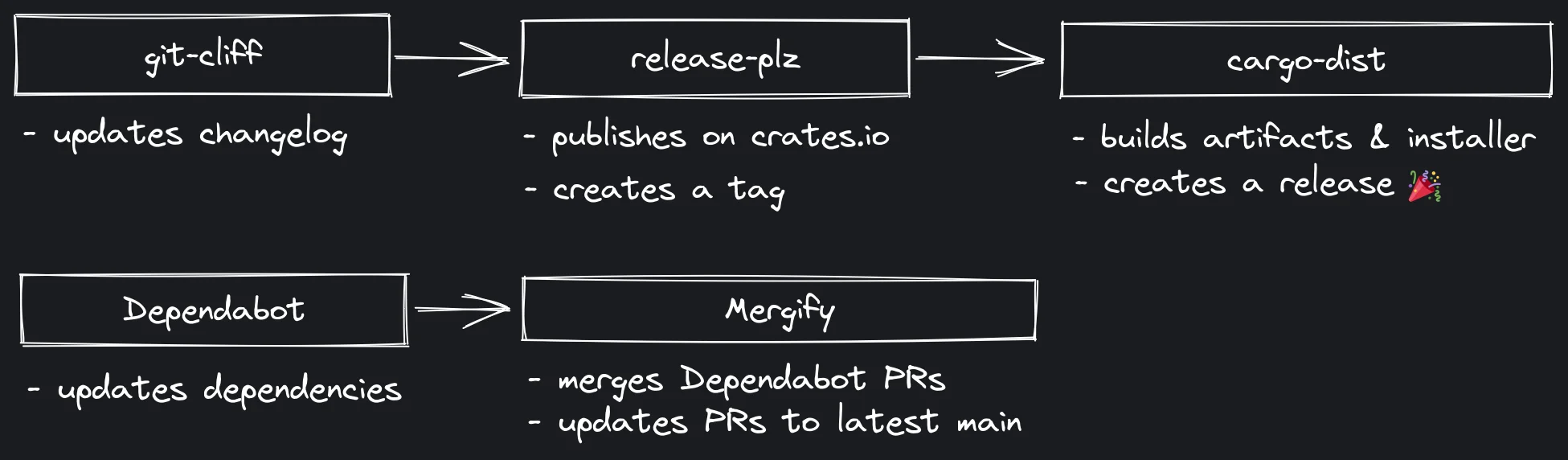
The true value of static binaries lies in the automation of the release process. With a well-designed CI/CD pipeline, developers can generate binaries for all OS environments and publish crates simply by merging a single PR. The automation system largely consists of release-plz for managing versions and change history, git-cliff for automatically generating changelogs, and cargo-dist for handling multi-platform binary output and release page management.
In practical environments, release-plz integrates with GitHub Actions' CI pipeline to detect version updates and automatically create a dedicated PR (Release PR) including the crates.io release. When this PR is merged, the system automatically executes the cargo publish command to distribute the package. To prevent this automation from entering an infinite loop, it is crucial to avoid using GitHub's default token (GITHUB_TOKEN) and inject a Personal Access Token (PAT) to clearly control workflow trigger cycles 10.
Subsequently, cargo-dist takes over the release pipeline to handle heavy build tasks. Applying cargo-dist init to the project root automatically generates workflow settings and controls the entire process, from binary output generation for multiple target environments like Linux, macOS, and Windows, to archiving, automatic upload to GitHub release pages, and installer creation. This pipeline combines with automatic merge bots like Dependabot and Mergify to complete a release routine that eliminates manual work 10.
A practical issue to be aware of here is the physical constraints of Docker container-based builds. In build pipelines like cargo-dist, specifying linux/arm64,linux/amd64 architecture targets on a single machine is common for multi-architecture deployment (amd64, arm64, etc.). In such cases, build operations for non-host architectures (e.g., compiling arm64 on an x86 environment) go through the CPU emulator QEMU, potentially delaying build times by up to 30 times compared to native machines. Therefore, to avoid performance degradation in multi-platform build pipelines, consider remote builder services or architecture-specific runners that provide native CPU resources and NVMe-based cache capacity, rather than simple build machines 11.
# 멀티 플랫폼 빌드 시 에뮬레이션 최적화를 위한 GitHub Actions 빌드 워크플로 예시
name: Multi-Platform Static Release

on:
  push:
    tags:
      - 'v*.*.*'

jobs:
  docker-build:
    runs-on: ubuntu-latest
    steps:
      - name: Checkout repository
        uses: actions/checkout@v4

      - name: Set up QEMU (비호스트 아키텍처 에뮬레이터 설치)
        uses: docker/setup-qemu-action@v3

      - name: Set up Docker Buildx
        uses: docker/setup-buildx-action@v3

      - name: Build and push multi-platform image
        uses: docker/build-push-action@v5
        with:
          context: .
          # 정적 바이너리를 실행하기 위한 초경량 scratch 베이스 컨테이너 빌드 시나리오
          platforms: linux/amd64,linux/arm64
          push: true
          tags: user/app:latest
          cache-from: type=gha,max-size=2GB
          cache-to: type=gha,mode=max
(Note: As a simple approach using QEMU, cache optimization is essential for significantly reducing large-scale Rust build times 11, 10)
Practical Execution File Verification and Multi-Stage Build Optimization
When deploying a Rust project as a static binary, controlling the final binary size and ensuring it fits perfectly into a container environment is a critical practical step. Binaries produced in the default release mode by the build toolchain retain significant size due to debugging symbols and an unoptimized structure. Enabling strip = true in the Cargo.toml's [profile.release] section strips unnecessary debugging symbols from the executable. Applying lto = true and opt-level = "z" options concurrently can further reduce the overall binary size by 20–30% through the compiler's Link-Time Optimization (LTO) process 3.
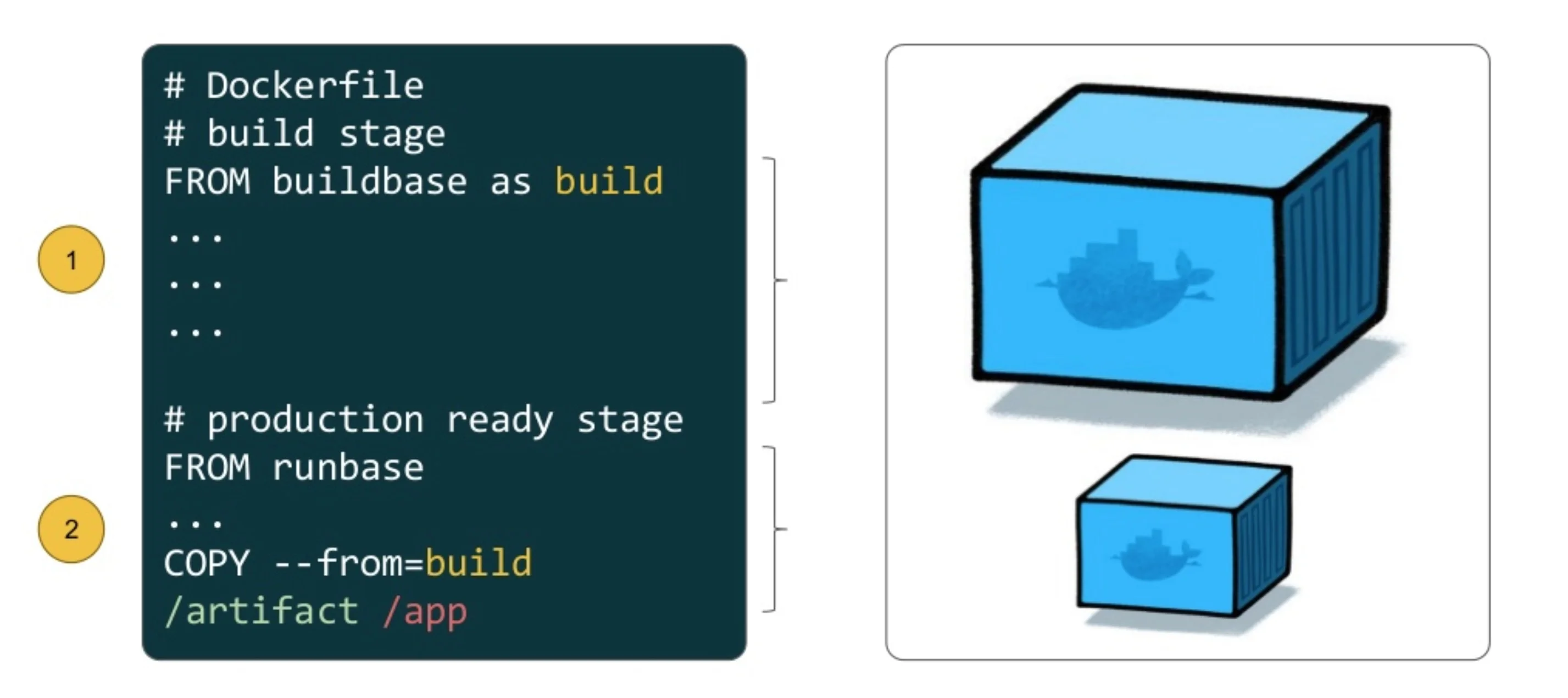
When packaging these reduced binaries into container images, the multi-stage Dockerfile configuration is the standard. The build stage uses a compiler image equipped with the Rust toolchain to produce the static binary, while the final deployment stage uses base images close to zero bytes that do not even include an OS shell, such as scratch or distroless. Reducing the final container size to under 20MB significantly saves cloud storage and network packet transmission costs. It also eliminates the possibility of arbitrary package manager commands being executed via an external shell inside the application, thereby drastically reducing the security attack surface 3.
Just before deployment, the application's normal startup must be verified within the container. Particularly in environments using scratch images, there is no TLS certificate store inside the container. Therefore, the ca-certificates.crt file must be explicitly copied into the final container stack to ensure HTTPS communication of the static binary is not broken. Additionally, to prevent the misuse of root privileges in the deployment environment, best practices recommend running binaries in non-root account contexts such as USER 65534:65534.
Most importantly, it is crucial to verify whether the produced executable is indeed fully statically linked. Production deployment should only proceed after clearly confirming "not a dynamic executable" or "statically linked" status by running the ldd /app/server or file /app/server command on the binary produced in the build environment 3. However, for staging environments or when debugging is necessary, a flexible strategy is required, such as appropriately choosing distroless containers that include basic Unix utilities over scratch images where debugging is extremely limited.
Rust's static binary deployment offers a new benchmark for controlling application operations, going beyond simple technical achievement. By absorbing the excessive package management and deployment instability experienced by interpreter languages into compile-time compiler operations, Rust-based CLIs have created an environment where they can be reliably executed anywhere, anytime, with just a single file. However, as seen in the failure cases of projects involving system libraries, which account for 42.4%, their inherent benefits can be fully realized only when accompanied by meticulous engineering capabilities that accurately understand the ecosystem's dependency characteristics and properly configure static linking modes.
References
- 스탠드얼론 정적 바이너리로 도구를 배포해야 하는 이유 | GeekNews · news.hada.io↩
- Linkage - The Rust Reference · doc.rust-lang.org↩
- Static Binaries with Go and Rust for Tiny Images | 2026 Guide · khimananda.com↩
- Building a statically linked binary in Alpine Linux · users.rust-lang.org↩
- 자바스크립트 의존성 지옥 · yceffort.kr↩
- 1721-crt-static - The Rust RFC Book · rust-lang.github.io↩
- ↩
- Updating Rust's Linux musl targets | Rust Blog · blog.rust-lang.org↩
- Cross-Compiling 10,000+ Rust CLI Crates Statically · blog.pkgforge.dev↩
- Fully Automated Releases for Rust Projects - Orhun's Blog · blog.orhun.dev↩
- ↩



