With the 2026 College Scholastic Ability Test (Suneung) administered on November 13, 2025, examinees must formulate optimal application strategies within the short period between the score release and the deadline for regular admissions applications. Because this year's admissions cycle features numerous variables, including an increase in the number of applicants, a reduction in medical school enrollment quotas, and changes in selection methods by university, it is crucial to rely on precise simulations based on the latest data rather than past experiences. This article guides readers through specific methods and precautions for increasing admission chances by utilizing key schedules following the release of Suneung scores and the Korean Council for University Education's (KCUE) College Admissions Simulation Support System.
Key Schedules and Environmental Changes for Regular Admissions
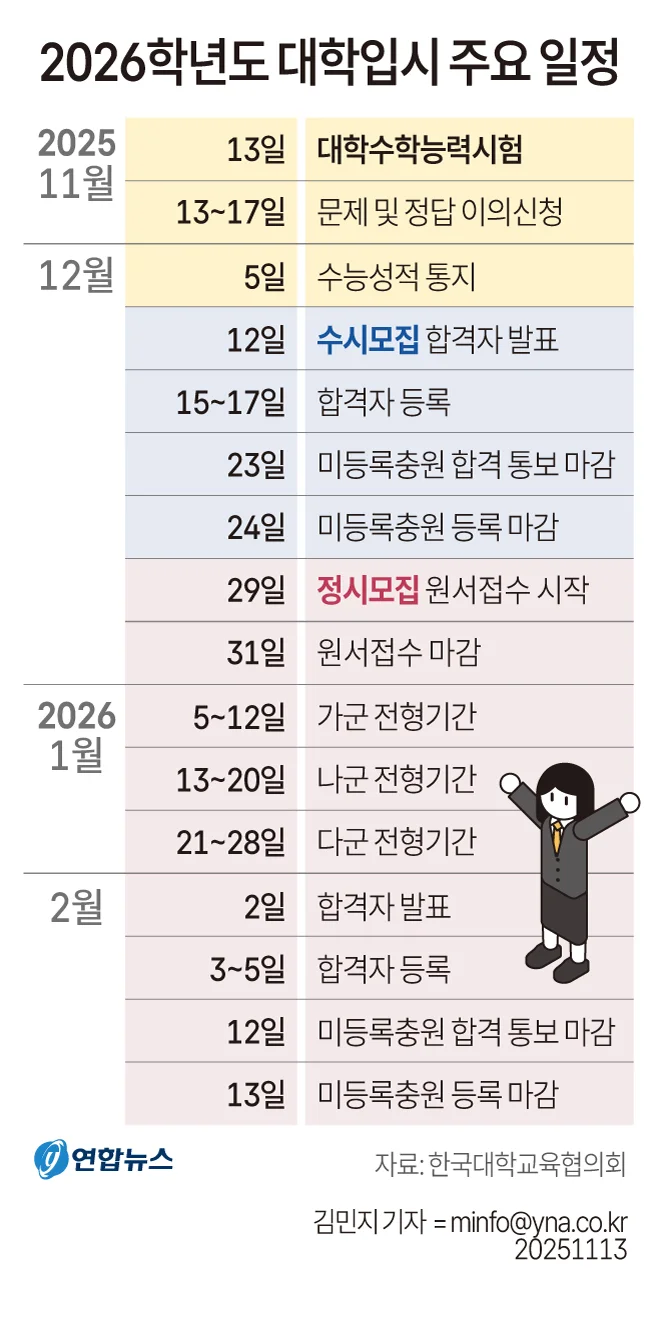
The first task immediately after the Suneung is to accurately grasp the revised admissions schedule. The 2026 admissions cycle features structural changes, such as a shortened period for filling vacancies from early admissions and unified application periods for regular admissions, requiring corresponding strategic adjustments.
[IMAGE 1]
Key Admissions Schedules After the Suneung
| Category | Schedule | Remarks |
|---|---|---|
| Suneung Exam Date | Thursday, November 13, 2025 | Conducted nationwide simultaneously |
| Suneung Score Release | Friday, December 5, 2025 | Score notification |
| Regular Admissions Application | Monday, December 29 ~ Wednesday, December 31, 2025 | 3 days (unified across all universities) |
| Regular Admissions Selection Period | January 5 ~ 28, 2026 | Sequential progress for Groups Ga, Na, and Da |
| Regular Admissions Results Announcement | By Monday, February 2, 2026 | Announced by each university |
| Registration Period | Tuesday, February 3 ~ Thursday, February 5, 2026 | 3 days |
| Additional Recruitment | February 20 ~ 27, 2026 | Conducted by each university |
Source: Synthesized information from EduInsight and NoDaji blog 1, 2
It is particularly important to recognize that the gap between the conclusion of university-specific assessments for early admissions and the start of regular admissions applications has shortened, and that filling vacancies from non-registered early admission students may impact regular admissions competition rates. Additionally, the number of applicants for the 2026 Suneung increased by more than 30,000 compared to the previous year, while medical school enrollment quotas decreased, leading to projections of increased competitive intensity across all levels, from top-tier to mid-tier students 3.
Understanding University-Specific Converted Scores and Initial Strategies Based on Preliminary Scoring
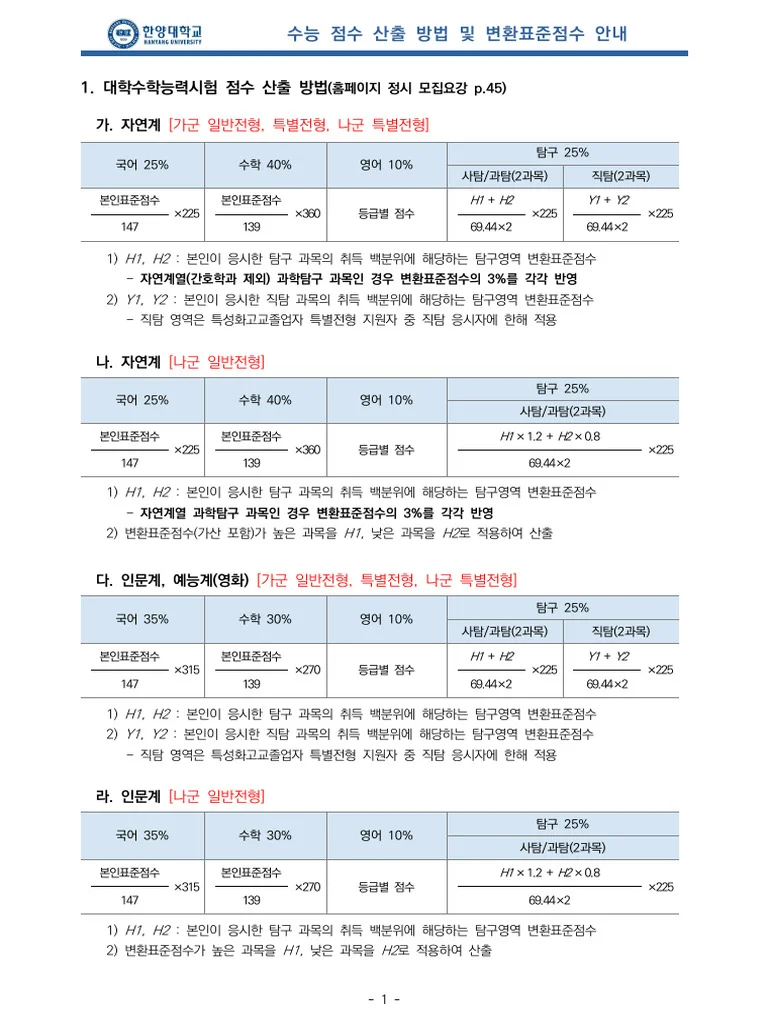
The success or failure of regular admissions applications depends on how accurately one predicts the 'university-specific converted scores,' rather than the 'raw scores.' While Suneung score reports list only standard scores, percentile ranks, and grades, actual regular admissions selection applies weights and conversion methods set independently by each university.
1. Standard Score vs. Converted Standard Score
- Standard Score: A relative indicator showing how far one's raw score deviates from the average. The more difficult the subject, the higher the standard score tends to be.
- Converted Standard Score: Scores converted by universities according to their own criteria. Major universities such as Seoul National University, Yonsei University, and Korea University utilize converted standard scores for areas such as inquiry subjects; therefore, one must check the method for calculating university-specific converted scores 4, 5.
2. Weight by Area and Practical Influence A higher weight in a specific area does not necessarily mean that subject has a greater impact. The practical influence on scores changes if the number of areas considered varies.
- Example: If University A reflects Korean at 40% (summed over 3 areas) and University B reflects it at 35% (summed over 4 areas), the practical value considering the number of areas may be higher at University B 5.
Introduction/Modification of Penalty Systems: Universities such as Korea University, Kyung Hee University, and Seoul National University have adopted or modified systems that apply penalties based on English grade levels. Notably, Korea University changed its English scoring system from bonuses to penalties starting with the 2026 admissions cycle 3, 5, 6.
[IMAGE 2]
When formulating initial strategies, one must assess their position 'conservatively' based on preliminary scoring results. Since projected grade cutoffs may be higher than actual results, it is advisable to first probe for stable admission possibilities rather than overly ambitious upward applications, and to use this as a reference for deciding whether to take university-specific assessments for early admissions 7.
How to Utilize the KCUE Simulation Support System and Data

The 'Simulation Support' service provided around the regular admissions application period is a useful tool for checking applicant distribution in real time. This data is available through the Korean Council for University Education's (KCUE) 'College Admissions Information Simulation Support System,' as well as major admissions platforms (MegaStudy, Jinhaksa, etc.).
Principles for Interpreting Simulation Support Data
- Results are for 'reference' only, not 'certainty': The landscape of applications can change rapidly just before deadlines. It is crucial to remember that the situation remains fluid until the final day of submissions 1, 8.
- Focus on the 'lower admission cutoff' and 'distribution' rather than averages: The average scores of previous year's admitted students have limited significance. As smaller enrollment quotas lead to greater deviations, one must analyze the score distribution of lower-ranking admitted students to judge stability 8.
- Accuracy of Data Input: While entering actual scores is the principle, during the preliminary scoring phase before official results are released, one should use conservative estimates for predicted values to reduce optimistic bias.
The key aspect to verify through simulation support is 'where applicants with similar scores to mine are distributed.' Using this information to narrow down expected competition rates and the range of possible universities is essential.
Designing a 3-Step Portfolio and Application Tips
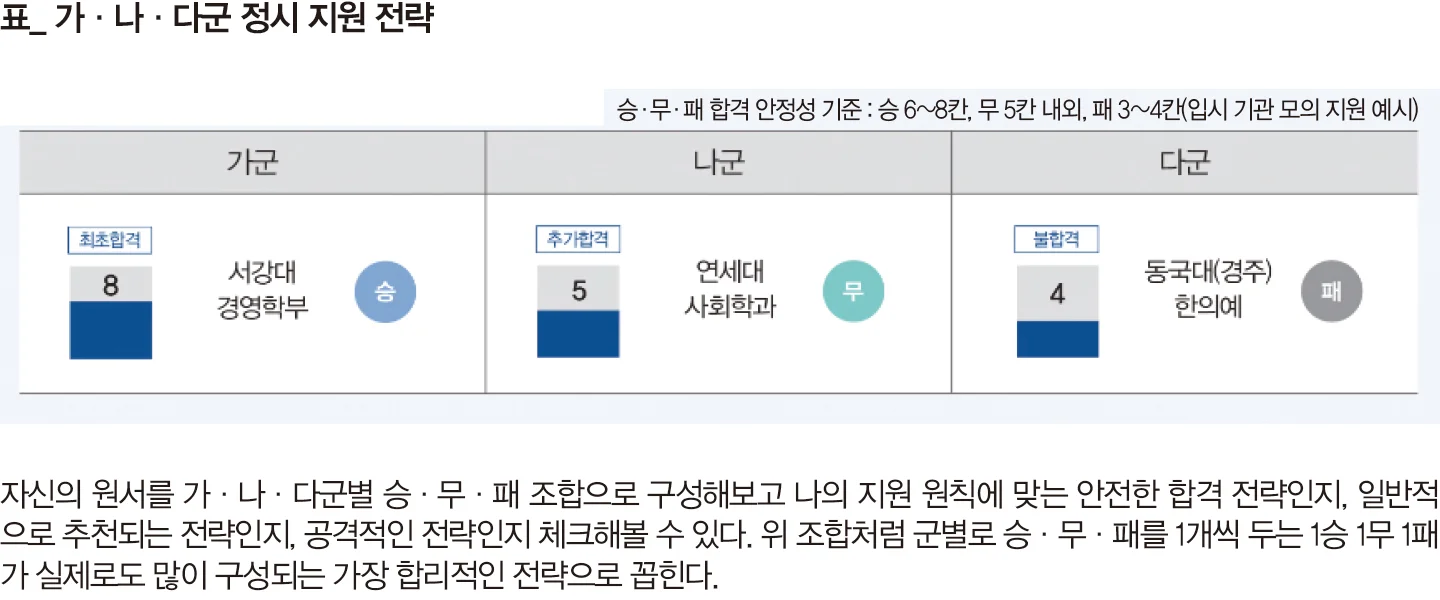
Regular admissions offers a total of three application opportunities, one each for Groups Ga, Na, and Da. Rather than simply applying based on 'prestige,' strategic card placement tailored to one's specific academic profile is necessary.
[IMAGE 3]
Recommended Application Strategy: Balance of Ambitious (Faith), Appropriate, and Conservative (Stability)
Experts generally recommend the principle of 1 Win (Stability), 1 Draw (Appropriate), and 1 Loss (Faith/Challenge). This involves combining one conservative card where admission is virtually certain, one appropriate card with a high probability of admission, and one ambitious, challenging card 7, 8.
- Ambitious (Faith) Application: Universities where the previous year's admission cutoff was at the mid-to-upper level, but where one's converted score is favorable.
- Appropriate Application: Universities where one's score aligns with the mid-level of the previous year's admission cutoff. This sets the most realistic target.
- Conservative (Stability) Application: Universities where one's score is 2 to 3 points or more higher than the top-tier of the previous year's admission cutoff, or where the enrollment quota is large enough to ensure stability. This role secures 'stability' and lowers the possibility of needing additional recruitment rounds.
Practical Tips
Although application submissions take place over 3 days, it is advisable to avoid submitting close to the deadline and to complete the application beforehand to prepare for system errors 1, 2.
Conclusion
Regular admissions applications for the 2026 cycle can easily be described as a 'battle of information' due to complex variables such as fluctuations in Suneung difficulty, skews in inquiry subject choices, and adjustments to medical school quotas. Examinees should use university-specific converted score calculators to accurately determine their advantages and disadvantages, and check real-time application statuses through the KCUE and admissions institution simulation support systems.
Finally, regular admissions applications are not the end. Flexible responses are required by considering the registration period from February 3 to 5, 2026, the filling of non-registration vacancies around February 12, and opportunities for additional recruitment after February 20. Remember that all data is merely reference material and that final decision-making power rests with the examinee, and please make calm and wise choices.
References
- 2026 대입 수능 이후 핵심 일정표 정시, 추가 합격까지 완벽 정리 – 에듀인사이트 · exitbasic.com↩
- 2026 정시 일정표 핵심 정보와 수능 정시 원서 접수 기간 안내 - 노다지... · ss78.co.kr↩
- ‘황금돼지띠 수능생’ 37만 명… 정시 합격 점수 높아질 듯 · v.daum.net↩
- 2026 수능 성적표 발표 후 정시 지원 전략 대학별 반영 비율 분석 꿀팁 · exitbasic.com↩
- 2026학년도 정시모집 수능위주전형, 대학별 전형요소와 반영방법 · localnaeil.com↩
- 2026학년도 대입 전략 이대·외대·시립대 영어 반영 비중 20로 높아... · sgsg.hankyung.com↩
- [2026 수능] 수능 종료 후 합격 로드맵은?… “ ‘가채점·수시·정시’ 3박자...” · news.unn.net↩
- 에듀셀파 독학기숙학원 블로그 - 정시 지원 전략 A to Z : 합격률 높이는... · blog.edusherpa.kr↩