
How would you feel if you discovered a smooth seashell in the middle of a desolate desert, amidst endless sand dunes under a scorching sun, where hardly any life can be found?
Most people would doubt their eyes and look around in confusion. A chain of questions would follow: "Did someone leave this here?" or "Is this even possible?"
However, this wondrous scene is no mere illusion. It is a signal hinting at one of Earth's massive secrets: that the parched land we stand upon might have been a sea with rolling blue waves a very long time ago. Today, through the intriguing subject of a seashell found in a desert, we will explore the epic history written by Earth and the scientific debates hidden within it.
Is what we saw a real 'seashell'? : The beginning of a scientific debate
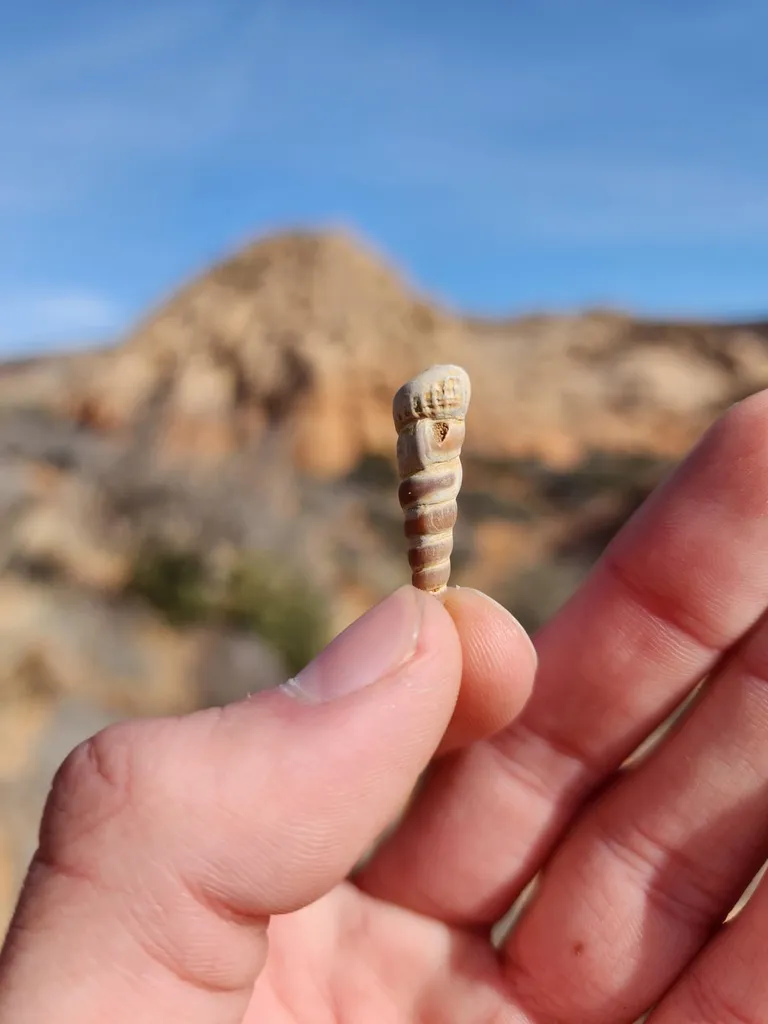
There was a recent article that heated up the online community, Hacker News. It was a story about finding a seashell in the middle of a desert. Yet, regarding this interesting discovery, a rather intense "argument" broke out among intellectuals.
The core of the debate lay in the definition of a fossil.
Some sharp observers pointed out, "That is not a real seashell." What they were arguing for was the concept of a Steinkern (internal mold). While the fossils we commonly think of are the preserved hard shells of organisms, in actual nature, the shell often weathers away, leaving only the internal space to be filled with minerals, preserving only the shape. In other words, it looks like a shell on the outside, but it is actually a "lump of stone" that serves as a cast of the shell's interior.
Of course, there were strong counterarguments claiming this was "splitting hairs" and that such pedantic distinctions would only dampen public interest. However, these debates are by no means meaningless. Knowing exactly what artifact we are facing is the first step in reconstructing the ancient environment that the artifact describes.
Furthermore, the difficulty of biological identification cannot be ignored. For organisms like gastropods, it is extremely difficult to determine the exact species based solely on the shape of the shell. Experts advise that one must examine minute structures such as the peristome or the siphonal canal. This means that even if they look similar on the surface, they could be entirely different organisms from millions of years ago.
Evidence that the desert was once an ocean: Earth's massive transformation
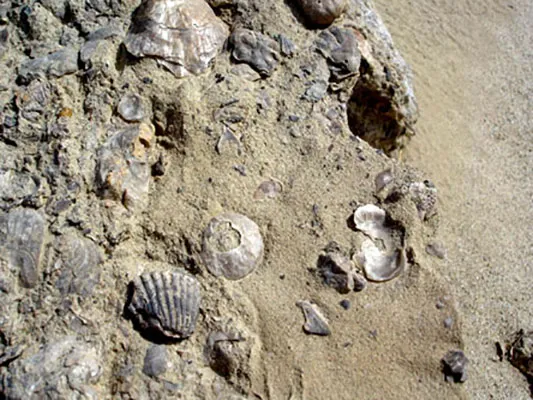
Then, why are traces of such marine life found in a desert of all places? The answer lies in Earth's dynamic geological changes.
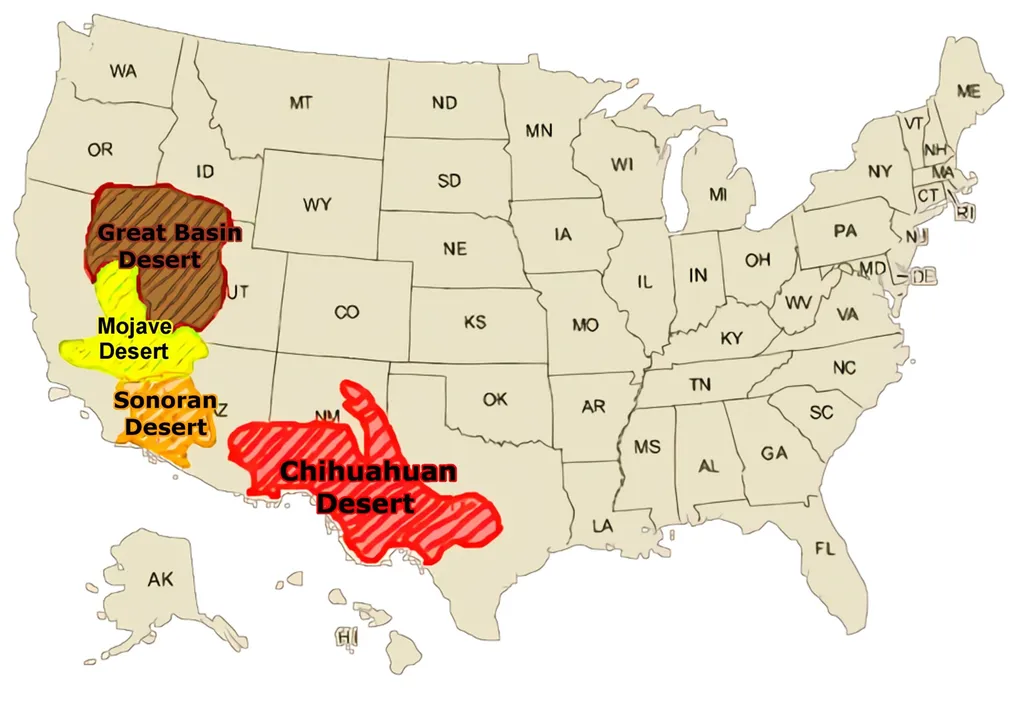
Cases of seashells found in the Sonoran Desert in Arizona, USA, or near La Ritche in Texas, send a powerful message to us. They prove that these regions were completely different from what they are now—specifically, shallow seas or massive inland seas—millions of years ago.
The Earth's crust moves constantly, much like a living organism. Massive continents collide to form mountain ranges, and tectonic shifts can turn oceans into land.
Shall we look at an example? St. Stephen's Cathedral in Vienna, Austria, was built with sandstone containing marine fossils. About 15 million years ago, that location was not where the cathedral stands today, but the bottom of the sea. The same applies to the center of Australia or the Western Interior Seaway in North America. Traces of massive ancient oceans, such as the Tethys Ocean, are hidden throughout the arid continents we walk upon today.
The seashell sleeping beneath the desert sands is the smallest yet most powerful piece of evidence showing the dramatic environmental changes Earth has undergone.
Between data and illusion: How do we perceive nature?
Nature sometimes plays tricks on us. A representative case is the unique rock pillars found in Arches National Park in Utah, USA. These rocks were eroded by wind and rain over a long period to take a pillar shape with rounded tops, and people were enthralled, claiming they looked like intentional sculptures.
An interesting psychological phenomenon occurs here: Pattern Recognition. The human brain has an instinct to find familiar shapes even within disordered natural objects. This is why people look at a rock created by simple erosion and feel, "That looks like a human face!" or "That looks like an animal!"
This cognitive bias influences how we view nature. While scientists explain this as a simple optical illusion, to the public, that rock is not just a stone, but a "story."
Technological advancements also aid in such interpretations. While in the past, identifying the shape of a fossil was limited to analyzing a single 2D photograph, modern science uses statistical techniques like Principal Component Analysis (PCA) to digitally reconstruct and identify 3D forms. Although such methods were once criticized for being potentially inaccurate, like "phrenology," data analysis has established itself as a very precise and reliable tool in modern geology.
The secret of Pohang: An ancient lake within the Korean Peninsula
Such geological explorations are not just stories from distant lands. A massive "Earth library" exists right beside us: Pohang, Gyeongsangbuk-do.
Beyond being a mere industrial city, Pohang is known as the largest Cenozoic fossil site on the Korean Peninsula. In particular, the geological layer called the 'Geumgwangdong Formation' tells a vivid story of approximately 20 million years ago.
The interesting part is the climate revealed by the fossils here. By synthesizing the plant fossils (Metasequoia, maple trees, etc.) found in the Geumgwangdong Formation with the traces of insects and centipedes, it is estimated that the Pohang area was a cold climate, the complete opposite of today's temperate weather. Furthermore, these layers were formed in a lake environment, not an ocean.
In other words, the strata of Pohang are like a time machine, telling us that this place was a cold lake tens of millions of years ago, a thriving ecosystem surrounded by various organisms. If the seashell in the desert holds the memory of the sea, the sedimentary layers of Pohang hold the memory of an ancient lake.
How to read the time capsule left by nature
So far, we have traveled a long journey, starting from the small discovery of a seashell in a desert to Earth's massive geological history, psychological illusions, and the secrets of our land, Pohang.
Ultimately, a seashell found in the desert is not just a simple stone or a shell. It is a verse in the grand epic written by Earth. Geology and paleontology are disciplines that collect these verses to form a single, perfect sentence.
The fact that the land we stand upon might have once been a deep sea or a cold lake inspires awe in us. Nature changes constantly, but the traces of that change are constantly speaking to us in the form of fossils.
I hope today's story has gifted you with a new perspective on looking at the Earth. Next time you find a uniquely shaped stone while walking, why not pause for a moment and imagine the story from tens of thousands of years ago that the stone might be holding?
If you were to discover a mysterious object in the desert, what would be the first thing you would want to check?
References
- I found a seashell in the middle of the desert | Hacker News · news.ycombinator.com
- One thing that will have thrown the author off the trail is that he is ... · news.ycombinator.com
- Chapter 2. 지질과 지사학 · patentschool.co.kr
- 미국 유타주 사막의 독특한 바위 기둥이 온라인에서 화제를 모으고 ... · instagram.com
- 동해안 일대에 분포하는 신생대 퇴적층 (2). 포항, 한반도 최대의 ... · dinos119.tistory.com