
Every winter, when heavy snow falls, we invariably witness the sight of massive snowplows struggling to clear the roads.
However, the winter of 2026 might be a little different. Instead of giant machines, a small spray bottle that repels snow like magic is changing the fate of roads and automobiles.
Have you ever felt panicked when your car windows were frozen solid after a snowfall, or felt your heart sink due to icy roads? A scientific revolution that will put an end to those worries is coming to us.
Why are we powerless against snow and ice every time?
The greatest suffering we experience in winter is not simply the falling snow. The real problem lies in the powerful adhesion that occurs when water and ice transform the moment snow hits a surface.
The snow removal we commonly see involves physically pushing away already accumulated snow or chemically melting it by spreading calcium chloride. However, calcium chloride causes environmental pollution, and snowplows consume massive amounts of fuel and manpower.
What is the fundamental cause? It is the property where water molecules penetrate into microscopic crevices on a surface and bond with ice crystals, becoming "one body" with the surface. Even if a surface looks smooth, if you look at the nano-scale, there are microscopic irregularities; when water seeps into these gaps and freezes, it forms a hard sheet of ice that is difficult to remove with physical force alone.
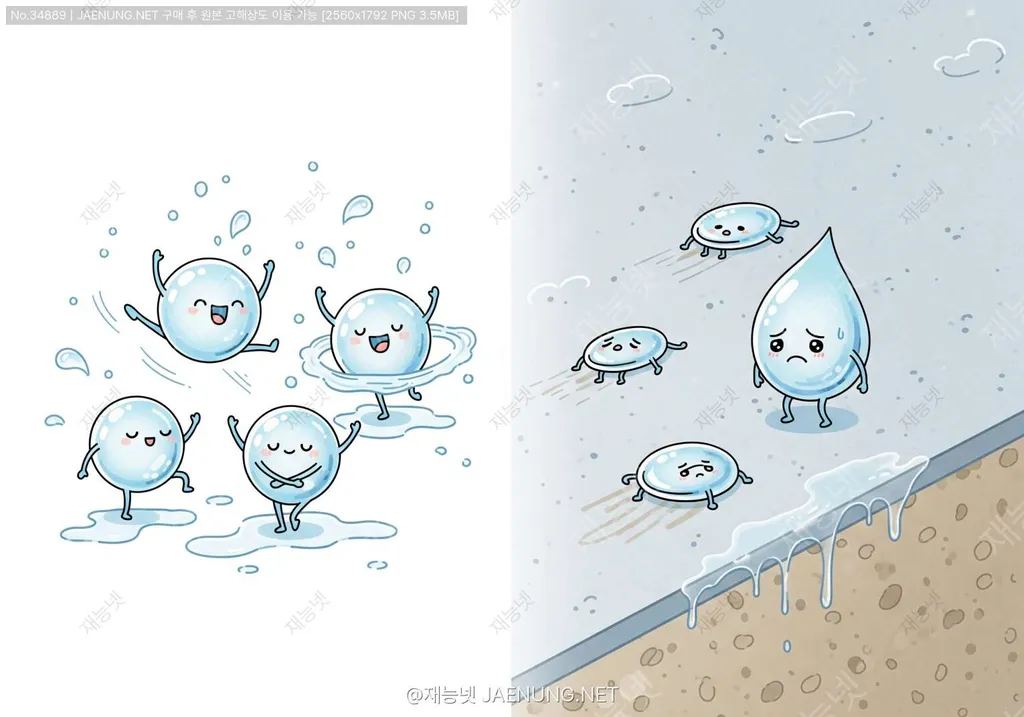
The answer found in nature: The wisdom of lotus leaves and water striders
To solve this problem, scientists have begun to look into the blueprints perfected by nature over thousands of years: the amazing property known as "Superhydrophobicity."
Have you ever wondered how water striders can walk as if sliding across the water? Or what the secret is behind lotus leaves always staying clean even in muddy water?
The secret lies in the Lotus Effect. If you look at the surface of a lotus leaf under a microscope, you will see densely packed, extremely fine protrusions. Tiny air pockets become trapped between these microstructures. Even when a water droplet tries to touch the surface, these air pockets act as a cushion, preventing the water from directly contacting the surface.
In technical terms, this state is called the "Cassie-Baxter state." As the contact angle of the water droplet increases to over 150 degrees, the water maintains a perfect spherical shape and rolls off instead of sticking to the surface. You can think of it as a bead rolling across a slippery ice rink.

Innovation to replace snowplows: Ultrasonic spray and superhydrophobic coating
Now, how can we apply this principle of nature to our lives? As of 2026, the most notable technology is superhydrophobic coating using Ultrasonic Spraying.
Moving beyond simply repelling water, we have reached the stage of uniformly applying extremely fine nano-particles to a surface. While traditional spraying methods often left gaps due to uneven particle distribution, ultrasonic technology allows for precise coating at the nanometer scale.
The changes this technology will bring are remarkable:
- Smart Anti-icing: If this coating is applied to car windows or aircraft wings, snowflakes will bounce off the surface immediately upon contact instead of sticking. It denies ice the opportunity to form.
- Self-cleaning: When it rains or snow melts, the rolling water droplets wash away dust and contaminants from the surface. Applying this to building exteriors could drastically reduce cleaning costs.
- Corrosion Prevention: It creates an 'air cushion' on metal surfaces, fundamentally blocking water and chloride ions from directly contacting the metal. This exponentially increases the lifespan of metal structures in industrial sites.
Of course, there are limitations. No matter how excellent a superhydrophobic coating is, it is difficult to perfectly control the energy generated when snow particles physically collide with the surface in extreme snowy environments. Recently, researchers have been working on more sophisticated designs to go beyond simply repelling water and actually inhibit the phase change at the moment snow turns into ice.

Future coatings will think and heal themselves
The superhydrophobic technology of the future we will encounter will go beyond the level of a simple 'waterproof spray.' The future becomes clearer when looking at the intelligent active protection systems currently under research.
For example, by utilizing materials that mimic the principle of how mussels cling tightly to rocks, we can implement a "Self-healing" function where the coating automatically fills in scratches and damages. Additionally, it could act like a 'smart pharmacist,' automatically releasing corrosion inhibitors upon detecting specific chemical (pH) changes.
There is even the addition of functions to monitor the state of the coating by detecting temperature differences via infrared. Coating is evolving from a simple film covering a surface into an intelligent skin that protects itself and communicates its status.

Summary: Creating a safe winter with nature's gift
So far, we have explored how the superhydrophobic principle obtained from nature's wisdom can change our winters.
- Superhydrophobicity is the property of creating microscopic structures like a lotus leaf to repel water.
- Ultrasonic spray technology precisely applies this property to surfaces for use in snow removal and corrosion prevention.
- In the future, the era of intelligent coatings that can heal themselves and sense their own condition will arrive.
The sight of massive snowplows roaming the roads will gradually disappear, and the era where invisible nanotechnology safely guards our paths is not far off. This is because science always finds the most natural answers in places we never thought to look.
Wouldn't you like to spray this magical spray on your car or house? Or if this technology becomes commercialized, which field would you want to see it used in first?
Please share your thoughts in the comments!
References
- 물 위를 걷게 해주는 신기한 소재의 세계: 초소수성의 과학적 원리와 응용 · jaenung.net
- 제 출 문 · codil.or.kr
- 초음파 스프레이가 초소수성 기술을 사용하여 부식 문제 ... - RPS-SONIC · rps-sonic.com