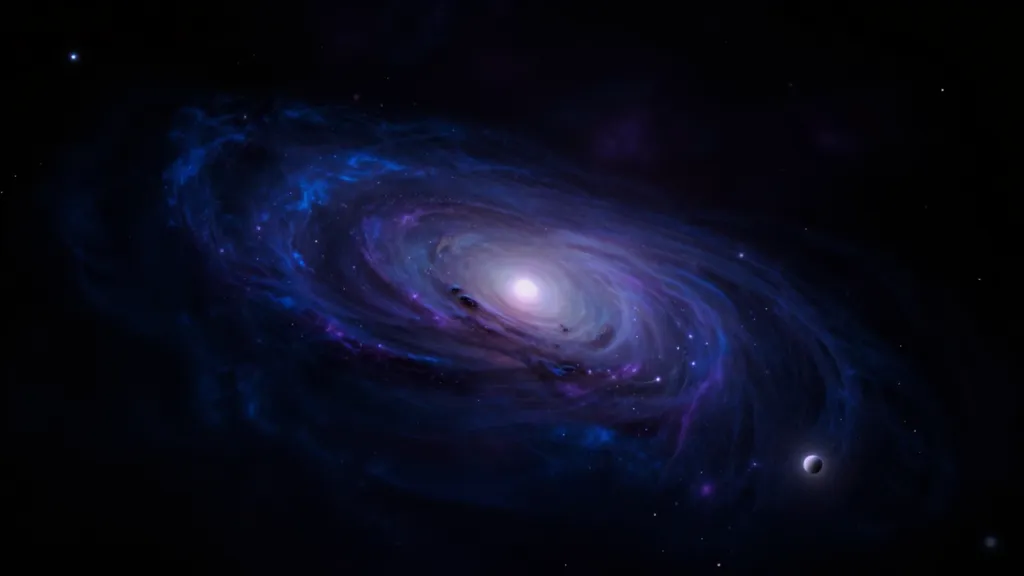
Did you know that the world we can see, touch, and measure is actually only a tiny fraction of the universe?
The stars and galaxies that adorn the night sky, and all the matter that constitutes us, account for only about 15% of the total mass of the universe. The remaining 85%, which holds the massive structure of the universe together, is the "invisible hand" known as dark matter.
For the past 90 years, humanity has struggled to find this ghost-like entity. However, as of 2026, we have finally begun to reach out and touch its reality. Moving beyond mere theoretical speculation, we are standing at a decisive turning point where dark matter is attempting to reveal itself as a physical entity before our eyes.
A Journey to Find the Invisible Pieces of the Universe
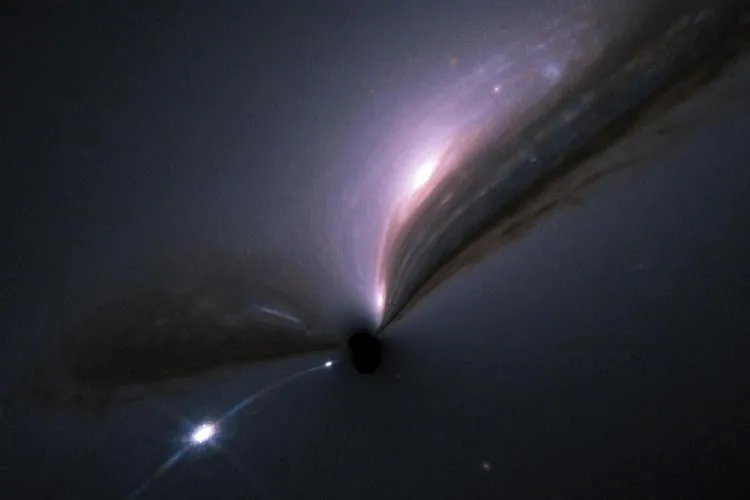
Our perspective of looking at the universe is similar to wandering through a forest at night with only a single flashlight. We can see the places illuminated by the light (visible matter), but we cannot see the massive shadows (dark matter) that maintain the shape of the forest in the places where the light does not reach.
By observing the rotation speeds of galaxies and the large-scale structures of the universe, physicists realized long ago that an "invisible mass" must exist that cannot be explained by the visible matter alone. Without this mysterious mass, galaxies would have scattered like spinning tops.
According to recent research, the most likely candidates for the identity of this dark matter are axions or Weakly Interacting Massive Particles (WIMPs). In particular, the axion is drawing attention as a potential key to solving the "matter-antimatter asymmetry" problem related to the origin of the universe.
The problem, however, is that these particles interact almost not at all with ordinary matter. Much like a ghost passing through a wall, dark matter passes through our bodies and the Earth without leaving any trace. Because of this, existing detection experiments have often come up empty-handed. It was an extremely difficult task, akin to trying to catch a "signal that might occur only once in ten years."
Korean Researchers Complete World-Class 'Axion Detector'

To perform this seemingly impossible mission, South Korean researchers are achieving brilliant results on the world stage. This is the achievement of Professor Sung-woo Yoon's team at the Institute for Basic Science (IBS).
Finding axions requires very specific conditions. One must capture the minute electromagnetic wave signals produced by axions within a powerful magnetic field and an ultra-low temperature environment reaching -273.11 degrees Celsius. However, a technical hurdle arises here: to search for higher frequencies, the size of the detection device (resonator) must be reduced, but this creates a paradox where the area for receiving signals decreases, thereby reducing sensitivity.
To solve this problem, the research team designed an innovative 8-cell multi-cell resonator. By introducing a structure divided into eight small chambers instead of one large room, they made it possible to stably capture signals in high-frequency bands without increasing the size of the device.
The results were astonishing. This device demonstrated a search sensitivity more than twice as high compared to major projects in the United States. This means we have reached a level where we can precisely scan the regions where the axion signals we theoretically predicted are expected to exist. Although no direct signal was discovered in this experiment, it provided invaluable data that allowed for the definitive physical conclusion that "axions do not exist in this specific region."
KAIST's Metamaterial Technology Expands the Horizons of Exploration

The search for dark matter is not simply a game of building "larger devices." It is a battle of how to filter signals more cleanly and more precisely. At this point, KAIST's research demonstrates another layer of innovation.
KAIST researchers have evolved dark matter detection technology by utilizing metamaterials with special structures. A metamaterial is an artificial structure designed to possess physical properties that do not exist in nature.
KAIST developed a tuning structure that can freely change the distribution of the electric field by adjusting the structure of these metamaterials. While existing detectors were "static" methods that waited for signals in a fixed state, this technology drastically removes surrounding noise by dynamically controlling the electric field.
To use an analogy, it is like using high-end noise-canceling earphones to cancel out surrounding noise instead of plugging your ears to hear a whisper next to you in a noisy party. Thanks to this technology, the possibility of capturing signals even in high-frequency regions where the probability of dark matter existing is extremely low has opened up.
What is even more interesting is that this technology does not stop at cosmic physics research. This precision measurement technology holds enormous potential to expand into fields such as next-generation quantum sensing, advanced semiconductors, and even ultra-precision medical devices. It is expected to be a wonderful example where achievements in basic science lead to practical technological innovation for humanity.
Conclusion: From the Era of Newton to the Era of Dark Matter

We are witnessing a moment where the history of physics is being rewritten. Just as Newton opened the door to classical mechanics by discovering gravity, uncovering the identity of dark matter will completely redefine humanity's perspective on the universe.
Let's summarize the research findings so far:
- Identifying the Reality of Dark Matter: Physical property constraints have begun to be set to find dark matter (especially axions), which accounts for 85% of the universe's mass.
- Superiority of Korean Technology: IBS's multi-cell resonator and KAIST's metamaterial tuning technology are breaking the limits of exploration by implementing world-class sensitivity.
- Technological Impact: These studies signal technological innovation across quantum sensing and advanced industries beyond simple physical discovery.
Although we have not yet called out the "true name" of dark matter, we are accurately locating the room where they are hiding. Within the next five years, we might just face the hidden rulers of the universe.
What do you think about this massive challenge humanity is undertaking to see the invisible? Will we be able to perfectly reveal the identity of these ghost-like particles?
Please share your thoughts in the comments!
References
- [특허뉴스] 암흑 물질 탐색의 새 장 열다... KAIST, 고주파 액시온 검출 ... · e-patentnews.com
- 韓 연구팀, 암흑물질 유력후보 '액시온' 세계 최고 수준 탐색 · dongascience.com
- 첨단 양자 검출기, 암흑 물질 탐색의 한계를 넓히다 - 뉴스에프엔 · newsfn.co.kr
- 우주의 비밀 '암흑물질'…탐지할 수 있을까 [지금은 우주] - Daum · v.daum.net