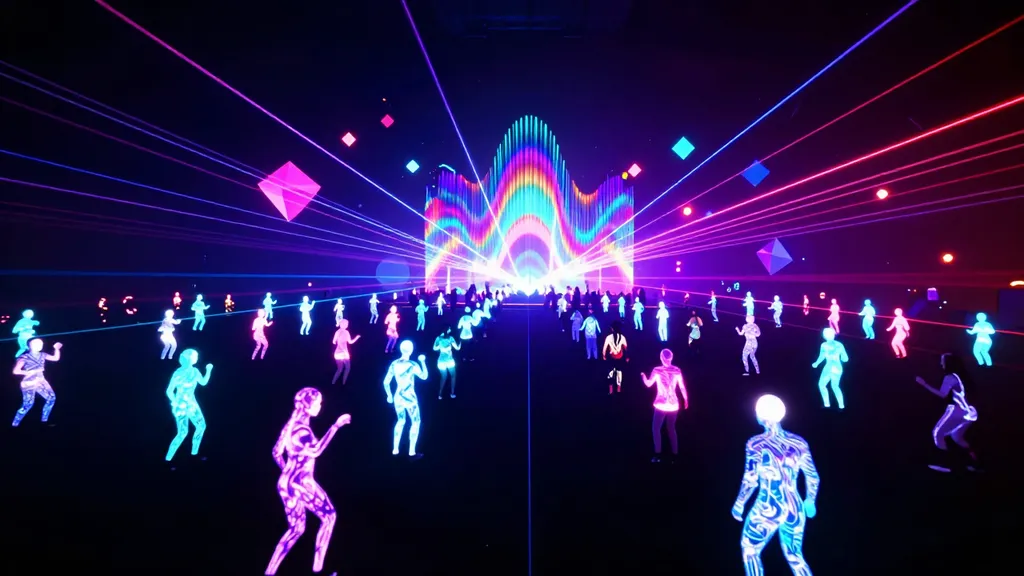
What if you opened your web browser and found a virtual space unfolding before your eyes, where thousands of people are gathered, dancing to the beat of the music?
It is not merely watching a video, but becoming an avatar yourself—feeling the movements of others and experiencing a synesthetic immersion within the same rhythm. Hallucinate, which has recently been heating up Hacker News and tech communities, is bringing this dreamlike concept of a 'Massively Multiplayer Online Rave' into reality.
In 2026, we are facing a new answer to how we can share 'joy together' in the digital world, transcending the constraints of physical space.
A loading bar stuck at 0%: The explosive interest hidden behind it

The project name, Hallucinate, is as intense as its meaning. Released by developer stagas on GitHub, this project has adopted the MIT open-source license and is awaiting participation from developers worldwide. However, even before its official launch, the service experienced a state of "successful overload."
As soon as the project was introduced on Hacker News, a massive influx of users swarmed in. In the process, some users experienced a phenomenon where the loading bar stuck at 0% or failed to progress on Firefox browsers. While technically an error, the community humorously referred to this as the 'HN kiss of death.' It was essentially a 'problem caused by being too popular'—a situation where the servers could not handle the sudden surge of traffic.
Of course, not everything was perfect. There were heated debates among users regarding the controls. The unique control scheme using IJKL keys instead of the gamer-familiar WASD was intended to enhance immersion, but it acted as a foreign barrier for users who prioritize practicality. These technical debates go beyond simple complaints; they serve as important data showing how web-based 3D environments must balance user experience (UX) with artistic immersion.
The shield of anonymity, and nostalgia for the lost 'free dance floor'
The reason Hallucinate holds more significance than a mere game is that it touches upon a 'cultural thirst.' Hacker News users focused on the anonymity provided by this platform.
Past rave culture was a kind of sanctuary, free from the gaze of cameras or the judgment of others. A sense of nostalgia for a "space where one can exist as their true self without worrying about being filmed or having their identity revealed" formed a strong consensus, intersecting with Hallucinate's anonymity features. In fact, Berlin's actual club culture has a tradition of strictly prohibiting filming to protect privacy, and Hallucinate is interpreted as an attempt to migrate these physical spatial values into the digital realm.
However, sharp counterarguments also exist. Some users point out that the real reason modern people do not go out is not due to a 'lack of anonymity.' The analysis suggests that as giants like Live Nation and Ticketmaster have driven ticket prices through the roof and small venues have disappeared, people have turned to online spaces instead of physical clubs.
Ultimately, Hallucinate goes beyond technical progress to pose a social question: in a commercialized entertainment industry and a surveillance society, 'how can we play together joyfully again?'
A new art form envisioned by 2026 technology: MMO Rave

So, in what direction will this project move forward? The technological trends of 2026 are focused on 'experiencing' rather than simply 'watching.'
Hallucinate is not just a simple 3D chat room. It is pioneering a new genre called Massively Multiplayer Online Rave (MMO Rave). Developers are continuing technical deliberations for the project's sustainability, such as optimization tasks to reduce server load and improvements to the CI (Continuous Integration) pipeline.
If this project successfully establishes itself, we will witness the following changes:
- A hub for digital creative collaboration: DJs from all over the world can perform real-time mixing in a single virtual space, regardless of physical distance.
- The evolution of interactive media: An ecosystem will be built where the audience is not just a spectator, but through their avatars, they influence the atmosphere of the space and become part of the content.
- Expansion of web-based 3D environments: The 'Internet of Experiences' will be realized, providing high levels of immersion through a browser alone without the need to install heavy separate software.
Of course, challenges remain. Issues such as latency when a large number of people connect simultaneously, and establishing a management system for users who abuse anonymity, are tasks the project must solve.
Summary and points to ponder
Hallucinate is an intriguing experiment born from crossing the line between technical limitations and cultural thirst. Moving beyond a simple web-based 3D game, it is becoming an important milestone that shows how we can maintain social interaction and create new art forms in the digital age.
To summarize what we have explored today:
- Hallucinate aims for an 'MMO Rave' where large numbers of people connect simultaneously to enjoy music and visuals.
- It is gaining attention as a recreation of past rave culture through anonymity and as an alternative to commercialized offline performance culture.
- As an open-source project, it is in the process of increasing its technical and cultural completeness through community participation.
What do you think? If a perfect platform emerged where you could dance with tens of thousands of people in a virtual space, would you head there instead of a real-life club?
Please share your thoughts in the comments!
References
- Hallucinate – Massively Multiplayer Online Rave - Hacker News · news.ycombinator.com
- stagas/hallucinate - GitHub · github.com
- Very cool to vibe out with folks anonymously. Almost like the old ... · news.ycombinator.com